Table of Contents
What Monstera Symbolism Means at a Glance
Monstera symbolism usually centers on growth, abundance, prosperity, longevity, and bold transformation. That reading comes from a mix of factors: the plant’s dramatic size, fast climbing habit, lush tropical look, and the unusual holes and splits in mature leaves that people interpret as openness, evolution, and possibility. Across modern symbolism pages and plant-lifestyle references, Monstera is also regularly associated with respect, honor, and a long, flourishing life. (Plants and Flowers Foundation Holland)
That matters because most people searching this topic are not just asking for a dictionary definition. They usually want one of four things: a gift meaning, a spiritual angle, a feng shui interpretation, or a deeper reason this plant feels so visually powerful. The weak content on this topic tends to stop at “Monstera means prosperity.” Useful content goes further. It explains why people see prosperity in this plant, where those meanings come from, when they make sense, and where symbolism becomes projection instead of fact.
The simplest way to think about Monstera is this: it symbolizes life that expands. It climbs. It spreads. It matures into bigger, more dramatic leaves. It turns plain green foliage into something unmistakable. That makes it an easy symbol for people who are building something, stepping into a new phase, or trying to make a home feel alive instead of merely decorated.
Why This Plant Carries So Much Meaning
Symbolism usually sticks when form and feeling line up. Monstera is a great example. It does not look timid. It looks like a plant that wants space, light, support, and room to become more of itself. Even before anyone layers spiritual or cultural meaning onto it, the plant already suggests movement, confidence, and momentum.
Botanically, Monstera deliciosa is a tropical climbing plant in the Araceae family. It is native to Central America, with authoritative sources placing its native range in southern Mexico through Guatemala or, more broadly in common horticultural references, Central America. In the wild it climbs trees with aerial roots, and mature foliage can become impressively large. That growth habit is one reason people read the plant as expansive and ambitious rather than delicate or contained. (Plants of the World Online)
Another reason is cultural timing. Monstera became a major visual symbol in modern interior design and social media culture, where its leaf shape came to represent tropical calm, style, aspiration, and curated abundance. A plant can be biologically old and symbolically new at the same time. Monstera is both.
The Story Told by Split and Perforated Leaves
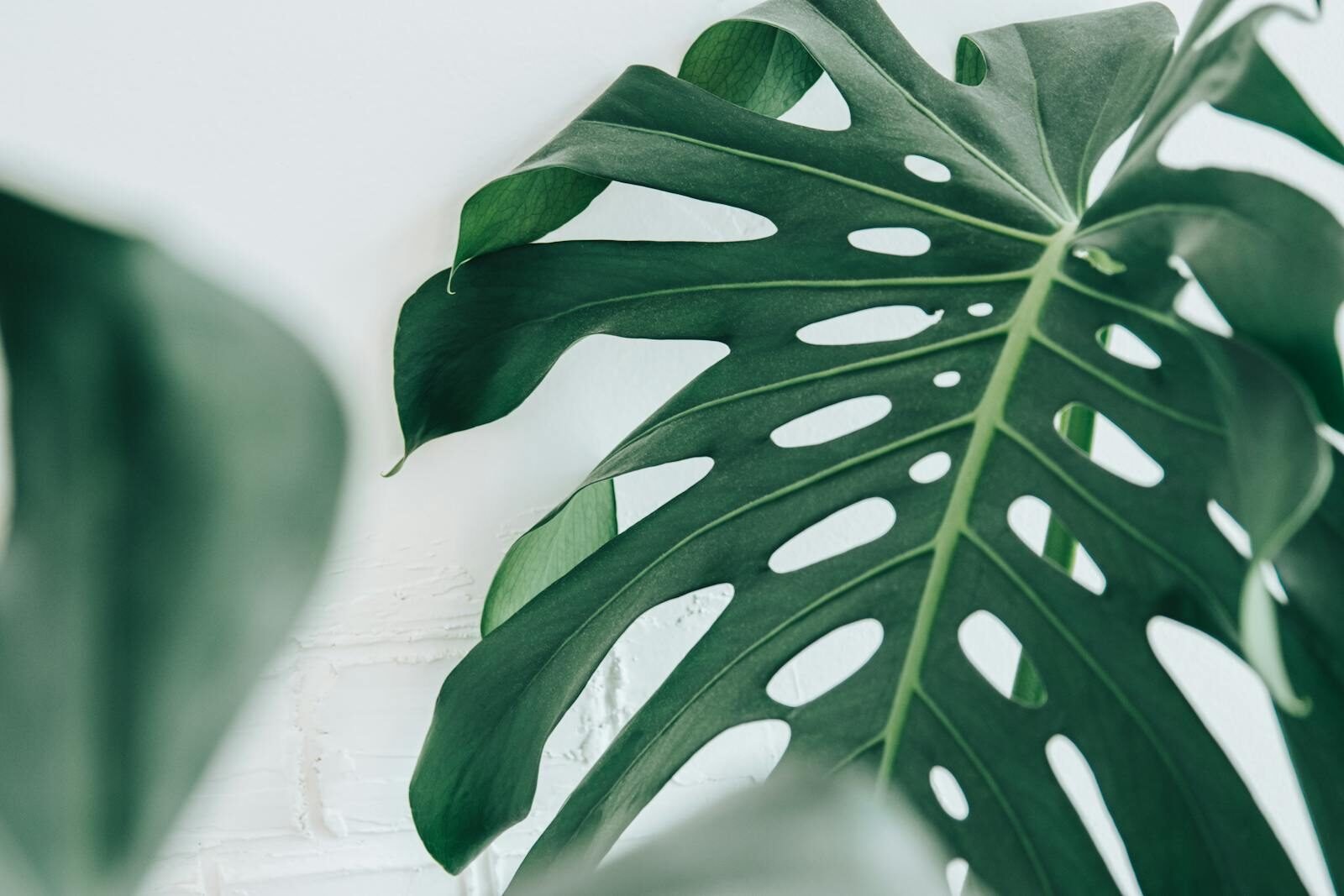
The most obvious symbolic trigger is the leaf itself. Monstera’s mature leaves develop fenestrations: the natural holes and splits that make the plant instantly recognizable. Scientists have studied these perforations for decades, and while the adaptation is still discussed through multiple hypotheses, common explanations include light optimization, resilience in rainforest conditions, and adaptation to climbing life. Penn State Extension notes that when grown upright on support, Monstera develops the mature fenestrated leaves people expect, and botanical references describe those perforated leaves as one of the plant’s defining traits. (Digital Commons)
Symbolically, people read those openings as more than biology. The holes look like space made on purpose. They suggest breathing room. They suggest adaptation instead of rigidity. They suggest that becoming more mature does not always mean becoming more closed off. In symbolism terms, that translates into ideas like personal growth, openness to opportunity, resilience, and even beauty in imperfection.
That last interpretation matters because Monstera does not fit a neat, symmetrical idea of beauty. It is bold, irregular, and full of negative space. That makes it a useful symbol for people who value character over polish. A perfect rose says one thing. A Monstera leaf says something else: become fuller, stranger, stronger, and more yourself.
Climbing Growth, Scale, and Presence
Monstera’s growth habit adds another layer. This is not a compact, stay-in-its-lane plant. With the right support, it climbs, enlarges, and becomes architectural. RHS describes Monstera deliciosa as a vigorous evergreen climber that can become a real statement plant indoors, while Missouri Botanical Garden notes that in native habitat it can climb high into trees. (RHS)
That matters symbolically because humans constantly attach meaning to growth patterns. Upright, supported climbing reads differently from low, sprawling ground cover. A Monstera does not symbolize survival in a minimal sense. It symbolizes expansion with support. That is why it resonates so well in homes, studios, offices, and creative spaces. It visually says, “This place is growing.”
There is also a status element. Not status in the shallow luxury sense, but in the sense of presence. A healthy Monstera changes a room. It becomes part of the architecture. Anything that can command space that way is likely to pick up symbolic associations with confidence, prosperity, and ambition.
The Core Meanings Most People Attach to Monstera
When you strip away the internet noise, most Monstera meanings fall into three clusters: growth, abundance, and longevity. Everything else tends to branch off those roots. Good luck, success, openness, fresh starts, creative energy, and respect are usually variations or extensions of the same symbolic logic.
This is worth stating clearly: those meanings are not hard science. They are cultural, visual, and emotional interpretations. But they are not random either. They follow the plant’s form, its use in homes, and repeated patterns in symbolism and gifting content. If enough people keep using a plant to represent the same ideas, that symbolism starts to hold social weight, even if it is not botanically measurable.
Growth, Expansion, and Transformation
If one meaning belongs at the center of Monstera symbolism, it is growth. Not vague self-help growth. Real, visible, spatial growth. The plant gets larger. The leaves mature into more complex forms. The plant often needs support to realize its best shape. That is almost too perfect as a metaphor.
This is why Monstera makes sense for milestones. New homes. New jobs. New businesses. Recovery periods. Reinvention phases. It carries the message: you are not finished becoming. That message lands because the plant itself appears to evolve as it matures. Juvenile leaves look simpler. Mature leaves look more open and dramatic. Penn State Extension specifically notes that support helps the plant develop the classic mature fenestrations people associate with a thriving Monstera. (Penn State Extension)
That growth symbolism also explains the plant’s popularity in branding, content backdrops, and aspirational interiors. People use Monstera when they want a visual shorthand for a life that is expanding, not shrinking. It is less about “nature” in the abstract and more about vital motion.
Abundance, Prosperity, and Vitality
Monstera is also strongly tied to abundance and prosperity. That association appears across contemporary symbolism sources and plant-lifestyle references, including Dutch flower-industry content and feng shui-oriented home articles. The logic is straightforward: big leaves, lush mass, vigorous growth, tropical fullness. The plant does not read as sparse. It reads as overflowing. (Plants and Flowers Foundation Holland)
This does not mean owning a Monstera creates wealth. That is where bad content loses the plot. Symbolism is not a vending machine. What it can do is shape atmosphere and intention. A Monstera in a room communicates fullness, life, and upward energy. In that sense, it works the way many symbolic objects work: not as magic, but as a cue. It reinforces the story people want a space to tell.
There is also a vitality angle here. Peer-reviewed reviews on indoor plants suggest houseplants can support psychological well-being, and research summarized by the University of Reading and RHS found that attractive, healthy plants can give a stronger well-being boost than neglected ones. That does not prove Monstera has unique mental-health powers. It does help explain why lush, visually striking plants become associated with energy, optimism, and life force in everyday perception. (PMC)
Longevity, Respect, and Endurance
The third major meaning cluster is longevity. Multiple symbolism references tie Monstera to a long life, enduring respect, and honor, especially in gifting contexts. Some houseplant guides also note that with proper care, Monstera can live for decades. Better Homes & Gardens says a well-cared-for Monstera can live up to 40 years, which strengthens the symbolic link between the plant and endurance. (Planet Natural)
That long-life symbolism makes Monstera a strong gift for elders, long-term relationships, family milestones, and housewarmings. It says more than “good luck.” It says, “May your life keep unfolding well over time.” That is a more grounded, generous message.
Respect also enters the picture because Monstera has a certain gravity to it. It is lush, but not fussy. Dramatic, but not fragile-looking. It feels established. So when people give Monstera as a symbolic plant, they are often signaling admiration, esteem, and a wish for lasting good things rather than quick wins.
Cultural and Spiritual Interpretations
The biggest mistake on this topic is pretending Monstera has one universal meaning everywhere. It does not. Symbolism changes by region, community, aesthetic movement, and personal belief system. A feng shui reading is not the same as a florist’s gift interpretation. A design-world reading is not the same as a spiritual one. Better content separates these instead of blending them into a fake global consensus.
What can be said honestly is that several recurring interpretations show up again and again: longevity, prosperity, respect, growth, and positive energy. Those themes are consistent enough across live results that they form the practical symbolic core, even if details vary by source. (Plants and Flowers Foundation Holland)
Chinese and Gift-Culture Associations
A common interpretation in contemporary plant-gifting content links Monstera with longevity, honor, and a long prosperous life, particularly in Chinese-associated gift symbolism. Several current symbolism and plant-gifting pages repeat that theme, positioning Monstera as a meaningful gift for elders, birthdays, and major life transitions. (Botanical Art)
The smart way to use that information is carefully. It is better to say Monstera is commonly presented this way in gift-culture content than to declare a rigid cultural rule. Symbolism gets simplified online. Traditions travel, get repackaged, and sometimes lose nuance. Still, the repeated association with long life and respect is strong enough that it clearly shapes how people shop for and interpret the plant today.
So if someone gives you a Monstera, the likely message is generous and future-facing. They are not just handing you decor. They are often signaling respect, encouragement, and a wish for your life to flourish.
Feng Shui and Home Energy Beliefs
In feng shui-oriented content, Monstera is usually framed as a plant of growth, prosperity, positive energy, and expansion. Homes & Gardens describes houseplants in feng shui as expressions of the wood element, connected with growth and vitality, and notes Monstera’s large leaves as part of its auspicious appeal. Architectural Digest India and other lifestyle sources similarly position Monstera as a plant linked to prosperity and energetic uplift in specific rooms. (Homes and Gardens)
This is where nuance matters. Feng shui is a belief framework, not a lab-tested output. But belief frameworks influence real behavior. They shape placement, rituals, and how people relate to space. If Monstera helps someone create a home that feels more alive, intentional, and abundant, the symbolic value is still real at the lived-experience level even if it cannot be scientifically verified.
The best practical reading is this: Monstera works well in feng shui-inspired interiors because its form naturally aligns with themes of lush growth, vitality, and upward movement. That is believable. It matches what the eye sees. It is also why the plant shows up so often in “wealth corner” and auspicious-home advice content.
Modern Design, Identity, and Aspirational Living
There is also a very modern layer to Monstera symbolism: taste. Over the last decade, Monstera became more than a houseplant. It became a design icon. Its leaf shape spread across wallpaper, textiles, logos, ceramics, art prints, cafés, and hospitality branding. Recent commentary on Monstera symbolism explicitly ties that popularity to Instagram, Pinterest, and visual culture. (Botanical Art)
That matters because symbols evolve through repetition in public space. Today, Monstera often stands for a certain kind of life: creative, calm, aesthetic, tropical, upwardly mobile, maybe a little design-savvy. It can signal softness without weakness. Luxury without stiffness. Nature without chaos.
That modern meaning is not shallow. It is social. People use visual symbols to say who they are and what kind of environment they are building. Monstera has become one of the clearest plant symbols for curated vitality.
What It Means to Receive or Give a Monstera
A Monstera gift usually communicates growth, encouragement, warmth, and long-term good wishes. It is not as romantic as red roses, not as overtly spiritual as a peace lily, and not as stoic as a snake plant. It sits in a useful middle zone. Stylish, alive, meaningful, but still practical.
That makes it a strong gift when you want to say something positive without sounding scripted. For a housewarming, it says, “May this space thrive.” For a promotion, it says, “Keep growing.” For a birthday, it says, “Here’s to a bigger, richer next chapter.” For someone rebuilding after a hard season, it can quietly say, “Life comes back.”
Best Occasions for a Monstera Gift
Monstera is especially strong for occasions tied to new phases. Housewarmings are the obvious fit because the plant instantly changes a room and symbolically reinforces the idea of a home growing into itself. New jobs, studio launches, office openings, graduations, and milestone birthdays also make sense because the plant’s whole visual language is about expansion.
It also works well when you want a gift with presence. Not just sentimental meaning, but physical impact. A bouquet fades. A healthy Monstera settles in and becomes part of the recipient’s daily environment. That gives the symbolic message durability. The wish stays visible.
And because Monstera is commonly linked with prosperity, longevity, and respect in plant-gifting content, it fits moments where you want the gift to feel substantial without becoming overly formal. (Verdeia)
When a Monstera May Be the Wrong Gift
Not every symbolic plant is right for every person. Monstera may be a poor gift if the recipient has pets that chew plants, very low-light conditions, or no interest in medium-to-large houseplants. The ASPCA lists Swiss cheese plant as toxic to cats and dogs because of insoluble calcium oxalates, which can cause oral irritation, drooling, vomiting, and difficulty swallowing if ingested. (ASPCA)
It may also be the wrong gift if you want a symbol of strict minimalism, discipline, or low-maintenance endurance. That is more snake plant territory. Monstera symbolizes expansion and lushness. If the recipient hates sprawling plants, the message and the object will clash.
A good symbolic gift should feel like it belongs in the recipient’s life, not just in your Pinterest board. That sounds obvious, but it is where most bad gifting decisions happen.
Monstera in Home Decor, Branding, and Visual Symbolism
Monstera’s symbolic power is not just cultural. It is visual. Few houseplants have a silhouette this recognizable. You can reduce a Monstera leaf to a simple icon and people still know what mood it represents: tropical ease, modern softness, organic luxury, creative energy.
That is why Monstera shows up so often in branding for cafés, wellness brands, beauty studios, boutique hotels, and lifestyle products. It offers a shortcut to a feeling. It says “fresh,” but more elevated than basic greenery. It says “natural,” but not rustic. It says “bold,” but still approachable.
In interior design, Monstera often functions as a symbol of living abundance. Not abundance in the maximalist clutter sense. Abundance in the sense that a room feels inhabited, nourished, and expansive. That is a big part of why people love the plant even when they do not know anything about formal symbolism. They feel the meaning before they name it.
Monstera vs Other Popular Symbolic Houseplants
Symbolism gets clearer when you compare it. A Monstera does not mean the same thing as every trendy houseplant, and that difference helps readers decide whether the plant matches the message they want.
| Plant | Common Symbolic Themes | Best Fit |
|---|---|---|
| Monstera | Growth, abundance, prosperity, longevity, bold transformation | Housewarmings, promotions, fresh starts, creative spaces |
| Snake Plant | Resilience, protection, discipline, endurance | Low-maintenance gifts, office desks, protective symbolism |
| Peace Lily | Peace, healing, sympathy, renewal | Condolence gifts, recovery, calming spaces |
| Pothos | Steady growth, adaptability, ease | Beginner plant gifts, casual encouragement |
| Lucky Bamboo | Luck, fortune, harmony | Feng shui gifts, compact symbolic decor |
That comparison matters because symbolism is context-sensitive. If you want to say “you’re safe and steady,” Monstera is not the sharpest tool. If you want to say “grow big, thrive, and take up space,” Monstera is one of the best.
Common Misconceptions About Monstera Symbolism
The first misconception is that Monstera has one fixed, ancient, globally agreed meaning. It does not. Some interpretations are traditional, some are regional, and some are clearly modern internet-era packaging. A trustworthy reading acknowledges that symbolism is partly inherited and partly built through repeated contemporary use.
The second misconception is that Monstera is “just a trendy aesthetic plant,” which misses why the trend lasted. Plenty of plants trend and fade. Monstera stuck because its form is unusually symbolic. The leaf itself communicates movement, openness, and abundance in a way that many houseplants simply do not.
The third misconception is that symbolism must be mystical to matter. It does not. A plant can be meaningful because of how it shapes a room, how it marks a milestone, or how its form mirrors a life transition. Symbolism works through emotion, culture, memory, and association. Science does not have to validate every symbolic use for it to be meaningful in human life.
Practical Caveats: Care, Pet Safety, and Reality vs Symbolism
A strong article on plant symbolism should not ignore reality. Monstera may symbolize flourishing, but a struggling Monstera in a dark corner sends the opposite message. RHS notes that Monstera deliciosa prefers bright but indirect conditions and can become a large statement plant with the right environment. Penn State Extension also points out that support encourages the mature, fenestrated foliage people want. (RHS)
That matters because symbolic plants work best when they are healthy enough to express the qualities people admire in them. A drooping, neglected Monstera does not feel prosperous. Research summarized by the University of Reading and RHS even found that neglected plants can be worse for well-being than having none at all. (University of Reading)
Pet safety is the other major caveat. This is not the plant to gift blindly into a cat household. The ASPCA is clear that Monstera is toxic to cats and dogs due to insoluble calcium oxalates. That does not make it a villain. It just means symbolism should never override basic suitability. (ASPCA)
There is also the issue of overclaiming. Monstera is often promoted as an air-purifying miracle or lucky-money magnet. Those claims get exaggerated fast. Indoor plants may support well-being and improve subjective experience of a room, but that is different from promising measurable transformation from one plant alone. (PMC)
How to Use Monstera Symbolism Intentionally
The best use of Monstera symbolism is intentional, not superstitious. Start by matching the plant to the message. If the message is growth, new beginnings, prosperity, creative expansion, or lasting good wishes, Monstera fits naturally. If the message is sympathy, spiritual purity, or strict low-maintenance practicality, another plant may fit better.
Placement matters too. In a home, Monstera works best where you want visible life and motion: living rooms, entryways, bright workspaces, creative studios, reading corners. In brand visuals, it works when you want to signal modern organic richness rather than minimal severity. In gifts, it works when you want the recipient to feel encouraged, seen, and set up for a thriving next chapter.
And do not underestimate the simplest interpretation: Monstera symbolizes the permission to grow into complexity. The plant does not become more meaningful by becoming simpler. It becomes more meaningful by becoming larger, stranger, more open, and more distinct. That is probably why so many people connect with it. It reflects a version of growth that feels human.
Conclusion
Monstera symbolism endures because the plant earns it. Its split leaves, climbing habit, lush presence, and long-lived appeal make it an unusually strong symbol for growth, abundance, prosperity, longevity, and confident transformation. Cultural and spiritual interpretations add depth, but even without them, the plant’s form already tells a clear story: make room, keep growing, and become more fully what you are.
That is also why Monstera works so well as a gift and a design symbol. It is beautiful, yes, but beauty is not the whole point. It communicates expansion. It turns a room into a place that feels alive. It turns a present into a message. And unlike most thin symbolism content online, the deeper truth is simple: Monstera matters not because people decided to attach random meaning to it, but because its biology, visual identity, and cultural use all point in the same direction.
FAQs
What does Monstera symbolize in one sentence?
Monstera most commonly symbolizes growth, abundance, prosperity, longevity, and bold transformation, largely because of its lush size, climbing habit, and distinctive split leaves. (Plants and Flowers Foundation Holland)
Is Monstera a good luck plant?
In feng shui and lifestyle symbolism content, Monstera is often treated as a good luck or prosperity plant, especially because its broad leaves are associated with growth and expansive energy. That said, this is a belief-based interpretation, not a scientific property. (Homes and Gardens)
What does gifting a Monstera mean?
Gifting a Monstera usually expresses encouragement, respect, prosperity, and a wish for long-term flourishing. It is especially well suited to housewarmings, promotions, milestone birthdays, and other life transitions. (Botanical Art)
Why are Monstera leaves split, and does that affect symbolism?
Monstera leaves develop fenestrations, or natural holes and splits, as they mature. Botanical sources describe these as a defining trait of mature leaves, and researchers have proposed functional explanations related to rainforest adaptation and growth habit. Symbolically, people often interpret those openings as signs of openness, adaptation, and beauty beyond perfection. (Digital Commons)
Is Monstera safe for pets?
No. The ASPCA lists Monstera as toxic to cats and dogs due to insoluble calcium oxalates, which can cause oral irritation, drooling, vomiting, and swallowing difficulty if chewed or eaten. If a pet household is part of the decision, that caveat matters more than the symbolism. (ASPCA)