Table of Contents
The short answer: how to tell quickly
If you want the fastest useful answer, here it is: your Monstera is probably rootbound if the plant dries out much faster than it used to, roots are pushing through the drainage holes or surfacing above the soil, the plant lifts out as a tight pot-shaped root mass, or growth has stalled even though light and watering are otherwise decent. The most reliable confirmation is simple: slide the plant partly out of the pot and look at the root ball. If you see dense circling roots with very little soil left, you’re not guessing anymore. University extension and botanical sources also consistently point to roots at the drainage holes, roots at the soil surface, wilting between normal waterings, smaller new growth, and a pot-shaped root mass as strong repotting indicators. (Illinois Extension)
That said, don’t make the classic mistake of treating one sign as proof. A few roots at the bottom can happen before a plant is truly cramped, and fast-drying soil can also come from hydrophobic mix, stronger light, heat, or a bigger plant simply using more water. Good diagnosis is pattern-based, not panic-based. When two or three signs show up together, especially combined with a dense root ball, the case gets much stronger. (Planet Houseplant)
What “rootbound” actually means
A plant becomes rootbound when its roots have filled most of the available space in the container and begin circling the pot perimeter instead of expanding through fresh growing medium. In plain English, the roots have run out of room. That matters because roots are not just anchors. They handle water uptake, nutrient access, oxygen exchange, and the foundation for new top growth. When the root zone becomes congested, the plant’s above-ground performance starts paying the price. (University of Maryland Extension)
For a Monstera, the problem is rarely “the plant hates its pot overnight.” It’s usually slower than that. The potting mix breaks down over time, air spaces shrink, drainage changes, and the roots increasingly occupy the space that used to hold water and nutrients. The Royal Horticultural Society notes that crowded roots limit top growth and that aging compost also loses drainage, aeration, and nutrient-holding performance. That combination is exactly why a Monstera that looked fine six months ago can start acting thirsty, dull, and sluggish now. (RHS)
Do Monsteras like being slightly rootbound?
This is where a lot of bad advice starts. Monsteras can tolerate being slightly snug in a pot, but that is not the same as “Monsteras love being rootbound.” The New York Botanical Garden’s Monstera guidance says they can stay in the same pot for years and move up only one size when roots come through the drain hole, which supports the idea that they do not need constant upsizing. Illinois Extension also notes that some plants do fine pot-bound while others do not. The practical takeaway is simple: slight crowding is normal; severe crowding is limiting. (libguides.nybg.org)
That nuance matters because overreacting causes its own damage. A Monstera in a pot that is only a little full may still be healthy, stable, and actively growing. Repotting too early into a pot that is much too big can leave too much damp mix around the roots, raising the odds of overwatering stress. Monsteras want enough room, not a giant empty bucket of wet soil. Think of it like shoes: a snug fit can work; shoes three sizes too big just make you trip. (RHS)
The clearest visual signs your Monstera is rootbound
The strongest signs are the ones you can actually see. Not guess. See. Current ranking pages for this topic heavily emphasize “signs + timing + repotting process,” and the most consistent diagnostic signals across extension and horticulture sources are visible roots, a packed root mass, and a plant that physically behaves like it has outgrown its container. That is also why “just look at the roots” keeps showing up across the SERP. (RHS)
Roots coming out of drainage holes
This is the sign most people notice first, and it matters for a reason. Roots head toward moisture, and when they’ve explored the container thoroughly, drainage holes become the escape route. Illinois Extension lists roots through drainage holes as a repotting indicator, and the University of Minnesota includes the same point in its Monstera transplant guidance. If you flip the nursery pot and see a web of roots sticking out, your plant is at least close to full. (Illinois Extension)
Still, don’t let that single sign bully you into repotting on the spot. A few roots peeking out do not automatically mean the entire root ball is a compacted brick. Some roots naturally chase water downward, especially if you bottom-water or if moisture lingers in a saucer. The better move is to use this sign as a prompt to inspect, not as a verdict by itself. That extra minute saves you from unnecessary repotting and from missing the real issue if the plant is struggling for another reason. (Planet Houseplant)
Roots pushing up at the soil surface
Roots at the top of the pot can mean the plant is crowded, but context matters. If actual soil roots are surfacing and circling around the rim, that often points to limited space. Illinois Extension lists roots appearing on the soil surface as another repotting indicator. In a truly cramped pot, the roots may have nowhere left to go, so they start showing themselves where they shouldn’t. (Illinois Extension)
But here’s the catch: Monsteras also make aerial roots, and people confuse them with rootbound symptoms all the time. Aerial roots growing from the stem are normal. Missouri Botanical Garden notes Monstera’s long cord-like aerial roots and explains they can be rooted into soil, attached to a support, or removed on upper sections. So if the “root” you’re seeing is attached to the stem and reaching outward like a brown tentacle, that is classic Monstera behavior, not proof your pot is too small. (Missouri Botanical Garden)
The root ball lifts out as one solid mass
This is one of the clearest signs because it removes ambiguity. The University of Minnesota says a Monstera is potbound when you can easily lift the plant and the whole root ball out of the container. If the pot comes off and you’re holding a dense pot-shaped cylinder of roots with barely any loose mix left, your Monstera has used up the real estate. (University of Minnesota Extension)
What you’re looking for is not just “many roots.” Healthy plants have lots of roots. You’re looking for density plus pattern: roots circling the outer wall, wrapping the bottom, and displacing much of the potting mix. University of Maryland describes pot-bound plants as having tight masses of roots that fill the pot and may even come over the edge. That is the difference between a vigorous plant and a constricted one. (University of Maryland Extension)
The growth and watering clues most owners notice first
Most people don’t discover rootbound issues because they randomly inspect roots on a Saturday afternoon. They discover it because the plant starts acting different. The watering rhythm changes. New leaves shrink. The plant looks tired. Those are useful clues because they reflect what a crowded root zone does to the plant’s day-to-day function. (University of Maryland Extension)
Soil drying out unusually fast
When a Monstera becomes rootbound, there is less potting mix left to hold moisture around the roots. University of Maryland notes that watering often passes through pot-bound plants too quickly and may not get absorbed adequately, leaving the center of the root ball dry. The University of Minnesota says soil drying within 24 hours is a strong repotting sign for Monstera. This is one of the best real-life indicators because it shows up in your routine before you ever inspect the pot. (University of Maryland Extension)
That said, fast-drying soil is not exclusive to rootbound plants. A chunky aroid mix, stronger summer light, low humidity, warm rooms, or a sudden growth spurt can also shorten the watering interval. This is why smart diagnosis asks a second question: Did the watering pattern change because the environment changed, or because the root zone changed? If the plant now needs water far more often and the root ball is dense, rootbound is likely. If the room just got hotter and brighter, that may be the bigger driver. (Planet Houseplant)
Smaller leaves, stalled growth, and a dull look
Illinois Extension lists smaller-than-normal new leaves as a repotting clue, and Minnesota Extension says a Monstera that seems dull and has stopped growing may need a larger container. That makes sense. Root crowding limits the plant’s ability to support fresh top growth. If your Monstera used to throw out satisfying new leaves and now produces smaller ones or pauses for a long stretch during active growing season, space may be part of the problem. (Illinois Extension)
Still, stalled growth is one of the easiest symptoms to misread. Monsteras also slow down in poor light, in cool conditions, or when nutrition is weak. Missouri Botanical Garden recommends bright indoor light without strong direct sun and notes reduced watering from fall to late winter, which reflects a seasonal slowdown in growth. So don’t use stalled growth alone as a rootbound diagnosis. Use it as supporting evidence. (Missouri Botanical Garden)
Leaning, tipping, or becoming top-heavy
A Monstera that suddenly feels unstable can be telling you the pot is no longer a good match. Minnesota Extension specifically notes that overgrown Monsteras can tip over easily and should then move to a larger pot. This is especially common with mature plants on poles or with broad leaves that create a lot of top weight. Once the roots dominate the pot, there may not be enough stable mix left to anchor the plant well. (University of Minnesota Extension)
The fix is not always “buy the biggest pot you can find.” Often the better answer is a pot that is slightly wider, slightly taller, heavy enough to stabilize the plant, and paired with support. Minnesota’s propagation guidance also mentions choosing heavier containers for top-heavy Monstera cuttings, which supports the broader point that plant stability matters. A rootbound Monstera and a top-heavy Monstera often show up together. (University of Minnesota Extension)
Symptoms people confuse with rootbound
A lot of Monstera problems look similar from the top of the pot. Wilting can mean thirst, root crowding, or root rot. Yellowing can mean stress, poor drainage, aging leaves, or nutrition issues. Slow growth can mean winter. This is why diagnosis based on leaves alone is weak. You need symptoms plus root evidence. (University of Maryland Extension)
Overwatering and root rot
This is the big one. A Monstera with soggy soil, yellowing leaves, and droop can look “unhappy” in the same way a rootbound plant does, but the solution is different. University of Minnesota says healthy roots should be creamy white and firm, while brown and soft roots point to overwatering or poor drainage. The University of Arizona likewise describes dark, squishy, smelly roots as signs of root disease caused by overwatering or poor drainage. (University of Minnesota Extension)
Here’s the practical rule: if the root ball is dense but the roots are still pale and firm, you’re probably dealing with crowding, not rot. If the roots are mushy, dark, and smell bad, space is not the core issue. Drainage and moisture management are. Repotting a rotten plant into an oversized pot without fixing the root health problem is like replacing the tires when the engine is the real issue. Wrong diagnosis, wrong fix. (UA Cooperative Extension)
Low light, poor nutrition, or compacted soil
A Monstera in weak light can stall even when the roots have room. A plant in exhausted potting mix can look dull because the medium has broken down, not just because the pot is full. The RHS explicitly notes that compost slumps over time and loses drainage, aeration, nutrient retention, and water retention, which can limit healthy growth. That means your plant can need attention even before it is severely rootbound. Sometimes the real issue is stale, compacted mix. (RHS)
That distinction matters because your next move changes. If the roots are not excessively crowded but the mix is degraded, a refresh or modest repot can solve the problem. If the plant is in low light, repotting alone will not magically restart growth. Good Monstera care is always a stack: light, drainage, substrate, watering, and root space all work together. Ignore that, and you’ll keep treating symptoms instead of causes. (Missouri Botanical Garden)

How to check your Monstera without stressing it
You do not need to yank your Monstera around every month. A gentle check is enough. Water the plant lightly a day before inspection so the root ball is not bone-dry and brittle, then support the base, tilt the pot, and slide the nursery pot off or ease the root ball out slightly. Illinois Extension recommends gently knocking the plant from its container and looking at the roots. If the plant is huge, you may only need to lift it an inch or two to inspect the sides and bottom. (Illinois Extension)
What you want to assess is simple: how much of the outer wall is roots, whether they are circling densely, whether the bottom is matted, and whether there is still meaningful soil volume left. Check color and texture too. Creamy white to light-colored, firm roots are healthy. Brown, soft, smelly roots are not. You are not trying to perform surgery here. You are trying to answer one useful question: Is this plant constrained enough that more space or fresh mix will materially help? (University of Minnesota Extension)
What a healthy root ball vs a rootbound root ball looks like
A healthy, not-yet-rootbound Monstera will have visible roots, but you’ll still see a fair amount of potting mix between them. The roots may trace the outer edge lightly, and the root ball will hold together, but it will not look like a woven basket. You can usually tease the roots apart without much resistance, and the potting mix has not been completely displaced. (University of Minnesota Extension)
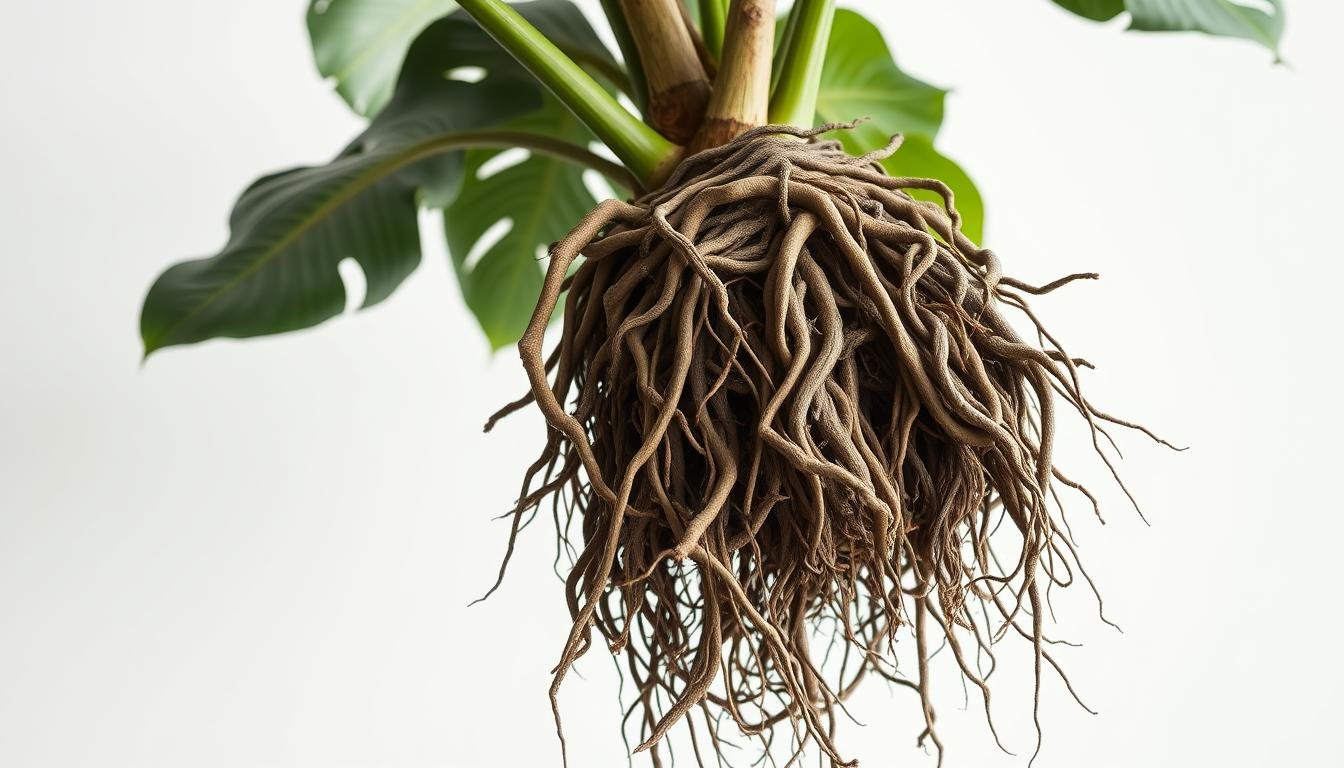
A rootbound Monstera looks different. The root mass often mirrors the exact shape of the container. The outer layer is densely packed with roots, the bottom may be wrapped in a circular mat, and there is much less visible soil than you’d expect. In more advanced cases, the roots are doing laps around the pot wall. That’s the version that leads to fast drying, poor water penetration, and stalled vigor. University of Maryland’s description of tight, impenetrable root masses and Illinois Extension’s “soil mass is filled with roots” language fit this picture closely. (University of Maryland Extension)
When you should repot and when you should wait
For Monsteras, the best repotting window is usually late winter through spring into early summer, when the plant is entering or already in active growth. Minnesota Extension recommends repotting Monstera in late winter or early spring every one to two years as it grows, and the RHS says spring to early midsummer is the best general repotting period while autumn and winter are riskier because growth slows and fresh compost can stay too wet. (University of Minnesota Extension)
But timing is not absolute. If your Monstera is severely rootbound, tipping over, drying in a day, or impossible to water properly, waiting months just because the calendar says winter can be worse than repotting carefully now. The smarter rule is this: repot urgently when the plant’s function is being compromised; otherwise, aim for active growth season. That balances ideal timing with real plant needs. (University of Minnesota Extension)
You should also wait if the plant is only lightly snug, actively growing, and otherwise healthy. Remember, Monsteras do not need endless upsizing. If the root check shows room left and your main issue is tired potting mix, a partial refresh may be enough. The RHS specifically recommends refreshing compost as an alternative when full upsizing is not necessary or practical. That can be the highest-value move for large indoor plants. (RHS)
Choosing the right new pot size and soil mix
This is where people create fresh problems. The right next pot is usually about 1 to 2 inches wider than the current one, not dramatically larger. Minnesota Extension says choose a container about two inches wider and 1 to 2 inches taller than the current one. The RHS advises moving into a pot about 2.5 to 5 cm wider and deeper for smaller containers and warns that going too large raises the risk of overpotting. NYBG’s Monstera guidance also points to moving only one size larger. (University of Minnesota Extension)
For soil, Monstera wants a mix that holds moisture without becoming swampy. Missouri Botanical Garden recommends a peaty soil-based potting mix for indoor Monstera, while current practical ranking content often recommends an aroid-style blend with ingredients like bark, perlite, and coco-based material for drainage and aeration. You do not need a magical proprietary recipe. You need a medium that drains well, leaves air around the roots, and doesn’t collapse into sludge. Drainage holes are non-negotiable. Minnesota Extension explicitly says Monstera containers need good drainage, with at least one proper hole. (Missouri Botanical Garden)
How to repot a rootbound Monstera step by step
Repotting a rootbound Monstera is not complicated, but the details matter. Start by preparing the new pot with drainage and fresh mix. Remove the plant carefully, supporting the base and any pole. If the roots are densely circling, loosen them with your fingers and trim off dead or rotted roots. Illinois Extension advises cutting or unwinding circling roots, and University of Maryland recommends loosening or cutting the tight root mass so roots can spread into the new mix. (Illinois Extension)
Set the plant at roughly the same depth it was growing before. Backfill around the root ball with fresh mix, firm lightly, and water thoroughly so the medium settles around the roots. Don’t bury the stem deeper than before. Don’t pack the mix so hard that you destroy aeration. And don’t add random rocks to the bottom for “drainage.” Current repotting guidance from The Spruce notes that adding rocks or ceramic shards at the bottom can inhibit proper drainage rather than improve it. (Illinois Extension)
After repotting, give the plant steady conditions. Bright indirect light. Reasonable warmth. No fertilizer blast on day one. Expect a short adjustment period, especially with large plants. Some droop or slower water use right after repotting is not unusual. What you want to see over the next few weeks is improved moisture retention, renewed stability, and eventually stronger new growth. (Missouri Botanical Garden)
What to do if your Monstera is huge
Big Monsteras are their own category. The question stops being “Can I repot this?” and becomes “Do I want this plant bigger?” If you have a mature Monstera already pushing your space, moving it into a much larger pot can accelerate top growth and make the plant harder to manage. The RHS notes that root pruning can be used to limit plant size while keeping container plants healthy, and light pruning of the root system every few years can be enough. (RHS)
That opens up three valid options. First, you can pot up modestly if you want continued size increase. Second, you can refresh the compost and keep the pot size the same if the plant only needs better substrate, not more volume. Third, you can root prune and repot into the same container size if space is tight. This is not reckless. It is an established container-growing practice when done carefully, especially for plants that are otherwise healthy and too large to keep upsizing forever. (RHS)
Large plants also need a handling plan. A heavy pot, a stable base, and a support pole matter more once the canopy gets broad. Minnesota Extension points out that Monstera can be top-heavy and may need heavier containers and trellising support. If your giant plant is leaning, a repot without support is only half a fix. (University of Minnesota Extension)
Common repotting mistakes that make things worse
The first mistake is repotting too early just because you saw one root. Root peeking is a signal to inspect, not an automatic emergency. The second mistake is going too big with the new pot. Bigger sounds generous, but oversized containers keep extra wet mix around the roots and increase stress if your watering doesn’t adapt. This is why trusted sources keep repeating the same advice: move one size up, not three. (RHS)
The third mistake is confusing aerial roots with a rootbound problem. Monsteras are climbers. Aerial roots are part of the package. Treating normal aerial growth as evidence that the pot is too small leads to unnecessary repotting and messy decisions. Missouri Botanical Garden is clear that aerial roots are characteristic of the plant and can be directed, rooted, or removed depending on location. (Missouri Botanical Garden)
The fourth mistake is ignoring root health during the repot. If the roots are black, mushy, or smelly, this is not just a space issue. Trim rot, fix drainage, and reassess watering. The fifth mistake is repotting into a pot without drainage holes or relying on rocks at the bottom to solve drainage. Minnesota Extension stresses proper drainage, and recent houseplant guidance continues to warn that “drainage layer” myths do not replace real drainage. (University of Minnesota Extension)
The last mistake is expecting repotting to solve everything. If your Monstera is in dim light, chronically overwatered, or badly underfed, more root room will not erase those issues. Repotting helps when root restriction or stale mix is the bottleneck. It does not replace basic plant care. That is why the best Monstera owners do not ask only, “Does it need a bigger pot?” They ask, “What exactly is limiting this plant right now?” (Missouri Botanical Garden)
Conclusion
If you’re asking “Is my Monstera rootbound?”, the smartest answer is not emotional. It’s observational. Check for the cluster of signs that actually matter: roots at the drainage holes or soil surface, a root ball that slides out as a dense pot-shaped mass, soil that dries much faster than it used to, smaller new leaves, stalled growth, and a plant that is getting unstable in its container. Then confirm with a root check. That is the difference between guessing and knowing. (Illinois Extension)
Also keep the nuance: Monsteras can tolerate being a little snug, but they do not benefit from being severely cramped. If the roots are healthy and the plant is still performing well, you can often wait or simply refresh the mix. If the plant is drying out too fast, tipping over, or growing as a solid root cylinder with barely any medium left, it is time to act. Repot one size up, use a well-draining mix, keep drainage holes mandatory, and treat root health as part of the diagnosis, not an afterthought. Done right, repotting does not just give your Monstera more room. It gives it back momentum. (libguides.nybg.org)
FAQs
How do I know for sure if my Monstera is rootbound?
The surest way is to slide the plant partly out of its pot and inspect the root ball. If the roots are densely circling the outside and bottom, the root ball holds the exact shape of the pot, and there is very little potting mix left, your Monstera is rootbound. Surface clues like fast-drying soil and roots at drainage holes are helpful, but the root check is the real confirmation. (University of Minnesota Extension)
Do Monsteras like being rootbound?
Not really. They can tolerate slight root crowding, which is why they often stay happy in one pot for a while and usually only need to move up one size at a time. But severe crowding limits water uptake, root function, and growth. Slightly snug is fine. Severely pot-bound is not a long-term strategy. (libguides.nybg.org)
Should I repot my Monstera if roots are coming out of the drainage holes?
Usually, yes soon, but inspect first. Roots at the drainage holes are a strong sign the plant is approaching or has reached the limits of the pot. Still, a few escaping roots do not always mean the entire root system is tightly packed. Treat it as a cue to check the root ball, not as proof by itself. (Illinois Extension)
How much bigger should the new pot be?
A good rule is about 1 to 2 inches wider, or roughly one pot size up. This gives the roots more space without creating a large volume of extra wet soil that can raise overwatering risk. Multiple trusted horticultural sources recommend only a modest size increase rather than a dramatic jump. (University of Minnesota Extension)
Can yellow leaves mean my Monstera is rootbound?
They can, but yellow leaves are not a rootbound-only symptom. Yellowing can also come from overwatering, poor drainage, root rot, low light, or normal leaf aging. If yellowing shows up with roots filling the pot, fast-drying soil, or a dense root ball, rootbound becomes more likely. If the roots are mushy and dark, think rot first, not crowding. (University of Minnesota Extension)