Table of Contents
What Most People Need to Know First about Monstera Aerial roots
Monstera aerial roots are normal. They are not a disease, not a sign your plant is failing, and not something you need to “fix” just because they look strange. Monsteras are climbing aroids in the Araceae family, and horticultural references consistently describe the genus as an evergreen climber that naturally produces aerial roots. (RHS)
Here’s the practical answer most people want: you can leave aerial roots alone, train them onto a support, tuck some into the pot, or prune them for appearance. All four options can work. The right choice depends on your goal. If you want a taller, more natural-looking plant with stronger support and larger leaves over time, keep them and give the plant something to climb. If you want a cleaner silhouette and your plant is otherwise healthy, trimming them is usually an aesthetic decision, not a life-or-death one. (Wisconsin Horticulture)
What you should not do is follow random hacks without understanding the trade-off. Aerial roots are useful structures. They help a Monstera anchor itself, and some expert sources note that they also help with moisture and nutrient uptake. That means removing them is usually safe, but not always the most strategic move if you want your plant to grow upright and perform at its best indoors. (Wisconsin Horticulture)
One more useful context point: houseplants are not a niche hobby anymore. Market research published in early 2026 estimated the global indoor plants market at USD 13.61 billion in 2026, with continued growth projected through 2031. In other words, more people are buying tropical climbers like Monstera, and more people are running into the same question you are: what am I supposed to do with these weird roots? (Mordor Intelligence)
What Monstera Aerial Roots Actually Are
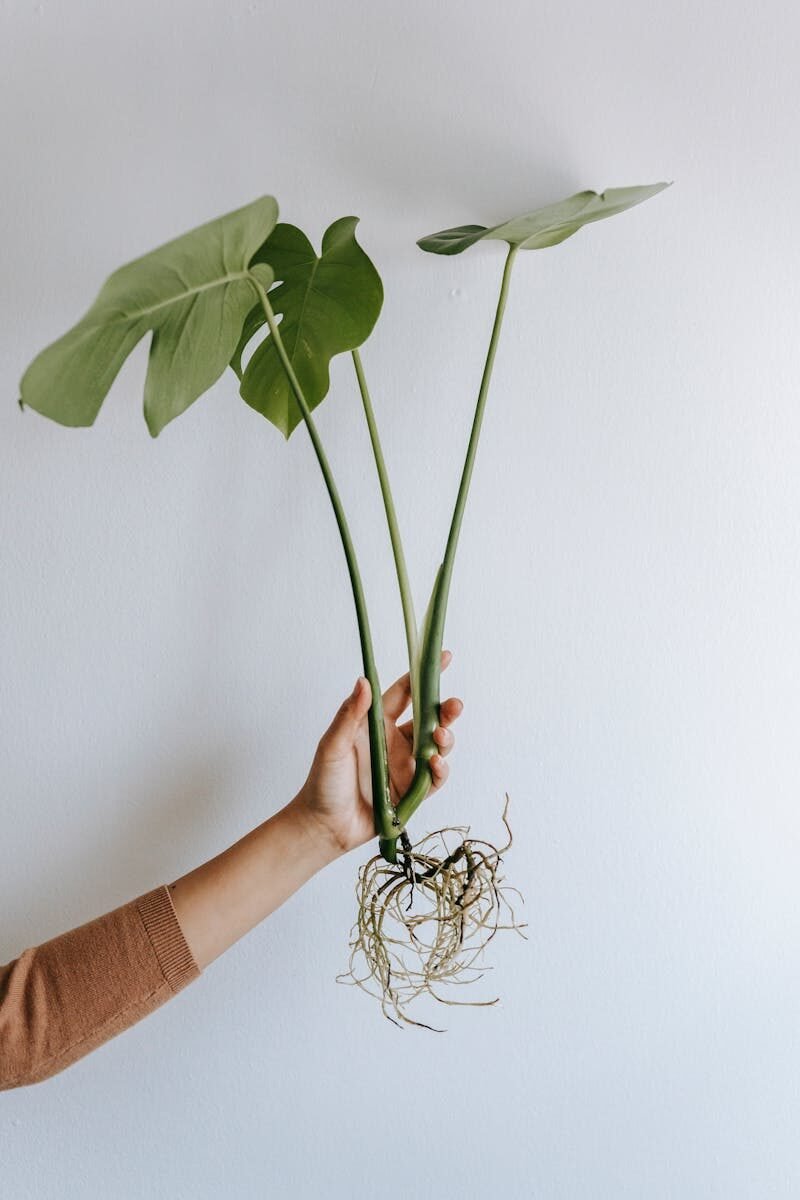
Aerial roots are roots that grow above the potting mix, usually from the plant’s stem near a node. On a Monstera, they often start as firm nubs or short protrusions, then lengthen into thick, cord-like roots that search for something to grab or somewhere to go. They can look woody, tan, brown, or greenish depending on age, moisture, and light exposure. That appearance can make people think something is wrong. Usually, nothing is wrong at all.
The confusion happens because people mix up aerial roots and nodes. They are not the same thing. A node is the point on the stem where leaves, buds, and roots can develop. University of Minnesota Extension makes this distinction clearly in its propagation guidance: a viable cutting needs a node and axillary bud, while a leaf or petiole alone will not create new growth. That matters because many people assume an aerial root by itself can become a whole new plant. It cannot. (University of Minnesota Extension)
Think of the node as the command center and the aerial root as one output the plant can produce from that area. Aerial roots are a feature of the plant’s climbing growth habit. They are not decorative extras. They are part of how the plant behaves in nature, where it grows up trees instead of sitting politely in a plastic nursery pot. RHS botanical guidance describes Monstera as a climbing shrub with aerial roots, which tells you this is built into the genus, not a weird exception. (RHS)
Indoors, the same instincts keep showing up even though the environment is smaller and stranger. Your Monstera does not know it lives next to a couch. It only knows it is a climbing tropical plant looking for height, support, and access to resources. The aerial roots are evidence of that natural program still running.
Why Monsteras Grow Aerial Roots
Climbing, anchoring, and support
The first job of a Monstera’s aerial roots is support. In the wild, these roots help the plant latch onto trees and climb toward brighter light. Better Homes & Gardens summarized this function well through expert commentary: Monsteras are climbers, and aerial roots help them attach to surfaces and pull themselves upward. That lines up with university and horticultural guidance recommending a bark, pole, or moss-covered support so the roots can attach. (Better Homes & Gardens)
This matters indoors because a Monstera without support often grows like a compromise. It sprawls, leans, and throws weight sideways instead of upward. You still get leaves, but you often do not get the same structure, balance, or mature look people actually want. UConn’s houseplant guidance notes that as vines attach successfully to a moss pole, leaf size typically increases drastically. That one line explains why support is not just about tidiness. It changes the way the plant grows. (Home & Garden Education Center)
So if your aerial roots are reaching out like antennae, the plant is not being dramatic. It is doing exactly what a climbing plant does when it wants a vertical surface. It is basically saying, “Give me a tree. I’ll settle for a moss pole.” That is the signal.
Moisture and nutrient uptake
Aerial roots are not just grappling hooks. They also help with moisture and nutrient uptake, though how much that matters indoors depends on how you grow the plant. University of Wisconsin notes that when you use a moss-covered support, you should water the support too, so the aerial roots can obtain water and nutrients. Better Homes & Gardens similarly reports expert input that aerial roots can absorb water and nutrients from the air and surrounding environment, supplementing what the plant gets from soil roots. (Wisconsin Horticulture)
This is the part people oversimplify. Aerial roots do not magically replace the root system in the pot. Your Monstera still gets most of its support and nutrition through its underground roots. But aerial roots can still contribute, especially when they contact moist moss, potting mix, or a suitable support. That is why keeping them can be useful if your plant is climbing, growing large, or living in a setup designed to mimic its natural habit. (Wisconsin Horticulture)
It also explains why some plants seem to “like” support structures so much. A damp moss pole is not just a stick. It creates a better target for aerial roots, which can reinforce the plant’s climbing behavior and improve its relationship with the support. That is a big reason moss poles tend to outperform bare stakes when the goal is a more upright, mature Monstera.
Healthy vs Unhealthy Aerial Roots
A healthy aerial root usually looks firm, not mushy, and it should feel structurally sound rather than hollow or collapsing. The color can vary more than people expect. Young roots may look pale or greenish. Older roots often turn tan or brown and become more rigid. Brown does not automatically mean dead. On Monsteras, older aerial roots often look rugged because they are functioning more like support cables than delicate feeder roots.
In most cases, the mere presence of aerial roots is a healthy sign. A Monstera producing them is behaving like a climbing vine. That said, healthy roots do not exist in isolation. You have to read them together with the whole plant. If the aerial roots are present but the plant is also yellowing, mushy at the base, sitting in wet mix, or smelling sour, the issue is not the aerial roots. The issue is likely a broader care problem such as overwatering or poor drainage. RHS specifically warns that waterlogging and poorly draining compost can lead to root rot and collapse, and Penn State recommends a well-draining, organic-rich soilless mix for indoor Monsteras. (RHS)
Another common mistake is assuming large aerial roots mean the plant is rootbound or desperate. Not necessarily. They often mean the plant is maturing and searching for support. UConn notes that Monstera roots aggressively both in soil and aerially, which makes this growth habit normal rather than alarming. (Home & Garden Education Center)
The roots become a concern when they are damaged repeatedly, forced into bad conditions, or misunderstood. If you keep shoving them into standing water, bend them sharply until they split, or bury the wrong parts of the stem, you can create problems that did not need to exist. The root itself is rarely the villain. The handling usually is.
Should You Cut Monstera Aerial Roots?
Yes, you can cut Monstera aerial roots, and in many indoor setups the plant will remain healthy afterward. Better Homes & Gardens quotes houseplant experts saying removal generally does not harm the plant and that the roots will grow back. Iowa State’s guidance for philodendron-type houseplants with aerial roots says a similar thing: you can leave them, guide them into the soil, use them for support, or prune them off if you dislike the appearance. (Better Homes & Gardens)
That does not mean cutting is always the best move. It means cutting is usually optional. The more useful question is not “Can I?” but “What am I trying to optimize?” If your priority is a clean indoor look and you have no interest in climbing support, pruning can be reasonable. If your priority is bigger leaves, stronger vertical growth, and a plant that behaves more like a climbing aroid, cutting every aerial root is often working against your goal. (Better Homes & Gardens)
The best decision comes from understanding what the plant gains from them and what you gain by removing them. One is performance. The other is appearance. Neither is morally superior. But one is more aligned with the plant’s natural growth habit.
When pruning makes sense
Pruning aerial roots makes sense when the roots are becoming awkward, intrusive, or visually messy in a space where you want tighter control. This is common in homes where the plant sits near walkways, shelves, painted walls, or furniture. Better Homes & Gardens notes that some owners simply prefer a neater look and choose to cut for aesthetic reasons. That is legitimate. A houseplant lives in your home, not a rainforest. (Better Homes & Gardens)
Pruning can also make sense when the plant has outgrown your willingness to support it properly. Not everyone wants to maintain a tall moss pole, re-tie vines, and repot around thick roots. If your Monstera is staying as a medium-sized décor plant rather than becoming a climbing specimen, strategic trimming may be the cleaner long-term system.
If you do prune, use a clean, sharp tool and cut carefully without gouging the main stem. Avoid hacking every aerial root off at once just because you are annoyed. The plant will likely survive, but a measured approach is smarter. You are not trying to win a fight with the plant. You are trying to manage growth without creating unnecessary wounds or stress.
When leaving them alone is smarter
Leaving aerial roots alone is usually smarter when you want the plant to climb, stabilize, and size up. Expert commentary cited by Better Homes & Gardens recommends keeping them when you want to maximize moisture absorption or train the plant upward. UConn adds that once vines attach to a moss pole, leaf size can increase drastically. Those two ideas connect directly: if your goal is a more mature-looking Monstera, aerial roots are useful assets, not clutter. (Better Homes & Gardens)
It is also smarter to leave them when your plant is already producing long, healthy vines and showing obvious climbing behavior. Cutting those roots repeatedly can become a maintenance loop. The plant keeps producing them because the plant wants support. You keep removing them because you dislike the look. That cycle does not solve the underlying mismatch between the plant’s habit and your setup.
There is another practical reason to leave them when possible: some roots can be redirected into the pot or onto a support, which gives you more options later. Once you cut them, that opportunity is gone for that growth point. If you are undecided, do not rush. Aerial roots are one of the rare houseplant features you can often ignore for a while without penalty.
What to Do With Aerial Roots Instead of Cutting Them
If you do not want to prune them, you have three practical choices: train them onto a support, tuck some into the soil, or let them hang. Each option works in the right context. The mistake is assuming there is only one “correct” answer. There is not.
Training aerial roots onto a support is usually the best move if your goal is shape and growth quality. University of Wisconsin recommends a strong bark or moss-covered support so aerial roots can attach, and UConn notes moss poles mimic the porous surfaces Monsteras climb in the wild. That is the closest indoor equivalent to the plant’s natural behavior. (Wisconsin Horticulture)
Tucking roots into the soil is a strong second option, especially if the roots are long enough to reach the pot comfortably. Better Homes & Gardens quotes an expert recommending exactly that for added stability and more upright growth, and UConn notes that vines with established aerial roots can be buried within a few inches of the first leaf node with a high success rate, as long as you do not bury the growing tips. (Better Homes & Gardens)
Letting them hang is also fine if the plant is healthy and you like the look. This is the least intervention-heavy option. It does not maximize structure, but it does respect the plant’s natural growth. For many indoor gardeners, that is enough.
Moss pole vs trellis vs letting them hang
If you want a direct answer, a moss pole is usually the most functionally useful option for a climbing Monstera, especially when compared with a decorative trellis or no support at all. Why? Because the pole is not just vertical. It can also be moist and textured enough for aerial roots to interact with. That makes it a better biological match. University of Wisconsin explicitly says to water a moss-covered support so aerial roots can obtain water and nutrients, and UConn notes that attaching to moss poles often correlates with much larger leaves. (Wisconsin Horticulture)
A trellis can still work well, especially if your priority is appearance and basic organization. It gives the stems something to lean on and tie to, but it usually does less for the aerial roots themselves unless paired with a moisture-retentive surface. Letting the roots hang is the lowest-effort option, but it offers the least structural benefit.
Here is the practical comparison:
| Option | Best For | Main Benefit | Main Limitation |
|---|---|---|---|
| Moss pole | Upright growth, larger leaves, natural climbing habit | Supports attachment and can provide moisture to aerial roots | Requires setup and maintenance |
| Trellis or stake | Basic support and tidier shape | Easier, cleaner, often more decorative | Less biologically useful for roots |
| Letting roots hang | Low-maintenance, natural look | No intervention needed | Less support, less control over form |
A simple training process works better than overcomplicating it:
- Install the support deep enough to stay stable.
- Position the vine so the stem faces the support.
- Loosely secure the stem, not the leaves.
- Guide aerial roots toward the pole or surface without forcing sharp bends.
- Keep the potting mix appropriate and, if using moss, keep the support lightly moist rather than soggy. (Wisconsin Horticulture)
That is usually enough. Monsteras do not need a motivational speech. They need a target.
Soil, Repotting, and Propagation Rules
Good aerial root management is impossible if the rest of the setup is wrong. Start with the basics: free-draining mix, sensible watering, and enough room to anchor the plant safely. Penn State recommends a well-draining soilless mix rich in organic matter, UConn recommends a high-organic-matter, well-draining mix, and RHS warns that staying too wet can lead to root rot. The common thread is obvious: Monsteras like moisture, but not suffocation. (Penn State Extension)
Repotting gets trickier once aerial roots have wrapped around a support or stretched in multiple directions. The Spruce notes that mature Monsteras with aerial roots can be awkward to repot and recommends handling the plant carefully, often with extra support, to prevent unnecessary breakage. A few broken aerial roots are usually not catastrophic, but careless repotting can turn a manageable project into a mess. (The Spruce)
If you want to tuck aerial roots into the pot during repotting, do it selectively. UConn’s guidance is helpful here: vines with established aerial roots can often be buried near the first leaf node with a high success rate, but you should not bury growing tips, because that increases the risk of rot. That is the nuance people miss. “Put the roots in soil” is not the same as “bury whatever you can.” (Home & Garden Education Center)
Now for the question that trips up a lot of propagation attempts: you cannot propagate a Monstera from aerial roots alone. University of Minnesota Extension states that successful propagation requires a node and axillary bud; leaves and petioles without a node will not produce new growth. The Spruce echoes this by noting that aerial roots themselves do not contain the structures needed to become a new plant. An aerial root on a cutting is helpful. An aerial root without a node is not enough. (University of Minnesota Extension)
Another popular shortcut deserves a direct answer: do not keep Monstera aerial roots permanently submerged in water. The Spruce warns that aerial roots are not designed for constant submersion and that this can contribute to rot. That advice also fits broader houseplant guidance from RHS on avoiding prolonged standing water in general. Aerial roots may tolerate brief contact during propagation setups or incidental moisture, but turning them into permanent water roots is not a best practice. (The Spruce)
There is also a safety point worth knowing if you have pets or curious kids. Monstera deliciosa is toxic to dogs and cats, according to the ASPCA, due to insoluble calcium oxalates that can cause oral irritation, drooling, vomiting, and difficulty swallowing. The aerial roots are not uniquely more dangerous than the rest of the plant, but they are still part of a toxic plant. If your pet likes chewing dangling roots, that matters. (ASPCA)
The bottom line is simple: aerial roots make more sense when you stop treating them as a weird accessory and start treating them as part of the plant’s whole system. The support, the mix, the watering, the pruning choices, and the propagation method all connect.
Conclusion
Monstera aerial roots are not a problem to solve. They are a clue. They tell you your plant is behaving like the climbing tropical vine it actually is. Once you understand that, most of the confusion disappears.
If you want the cleanest possible look, prune them carefully and move on. If you want stronger vertical growth, larger leaves, and a plant that looks more like the dramatic specimens people admire online, keep them and give them something useful to do. A moss pole, a smart repot, and selective guidance usually beat random trimming.
The best rule is this: match your choice to your goal. Aerial roots are normal. Cutting them is optional. Training them is often smarter. Putting them in permanent water is usually a bad idea. And propagation still starts with a node, not just a root. Get those four ideas right, and you will handle Monstera aerial roots better than most plant owners on the internet. (Wisconsin Horticulture)
FAQs
Do aerial roots mean my Monstera is happy?
Usually, yes. Aerial roots are a normal part of Monstera growth and often indicate the plant is maturing and expressing its climbing habit. They are not proof that every part of care is perfect, but by themselves they are generally a healthy, expected sign rather than a warning flag. Read them alongside the whole plant: healthy leaves, good drainage, and stable growth matter more than the roots alone. (RHS)
Can I put Monstera aerial roots in water?
As a long-term strategy, that is usually not recommended. The Spruce specifically warns that aerial roots are not meant to stay permanently submerged and that doing so can contribute to rot. If your goal is better moisture access, a properly maintained moss pole or tucking selected roots into the potting mix is generally a better approach. (The Spruce)
Will cutting aerial roots slow growth?
Not necessarily in a dramatic way, especially on a healthy indoor plant with good light, proper watering, and a solid root system in the pot. Experts cited by Better Homes & Gardens note that removing aerial roots generally does not harm plant health. But if you want the plant to climb, stabilize, and potentially size up more effectively, keeping those roots can support that goal. (Better Homes & Gardens)
Can aerial roots turn into normal roots in soil?
They can function more like soil roots when directed into potting mix, which is why tucking some into the pot can improve stability and resource uptake. UConn notes that vines with established aerial roots can be buried near the first node with a high success rate, and Better Homes & Gardens cites expert advice supporting the practice for upright growth. The key is doing it selectively and avoiding burial of growing tips. (Home & Garden Education Center)
Are Monstera aerial roots dangerous for pets or people?
The aerial roots are part of Monstera deliciosa, which the ASPCA lists as toxic to dogs and cats because of insoluble calcium oxalates. Chewing any part of the plant can cause oral irritation, drooling, vomiting, and swallowing difficulty. For people, irritation is also possible, especially with sap exposure or ingestion. So the roots are not dangerous to touch in a normal gardening sense, but they are not something pets or children should chew on. (ASPCA)