Table of Contents
What Monstera light deficiency actually means
Monstera light deficiency means your plant is not receiving enough usable light to produce the energy it needs for healthy, vigorous growth. That sounds technical. In practice, it looks simple: the plant slows down, stretches toward the nearest light source, produces smaller leaves, and often stops making the dramatic splits and holes people buy Monsteras for in the first place. Extension and RHS guidance consistently place Monstera deliciosa in the bright, indirect light camp, not the “dark corner survivor” camp that social media often suggests. (Wisconsin Horticulture)
The important nuance is this: a Monstera can survive in low light for a while, but survival is not the same thing as thriving. A plant surviving in a dim room may stay alive, but it usually grows slowly, looks sparse, develops weaker stems, and loses the bold leaf size and fenestration that signal good health. Penn State Extension states plainly that Monstera will get “leggy” in lower light, while Wisconsin Extension notes inadequate light prevents those signature perforations from developing properly. (Penn State Extension)
Quick answer: can Monstera survive in low light?
Yes, Monstera can survive in low light, but it usually won’t perform well there. The plant may remain alive for months or longer, yet growth slows, internodes stretch, leaves stay smaller, and the overall form becomes less stable and less attractive. Low light also changes how quickly the potting mix dries, which quietly raises the risk of overwatering problems. (Penn State Extension)
That difference matters because many plant owners think, “It’s not dead, so the spot must be fine.” That logic fails with Monsteras. These plants are good at tolerating subpar conditions long enough to fool you. The problem shows up later as weak structure, yellow leaves, stalled growth, or persistent soggy soil. By then, the lighting issue has often created a watering issue too. (The Spruce)
Why Monstera wants bright, indirect light
In nature, Monstera grows in tropical forest environments where it gets plenty of light, but often filtered through surrounding canopy. Indoors, that translates to bright, indirect light rather than harsh, prolonged direct midday sun. The Royal Horticultural Society recommends bright, indirect light for Swiss cheese plants, and N.C. State Extension describes their preference as moderate brightness but not direct sunlight. (RHS)
This is also why people get confused. “Indirect light” does not mean “dark room.” It means strong ambient light without long periods of scorching exposure on the leaves. Recent lighting guidance aimed at indoor gardeners describes bright indirect light as roughly 1,000 to 2,000 foot-candles near a bright window, while University of Minnesota Extension places medium indoor light around 250 to 1,000 foot-candles, with south-facing windows offering the highest natural indoor light. Those ranges help explain why a Monstera placed six feet into a dim room usually struggles, even if the room feels bright to a person. (Popular Science)
The clearest signs your Monstera needs more light
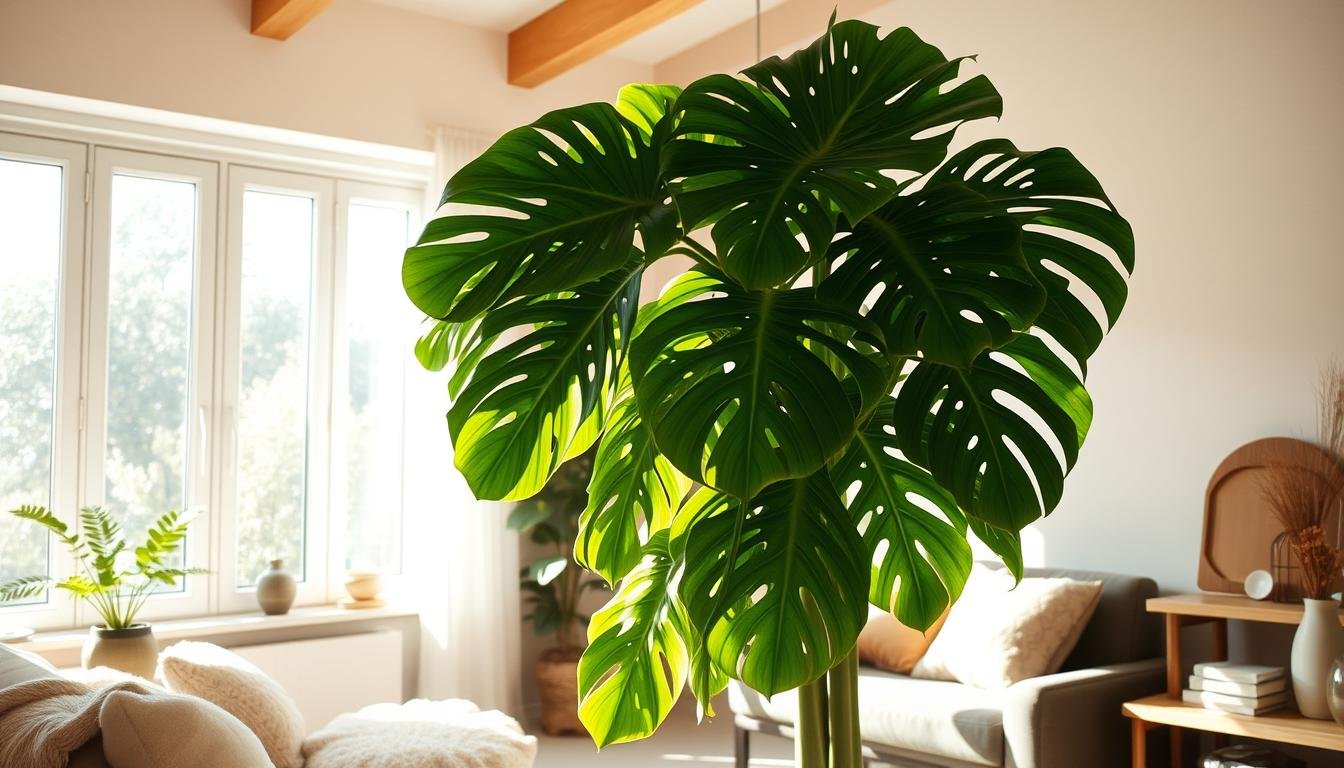
Low light usually shows up as a pattern, not one isolated symptom. One pale leaf by itself does not prove light deficiency. But when you combine slow growth, leaning stems, long gaps between leaves, weak fenestration, and soil that stays wet forever, the picture gets clearer fast. University and horticultural sources repeatedly tie inadequate light to legginess, poor perforation, and weak growth in Monstera. (Wisconsin Horticulture)
The easiest way to diagnose the problem is to stop staring at one damaged leaf and start reading the whole plant. Look at new growth. Look at shape. Look at leaf size over time. Look at how the plant is behaving in relation to the light source. A healthy Monstera in the right conditions tends to look balanced and purposeful. A light-deficient one looks like it is negotiating for survival.
Leggy stems, stretching, and leaning
Legginess is one of the strongest signs of low light. The plant stretches because it is trying to find better exposure. Penn State Extension specifically notes that Monstera gets leggy in lower light, and that aligns with what indoor growers see in practice: elongated stems, longer internodes, petioles that reach hard toward the window, and an awkward, sparse silhouette. (Penn State Extension)
This matters for more than appearance. Leggy growth is weaker growth. When a Monstera stretches instead of building compact, sturdy structure, it becomes harder to support, less stable on a pole or stake, and less capable of producing large, mature-looking leaves. If your plant seems to be crawling sideways, leaning dramatically, or rotating itself toward one light source every few days, that is not personality. That is a clear signal.
Small leaves and missing fenestrations
A lot of people ask one version of the same question: “Why is my Monstera not splitting?” Low light is one of the most common answers. Wisconsin Extension notes that Monstera grown under fluorescent light can live, but it will not develop perforations when light is inadequate. The RHS also connects the biggest, most perforated leaves with good light and high humidity. (Wisconsin Horticulture)
Younger Monsteras naturally produce smaller, unsplit leaves at first, so you need context here. But if your plant has matured, is climbing, and still keeps pushing out undersized leaves with little or no fenestration, light should move high on your suspect list. In most homes, the issue is not “no light at all.” It is not enough intensity or duration to support mature leaf development. Think of fenestration as a luxury feature. A plant underfed by light spends its energy on survival first.
Pale color, yellowing, and stalled growth
Low light can also show up as paler foliage, reduced vigor, and slower new growth. In some cases, leaves may lose that deep green look and appear washed out. Yellowing is trickier because it has many causes, but reputable recent guides and expert commentary include insufficient light among the common reasons Monstera leaves turn yellow, especially when paired with wet soil or poor growth. (The Spruce)
The key is pattern and timing. If yellowing appears alongside soil that stays damp for a long time, growth that has nearly stopped, and a plant positioned in a dim area, low light is a credible part of the diagnosis. That does not mean every yellow leaf is caused by shade. Older leaves can yellow naturally, and watering, root health, temperature, pests, and nutrition all matter too. But a Monstera that has gone pale and stagnant in a dark spot is not asking for motivational quotes. It is asking for better light. (The Guardian)
Why low light causes bigger problems than most people think
Low light is not just a light problem. It is a whole-care problem because light influences how fast your plant uses water, how much energy it makes, how quickly it grows, and how resilient it is under stress. That is why people often treat the wrong symptom. They focus on a yellow leaf, add fertilizer, and leave the plant in the same gloomy corner. The plant then gets weaker, not stronger, because the real bottleneck never changed.
When a Monstera receives the light it needs, it can build new tissue efficiently, dry the soil at a reasonable pace, and recover faster from normal stress. When it does not, everything slows down. Water lingers longer. Roots sit in wet media longer. Growth becomes thin and stretched. New leaves emerge smaller. The whole system becomes less forgiving. That is why light sits upstream of so many other care issues. (University of Minnesota Extension)
The photosynthesis-watering-root rot connection
Here is the most useful way to think about it: less light means less energy demand. If the plant is using less energy, it also uses water more slowly. The soil stays wet longer. If you keep watering on the same schedule you used during brighter conditions, you increase the chance of waterlogged soil and root stress. Recent Monstera guidance from major gardening publications and houseplant care sources explicitly links low light with yellowing foliage and with soil remaining too moist, which can contribute to rot. (The Spruce)
This is why low light gets misdiagnosed as “I guess I just overwatered.” Sometimes you did overwater. But often the hidden reason is that your plant was underlit first, which made your normal watering routine excessive for the conditions. That distinction matters because the fix is different. If you only water less but keep the plant in inadequate light, growth still stays weak. If you only move it brighter but keep drowning the roots, you still have a problem. Good diagnosis handles both pieces.
Low light or overwatering? How to tell the difference
This is where most Monstera owners get stuck. The symptoms overlap. Yellow leaves, droop, stalled growth, and unhappy roots can all show up in both scenarios. That is why you need a whole-plant diagnosis, not a one-symptom guess. The Guardian’s houseplant clinic and other reputable care references note that yellowing can stem from overwatering, underwatering, low light, or nutrient problems, with overwatering often the more common immediate cause. (The Guardian)
The better question is not “Which single problem is it?” but “Which problem is most likely driving the rest?” If your Monstera is in a dim location and the soil is staying wet for too long, the answer may be both: inadequate light created conditions where overwatering became easy. That is common. It is also why the best fix often combines brighter placement, adjusted watering, and patience.
A fast diagnostic checklist
Use this quick comparison:
| Symptom or clue | More consistent with low light | More consistent with overwatering |
|---|---|---|
| Long gaps between leaves | Yes | Sometimes |
| Strong leaning toward window | Yes | No |
| New leaves smaller than older leaves | Yes | Sometimes |
| No fenestration on otherwise mature plant | Yes | Not usually |
| Soil staying wet for many days | Often | Yes |
| Mushy roots or sour smell | Possible secondary issue | Strong sign |
| Sudden generalized yellowing after frequent watering | Sometimes | Yes |
| Weak, stalled growth in dim spot | Yes | Yes |
This table is not a perfect test, but it gives you a more accurate starting point than guessing from one yellow leaf. If your plant has structural low-light signs like stretching, leaning, and tiny leaves, fix the lighting first. If you also find mushy roots, compacted soil, or water sitting in the pot for too long, address the watering and soil issue at the same time. Expert recommendations on yellowing Monstera leaves consistently stress checking soil moisture, drainage, root condition, and lighting together rather than in isolation. (The Guardian)
The best light for Monstera indoors
The target is simple: bright, indirect light for several hours a day. Penn State Extension recommends a site near a sunny window with bright light but not direct sun, while RHS guidance also points to bright, indirect conditions under glass or indoors. In practical home terms, that usually means near an east, west, or filtered south-facing window rather than in the center of a room. (Penn State Extension)
The challenge is that humans judge light badly. A room that feels bright enough to read in may still be far below what a Monstera wants for vigorous growth. Recent indoor-light explainers put bright indirect light in a much stronger range than many people assume, and University of Minnesota Extension notes that unobstructed south-facing windows provide the highest indoor natural light. That is why moving a plant just a few feet closer to a window can change everything. (Popular Science)
Window direction, distance, and room placement
If you want the simple version, start here: east-facing windows are often the easiest natural-light placement, west-facing windows can also work well, and south-facing windows can be excellent if the light is filtered or the plant is positioned slightly off the harshest direct beam. Recent Monstera care sources and general indoor-light guidance consistently identify east and west windows as favorable and south windows as the strongest source of natural indoor light. (The Spruce)
Distance matters more than most people realize. A Monstera one foot from a bright window and a Monstera six feet into the room are living in different worlds. If your plant is underperforming, the fastest useful test is usually to move it closer to the window without exposing it abruptly to hot, intense direct sun for long periods. Filtered light through a sheer curtain often works well. And if one side keeps reaching, rotate the plant occasionally so growth stays more balanced, a step also recommended in recent expert advice for preventing uneven development. (The Guardian)
One more nuance: variegated Monsteras usually need more light than solid green forms because they have less chlorophyll-rich tissue available for photosynthesis. N.C. State Extension notes that variegated cultivars need more sunlight than darker green cultivars. That does not mean harsh direct sun is automatically safe. It means dim placement becomes even more limiting. (Plant Toolbox)
When grow lights make sense
Grow lights make sense when your home simply does not provide enough consistent natural light, especially in winter, in north-facing spaces, or in deep rooms with obstructed windows. University of Minnesota Extension recommends supplemental lighting in some Monstera contexts, and mainstream Monstera care sources increasingly point low-light growers toward LED grow lights when window options are weak. (University of Minnesota Extension)
You do not need to turn your living room into a commercial greenhouse. A full-spectrum LED grow light positioned reasonably close to the foliage can make a real difference. Practical grow-light guides often suggest positioning the light roughly 12 to 18 inches above the plant, though exact distance depends on the fixture’s output. The broader principle matters more than the gadget hype: the plant needs enough usable light, delivered consistently, without leaf scorch. (tropicalplantkit.com)
The mistake is buying a light and then setting it so far away that it barely changes the plant’s reality. If you use supplemental lighting, treat it like a real light source, not decorative mood lighting. And remember that better light usually means the plant will eventually use water faster again. When the environment improves, your watering rhythm should evolve too.
How to fix Monstera light deficiency
The fix is usually straightforward, but not always instant. Start by moving the plant into brighter, indirect light. That means closer to a suitable window or under a proper grow light. If the plant has spent months in dim conditions, make changes deliberately rather than slamming it into harsh direct midday sun in one move. Monsteras can tolerate some direct sun in the right context, especially gentler exposure, but sudden high-intensity change can scorch leaves. (Penn State Extension)
Next, adjust your watering to match the new conditions. Low-light Monsteras often sit wet too long, so check the soil before watering rather than following a fixed schedule. If drainage is poor, the mix is compacted, or roots are unhealthy, fix that too. Recent care advice on yellowing Monstera leaves repeatedly recommends assessing moisture, drainage, and root health alongside light corrections. (The Guardian)
Then look at structure. If the plant has become floppy and sprawling, add a support such as a moss pole or sturdy stake so future growth has direction. Monsteras are climbers. When they are given enough light and support, they typically grow more purposefully and produce more attractive mature foliage. You do not need to chop the whole plant down immediately unless it is severely compromised. Often, giving it better conditions first helps you make cleaner pruning decisions later. (Plant Toolbox)
You should also reset expectations. Existing damaged leaves may not turn dark green again or suddenly sprout fenestrations. Recovery shows up mostly in new growth. That is where you judge success. New leaves should gradually emerge larger, stronger, better colored, and more appropriately spaced if your changes are working. That is the real scoreboard.
What recovery looks like over the next 2 to 6 weeks
Recovery is not magic. It is a trend. In the first one to two weeks, the biggest signs are usually stabilization: less dramatic leaning, better leaf posture, and soil drying at a more normal pace if the plant is warmer and brighter. If you corrected both light and watering, the plant may simply stop getting worse before it starts looking better.
In about two to six weeks, you may begin to see more meaningful improvement in new growth. New leaves can emerge slightly larger, petioles may look sturdier, and the spacing between leaves may begin to tighten. Fenestration usually takes longer because it depends on plant maturity, light, support, and overall vigor, not just one good week by a window. Wisconsin Extension’s note that inadequate light limits perforation is useful here: once the plant has enough light again, future leaves have a better chance to develop normally, but old leaves will not retroactively change. (Wisconsin Horticulture)
If nothing improves after several weeks, reassess. Ask harder questions. Is the plant still too far from the light? Is the pot too large for the root system? Is the soil staying soggy? Are pests involved? Are you dealing with a plant that needs pruning and restart rather than only relocation? A recovery plan works only if the diagnosis was right.
Common mistakes that keep Monsteras weak
The first big mistake is believing Monstera is a “low-light plant.” It is more accurate to call it a low-light tolerant plant with much better performance in bright, indirect light. That distinction is huge. Tolerance keeps the plant alive. Better light makes it actually look like the plant you wanted. Extension and RHS sources support that stronger-light preference clearly. (Penn State Extension)
The second mistake is placing the plant too far from the window and assuming room brightness equals plant brightness. It does not. Light intensity drops fast as you move away from the source indoors. That is why a Monstera can struggle even in a room that seems cheerful and well lit to you. A small placement change often outperforms an expensive care-product haul.
The third mistake is treating yellow leaves as a fertilizer problem first. Sometimes nutrition matters. But if the real bottleneck is light, added fertilizer will not fix weak energy production. In some cases, it can create extra stress. Recent expert-backed guides on Monstera yellowing consistently rank watering and light issues among the top causes to evaluate before reaching for feed. (The Guardian)
The fourth mistake is watering on autopilot. A Monstera in low light, cool temperatures, or winter conditions usually uses water more slowly than one growing vigorously in brighter, warmer conditions. Fixed weekly watering schedules are convenient, but convenience is not care. Soil moisture, drainage, temperature, and light all change how fast the plant dries.
The fifth mistake is expecting a dramatic transformation overnight. Plants work on plant time. Stronger light can improve future growth, but it does not instantly rewrite months of weak development. The goal is not cosmetic speed. The goal is to restore the conditions that let the plant build healthy leaves going forward.
The sixth mistake is ignoring support. A Monstera that is given brighter light but no support may still sprawl awkwardly. Since these plants naturally climb, a pole or stake is often part of the solution, not a decorative extra. Better light plus vertical support is usually a better combination than either one alone for producing a stronger, more mature-looking plant. (RHS)
The seventh mistake is failing to adjust seasonally. A location that works in summer may become mediocre in winter as day length drops and the sun angle changes. If your Monstera suddenly stalls during darker months, reassess its location instead of assuming the plant has become “fussy.” Seasonal supplemental light is a rational fix, not a sign you failed.
Conclusion
A Monstera with light deficiency usually tells on itself. It stretches. It leans. It shrinks its ambitions. Leaves stay smaller, splits disappear, growth slows, and wet soil lingers longer than it should. The fix is rarely complicated, but it does require honesty: if the plant is living in a dim corner, that corner is the problem.
The highest-leverage move is almost always to improve the light first, then bring watering and support into alignment with the new conditions. Bright, indirect light is the standard repeated by extension sources and the Royal Horticultural Society for a reason: it matches how this plant grows best indoors. (Penn State Extension)
So judge your Monstera by its new growth, not just its survival. If fresh leaves are getting larger, sturdier, deeper green, and more structured, you are on the right track. That is how you know the plant has stopped enduring your setup and started using it.
FAQs
Can a Monstera recover from light deficiency?
Yes. A Monstera can recover well if you correct the light before root damage or severe decline goes too far. The best evidence of recovery is healthier new growth, not perfect old leaves. Existing stretched stems or damaged foliage may remain imperfect, but future leaves can improve significantly in size, color, and fenestration once the plant receives better light. (Wisconsin Horticulture)
How much light does a Monstera actually need indoors?
Most indoor guidance points to bright, indirect light near a strong window rather than deep-room ambient light. That typically means placement near an east, west, or filtered south-facing window, with enough intensity to support steady growth without prolonged harsh exposure. Indoor-light references put bright indirect light well above what many plant owners assume, which is why proximity to the window matters so much. (Popular Science)
Will my Monstera get splits if I move it to brighter light?
It can, but only on future leaves, and only if the plant is mature enough and otherwise healthy. Inadequate light is a known reason Monsteras fail to develop perforations, but fenestration also depends on maturity, climbing support, and overall vigor. Better light improves the odds. It does not retroactively change old leaves. (Wisconsin Horticulture)
Do grow lights work for Monstera?
Yes, especially when natural light is limited by season, room layout, or window direction. Supplemental LED grow lights are a practical option when they are strong enough and placed close enough to matter. The goal is consistent usable light, not simply owning a plant lamp. (University of Minnesota Extension)
Do variegated Monsteras need more light than green ones?
Usually, yes. Variegated forms have less chlorophyll-rich green tissue, so they generally need stronger light conditions than fully green cultivars to maintain growth. N.C. State Extension specifically notes that variegated cultivars need more sunlight than darker green cultivars, which makes dim placement an even bigger issue for them. (Plant Toolbox)