A leggy Monstera deliciosa is not a mystery. It is a signal. Your plant is telling you that the environment is not supporting the kind of growth you want.
Most people treat the symptom. They rotate the pot, add fertilizer, or hope the next leaf fixes everything. It usually does not. The real fix is more strategic: improve light, give the plant something to climb, prune with intent, and reset care so the next phase of growth comes in tighter, stronger, and better proportioned.
That matters because Monstera is not naturally a compact tabletop plant. It is a climbing aroid that wants to reach upward, anchor itself, and size up as conditions improve. Penn State Extension notes that indoor Monsteras should be placed near a sunny window with bright light but not direct sun, and specifically warns that the plant gets “leggy” in lower light. The RHS and NC State also describe Monstera as a large tropical climber that benefits from indirect light and support. (Penn State Extension)
Table of Contents
What “Leggy” Means in a Monstera
A Monstera is leggy when the stems stretch out with too much space between leaves, the vine looks sparse instead of lush, and the plant often leans or sprawls rather than growing in a strong, structured way. You will usually see long internodes, smaller leaves, less dramatic fenestration, bare lower sections, and growth that seems to chase light instead of holding shape. In plain English, the plant looks stretched, underbuilt, and awkward.
That look is not random. It is a growth pattern driven by conditions. A healthy Monstera can still look open and architectural, but a leggy one looks like it is working too hard for too little return. The difference matters because you do not fix a climber the same way you fix a naturally bushy plant. Monsteras can become fuller over time, but they do that through better future growth and smart pruning, not by magically densifying old stretched stems. Penn State ties legginess directly to low light, while RHS guidance explains that Monsteras naturally get very large and need pruning and support indoors. (Penn State Extension)
Why Monstera Deliciosa Gets Leggy
Legginess usually comes from a few causes working together, not one problem in isolation. The plant stretches, the leaves stay smaller, the vine does not anchor, and the whole structure gets weaker with each new node. Once that starts, every mediocre care choice compounds the shape problem.
The most important thing to understand is this: a leggy Monstera is usually not “unhappy” in a dramatic sense. It is adapting. It is doing the best it can with the light, support, and root-zone conditions it has. That is why generic care advice often fails. The plant may still be alive, still growing, and still putting out leaves while slowly becoming less attractive.
Not Enough Light Is the Main Cause
Low light is the biggest driver of legginess. When light is weak, a plant stretches to find more of it. That means longer internodes, thinner stems, slower maturation, and less energy available to produce large, well-fenestrated leaves. Penn State’s Monstera houseplant guidance says it plainly: place it near bright light, because it becomes leggy in lower light. University of Minnesota lighting guidance also explains that plants in low-light conditions grow more slowly and use less water, while Clemson notes that many homes provide lower light than people think. (Penn State Extension)
This is where many owners get fooled. Monsteras are often marketed as “low-light tolerant,” and that phrase gets misread as “low light is fine.” Tolerant is not the same as thriving. A plant may survive in dim corners, but survival growth is not display-worthy growth. If your Monstera has long bare reaches, small leaves, or one-sided stretching toward a window, light is your first suspect.
Lack of Support Changes the Growth Habit
Monstera deliciosa is a climber. In nature, it attaches to trees using aerial roots. Indoors, if it has nothing to climb, it often sprawls outward, bends under its own weight, and produces looser-looking growth. Gardeners’ World recommends growing Monstera up a mossy pole and tucking aerial roots into it, while The Spruce notes that moss poles help Monsteras stay upright and can support larger leaves. NC State also identifies the species as a climbing vine. (BBC Gardeners World Magazine)
Support does not just make the plant look neater. It changes the way the plant organizes itself. A supported vine is easier to train, easier to light evenly, and more likely to create that bold vertical look people actually want. Without support, even a reasonably healthy Monstera can look sloppy, stretched, and “leggy” in a way that is partly structural rather than purely light-related.
Pruning Gaps, Long Internodes, and Uneven Growth
Sometimes the plant got leggy because it was allowed to run too long without shaping. One vine reaches, another stays short, older lower leaves drop, and the plant turns into a lopsided tangle. Heavy pruning is not always necessary, especially on younger plants, but targeted cuts can reset direction and encourage stronger future branching or at least a cleaner silhouette. Recent pruning guidance highlighted by The Spruce notes that pruning helps control size, improve air circulation, and reduce legginess risk when paired with proper support. (The Spruce)
There is also a hard truth here: if you let a Monstera build long internodes over many months, you cannot “fill in” those exact spaces later. New growth can improve. Side shoots may develop depending on the cut and plant maturity. But old spacing usually stays old spacing. That is why strategic pruning matters more than cosmetic tinkering.
Watering, Pot Size, and Fertilizer Problems That Make It Worse
Bad light starts the problem. Bad care makes it uglier. When a Monstera sits in low light and gets watered like it is in bright light, growth slows and roots stay wetter longer. University of Minnesota warns that plants in lower light use less water, which raises overwatering risk. Clemson also notes that low interior light levels limit how much benefit foliage plants get from fertilization, which means feeding heavily in weak light does not create lush structure; it can just push weak, imbalanced growth. (University of Minnesota Extension)
An oversized pot can also work against you. Too much wet soil around a modest root system makes moisture control harder. Add excess nitrogen and you can get soft, fast top growth without the strength or light to support it. In other words, fertilizer is not a fix for a leggy Monstera. Used in the wrong setup, it can be fuel for worse form.
Can a Leggy Monstera Recover?
Yes, but recovery needs to be defined correctly. A leggy Monstera can produce better future growth once you improve the setup. It can become fuller-looking, better balanced, and more attractive over time. What it usually will not do is shrink existing internode gaps or turn old stretched vines into dense, compact stems. That is the central misconception that traps people.
Think of recovery in two layers. Layer one is prevention going forward: better light, better support, better care. Layer two is structural reset: pruning, training, and propagation. If the plant is only mildly stretched, you may only need the first layer. If it is severely sparse, long, or top-heavy, you probably need both. That distinction is supported across current care sources: Penn State ties legginess to light, RHS emphasizes pruning and indirect light, and university propagation guidance confirms that Monstera is easy to restart from node-bearing cuttings when shape has gotten out of hand. (Penn State Extension)
So yes, your plant can get better. But the path is not “wait and see.” It is “change the inputs and, if needed, edit the structure.”
A Fast Diagnosis Checklist Before You Cut Anything
Before you reach for pruners, diagnose the plant like a strategist, not a panicked owner. Look at the distance between leaves, leaf size, direction of growth, window proximity, presence or absence of support, and overall root-to-pot balance. A Monstera in bright indirect light with a proper pole that still looks sparse needs a different fix than one sitting six feet from a north window with no support.
A quick check helps. If the plant is leaning hard toward the nearest window, has long stretches of bare stem, or produces noticeably smaller leaves than before, light is likely part of the issue. If the stems are flopping and aerial roots are wandering without anything to attach to, support is likely missing. If the soil stays wet for too long, the pot is oversized, or the plant was heavily fertilized in dim conditions, the care routine may be amplifying the problem. This kind of diagnosis lines up with extension guidance on light-driven growth, water use in low light, and Monstera’s natural climbing habit. (University of Minnesota Extension)
Do that first. A good diagnosis prevents bad pruning decisions.

Step 1: Move It Into Better Light
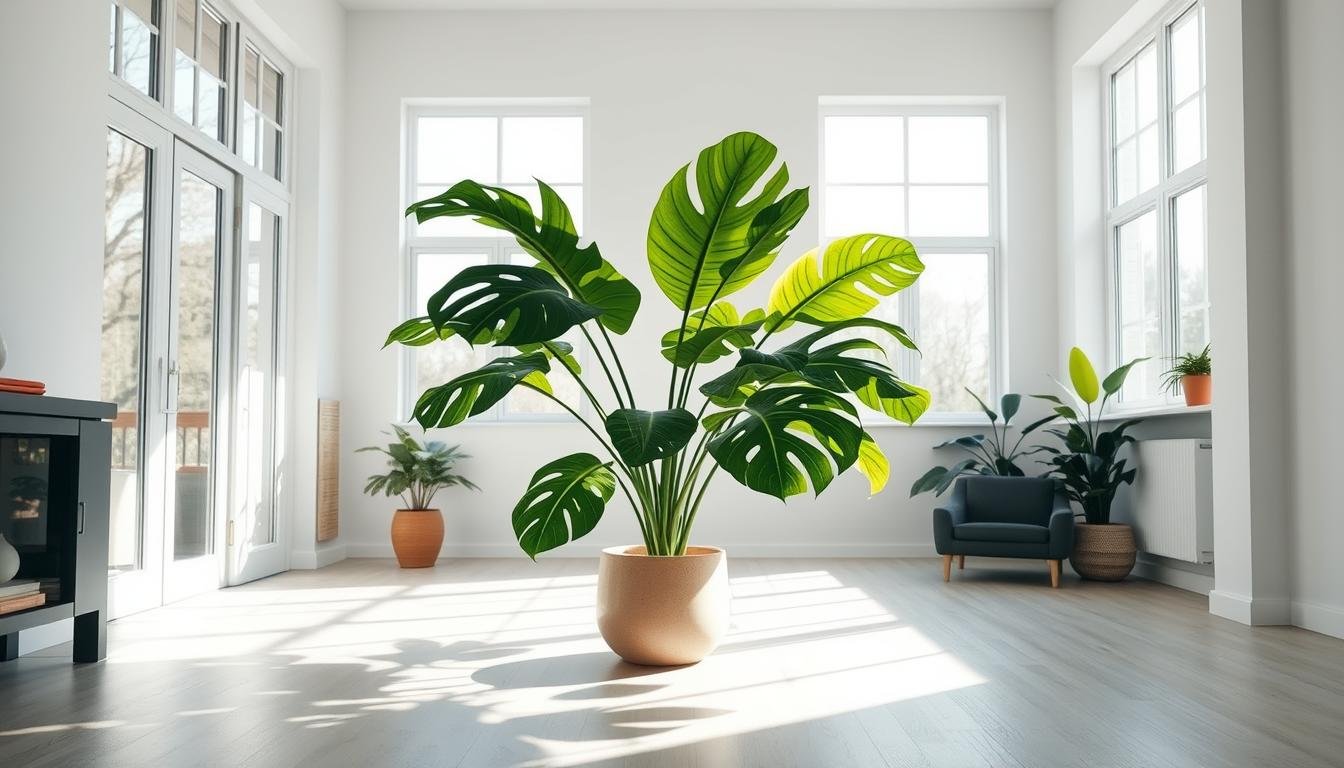
If you only change one thing, change the light. A Monstera that is too far from a window will usually not become full and compact, no matter how well you water or fertilize it. The goal is bright, indirect light. That usually means near an east-facing window, near but not pressed against a bright west-facing window, or in a strong south-facing room with protection from harsh direct midday sun. Penn State recommends bright light near a sunny window without direct sun, and RHS says Swiss cheese plants like indirect light while intense direct sun can scorch leaves. (Penn State Extension)
This is also the easiest test with the biggest payoff. Move the plant closer to better light and watch the next two or three leaves. Do they emerge on shorter internodes? Are they larger? Does the plant stop lunging sideways? Those signals tell you more than any label on the nursery pot. Better light does not repair the old stem, but it dramatically improves what comes next.
How Much Light a Monstera Actually Needs Indoors
Most indoor plant guides use vague language like “medium to bright indirect light,” which is technically true but not very useful. In practice, Monsteras want more light than many owners give them. University of Minnesota describes medium-light houseplants as suitable for well-lit areas such as east-facing windows or near west-facing windows out of direct sun. Clemson’s indoor light guidance also shows how indoor light drops quickly away from windows, which explains why a spot that looks “bright” to you may still be weak for strong Monstera growth. (University of Minnesota Extension)
Here is the practical version: if the plant is several feet back in a room and casting only a faint shadow most of the day, the light is probably too weak for compact growth. If it sits close to a bright window, avoids harsh scorch, and the newest leaves arrive bigger and closer together, you are in the right zone. Wiping dust off the leaves also helps the plant use the light it gets more effectively, a tip echoed in current Gardeners’ World guidance. (BBC Gardeners World Magazine)
Step 2: Add the Right Vertical Support
A Monstera without support often grows like a lazy octopus. It sprawls, drifts, twists, and then people call it leggy when part of the problem is that the plant is doing what climbers do without a tree. Adding support gives the plant a direction. It also makes the plant easier to place in good light and easier to prune intelligently later.
This is why moss poles are so common. They mimic the climbing surface Monsteras use in nature. The Spruce notes that Monsteras benefit from moss poles, which help keep the plant upright and support larger leaves. Gardeners’ World likewise recommends a mossy pole and says to tuck aerial roots into it as the plant grows. (The Spruce)
Moss Pole vs Stake vs Plank
Not every support does the same job. A basic stake can hold a stem upright, but it does not offer much for aerial roots to grab. A moss pole provides structure plus a moisture-retentive surface that roots can attach to. A plank gives strong support and is popular with growers who want controlled vertical climbing, though it is more associated with collector-style setups than beginner care content.
Here is the practical comparison:
| Support Type | Best For | Main Advantage | Main Limitation |
|---|---|---|---|
| Stake | Short-term support | Cheap, simple, stabilizes a leaning stem | Minimal root attachment, less natural climbing behavior |
| Moss or coir pole | Most indoor Monsteras | Encourages upright growth and aerial root anchoring | Needs setup and occasional maintenance |
| Plank | Structured, long-term training | Strong support and clean form | Less beginner-friendly and less forgiving aesthetically |
If your Monstera is mildly leggy, a pole plus better light may be enough to improve future growth. If it is severely stretched, use the support after pruning or repotting to train the rebuilt structure, not just to prop up a mess.
Step 3: Prune for Fuller Future Growth
Pruning is not punishment. It is editing. The goal is not to hack the plant into submission. The goal is to remove weak, overextended growth so the plant can redirect energy into a stronger shape. This matters most when the Monstera has long bare vines, uneven structure, or top-heavy growth that a support alone will not solve.
Timing matters. Heavy shaping is best during the growing season, especially spring into early summer, which aligns with current pruning advice summarized by The Spruce and general RHS guidance on active growth and size control. Prune with clean, sterile tools, and wear gloves because Monstera sap can irritate skin and the plant is considered toxic if handled or ingested improperly around children and pets. (The Spruce)
Where to Cut a Leggy Monstera
Cut just above a node if you want to preserve the lower plant and encourage future regrowth from that section. Cut below a node on the piece you want to propagate, because the cutting needs a node to produce new growth and roots. University of Minnesota is explicit about this: cuttings without a node and axillary bud will not produce new growth and will rot. Their propagation guidance recommends cutting along the internode 1 to 2 inches below the node when taking stem cuttings. (University of Minnesota Extension)
That means your pruning plan should be intentional. If the top half of the plant is healthy but the base is awkward, you can chop and propagate the top. If the whole structure is stretched, you may take multiple node-bearing sections and rebuild the pot with rooted cuttings later. Done well, this is not losing plant mass. It is trading weak structure for better structure.
Step 4: Propagate Long, Bare Vines
If your Monstera has long, unattractive stretches of stem, propagation is often the smartest move. It turns a problem into raw material. Instead of staring at a sparse vine for the next year, you can cut it into viable sections with nodes, root them, and either create new plants or replant several rooted cuttings into the original pot for a fuller look.
University of Minnesota’s Monstera propagation guide is especially useful here. It confirms that stem cuttings, air layering, or division can work as long as each division includes a node, and it notes that cuttings may be taken at any time of year, though conditions for rooting need to be supportive. The guide also points out that Monstera cuttings are top-heavy, so heavier containers can help prevent tipping. (University of Minnesota Extension)
This is how many “bushy” Monsteras are really built indoors: not because one vine naturally became dense, but because multiple cuttings were combined and trained together. That matters if your idea of success is a lush pot rather than a single specimen climbing elegantly up one support. Both approaches are valid. They just create different looks.
Step 5: Reset Care So New Growth Stays Compact
Once the plant is in better light, supported, and pruned or propagated as needed, your job changes. Now you are protecting the next wave of growth. That means watering according to actual dry-down, not habit; feeding moderately during active growth; and keeping the plant in conditions that support steady, strong development. Gardeners’ World recommends watering when the top inch or so of compost has dried, while RHS highlights warmth, humid air, and indirect light. (BBC Gardeners World Magazine)
Humidity helps, but it is not the main fix for legginess. Light and structure matter more. Fertilizer helps, but only when the plant has enough light to use it well. Repotting helps when the root system genuinely needs space, not as a reflex. If you recently chopped and propagated, go easy on feeding until you see active new growth. The win here is consistency. A Monstera becomes compact and impressive because the setup stays good long enough for several better leaves in a row.
Common Mistakes That Keep a Monstera Leggy
The most common mistake is trying to solve a light problem with everything except light. People add fertilizer, larger pots, decorative stakes, or random pruning while the plant still lives in a dim corner. That is like trying to fix bad sleep with better coffee. You are treating the downstream issue.
The second mistake is misunderstanding the plant’s nature. A Monstera is not a dense shrub. It is a climber. If you want a fuller pot, you may need multiple cuttings. If you want a dramatic specimen, you need vertical support and patience. The third mistake is cutting without a node-based plan. A leaf without a viable node will not become a new plant, a point clearly emphasized by University of Minnesota. The fourth is ignoring safety: RHS notes that Monsteras are poisonous and recommends gloves during handling. (University of Minnesota Extension)
The last mistake is expecting instant cosmetic improvement. A leggy Monstera can look much better, but it often improves in stages. First the setup changes. Then the new leaves improve. Then the structure catches up. The people who get the best results are usually the ones who stop chasing quick fixes and start building the environment the plant actually wants.
Conclusion
To fix a leggy Monstera deliciosa, focus on the root causes, not the symptoms. Give it brighter indirect light. Train it upward on a real support. Prune stretched growth with a node-aware plan. Propagate what is too sparse to keep. Then keep care steady enough for the next round of growth to come in tighter and stronger.
That is the whole game. You are not trying to force a dramatic plant into being something it is not. You are helping a climber behave like a well-grown climber indoors. Do that consistently, and the next leaves will tell you the truth fast: shorter gaps, bigger blades, better posture, and a plant that finally looks like it belongs where you put it.
FAQs
How do I make my Monstera deliciosa bushier?
The fastest reliable way is usually a combination of better light, pruning, and replanting rooted cuttings into the same pot. A single Monstera vine is naturally more vertical and open than dense. If you want a fuller container look, multiple stems often create that effect better than waiting for one stretched vine to fill itself in. Better light and support help future growth come in tighter. (Penn State Extension)
Will old leggy Monstera stems become shorter or fuller on their own?
Usually no. Existing internode spacing does not compress later. What improves is the new growth after you change the environment. That is why light, support, and pruning matter so much. Recovery is real, but it mostly shows up in what the plant does next. (Penn State Extension)
Does a moss pole actually fix a leggy Monstera?
A moss pole helps, but it is rarely the only fix. It supports upright climbing, gives aerial roots something to attach to, and can improve the plant’s structure and leaf development. But if the Monstera is in poor light, the pole alone will not stop stretched growth. Best results come from combining support with brighter indirect light and, when needed, pruning. (The Spruce)
Should I repot a leggy Monstera?
Only if the plant actually needs it. Repotting can help when the plant is root-bound or unstable, but it does not fix legginess by itself. In some cases, moving into too large a pot makes moisture control harder, especially if light is already weak. Solve the light and structure issues first, then repot when root health or stability justifies it. (University of Minnesota Extension)
Can I propagate a Monstera from just a leaf?
Not if the cutting lacks a node. A leaf and petiole without a viable node may stay green for a while, but it will not produce new growth. For successful propagation, you need a stem section with a node and ideally an axillary bud. That is one of the most important details to get right before chopping up a leggy plant. (University of Minnesota Extension)