Brown Leaves on Aglaonema Maria: Water & Light Checks
Quick answer
Brown leaves on Aglaonema Maria are necrotic tissue on dark green and silver marbled blades—usually underwatering in bright rooms, overwatering root stress in dim corners, or fluoride brown tips spreading inward on municipal water. First step: probe whether top half of mix is dry or wet, and feel if brown tissue is crispy or soft.
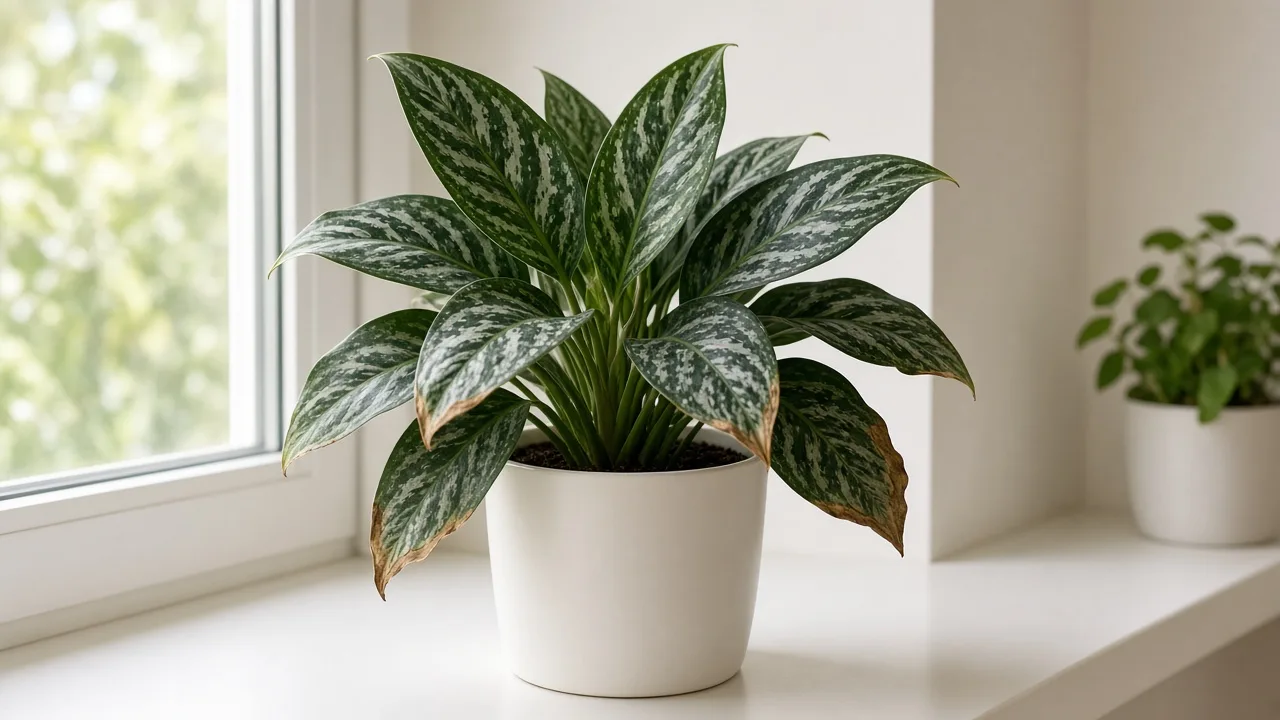
Brown Leaves on Aglaonema Maria: Causes, Checks & Fixes
This guide covers brown leaves on Aglaonema Maria. See also the general Brown Leaves guide, watering, and light pages for this plant.
Brown Leaves on Aglaonema Maria: Causes, Checks & Fixes
Quick answer
Brown leaves on Aglaonema ‘Maria’ mean dead tissue on dark green and silver marbled blades—not a reversible color fade. For how necrosis spreads in general, see our brown leaves guide. On Maria, the top-half dry-down test and crispy-vs-soft texture separate thirst from root stress faster than any fertilizer fix.
First step: stick a finger or skewer into the mix at half-pot depth, lift the pot to feel weight, and note whether brown tissue feels crispy-dry or soft and limp.
When to use this page vs other Maria guides
| Pattern | Read next |
|---|---|
| Tips only, margins crisp | Brown tips |
| Wet heavy pot, yellow lowers | Overwatering |
| Dry light pot, cupped leaves | Underwatering |
| Tan patches on window side | Direct sun scorch—move back from glass |
| Webbing on new growth | Spider mites |
What brown leaves look like on Aglaonema Maria
Maria carries compact dark green and silver marbled foliage on short upright petioles. Brown shows as permanent necrosis—dead cells that will not green up again.
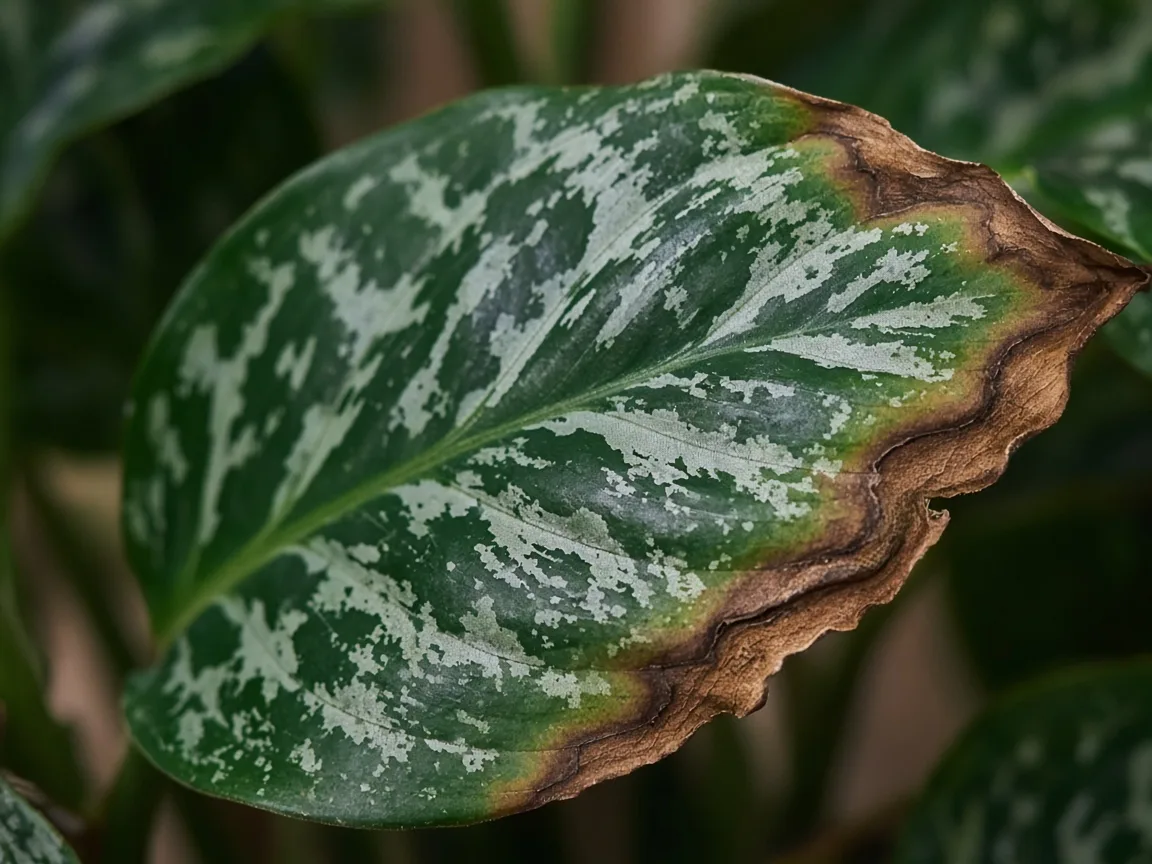
Crispy brown necrosis on Maria—compare texture with firm green tissue on the same petiole.
Thirst brown (underwatering):
- Crispy brown margins or full-leaf necrosis on a light, dry pot
- Leaves feel thin; silver marbling looks dull
- Often hits outer leaves first while the crown stays firm
- Common in bright offices where Maria dries faster than a weekly watering habit
Root-stress brown (overwatering):
- Soft brown lower leaves on a heavy, wet pot in a dim corner
- Yellowing may precede brown on oldest blades
- Soil smells sour or stays cool and damp for weeks
- Chinese evergreens in wet low light lose root function before upper leaves show obvious wilt
Fluoride and water-quality brown:
- Brown starts at tips and spreads inward along margins
- Hits silver zones and leaf edges before the center
- Municipal tap with fluoride or chlorine is a common trigger—see brown tips
Sun scorch brown:
- Tan-to-brown patches on the window-facing side of broad marbled blades
- Maria tolerates low to medium indirect light but direct afternoon sun burns shade-adapted tissue
Pest-related brown:
- Fine stippling with bronzed patches on new crown flush—often spider mites in dry heated air
- Sticky honeydew with distorted tips points to aphids, not drought
Check newest leaves first. Brown on fresh crown growth is urgent; a single fully brown lower leaf may be normal senescence if the crown is clean.
Why Aglaonema Maria gets brown leaves
Maria is drought-tolerant but not drought-proof in bright rooms. Its thick petioles and well-drained potting mix dry from the top down. Owners who water on a calendar instead of checking the top half of the pot let Maria go crispy in sunny placements—or water a still-wet half-pot in dark hallways.
Low light slows uptake without slowing evaporation from wet peat. Maria survives dim offices, but a chronically damp mix in poor light causes root oxygen loss. Lower leaves brown softly while the plant looks otherwise upright—a pattern that mimics thirst but worsens with more water.
Silver marbling does not protect against fluoride. Like other Aglaonemas, Maria is sensitive to fluoride and chlorine in tap water. Tips brown first; if watering continues without change, necrosis spreads inward and can look like a mysterious “brown leaves” problem rather than water quality.
Maria’s broad blades hold heat near glass. A plant pushed against a south window can scorch even when the room feels comfortable. Scorch brown is localized to the exposed side and does not match uniform lower-leaf senescence.
Maria top-half dry-down and texture test
This three-step check is specific to Maria’s watering rhythm:
- Probe half-pot depth — not just the surface. In a 6-inch pot, push a skewer to 3 inches. Dry at depth + light pot + crispy brown = thirst.
- Feel brown tissue — crispy and papery means desiccation or scorch; soft and mushy with wet mix means root stress.
- Read the crown — firm new silver-green leaves with one brown lower blade is often age; brown spreading up the plant on wet mix is not.
Maria in low light may need water only every two to three weeks. In a bright east window, the same pot may need a drink every ten days. The half-pot rule stays constant; the calendar does not.
Lookalike symptoms
| What you see | Often confused with | How to tell them apart |
|---|---|---|
| Brown tips only | Full brown leaves | Margins crisp, center green—water quality or dry air |
| Yellow then brown lowers | Normal aging | Wet heavy pot + sour smell = roots, not age |
| Tan window-side patches | Disease | One-sided, dry texture, no water-soaked spots |
| Stippled bronzing on new leaves | Sunburn | Webbing or moving specks = mites |
| Single brown lowest leaf | Overwatering | Crown clean, mix appropriate, no spread |
How to confirm the cause
- Pattern — Which leaves? Lowers only, whole plant, or window side?
- Soil moisture — Half-pot dry or wet? Match to watering guide.
- Pot weight — Light and dry vs heavy and wet splits thirst from root failure.
- Light level — Compare placement to light guide.
- Pests — Magnify newest leaf undersides and crown flush.
- Progress — Photo the same leaves in three days; spreading brown on wet mix needs faster action.
First fix for Aglaonema Maria
Match one correction to soil moisture: if the top half is dry and brown tissue is crispy, water thoroughly and drain the saucer within 30 minutes. If the mix is wet and brown tissue is soft, stop watering until the top half dries.
Secondary steps, in order:
- Move scorched plants back from direct glass into low to medium indirect light.
- Switch to filtered or rested tap water if tips were browning first.
- Rinse and inspect for mites if stippling appears on new growth—see spider mites.
- Remove fully brown leaves with clean shears once the cause is fixed.
Do not fertilize a brown, stressed Maria. Do not repot on day one unless roots are mushy—see root rot if the crown softens.
Mistakes to avoid
- Watering on a calendar without probing half-pot depth
- Adding more water to a curled, wet, heavy pot—wet-wilt browns from root failure, not thirst
- Misting foliage to “help” brown leaves—wet marbled blades invite leaf spot
- Fertilizing before fixing moisture or water quality
- Removing every partially green leaf—keep blades that still photosynthesize
Recovery timeline
Correct moisture or water quality shows clean new marbled leaves in two to four weeks. Severely necrotic blades stay brown permanently—judge success on new crown growth, not old tissue.
Root-stressed plants in dim wet corners need longer: four to eight weeks after dry-down stabilizes before consistent new leaves return.
Prevention
- Water when the top half of mix dries—see watering guide.
- Use well-draining mix per the soil guide.
- Keep low to medium indirect light so the pot dries predictably between drinks.
- Use filtered or rested water if tips brown on municipal supply.
- Empty saucers within 30 minutes; never let Maria sit in standing water.
- Inspect new growth weekly in winter when heating dries the air.
Related Aglaonema Maria guides
Conclusion
Brown Maria leaves are moisture and water-quality signals on compact marbled foliage—half-pot dry-down, crispy-vs-soft texture, and filtered water beat guessing fertilizer.