Brown Leaves on Aglaonema Red Valentine: Water & Light
Quick answer
Brown leaves on Aglaonema Red Valentine are necrotic tissue on large pink-red and green variegated blades—often fluoride or chlorine tip burn spreading inward, overwatering in dim light, or sun scorch on pale pink zones. First step: note whether brown starts at tips after tap watering, or as soft brown lower leaves on a heavy wet pot.
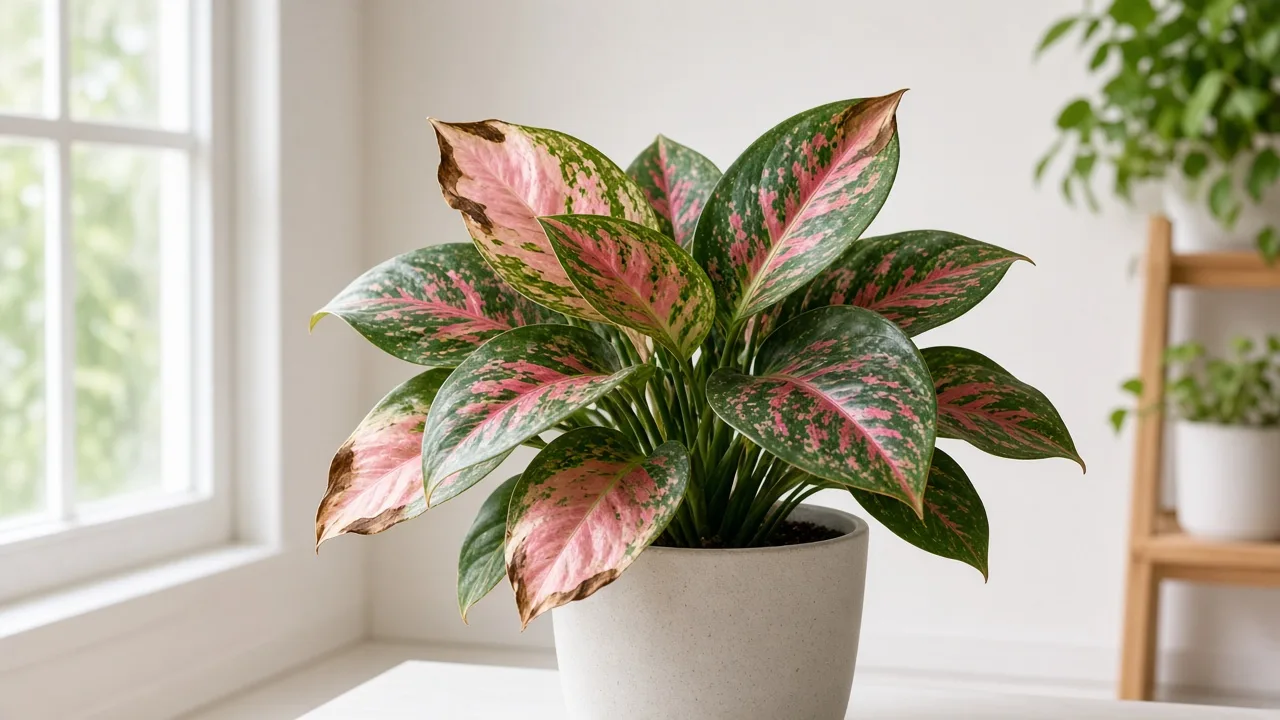
Brown Leaves on Aglaonema Red Valentine: Causes, Checks & Fixes
This guide covers brown leaves on Aglaonema Red Valentine. See also the general Brown Leaves guide, watering, and light pages for this plant.
Brown Leaves on Aglaonema Red Valentine: Causes, Checks & Fixes
Quick answer
Brown leaves on Aglaonema commutatum ‘Red Valentine’ mean dead tissue on large pink-red and green variegated foliage. See our brown leaves guide. On this cultivar, fluoride tip burn and sun scorch on pale pink-red zones are more visible than on green office types like ‘Maria’ or ‘Silver Bay’.
First step: check if brown begins at tips after tap watering, or as soft brown lower leaves on wet mix in a dim room.
Red Valentine carries broad glossy leaves with larger pink-red anthocyanin sections than Lady Valentine. Those pale sectors have less chlorophyll than the green tissue, so they show water chemistry and light stress first. A single brown lower leaf is not always an emergency—but brown on the newest crown flush, or soft brown lowers on a pot that stays heavy for weeks, needs a cause before you change five variables at once.
When to use this page vs other Red Valentine guides
| Pattern | Read next |
|---|---|
| Tips and margins only | Brown tips |
| Wet heavy pot | Overwatering |
| Dry light pot, crispy edges | Underwatering |
| Tan on window-facing pink | Direct sun scorch—filter light; see light guide |
| Pink reverting to green | Not enough light |
| Yellow lowers with wet mix | Yellow leaves |
What brown leaves look like on Red Valentine
Brown on Red Valentine is not one disease—it is necrosis (dead tissue) that can start in different zones depending on the cause:
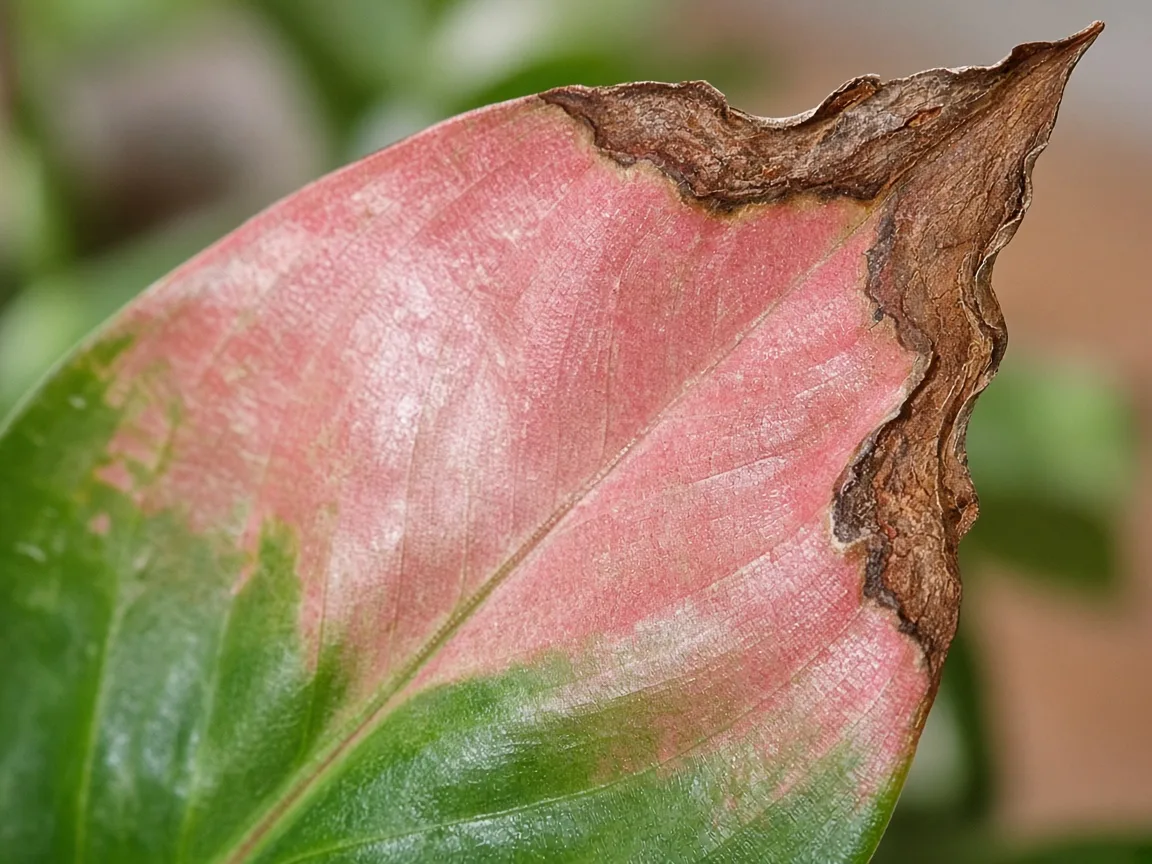
Brown necrosis on pink-red Red Valentine tissue—tip burn from tap water differs from soft brown lowers on wet mix.
- Crispy brown tips on pink-red zones after tap water — Fluoride or chlorine injury. Margins and tips on the palest pink-red tissue brown before the whole blade dies. Often spreads inward over several waterings.
- Soft brown lower leaves, wet mix in low light — Root stress from chronic saturation. Lower petioles soften; leaves feel limp rather than papery. Pot stays heavy days after watering.
- Tan papery patches on pink facing glass — Direct sun scorch on low-chlorophyll tissue. Damage appears on the window side of broad leaves, not randomly across the plant.
- Uniform brown on one oldest lower leaf — Normal senescence if new pink-red flush at the crown is clean and firm.
- Speckled brown with fine webbing — Spider mites in dry heated air; inspect undersides of pink streaks.
Check newest leaves at the crown. Brown on fresh pink-red growth is urgent—something in the current environment is still wrong. Cosmetic brown on one old lower leaf while new leaves open clean is a different story.
Why Red Valentine gets brown leaves
For how chronic wet mix damages roots in general, see our overwatering guide. On Red Valentine, the pattern usually shows up as soft brown lower leaves in a dim room where the pot never dries between calendar waterings.
Chinese evergreens are shade-tolerant, but Red Valentine is not a dark-hallway plant. Variegated aglaonema cultivars need brighter indirect light than green types to hold pink-red anthocyanin color. In weak light the plant uses less water, the mix stays wet longer, and roots lose oxygen—the same wet conditions that brown lower leaves before you notice yellowing.
Three causes dominate on this cultivar:
Fluoride and chlorine in tap water. Some houseplants are sensitive to fluoride or chlorine in municipal water. Aglaonemas are among them. Tip and margin burn on pink-red tissue is often the first sign; left unchecked, necrosis spreads inward until most of the blade is brown.
Overwatering in dim placement. Root rot occurs if Aglaonema is overwatered, often after root oxygen loss from wet peat mix. Red Valentine in a decorative cachepot, on a shelf away from windows, or in winter with unchanged watering frequency is a common setup. The surface may feel dry while deeper mix stays saturated—brown soft lowers follow.
Direct sun on pale pink-red zones. Red Valentine needs bright indirect light. Direct sun scorches shade-adapted aglaonema leaves—afternoon sun through south or west glass cooks anthocyanin-rich tissue that lacks the chlorophyll buffer green leaves have. Scorched patches look tan-brown and papery, distinct from fluoride tip burn.
Less common but worth ruling out: cold draft on a recently watered leaf (brown edges overnight), salt crust on the pot rim from hard water or over-fertilizing, and pest stippling that progresses to brown necrosis.
Fluoride on large pink-red variegation
This section would be wrong pasted onto green ‘Cutlass’ or ‘Maria’—Red Valentine’s broad pink-red sectors behave differently.
- Pink-red tissue burns first. Anthocyanin variegation has less functional chlorophyll. Fluoride and chlorine concentrate at leaf margins; on Red Valentine those margins are often cherry-pink, so damage is visible before green cultivars show the same stress.
- Switch water for four weeks before repotting. Use filtered, rain, or tap water rested 24 hours at room temperature—Clemson HGIC recommends resting water for fluoride-sensitive houseplants. Flush the pot once if white crust rings the soil surface.
- Separate tips from whole-leaf rot. If only tips browned, see brown tips before assuming root failure. Tip burn alone does not require stopping all water.
Sun scorch on pale pink-red tissue
Red Valentine owners often move a fading plant closer to glass to “bring back pink.” That can fix color—or scorch tissue if the plant crosses into direct sun.
Scorch clues:
- Damage only on leaves facing the window
- Tan-brown patches in the middle of pink-red zones, not starting at tips
- Firm papery texture, not soft limp tissue
- Recent move to a brighter sill or removal of a sheer curtain
Fix: Pull back behind a sheer curtain, or set 1–2 m inside a south or west window. East exposure is usually safe. Match placement to the Red Valentine light guide—bright indirect, not hot beams on pink-red blades.
Dim-room wet-pot trap
Pink-red aglaonemas need more light than green office cultivars, but many Red Valentine plants live in dim corners because owners fear sun scorch. That creates a moisture trap:
- Low light slows transpiration and root uptake
- Top surface dries on schedule while deeper mix stays wet
- Owner waters again on calendar because the surface “felt dry”
- Lower leaves brown softly; pink-red on new growth may look washed out
Red Valentine-specific dry-down:
- Water only when the top half of the mix dries—not surface dust alone. Use a skewer at mid-depth per Chinese evergreen culture and the watering guide.
- In dim rooms, that dry zone may take two to three weeks. Do not calendar-water weekly.
- If the pot is heavy and a skewer pulls damp material at mid-depth, pause water and improve light before the next drink.
How to confirm the cause
Work through these checks in order before stacking treatments:
- Pattern — Tips only, lowers only, window side only, or whole plant? Match to the table above.
- Texture — Crispy papery (water chemistry, sun, drought) vs soft limp (wet roots).
- Soil moisture — Probe mid-depth with a skewer. Match findings to the watering guide.
- Water source — Did browning start after repotting or switching to straight tap? White rim crust?
- Light — Is any pink-red tissue in direct sunbeams? Is the plant in deep shade with a heavy pot?
- New growth — Are emerging leaves firm with strong pink-red, or already browning at the tip?
- Pests — Magnify pink-streaked undersides for mites; check midribs for scale bumps.
Photo the same leaf in three days. Spreading necrosis on new pink-red flush needs faster action than one aging lower leaf.
First fix for Aglaonema Red Valentine
If tips browned after tap water, switch to filtered or rested water immediately—and do not change anything else for one week.
That single correction isolates fluoride injury, the most common whole-leaf brown pattern on pink-red aglaonemas. If tips were the only symptom, new leaves should open with clean pink-red margins within two to four weeks.
If the pot is wet and heavy with soft brown lower leaves, stop watering until the top half of the mix dries and the pot lightens. Follow overwatering protocol if stems soften or smell develops.
If tan patches face the glass, move behind a sheer curtain the same day—do not prune first.
Do not fertilize, repot, and prune on the same day. Red Valentine is a slow grower; stacked stress makes brown leaves worse before you learn which cause was real.
Mistakes to avoid
- Misting foliage to “help humidity” when leaves are already spotting or browning—wet pink-red tissue in dim corners worsens problems; water soil only
- Assuming brown means fertilizer deficiency and feeding a stressed plant
- Removing every partially green leaf immediately—keep blades that still photosynthesize until new pink-red growth is clean
- Repotting into a larger pot while roots are wet and failing
- Blaming low light alone when soil stays saturated—dim light plus overwatering browns lowers; see not enough light only after moisture is stable
Recovery timeline
Filtered water: Cleaner new pink-red leaves in two to four weeks if fluoride was the cause. Existing brown tissue does not green up—only new blades recover.
Dry-down after overwatering: Lower-leaf browning stops spreading in one to two weeks once mix dries appropriately. New crown leaves may take three to five weeks to look fully normal. Severe root damage takes longer—judge by firm new petioles, not old brown blades.
Sun scorch: Remove scorched sections only after light is corrected. New leaves should open without tan patches within one to two growth cycles.
Signs you are winning: firm new pink-red flush, browning stops at existing leaves, pot weight drops predictably between waterings.
Signs to escalate: crown softness, sour soil smell, brown spreading to every new leaf within days, or wilting with wet mix—see root rot.
How to prevent it next time
Match everyday care to how Red Valentine actually grows:
- Water: Top-half dry-down; empty saucers within 30 minutes. Full routine in the watering guide.
- Water quality: Filtered or rested tap if tips ever browned. Chinese evergreens need well-drained soil and even moisture—not constant saturation.
- Light: Bright indirect (east window or filtered south/west). Enough light to hold pink-red without direct scorch.
- Soil: Well-draining mix with perlite per the soil guide.
- Season: Reduce watering frequency in winter when growth slows and light is low.
- Inspection: Weekly check of newest pink-red leaves and leaf undersides—indoor plant pests spread in dry heated air.
Related Aglaonema Red Valentine guides
- Overview — placement, pink-red color, and first-month quarantine
- Watering — top-half skewer checks by light level
- Light — holding pink-red without scorch
- Brown tips — when necrosis has not spread past margins
- Overwatering — wet heavy pot with soft lowers
- Problems hub
Conclusion
Brown Red Valentine leaves are water chemistry, moisture, and light signals on pink-red tissue—not a mystery disease. Filtered water fixes tip burn; dry-down and brighter placement fix soft brown lowers in dim rooms; sheer curtains fix window-side scorch. Judge recovery by the next pink-red flush, not by old necrotic blades turning green.