Brown Leaves on Aglaonema Silver Bay: Water & Light Checks
Quick answer
Brown leaves on Aglaonema Silver Bay usually mean opposite moisture problems—crispy brown on dry soil is thirst; soft brown on wet mix is root stress. First step: probe whether the top half of the mix is dry or wet, then note whether brown tissue is crispy or mushy.

Brown Leaves on Aglaonema Silver Bay: Causes, Checks & Fixes
This guide covers brown leaves on Aglaonema Silver Bay. See also the general Brown Leaves guide, watering, and light pages for this plant.
Brown Leaves on Aglaonema Silver Bay: Causes, Checks & Fixes
Quick answer
Brown leaves on your Silver Bay Chinese evergreen (Aglaonema ‘Silver Bay’) are rarely one mystery cause. On this popular cultivar with broad silver-green blades and dark green margins, brown necrosis almost always comes down to moisture mismatch, fluoride in tap water, or direct sun scorch. See our brown leaves guide for general causes—on Silver Bay, crispy vs soft texture and soil moisture tell you which fix to apply.
First step: touch the brown tissue and probe soil. Crispy brown on a light dry pot means thirst. Soft brown on a heavy wet pot means root stress.
When to use this page vs other Silver Bay guides
| What you see | Read next |
|---|---|
| Brown tips only | Brown tips |
| Wet soil, yellow lowers | Overwatering |
| Dry light pot | Underwatering |
| Tan window-side patches | Direct sun scorch—move back from glass |
| Dark spots with halo | Black spots |
What brown leaves look like on Silver Bay
Silver Bay carries broad silver-green lance leaves with dark green margins. Brown damage shows up differently on silver tissue than on solid-green houseplants.
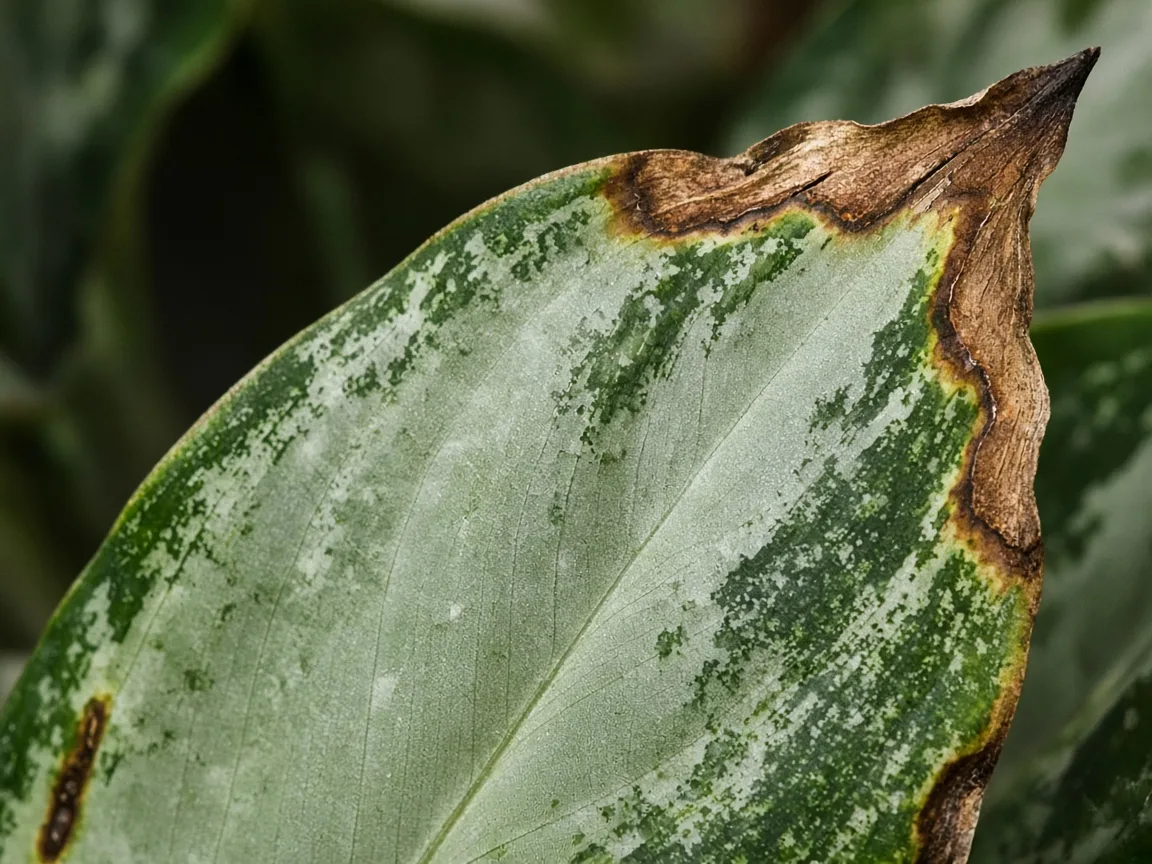
Crispy brown margin on a Silver Bay leaf—silver zones often show burn before dark green centers.
Underwatering and low humidity (crispy brown):
- Crispy brown margins on a light dry pot
- Top half of mix bone dry; leaves may curl slightly
- Common near HVAC vents in office settings
- Silver margins crisp before dark green center
Overwatering and root stress (soft brown):
- Soft brown lower leaves on chronically wet mix
- Root oxygen loss from wet peat in dim offices
- Yellowing may accompany brown; petioles limp
- See overwatering
Fluoride and salt burn:
- Brown from tips and silver margins inward on municipal tap water
- Crispy texture—often starts as brown tips first
- Silver tissue shows burn more visibly than dark green
Direct sun scorch:
- Tan to brown patches on window-facing side only
- Aglaonema scorches in direct sun—silver center burns first
Natural senescence:
- One or two oldest lower leaves brown fully at base—rest of plant healthy
Check newest crown leaves first. Brown on fresh unfurling tissue means active stress.
Why Silver Bay gets brown leaves
Chinese evergreens prefer evenly moist, well-drained soil. Silver Bay in office dim corners creates opposite moisture traps—owners add water when leaves look dry at the margins while soil stays saturated.
Crispy vs soft brown point opposite directions. Soil probe until top half of mix is dry or wet—mandatory before any fix.
Fluoride on silver margins. Like other Araceae, Silver Bay shows marginal burn from tap water fluoride—silver edges crisp inward.
Winter heating near desks. Dry forced air pulls moisture from broad silver blades faster than roots replace it.
How to confirm the cause
- Texture test. Crispy = dry or fluoride. Soft = wet roots.
- Pot weight and soil probe. Light dry = underwatering. Heavy wet = overwatering.
- Pattern. Window-side only = scorch. Tips inward = fluoride. Lowers on wet soil = root stress.
- Water source. Municipal tap without resting—fluoride likely.
- Spread speed. One old leaf slowly = senescence. Multiple softening in a week = urgent.
Silver margins vs whole-leaf brown
Three Silver Bay-specific details:
Crispy brown on dry silver zones is thirst or low humidity near vents—not always “underwatered” if only margins show burn.
Soft brown on wet mix in a dim office is root stress—do not add water.
Fluoride tips on silver tissue—filtered water if margins crisp inward repeatedly.
First fix for Silver Bay
If top half dry and crispy: soak thoroughly; empty saucer within 30 minutes. See underwatering.
If soil wet and soft brown lowers: stop water until top half dries. Improve medium to bright indirect light.
If tips browned first on tap water: filtered or rested water—see brown tips.
If window-side tan patches: move to bright indirect—never direct afternoon sun.
Step-by-step recovery
- Stabilize watering when top half of mix dries.
- Remove fully brown leaves once cause is fixed.
- Watch new growth three to four weeks for clean silver blades.
- Do not fertilize until new leaves firm for two weeks.
- Repot only if soil smells sour—see root rot.
Lookalike symptoms
| Pattern | Texture | Likely cause |
|---|---|---|
| Crispy margins, dry pot | Papery | Underwatering |
| Soft brown lowers, wet pot | Mushy | Overwatering |
| Tips inward, tap water | Crispy | Brown tips |
| Window-side tan | Dry scorch | Direct sun |
| Dark spots with halo | Soft spots | Black spots |
Mistakes to avoid
- Do not water on a calendar without checking top half dry-down.
- Do not soak a soft brown wet plant.
- Do not place in direct sun to “fix” low light.
- Do not ignore saucer water.
Recovery timeline
Brown tissue does not green again—judge by new leaves. Expect clean crown leaves within two to four weeks after corrected care. Severe root stress may need six to eight weeks.
How to prevent brown leaves next time
- Water when top half of mix dries
- Use filtered water if silver tips brown repeatedly
- Medium to bright indirect light—away from hot windows
- Empty saucers within 30 minutes
How to prevent brown leaves next time
Silver Bay is forgiving of missed waterings but punishes chronic wet feet in dim offices. Water only when the top half of the mix dries, use a pot with drainage holes, and empty saucers within 30 minutes. If tips brown on municipal tap water, switch to filtered or overnight-rested water before assuming a disease. Place the pot in medium to bright indirect light so the silver zones photosynthesize without scorching—direct afternoon sun through glass will tan the window-facing blade within days. Rotate the pot monthly so outer arching leaves do not lean against furniture and tear, which can dry into brown patches mistaken for thirst.
When to worry
- Multiple crown leaves brown and soften within a week
- Mushy stem base or sour smell—root rot
- Wilting with wet soil
Related Silver Bay guides
Conclusion
Brown Silver Bay leaves are moisture and water-quality problems first. Touch the tissue, probe the soil, fix watering rhythm, and let clean new leaves confirm recovery.