Pale Leaves on Alocasia Amazonica: Causes, Checks & Fixes
Quick answer
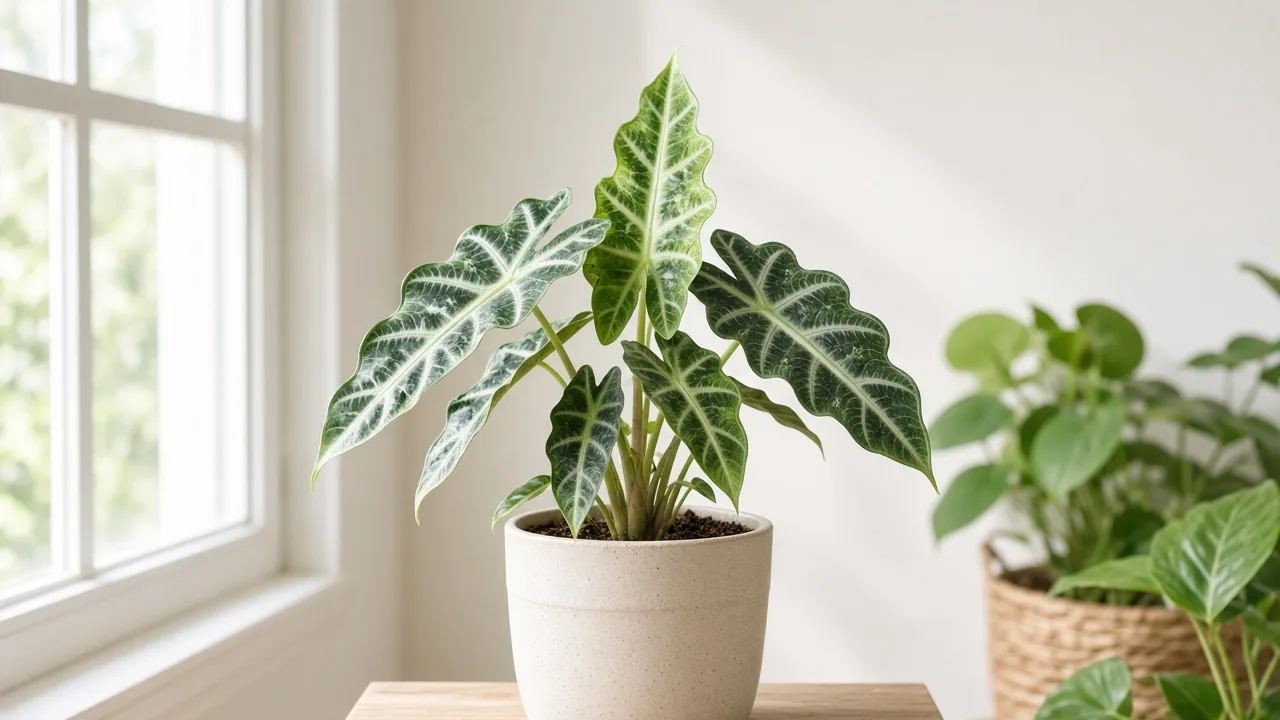
Pale leaves on Alocasia Amazonica look washed-out, lime-green, or dull across several blades—not just one fading lower leaf. The white vein contrast fades and new arrows open smaller on long petioles. First step: move the pot to bright indirect light and check whether soil dries in 7–10 days; dim rooms plus slow dry-down are the most common indoor cause before nutrient deficiency.
Pale Leaves on Alocasia Amazonica: Causes, Checks & Fixes
This guide covers pale leaves on Alocasia Amazonica. See also the general Pale Leaves guide, watering, and light pages for this plant.
Pale Leaves on Alocasia Amazonica: Causes, Checks & Fixes
Quick answer
Pale leaves on Alocasia Amazonica (African Mask plant) look washed-out, lime-green, or dull olive across several upright arrow-shaped blades—not the crisp dark green and bold white vein contrast healthy plants show in good light. For general chlorosis mechanics, see our pale leaves guide. On Alocasia Amazonica, pale color usually means photosynthesis is falling behind on the whole rosette while the corm still pushes new arrows—often from dim placement, the low-light watering trap, or less commonly iron or nitrogen stress on specific leaf tiers.
First step: move the pot to your brightest safe indirect-light spot and note how fast the top 2–3 cm of chunky aroid mix dries. If soil stays damp for two weeks in a north room or interior shelf, fix light before you add water or fertilizer. If only the newest crown arrow shows green-vein yellowing, start with iron deficiency instead.
When to use this page vs other Alocasia Amazonica guides
| Pattern | Read next |
|---|---|
| Washed-out green across many blades, weak vein contrast | Pale leaves (this page) |
| Long petioles, lean toward window, smallest new leaves | Not enough light |
| Soft yellow lower leaves on wet heavy soil | Yellow leaves or overwatering |
| Green-vein yellowing on newest crown unfurl only | Iron deficiency |
| Uniform pale on oldest lower leaves first | Nitrogen deficiency |
| Fine stippling with webbing on undersides | Spider mites |
| Bleached patches on sun-facing blades | Too much direct sun—see light guide |
What pale leaves look like on Alocasia Amazonica
Healthy Alocasia Amazonica carries dark glossy arrow blades with dramatic white or silver veins on stiff upright petioles from a single corm crown. Pale stress breaks that contrast before full yellowing spreads.
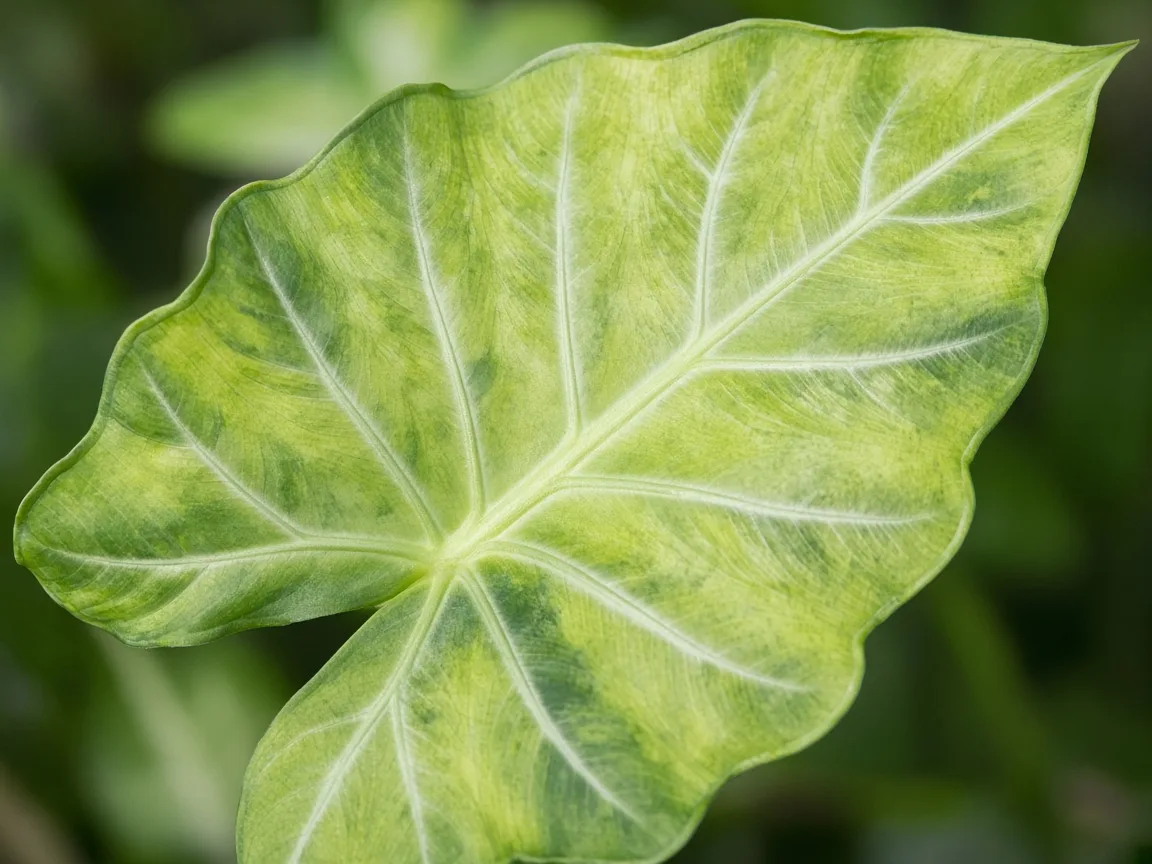
Pale wash on the green tissue between white vein bands—healthy mature blades below may still show dark contrast while newer arrows look lime-green and thin.
Typical pale-leaf signs:
- Uniform washed-out green or lime color across several blades at once—not isolated spots
- Weaker white or silver vein contrast—the mask pattern looks faded, not crisp
- Smaller new arrows at the crown compared with mature leaves lower on the stem
- Longer, thinner petioles reaching toward the brightest direction
- Dull, thin leaf tissue that feels less rigid than older hardened blades
- Soil that dries slowly at the surface because transpiration dropped in dim light
Not pale leaves:
- One soft yellow lowest leaf while crown stays dark — normal aging or yellow leaves senescence
- Yellow tissue between dark green veins on the newest unfurl only — iron deficiency
- Oldest lower blades fading uniformly while crown pushes green arrows — nitrogen deficiency
- Scattered yellow speckles with webbing — spider mites
- Bleached white patches on leaves facing hot glass — direct sun burn, not dim-room chlorosis
- Limp pale lowers on wet soil with soft stem base — root rot overlap
Reading pale wash on dark arrow blades with white veins
Alocasia Amazonica’s white vein bands are normal pigmentation on mature leaves—not a separate symptom stripe. Pale stress shows on the green portions of the blade: tissue between veins turns lime or olive while veins may still look bright.
That split-zone reading matters because white veins can look vivid even when chlorophyll is thin. Worry when every new crown arrow opens paler than the blade below it for two or three unfurls in a row—not when one older leaf lightens during winter dormancy.
Compare whole-rosette washout (many blades dull at once) against crown-only chlorosis (green veins on a yellowing new arrow). Whole-rosette fade with long petioles points to light or wet-soil metabolism slowdown. Crown-only veining points to micronutrient uptake—see iron deficiency before a general fertilizer dump.
Why Alocasia Amazonica gets pale leaves
Alocasia Amazonica is a fast-growing tropical aroid evolved for filtered understory light—not deep interior shade. Plants in the genus Alocasia are best grown in part shade, filtered sun, or bright indirect light. When photons fall short, the plant still pushes new arrows but opens them with less chlorophyll per leaf.
Alocasia Amazonica-specific causes:
- Insufficient light (most common indoors) — Alocasias grow best in bright but indirect light; in lower light, growth is much slower. Pale wash, small new arrows, and stretched petioles follow within weeks in north rooms or on interior tables more than 1–2 metres from glass.
- The low-light watering trap — Dim placement slows transpiration, so chunky mix stays damp longer. Owners who keep a summer watering calendar add moisture the plant cannot use. Pale limp foliage on wet soil mimics deficiency when roots lack oxygen—see overwatering.
- Too much direct sun — If grown in direct sun, leaf burn and pale foliage may result. Bleached or whitish patches on sun-facing blades differ from uniform dim-room washout.
- Iron or nitrogen stress — Magnesium or iron deficiencies are common in Alocasias and show as interveinal chlorosis on new growth (iron) or uniform fade on oldest lowers (nitrogen)—not whole-rosette lime wash unless deficiency is advanced.
- Low humidity in dry heating season — Low humidity can cause browning on leaf edges and dull, thin growth that reads pale before margins crisp. Pair with low humidity checks if edges brown simultaneously.
- Salt buildup or incomplete feed — White crust on the pot rim after hard tap water or heavy feeding injures roots and limits chlorophyll production in new crown tissue. Flush and resume diluted fertilizer only after light and moisture are stable.
- Winter dormancy fade — Some leaf loss and duller color in cool months is seasonal when the corm stays firm—do not chase pale dormancy leaves with chelated iron.
Corm metabolism and the dim-room dry-down test
Alocasia Amazonica stores reserves in a firm underground corm. That buffer lets the plant keep opening pale arrows in marginal light long after a faster-draining succulent would stall—so pale foliage can persist for months before owners notice the pattern.
Dry-down speed is your best free diagnostic. In active growth with adequate light, the top 2–3 cm of chunky aroid mix usually dries within about a week. If the same pot stays damp for two weeks after one watering in a dim corner, metabolism—not calendar thirst—is the limiter.
Work through this sequence:
- Window distance — Indoor light falls off quickly as you move away from glass. Stand where the pot sits; if you would not read a book comfortably there without a lamp, leaf-level light is likely too low.
- Last two crown unfurls — Are new arrows clearly smaller and paler than mature blades three nodes down?
- Petiole length — Are stems noticeably longer than when you bought the plant?
- Pot weight — Heavy and wet two weeks after watering supports the low-light trap, not underwatering.
- Corm squeeze — Firm potato-like tissue at the soil line means salvage is likely; spongy base on wet mix means unpot before brightening alone.
14-day placement test: Move to brighter indirect light without changing water volume. If the next emerging arrow is darker and stiffer, light was the primary cause. No improvement with firm corm and slow dry-down may mean depleted mix—repot or feed only after the light branch is ruled out.
How to confirm the cause
| Observation | Likely cause | Next step |
|---|---|---|
| Many blades washed out, long petioles, slow dry-down | Low light | Light guide + brighter placement |
| Pale limp lowers, wet heavy soil, sour smell | Root stress | Overwatering—stop watering, check corm |
| Green veins on yellowing newest crown leaf | Iron chlorosis | Iron deficiency after root check |
| Oldest lowers pale uniformly, crown green | Nitrogen loss | Nitrogen deficiency in bright light |
| Stippled blades, fine webbing | Spider mites | Spider mites before adjusting light |
| Bleached patches on sun side only | Direct sun | Filter or move back from glass |
| One bottom leaf fading, firm corm, winter | Senescence or dormancy | Normal—see watering winter rhythm |
Nutrient deficiencies can cause chlorosis where leaf tissue yellows while veins stay green—but on Alocasia Amazonica, match the leaf tier (whole rosette vs oldest vs newest) before treating pale wash as a feed problem.
First fix for Alocasia Amazonica
Move the pot to your brightest safe indirect-light location before you change water, fertilizer, or pot size.
Practical indoor targets:
- Within 0.5–1 metre of an east-facing window
- South- or west-facing glass with a sheer curtain or 0.5–1 metre back from direct sun beams
- A full-spectrum grow light 30–45 cm above the crown for 12–14 hours daily in dark rooms
Do not fertilize a pale plant in a dim wet pot—that stacks salt on roots that are already oxygen-limited. Do not repot on day one unless mix smells sour or the corm is soft.
After the move, water only when the top 2–3 cm of mix is dry—matching the watering guide rhythm for your new light level. In many homes that becomes less frequent than before because transpiration rises in brighter placement.
Step-by-step recovery
- Relocate to brighter indirect light (or add grow light) and leave the plant there at least 14 days.
- Probe moisture at 2–3 cm depth before every drink—skip irrigation while mix is still damp from the prior week.
- Inspect leaf undersides and petiole bases for mites; treat only if you confirm pests.
- Rotate the pot a quarter turn weekly so new arrows do not lean one-sided toward the glass.
- Raise humidity if edges crisp simultaneously—pebble tray or humidifier per overview targets (60–80%).
- Feed diluted complete fertilizer with micronutrients at half strength only after two new arrows open noticeably greener—see fertilizer guide.
- Flush salts if white crust rings the pot—water heavily until runoff drains freely, then resume normal rhythm.
If crown arrows stay pale with green-vein pattern after light correction and firm roots, step to the iron deficiency workflow rather than repeating nitrogen-heavy feeds.
Recovery timeline
Judge success by new crown growth, not old blade color.
- 1–2 weeks after brighter placement: next unfurl should look slightly darker; petiole stretch should slow.
- 3–6 weeks: two successive arrows with stronger white vein contrast and normal size mean the primary cause is corrected.
- Older pale blades rarely re-darken fully—remove them once two healthy new leaves harden if they detract from the display.
- Winter dormancy: pale fade with one leaf drop at a time and firm corm is seasonal—resume aggressive recovery steps in spring when new growth restarts.
Escalate if pale limp leaves multiply while soil stays wet, the corm softens, or stippling spreads despite good light—that is corm or pest territory, not patience.
Mistakes to avoid
- Watering on a calendar in a dim room while soil stays wet—deepens pale limp growth and invites rot.
- Fertilizing first on washed-out foliage without fixing light or root oxygen—burns stressed roots.
- Repotting, pruning, and spraying the same week—Alocasia Amazonica sheds leaves when stacked; change one variable at a time.
- Confusing white veins with health—bright vein bands can mask thin chlorophyll on green tissue between them.
- Treating one pale lower leaf as crisis—senescence is normal when the crown stays dark and the corm is firm.
- Maxing direct sun to fix pale color—direct sun can bleach and pale foliage on this species.
How to prevent pale leaves next time
Match care to how fast the pot dries in your room and season:
- Place for bright indirect light year-round; re-check each autumn when daylight shortens.
- Water when the top 2–3 cm of chunky aroid mix dries in active growth; cut back in dormancy per watering guide.
- Feed lightly with micronutrients during spring and summer only—not on a pale winter plant.
- Flush hard-water salts every few months if crust builds on the pot rim.
- Inspect weekly during heating season for mites that stipple dark leaves pale from a distance.
- Rotate the pot so the rosette does not lean permanently toward one window.
Related tool
Use the Plant Problem Diagnosis Tool to narrow causes for pale leaves on this plant before changing multiple variables at once.
Related Alocasia Amazonica guides
- Overview — placement, humidity, and seasonal dormancy rhythm
- Light — bright indirect targets and grow-light setup
- Not enough light — when stretch and small leaves dominate over washout color
- Yellow leaves — soft yellow on wet soil vs pale olive washout
- Iron deficiency — green-vein chlorosis on newest crown arrows only
- Overwatering — pale limp growth on saturated chunky mix