Whiteflies on Anthurium: Causes, Checks & Fixes
Quick answer
Whiteflies on Anthurium show as powdery white moth-like adults on leaf undersides and spathe peduncles that flutter into a cloud when disturbed, plus flat pale nymphs glued to glossy foliage. First step: isolate the plant away from your collection, then wash every leaf underside and flower stalk with lukewarm water before applying any spray.
Whiteflies on Anthurium: Causes, Checks & Fixes
This guide covers whiteflies on Anthurium. See also the general Whiteflies guide, watering, and light pages for this plant.
Whiteflies on Anthurium: Causes, Checks & Fixes
Quick answer
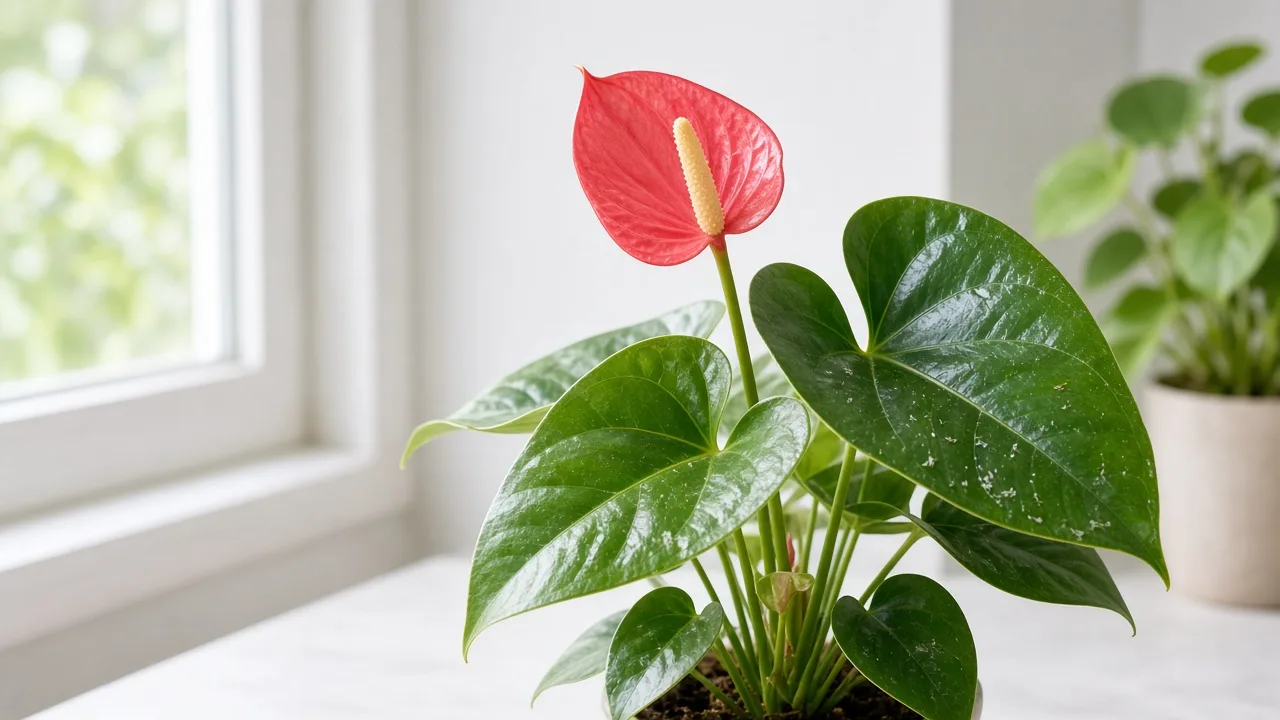
Whiteflies on Anthurium (Anthurium andraeanum, flamingo flower) appear as tiny white, moth-like insects on the undersides of heart-shaped leaves and along spathe peduncles. Disturb the foliage and they flutter away in a white cloud before resettling—one of the clearest pest signals on a compact rosette plant.
Immature nymphs look like flat disks glued to leaf undersides and do not fly. Both stages suck sap, excrete sticky honeydew, and can leave anthurium looking dull, yellowed, or coated in black sooty mold. Honeydew on an open red spathe dulls the waxy color within days—treat early if you are growing this plant for display blooms.
For general whitefly biology and control options, see our whiteflies guide. On Anthurium, adults and nymphs concentrate on crown shoots, petiole bases, and spathe stalks—places a quick top-side glance from across the room never reaches.
First step: isolate the plant away from your collection, then wash every leaf underside and flower stalk with lukewarm water before applying any spray.
When to use this page vs other Anthurium guides
| Pattern | Read next |
|---|---|
| White cloud when disturbed + flat nymphs on undersides + sticky honeydew | This page |
| Pear-shaped clusters on new tips, no flying cloud | Aphids |
| Cottony white wax in leaf axils, no flight | Mealybugs |
| Silvery scrape marks, slender fast insects | Thrips |
| Fine stippling and webbing in dry air | Spider mites |
| Tiny dark flies hovering at soil surface | Fungus gnats |
| Yellow leaves + soggy mix smell, no insects | Overwatering or root rot |
What whiteflies look like on Anthurium
Adult whiteflies are about 1/16 inch long, white, wedge-shaped, and moth-like with powdery wings. Nymphs are tiny, flat, pale green or whitish ovals stuck to leaf undersides—easy to miss until populations build on glossy foliage.
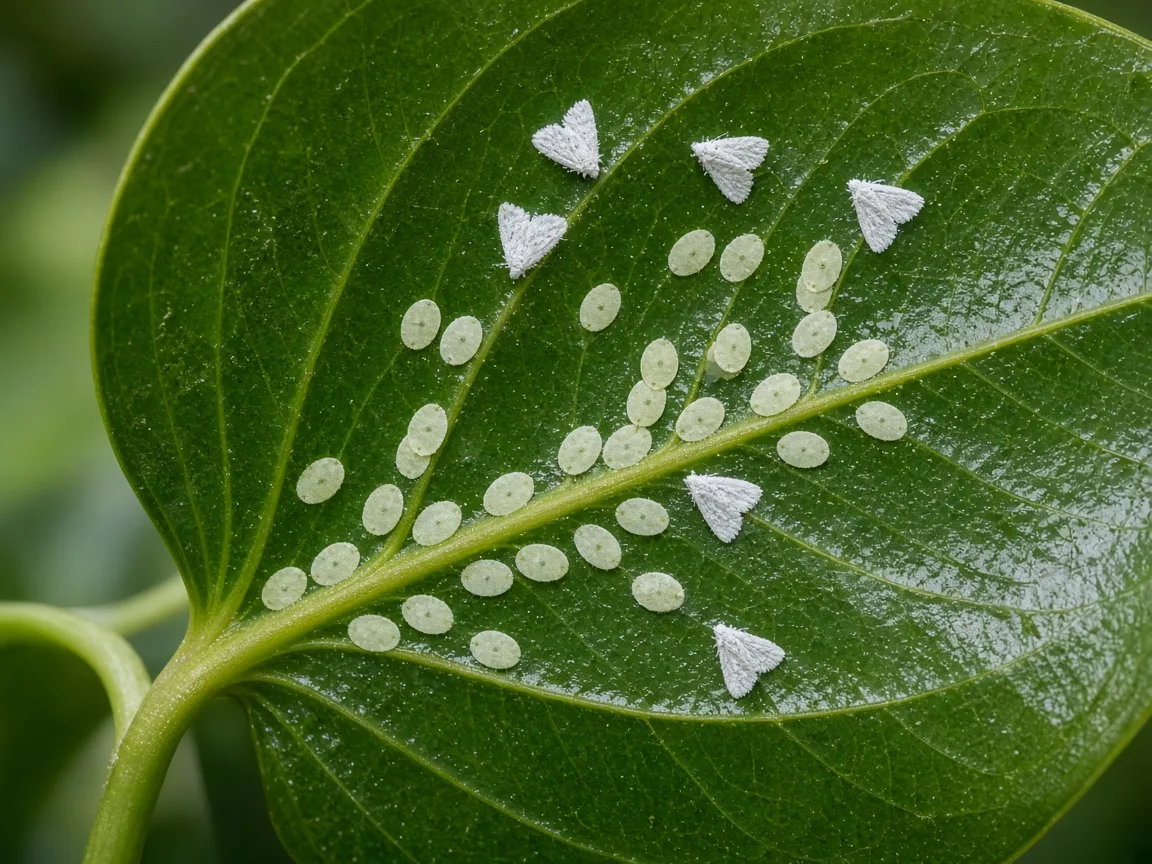
Flat pale nymph disks and powdery white adults on a heart-shaped leaf underside—compare with a clean neighbor leaf on the same petiole.
Typical signs on flamingo flower:
- A white cloud of insects rising when you water, mist, or move the pot
- Flat immobile specks on the backs of heart-shaped leaves, especially along midribs and near the crown
- Sticky honeydew on waxy leaf surfaces, spathe bracts, pot rims, or shelves below
- Black sooty mold growing on honeydew-coated foliage or open blooms
- Yellowing or stunted new leaves when feeding is heavy on crown shoots
- Premature spathe browning when honeydew coats display bracts
Unlike mealybugs, whiteflies lack cottony wax and actively fly when disturbed. Unlike fungus gnats, they stay on foliage, not at the soil surface. Unlike thrips, they do not leave silvery scrape marks—though heavy honeydew can look similar to other sap feeders until you trigger the flight response.
Why Anthurium gets whiteflies
Anthurium is not uniquely prone to whiteflies compared with hibiscus or poinsettia, but its growth habit makes certain spots easy targets. The plant pushes new leaves and flower spikes steadily when light, warmth, and humidity stay in range—exactly the conditions that keep tissue soft and sap-rich.
Introduction from outside is the usual starting point. Common entry routes include grocery-store bloom pots, open summer windows, shared greenhouse benches, and plants moved between rooms without inspection. Gardener’s Path notes anthuriums are not heavily pest-prone, which makes whiteflies easy to overlook until adults are flying—yet they can arrive on any new plant like other houseplant pests.
Warm indoor rooms without predators let whiteflies reproduce year-round because there is no cold season to break the cycle and few natural enemies indoors. UC IPM notes outbreaks often occur when biological control is disrupted.
Common entry routes on Anthurium:
- New bloom pots without quarantine — Eggs and nymphs hide on leaf undersides of newest growth before adults emerge and fly.
- Summer patio or porch time — Anthuriums moved outdoors can pick up whiteflies from garden beds; winged adults disperse when you bring plants back inside.
- Shared shelves and grouped collections — Compact rosettes placed close together let flying adults colonize neighboring pots within hours.
- Over-fertilized soft growth — Nitrogen-heavy feeding pushes tender new leaves that sap feeders prefer; hold feed until the infestation clears—see the Anthurium fertilizer guide for bloom-focused rates after recovery.
- Stressed plants in dim corners — Leggy, weak growth in low light recovers slowly from sustained sap loss.
Iowa State Extension notes whiteflies are extremely difficult to control on houseplants once established—prevention and early isolation matter more than with slower-spreading pests like scale.
Where whiteflies hide on flamingo flower
This is the Anthurium pattern generic whitefly pages miss. Before you spray, know where nymphs cling on a compact rosette with display blooms:
| Location | Why whiteflies settle here | What you might miss |
|---|---|---|
| Crown center | Newest leaves are softest and still partially folded | Nymph disks inside unfurling shoots |
| Petiole bases | Narrow gap where stem meets leaf holds moisture and shelter | Flat nymphs invisible from above |
| Spathe peduncles | Flower stalks are tender from soil line to bract | Honeydew on open red or pink spathes |
| Leaf undersides along midribs | Protected feeding sites on glossy foliage | Sticky residue mistaken for guttation |
| Lower older leaves | Heavy nymph colonies on shaded foliage | Yellowing blamed on overwatering alone |
Unlike trailing vines, Anthurium grows as an upright rosette. You cannot lift stems to inspect backs—you must tilt each leaf individually or rotate the pot under bright light. Gardener’s Path recommends inspecting thoroughly while dusting glossy leaves—a practical habit for bloom-focused growers.
Honeydew and sooty mold on waxy spathes
Anthurium is often grown for year-round display blooms, and whitefly damage shows up cosmetically before the crown fails. Sap feeding produces sticky honeydew on leaves and fruit that black sooty mold can colonize within weeks.
On foliage: Honeydew feels tacky across multiple leaves—not the dry dust that wipes off cleanly. Yellow halos may appear around feeding sites on dark green blades.
On spathes: Honeydew on an open waxy bract dulls the saturated red or pink color and can leave permanent marks even after pests are gone. Treat early when you see stickiness on a display bloom, not only when crown leaves yellow.
What sooty mold does not do: Mold grows on the sticky residue—it does not infect anthurium tissue directly. Once honeydew production stops, wipe affected spathes and leaves with plain water. Do not scrub open blooms aggressively; light dabbing preserves the waxy surface better than harsh rubbing.
How to confirm the cause
Work through these checks before reaching for spray:
- Disturbance test — Tap a leaf or gently shake the pot. Whiteflies fly up briefly; mealybugs and scale stay attached.
- Underside inspection — Tilt each heart-shaped leaf and examine every back with bright light. Nymphs look like flat disks; adults cluster near veins and on spathe stalks.
- Honeydew check — Rub a sticky leaf with a damp cloth. Honeydew wipes off cleanly; normal dust or low-humidity tip browning does not feel uniformly tacky across multiple leaves.
- Yellow sticky trap — Place a trap near the pot for 48 hours. Flying adults stick to yellow cards, confirming active whitefly presence even when counts look low.
- Lifecycle timing — Nymphs cause most of the damage and survive single applications. One treatment rarely clears a full generation—plan for repeated cycles.
- Neighbor scan — Check other houseplants on the same table, especially hibiscus, poinsettia, and fuchsia, which whiteflies favor—but anthurium on the same stand can harbor them too.
- Recent history — Note new purchases, outdoor summer stays, open windows, or propagation jars shared with other cuttings in the past month.
If you find flying white adults plus flat nymphs on anthurium undersides with sticky honeydew, whiteflies are confirmed. Yellow lower leaves alone, without insects or stickiness on new growth, points to watering or light stress—not whiteflies.
Symptom lookalike comparison
| Pest or issue | Key sign on Anthurium | Honeydew? | First differentiator |
|---|---|---|---|
| Whiteflies | White cloud when disturbed; flat nymph disks on undersides | Yes, sticky | Powdery moth-like adults fly and resettle |
| Aphids | Dense clusters on new tips and spathe bases | Yes | Pear-shaped insects crawl when prodded |
| Mealybugs | Cottony white wax in leaf axils and crown | Yes | Crush pink on swab; no flying cloud |
| Scale | Firm brown or tan bumps on petioles | Sometimes | Immobile; does not crawl or fly |
| Thrips | Silvery streaks on spathes and blades | Rare early | Slender fast insects; scrape marks |
| Spider mites | Fine stippling; webbing in dry rooms | No | Tap test on white paper; no cloud flight |
| Powdery mildew or dust | Surface coating without insects | No | Wipes dry; no flat nymph disks on undersides |
First fix for Anthurium
Move the plant away from every other plant, then wash the undersides of all leaves and flower stalks with lukewarm water.
Whiteflies spread by flying the moment you disturb them. Isolation stops adults from colonizing nearby anthuriums and other collections before you treat the source plant. Iowa State Extension recommends washing leaf undersides with a moist cloth or sponge as an early reduction step on manageable plants—and anthurium’s compact form fits a sink or shower if the pot is small enough.
Hold the pot at an angle so runoff does not saturate the soil for days. Work systematically from the soil line up each petiole and every spathe peduncle, because nymphs cling where you skip. Let leaves dry the same day in bright indirect light.
Do not return the plant to a shared shelf until you see no new adults on sticky traps for at least two weeks. Do not fertilize a pest-hit anthurium hoping to push replacement growth—tender new shoots attract whiteflies faster.
Wear gloves when handling heavily infested foliage. Anthurium sap can irritate skin, and the plant is toxic to cats and dogs if chewed.
Crown moisture management after rinse
Anthurium tolerates thorough rinsing but should not sit with water pooled where leaves emerge. After each shower or soap treatment, blot the crown center with a clean towel and keep the plant in airy indirect light until petiole bases feel dry to the touch. Saturated crown tissue on a repeatedly rinsed plant invites rot faster than the whiteflies alone would cause—cross-check watering rhythm before assuming the mix is failing.
Step-by-step recovery
After isolation and the initial wash:
- Set yellow sticky traps near the pot to catch flying adults and monitor whether numbers drop between treatments.
- Repeat washing every two to three days until live nymph counts fall on inspection. Anthurium’s waxy leaves generally tolerate repeated rinsing when they dry the same day.
- Apply insecticidal soap labeled for houseplants if adults or nymphs persist. Coat stems, leaf tops, undersides, and every spathe stalk thoroughly. Repeat every five to seven days through at least four cycles to catch eggs and newly hatched nymphs—soap kills on contact and has no residual effect indoors.
- Remove heavily infested leaves by hand when nymphs cover an entire leaf back and washing fails to clear them. Cut at the petiole base; the crown usually pushes new foliage from the center.
- Trim badly honeydew-coated spathe stalks at the peduncle base only when the bract is heavily stained and insects stay packed inside folded tissue after two soap cycles.
- Wash sooty mold off leaves and spathes with plain water once honeydew production stops. Mold does not infect anthurium tissue directly; it grows on the sticky residue whiteflies leave behind.
- Hold isolation until sticky traps stay clean and leaf undersides show no new flat nymphs for two full weeks.
For a small bloom pot encrusted on every leaf with adults reappearing daily after four soap cycles, discarding the plant may be safer than risking your collection—especially when several display anthuriums share one shelf.
Recovery timeline
Washing and trapping show results within a few days when infestations are caught early. A full soap treatment course typically takes two to four weeks with label-interval repeats because of the whitefly lifecycle. Yellowed or honeydew-coated older leaves and marked spathes may stay blemished; judge recovery by clean new crown leaves and fresh peduncles, not by perfect old foliage.
Anthurium in bright indirect light with consistent watering when the top inch dries often outpaces light whitefly damage once insects are controlled. Stalled tips that resume unfurling within two to three weeks signal success.
Mistakes to avoid
Do not treat once and assume whiteflies are gone—nymphs and eggs survive single applications, and adults fly to neighboring pots between sessions.
Do not use homemade dish soap on anthurium; commercial insecticidal soaps are formulated to reduce leaf burn and are labeled for houseplant use.
Do not skip leaf undersides when spraying—nymphs feed exclusively there, and adults rest on backs of leaves between flights.
Do not return an isolated anthurium to a shared shelf after one clean trap reading; hold quarantine through a full lifecycle (about two weeks) to confirm the infestation is broken.
Do not spray soap or oil on anthurium sitting in direct hot sun; treat in early morning or evening when leaves are cool.
Do not stack repotting, heavy pruning, and pesticide on the same day—handle pests first, then reassess crown and roots once feeding stops.
How to prevent whiteflies on Anthurium
- Quarantine new bloom pots and patio-season plants for at least two weeks before placing them near existing anthuriums.
- Inspect leaf undersides weekly during active growth—spring and summer indoors, or whenever you fertilize.
- Use yellow sticky traps as early monitors near susceptible collections, not only after infestations explode.
- Rinse foliage monthly in the shower to dislodge early colonizers and dust that weakens glossy leaves.
- Limit nitrogen spikes during warm months; steady, moderate feeding produces less whitefly-friendly soft tissue.
- Keep summer patio anthuriums isolated from garden beds where whiteflies are common, and rinse plants before bringing them inside.
- Space pots so rosettes do not touch neighboring foliage on shared shelves.
Healthy anthurium in bright indirect light with consistent watering weathers minor pest hits faster than stressed plants in dim corners.
When to worry
Escalate treatment when:
- Adults fly from multiple leaves every time you water
- Honeydew coats more than a few leaves or open spathes
- New crown leaves stop unfurling for two or more weeks
- Sticky traps refill within days after repeated soap cycles
- Whiteflies appear on anthurium and nearby houseplants simultaneously
A handful of nymphs on one leaf after a quarantine miss is not a lost cause—isolate, wash, and treat persistently. Discard only when the entire plant is encrusted, every leaf carries nymphs, and you lack patience for four to five weekly treatment cycles—or when protecting a large collection matters more than saving one small bloom pot.
Conclusion
Whiteflies on Anthurium are less common than aphids or thrips but spread quickly once flying adults establish on crown leaves and spathe stalks. Isolate immediately, wash every leaf underside and peduncle, then treat with repeated insecticidal soap while monitoring with yellow sticky traps. Flamingo flower recovers well from light damage when caught early; quarantine discipline and weekly underside checks keep whiteflies from becoming a collection-wide problem.
Related Anthurium guides
- Anthurium overview — Culture basics after treatment
- Anthurium watering — Crown moisture checks during recovery
- Anthurium light — Bright indirect placement for rebound growth
- Anthurium problems — Browse all common issues on this species
- Aphids on Anthurium — When clusters stay put without a flying cloud
- Mealybugs on Anthurium — Cottony wax in leaf axils instead of powdery fliers
Related tool
Use the Plant Problem Diagnosis Tool to narrow causes for whiteflies on this plant before changing multiple variables at once.