Scale Insects on Anubias: Causes, Checks & Fixes
Quick answer
Scale insects on Anubias look like flat tan or brown bumps glued to the exposed rhizome, petiole bases, and emersed leaf undersides—especially in quarantine tubs and turtle tanks. First step: remove the plant from animal water and scrape every visible disk with a cotton swab dipped in 70% isopropyl alcohol.
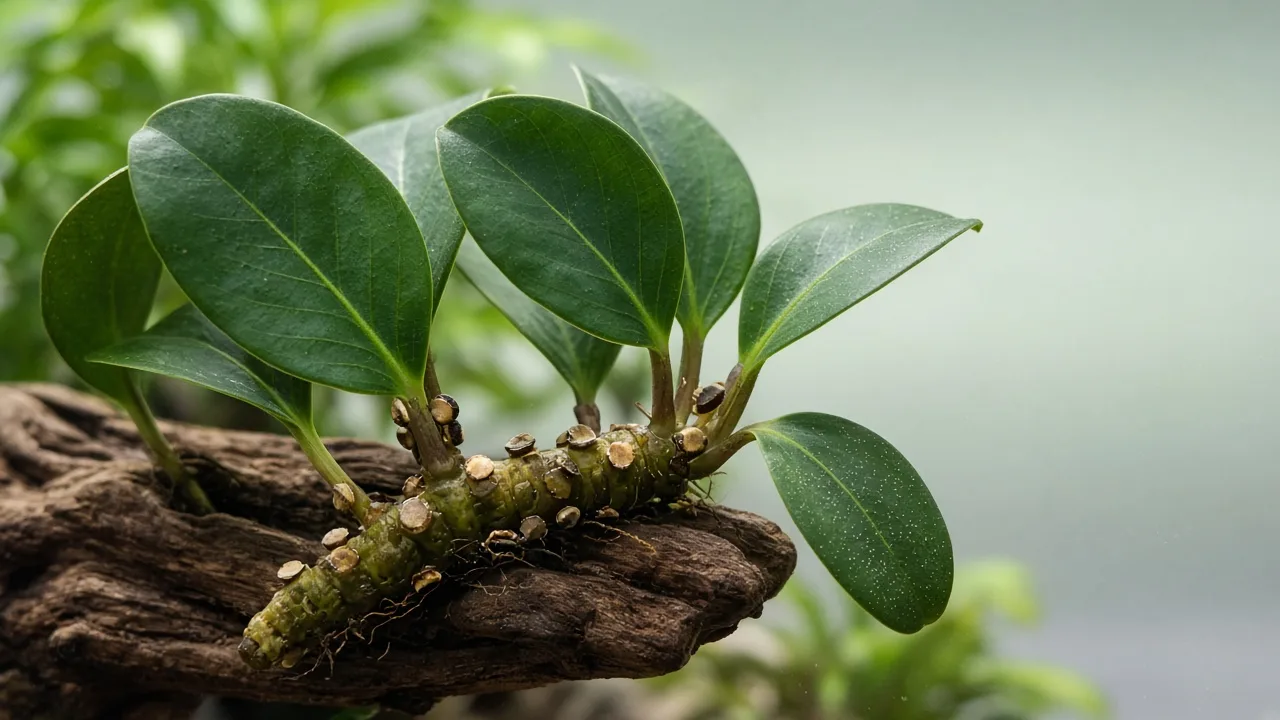
Scale Insects on Anubias: Causes, Checks & Fixes
This guide covers scale insects on Anubias. See also the general Scale Insects guide, watering, and light pages for this plant.
Scale Insects on Anubias: Causes, Checks & Fixes
Quick answer
Scale insects on Anubias barteri and cultivars like Anubias nana are immobile sap feeders protected by a waxy or shell-like cover that look like flat tan or brown bumps glued to the exposed rhizome, petiole bases, and emersed leaf undersides. They pierce tissue, drain sap, and—on soft scale species—leave sticky honeydew that can feed sooty mold on thick leaves and nearby hardscape.
For how scale life cycles work indoors in general, see our scale insects guide. On Anubias, the practical pattern is firm disks tucked into rhizome crevices where petioles meet the stem, honeydew on driftwood or tank glass below emersed growth, and extra caution because alcohol and oils must never enter occupied turtle or fish water.
First step: remove the Anubias from your main tank and scrape every visible bump with a cotton swab dipped in 70% isopropyl alcohol—then re-inspect in three to five days before spraying anything.
What scale insects look like on Anubias
On Anubias, scale insects rarely sit in plain view on the glossy leaf surface. They aggregate where this slow-growing epiphyte creates protected joints:
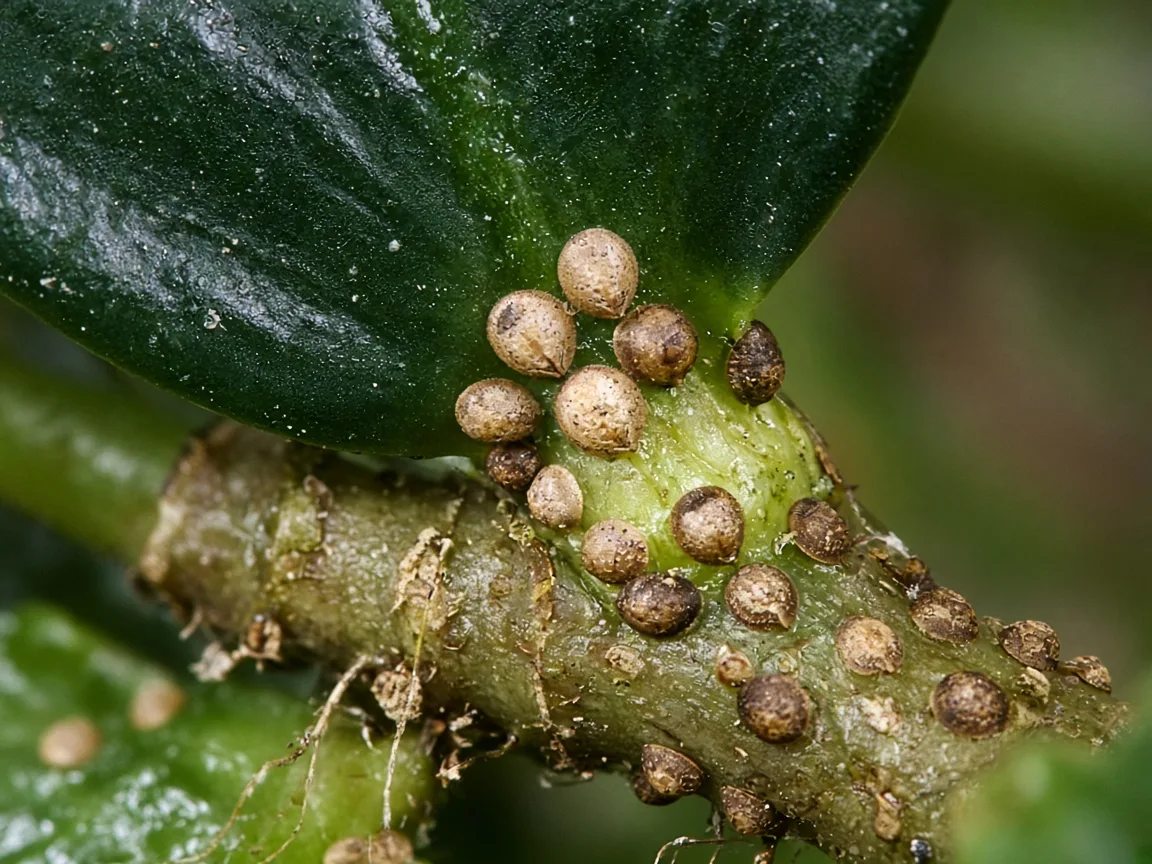
Scale insects symptoms on Anubias - compare with healthy tissue on the same plant.
- Flat or dome-shaped tan, brown, or bark-colored bumps along the rhizome, petiole bases, and leaf undersides
- Disks that do not wipe away with a dry cloth—unlike hard-water film or diatom algae on leaf faces
- Sticky honeydew on leaves, driftwood, or tank glass below infested emersed growth
- Black sooty coating on emersed leaves or hardscape from fungus growing on dried honeydew
- Ant trails on tank stands or shelves near open-top aquariums—ants protect scales from predators while harvesting honeydew
- Yellowing or stunted leaves on heavily fed parts of the rhizome while the crown stays firm
- Pale yellow to orangish crawlers before shells harden—immature scales are mobile until they settle and grow armor
Anubias is usually grown attached to rock or driftwood with the rhizome exposed, not buried in substrate. That horizontal rhizome gives scale a runway of tight crevices between leaf petioles—easy to miss during a quick glance at water clarity.
Scale needs air-breathing, above-water or emersed tissue to thrive long term. You most often see bumps on emerged leaves, plants in quarantine tubs, nursery stock kept damp but not fully submerged, or paludarium growth above the waterline. Fully submerged colonies are uncommon, but emerged tips and floating mats are worth checking.
Where scale hides on the exposed rhizome and petiole joints
Anubias barteri keeps its thick leaves on a slow-growing rhizome mounted above substrate. Scale follows the protected joints this architecture creates—not the open leaf blade you see from across the room.
Scale often concentrates in somewhat protected areas such as branch crotches, stem joints, and along leaf petioles. On Anubias, the equivalent hot zones are:
- Petiole bases where leaves meet the rhizome—flat bumps blend with green or reddish stem color
- Rhizome crevices on driftwood mounts—especially where the plant was tied with thread or fishing line
- Emersed leaf undersides above the waterline in turtle tanks and open-top aquariums
- Oldest leaf bases at the trailing end of the rhizome—shaded tissue that stays out of direct flow
- Root crowns where fine roots meet gravel—if the rhizome was mistakenly buried or partially covered
This rhizome-and-petiole inspection pattern is plant-specific. A snake plant guide tells you to search vertical leaf faces; on Anubias you are tracing every joint along the exposed rhizome with a swab or lens while the plant sits in a quarantine tub—not dosing the display tank.
Why Anubias gets scale insects
Scale insects are introduced pests that arrive on nursery stock, emersed propagation trays, or nearby infested houseplants. What makes Anubias vulnerable is its mounting style and aquarium culture, not dirty water alone.
Exposed rhizome crevices hide armored shells. The same architecture that makes Anubias easy to attach to wood creates flat feeding sites a quick rinse misses. Adult scales are relatively protected from contact sprays by their waxy covering, so disks on petiole bases survive one casual wipe.
Nursery stock often arrives emersed. Anubias from shops frequently sits in damp bags or propagation trays beside other tropicals—scale can hitchhike on infected plants before the rhizome ever reaches your turtle tank.
Warm quarantine rooms support year-round breeding. Plants held in propagation tubs or paludariums behave like houseplants; indoor conditions without natural predators let populations persist year-round.
Slow growth delays discovery. Anubias’s slow growth means a scale colony can sit on one rhizome section for weeks before you notice yellowing on just a few leaves. That delay is why rhizome inspection matters more than watching overall tank algae.
Poor water quality does not cause scale directly. However, honeydew plus organic film on emersed leaves can invite sooty mold that blocks light to slow-growing Anubias—clean sticky residue once insects are controlled.
How to confirm the cause
Work through these checks before treating:
- Scrape test—Pry a bump with a toothpick or alcohol swab. Scale should flake off with gentle pressure; mealybugs smear pink beneath cottony wax
- Rhizome-and-petiole focus—Disks sit along the exposed rhizome and petiole bases, not evenly across every submerged leaf face
- Honeydew and ants—Sticky residue on driftwood or tank glass below emersed growth points to sap feeders; melting tissue without stickiness fits yellow leaves from acclimation stress
- No cottony wax—White tufts that smear pink when dabbed point to mealybugs, not scale
- No webbing—Fine silk with stippling points to spider mites, not scale
- Soft-bodied insects on new growth—Pear-shaped bodies with cornicles point to aphids on emersed tips, not immobile bumps
- Rhizome firmness—Press the rhizome between leaf bases. Firm tissue with clean water suggests a foliage pest. Soft, dark rhizome with foul odor is root rot—not scale alone
Lookalikes to rule out first:
| Pattern | Likely cause | Key difference |
|---|---|---|
| Flat tan bumps on rhizome joints | Scale insects | Immobile disks; honeydew on hardscape below |
| White cottony clusters in axils | Mealybugs | Smears pink when crushed |
| Soft pear-shaped insects on emersed tips | Aphids | Move when disturbed |
| Flat brown-green film on leaf faces | Diatom or algae | Wipes off; no legs under a lens |
| Translucent brown melt after tank move | Acclimation stress | No immobile bumps; no honeydew |
Re-check in three to five days if you see empty shells but no live insects—crawlers resettle quickly in the same rhizome grooves.
First fix for Anubias
Remove the plant from the main tank and scrape every visible bump with a cotton swab dipped in 70% isopropyl alcohol.
Place the Anubias in a fish-free quarantine tub or bucket with clean dechlorinated water and adequate light. Small numbers of scale can be removed manually—alcohol dissolves the waxy cover on contact. Work systematically along the rhizome from the oldest leaf bases to the growing tip—lift each petiole and press alcohol directly onto every visible disk until the shell lifts and the insect underneath turns light brown. Colonies tucked under the rhizome where it meets rock or wood must be touched individually; spraying tank water does nothing.
Before a full pass, test alcohol on one older leaf and wait 24 hours. Anubias foliage is tough but can show phytotoxicity if alcohol pools on the surface. If the test leaf marks, dab insects only and keep liquid off the blade.
Never dump alcohol, insecticidal soap, or terrestrial pesticides into a tank occupied by turtles, fish, or shrimp. Treat the plant out of the display system, rinse treated emersed portions with clean dechlorinated water, and only return the plant after you see no new bumps for at least two weeks.
Do not bury, fertilize, or split the rhizome on day one unless scale is packed at substrate contact points from a mistakenly buried rhizome.
Step-by-step recovery
After the first alcohol scrape, continue on a weekly cycle until you see no new bumps for at least two weeks:
- Repeat alcohol scrapes weekly—Newly hatched crawlers are mobile and easy to miss. Hit every petiole base, rhizome crevice, and emersed leaf underside each session.
- Rinse emersed foliage—Gently spray leaf undersides with dechlorinated water in the quarantine tub to knock down crawlers. Let leaves air-dry before returning to high-humidity cover.
- Wipe honeydew—Clean sticky leaves and hardscape with a damp cloth so sooty mold does not block light to slow-growing tissue.
- Escalate for heavy infestations—If disks cover multiple petioles after two alcohol passes, follow scraping with horticultural oil or insecticidal soap labeled for houseplants, applied only in quarantine with emersed portions treated above open tank water. More than one application is often needed when scales have multiple generations indoors.
- Check the collection—Inspect every plant that shared quarantine space, nets, or tools. Treat any new bumps immediately.
- Remount if rhizome was buried—When scale clusters at substrate contact points, lift the rhizome, rinse it, and reattach to rock or wood with the rhizome above gravel—never buried.
Hold aquarium fertilizer until new growth looks clean for two weeks. Feeding a stressed Anubias during active pest pressure pushes soft tissue that sap feeders prefer.
Recovery timeline
Visible colonies should shrink within one to two weeks of consistent weekly alcohol scrapes in quarantine. Expect three to four weekly passes minimum before calling the plant clear—eggs and crawlers hatch on staggered schedules.
Clean new leaves emerging from the rhizome are the best recovery markers. Old Anubias leaves with yellow stippling or honeydew staining will not fully revert; trim them for hygiene once the plant is insect-free and the rhizome stays firm.
If bumps reappear in the same petiole grooves after four diligent weeks, look for missed rhizome colonies, reinfection from an untreated neighbor, or emersed regrowth above a display tank—not a need for more tank fertilizer.
Worsening signs: sooty mold spreading on emersed leaves despite cleaning, softening rhizome tissue at heavily infested joints, or fresh crawlers on every new leaf within days of treatment.
What not to do
Do not treat inside an occupied turtle or community tank with alcohol, soap, or pesticides—those products are not formulated for animal water and can harm turtles, fish, and invertebrates.
Avoid burying the rhizome while fighting pests; buried Anubias rots easily and gives scale more hidden substrate contact.
Do not return the plant to the display tank after one treatment. Two weeks with no new bumps in quarantine is the minimum before reintroduction.
Skip copper-based algaecides or random pond chemicals on infested Anubias—the Anubias overview notes copper sensitivity, and chemicals will not replace manual scale removal.
Do not assume submerged leaves are clean because you cannot see axils—inspect emerged portions and rhizome joints every time you thin old growth per the Anubias pruning guide.
Do not compost infested trimmings indoors where crawlers can walk to other pots or quarantine tubs.
How to prevent scale insects next time
- Quarantine new Anubias two to four weeks in a separate container before adding it to a turtle tank or community aquarium—inspect new plants thoroughly before introducing them
- Inspect rhizomes and petiole bases at each quarantine water change—this plant’s exposed rhizome hides pests by design
- Keep quarantine tools separate from nets and scissors used in display tanks
- Treat only in fish-free tubs; rinse emersed tissue with dechlorinated water before reintroduction
- Avoid burying the rhizome in gravel—attach to rock or driftwood as intended per the Anubias soil guide
- Check emersed nursery stock especially hard before it enters any warm propagation tray
- Manage ants near open-top tanks so they cannot farm honeydew producers on emersed Anubias
Stable clean water, moderate light per the Anubias light guide, and an unburied rhizome keep Anubias resilient. A plant melting after a tank move is not more likely to attract scale from nowhere, but it recovers more slowly once they arrive.
When to worry
Escalate immediately if multiple quarantined plants show tan bumps, if crawlers reach emersed leaves above a turtle basking area, or if ants appear near the aquarium feeding on honeydew from nearby houseplants.
Consider discarding and replacing the plant only when most rhizome joints are infested, disks pack crevices you cannot reach without destroying the mount, and four or more weeks of careful quarantine treatment fail—especially if the rhizome is already soft from being buried or rotting.
For a single cluster on one petiole base on an otherwise firm Anubias, quarantine plus weekly alcohol is usually enough. The urgency is stopping spread to your tank collection and neighboring plants, not panic.
Conclusion
Scale insects on Anubias are a contact pest that hides along the exposed rhizome and in petiole joints, not a mystery aquarium disease. Confirm them with immobile tan disks in rhizome crevices and a firm shell scrape test, remove the plant from animal water first, then scrape every bump with alcohol on a weekly schedule until new disks stop appearing. Prevent reinfestation by quarantining new Anubias and inspecting rhizome crevices every time you thin old leaves—on this species, the bugs hide exactly where petioles meet the rhizome.
When to use this page vs other Anubias guides
| Pattern | Read next |
|---|---|
| White cottony clusters in leaf axils | Mealybugs on Anubias |
| Soft pear-shaped insects on emersed tips | Aphids on Anubias |
| Fine webbing and stippling | Spider mites on Anubias |
| Yellow leaves with soft rhizome, no bumps | Root rot on Anubias or overwatering |
| Slow growth after pests are gone | Slow growth on Anubias |