Whiteflies on Anubias: Causes, Checks & Fixes
Quick answer
Whiteflies on Anubias attack emergent leaves and rhizome crowns in open-top tanks—not healthy submerged foliage. First step: rinse leaf undersides with dechlorinated water or submerge all affected tips below the surface for 24 hours; do not spray insecticidal soap into occupied aquarium water.
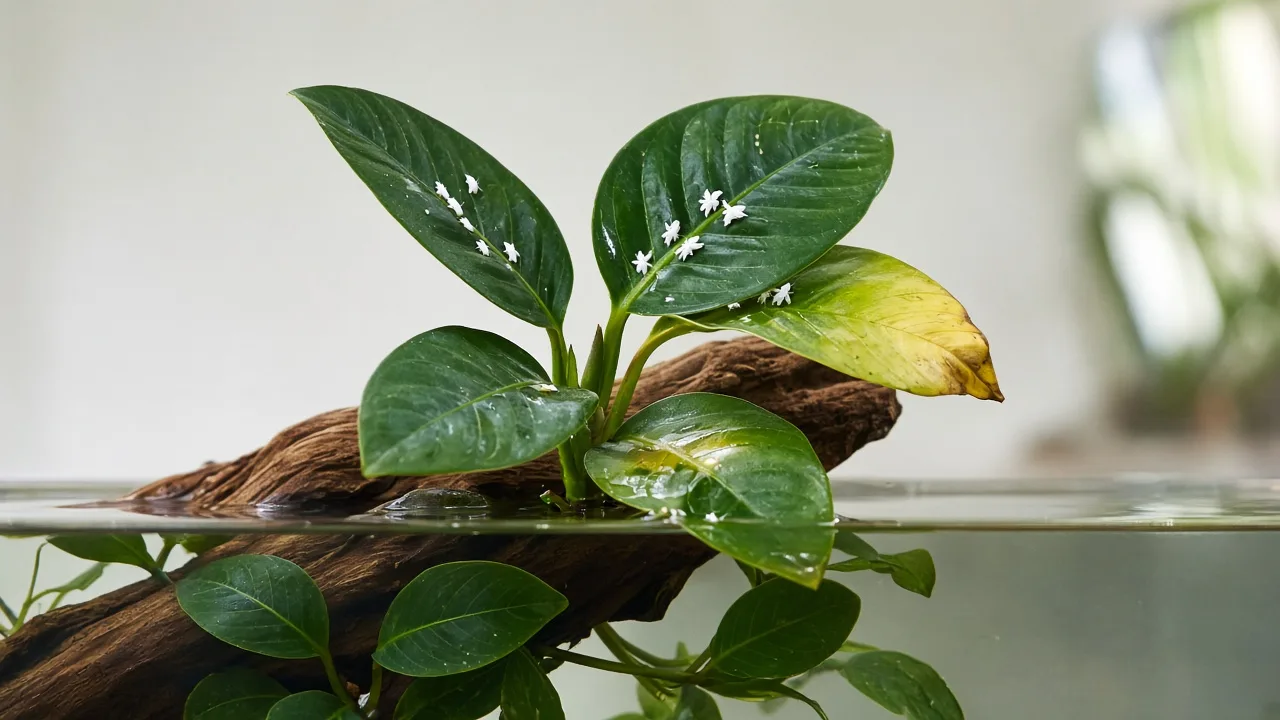
Whiteflies on Anubias: Causes, Checks & Fixes
This guide covers whiteflies on Anubias. See also the general Whiteflies guide, watering, and light pages for this plant.
Whiteflies on Anubias: Causes, Checks & Fixes
Quick answer
Whiteflies on Anubias (Anubias barteri and cultivars like nana and *coffeefolia) are tiny sap-sucking insects that colonize emergent tissue above the waterline—new leaves, rhizome crowns in open-top aquariums, paludariums, Wabi-Kusa bowls, and turtle tanks. Fully submerged Anubias leaves are rarely infested because adults and nymphs feed on tissue exposed to air.
First step: rinse every emersed leaf underside with a gentle stream of dechlorinated water, letting dislodged insects fall into the tank where fish may eat them—or submerge all affected tips below the surface for 24 hours in a quarantine tub. In turtle, fish, or shrimp setups, physical knockdown protects your animals better than houseplant sprays. Do not reach for insecticidal soap, neem oil, or horticultural oil in occupied aquarium water.
For how whiteflies reproduce, why ants defend them, and when yellow sticky traps help in general, see our whiteflies pest guide. On Anubias, the practical pattern is flying adults and scale-like nymphs on emersed leaves above the waterline, clean submerged blades below, and extra caution because insecticidal soap must never enter turtle or fish water—treat emersed tissue off-tank only.
This guide covers aquarium, turtle tub, paludarium, and riparium culture—not houseplant pots. For soft pear-shaped insects without white wings, see aphids on Anubias. For white cottony wax at the rhizome crown, see mealybugs on Anubias. For fine webbing and stippling on emersed leaves, see spider mites on Anubias. For mushy translucent submerged melt—not insects—see yellow leaves on Anubias. For culture and quarantine tubs, see the Anubias overview and propagation guide.
Whiteflies vs. aphids vs. mealybugs on Anubias
Use location on the rhizome as your first split—this saves you from chasing water-quality fixes when the problem is emersed tissue:
| Pattern | Location | Key sign | First action | Urgency |
|---|---|---|---|---|
| Whiteflies | Emersed leaves above waterline | Cloud of tiny white adults when disturbed; flat nymphs on undersides | Rinse or submerge emergent tips; bag trimmed tissue | Moderate—physical control first |
| Aphids | Emersed tips and flower stalks | Soft pear-shaped bodies, cornicles, sticky honeydew | Submerge infested growth 24–48 hours; rinse colonies | Moderate—submerge first |
| Mealybugs | Rhizome crown crevices | White cottony wax, greasy clusters | Bag infested cuttings; alcohol dab off-tank | Moderate—isolate from bench |
| Spider mites | Emersed leaves | Fine webbing, yellow stippling, no honeydew cloud | Rinse undersides; raise humidity on bench | Moderate—dry air worsens mites |
| Thrips | Emersed and sometimes submerged edges | Silvery scars, black fecal specks; insects jump | Rinse; isolate; avoid oil in tank water | Moderate—check new nursery stock |
| Submerged melt | Underwater blades | Translucent mush, foul odor | Fix acclimation or water quality—not insect treatment | High if rot spreads |
If submerged leaves are firm and dark green while insects cluster only on tissue above the waterline, you are dealing with a terrestrial-phase pest on emersed growth—not an underwater plague or nutrient crash.
Why whiteflies appear on Anubias—emersed nursery stock and open-top tanks
Whiteflies are not caused by low nitrates, dim aquarium light, or rhizome burial alone. They arrive on emersed tissue exposed to open air in warm, humid conditions—the same introduction route as aphids on emersed Anubias:
- Aquatic-plant nursery bundles grown emersed in humid greenhouses before submersion in your tank
- Open-top turtle tanks where new Anubias leaves break the surface near heat lamps
- Paludarium and Wabi-Kusa banks that intentionally keep rhizome tips in dry air
- Greenhouse whitefly (Trialeurodes vaporariorum) hosts nearby—tomatoes, peppers, begonias, or flowering ornamentals on the same propagation shelf
- Indoor houseplants with active whitefly colonies near an uncovered aquarium
- Quarantine tubs where emersed leaves are left above water during acclimation
Because Anubias is a slow-growing rhizome epiphyte tied to rock or driftwood—not a fast houseplant in potting mix—whiteflies persist when emergent tips sit in dry, warm air above the waterline. Adults and nymphs suck sap from leaf undersides on tissue exposed to air. Fully submerged blades in a closed aquarium do not offer the flight space and emersed leaf undersides where colonies establish.
Rhizome-crown note: Unlike buried-houseplant pests, Anubias problems concentrate where the thick rhizome meets emergent petioles—especially when turtles bask under lamps that dry leaf tips while the crown stays damp. That microclimate favors whiteflies that develop rapidly in warm weather and can rebuild populations within weeks if emergent tissue stays untreated.
What whiteflies look like on emersed Anubias leaves
On emersed Anubias growth attached to hardscape, expect:
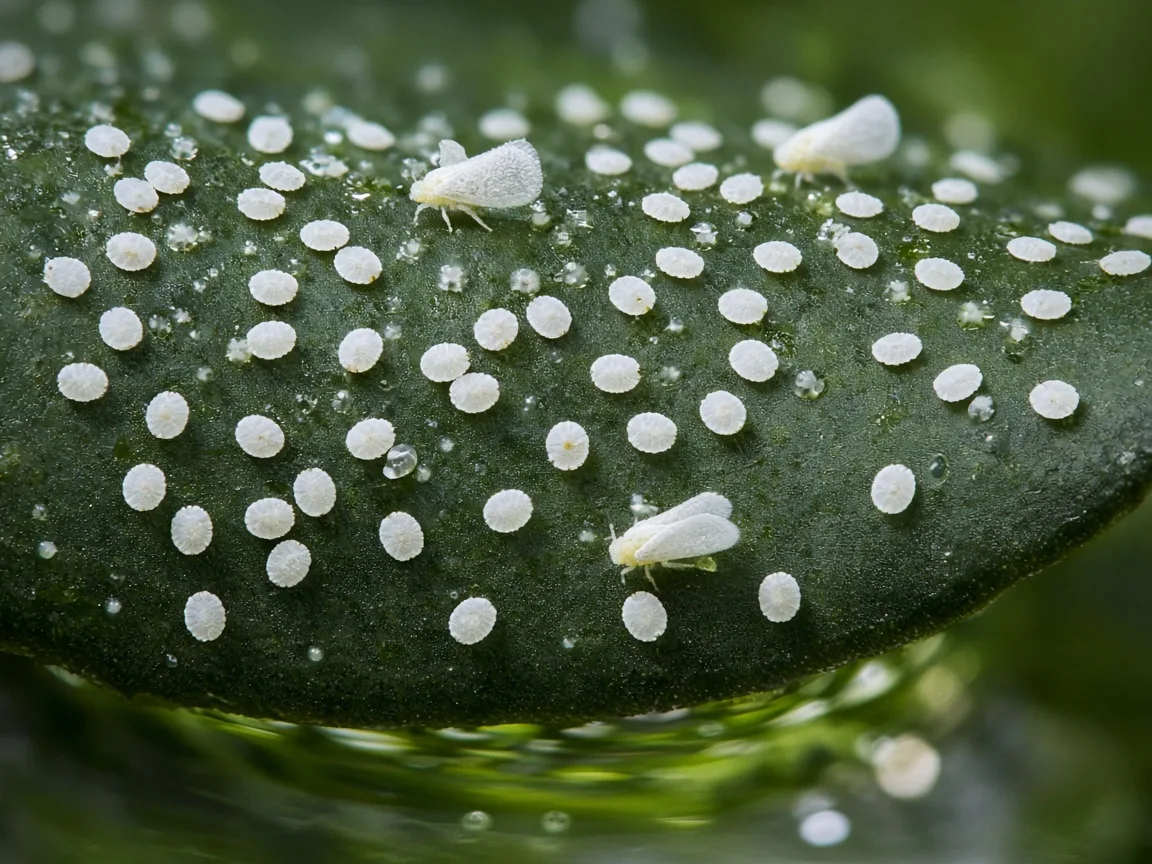
Whitefly nymphs on emersed Anubias leaf undersides—compare with healthy submerged blades on the same rhizome.
- Tiny white-winged adults with yellowish bodies—adults fly up in a cloud when leaves are disturbed, a hallmark greenhouse whitefly behavior on emersed tips
- Flat, oval, legless nymphs glued to emersed leaf undersides—nymphs cause most feeding damage and do not move once settled
- Sticky honeydew on leathery leaf surfaces, tank rims, or glass below emergent growth; honeydew may attract ants and sooty mold
- Yellowing, silvering, or drying on emersed leaves that still feel firm—not the translucent mush of submerged melt
- Deposits of white wax with certain whitefly species on emersed tissue near the waterline
Compare newest emersed leaf growth to submerged blades on the same rhizome: whiteflies stay above water; clean submerged sections confirm the plant can recover once infested emergent tissue is treated.
Does not match whiteflies:
- Soft pear-shaped bodies with cornicles—aphids, not white-winged adults
- White cottony wax clusters at the rhizome crown—mealybugs
- Fine silk webbing and yellow stippling without a flying cloud—spider mites
- Translucent, mushy submerged tissue after a new purchase—acclimation melt, not insects
- Flying adults over open tanks without stem nymphs—damp soil on a nearby stand; see fungus gnats
How to confirm whiteflies on Anubias
Work through this checklist in order:
- Disturbance test—Tap emersed leaves gently. A puff of tiny white flying adults? Strong whitefly signal.
- Location test—Nymphs only on tissue above the waterline? Submerged blades clean? Confirms emersed-tissue pest.
- Underside inspection—Flat immobile nymphs on leaf undersides? Whiteflies. Soft pear-shaped bodies with cornicles? Aphids.
- Honeydew and ants—Sticky residue or ant trails on emergent stems support whitefly diagnosis.
- Purchase timing—Adults appeared within one to two weeks of new emersed nursery stock? Strong hitchhiker signal.
- Rhizome health—Firm rhizome on wood with damage only above water? Pest on emergent tissue, not root rot from buried crowns.
Rule out thrips (silvery streaks, insects that jump when disturbed), scale (hard brown bumps that do not fly), and algae on slow Anubias leaves (green film that wipes off, no legs).
First fix for Anubias
Rinse emersed leaf undersides with dechlorinated water—or submerge all affected tips below the surface.
Unhook the rhizome from wood if needed. Direct a gentle stream at every emersed leaf underside and petiole base, letting dislodged whiteflies fall into the tank. Water sprays (syringing) dislodge adults and are the safest first response in fish and turtle setups.
If the plant is small enough, lower every emersed leaf below the waterline in a quarantine tub or main tank and hold it there 24 hours. Terrestrial whitefly stages on emersed aquarium plants cannot survive prolonged submersion the way submerged Anubias tissue thrives underwater—drowned adults and dislodged nymphs are often eaten before they can recolonize dry tips.
That single physical step comes before any chemical treatment. Only escalate to out-of-tank soap if rinsing and submersion fail after several days.
Step-by-step recovery
After the first rinse or submersion:
- Isolate new or heavily infested plants in a quarantine tub with matching temperature and dechlorinated water. Isolate affected plants from others until you see no flying adults or new honeydew for two weeks.
- Repeat rinsing every three to five days—Whiteflies develop rapidly in warm weather, and eggs hatch on a cycle that one pass rarely clears. Plan several follow-up rinses.
- Prune only infested emersed leaves you cannot reach—snip at the petiole and bag trimmings. Anubias recovers slowly; avoid stripping half the rhizome unless damage is severe.
- Hang yellow sticky traps above the tank, not in water—Sticky traps monitor and can reduce adult numbers on propagation benches near open-top setups. One trap per large emersed plant zone is a reasonable starting point.
- Let fish help in community tanks—Many fish eat dislodged insects. Do not assume turtles will control whiteflies on dry emergent leaves they never reach.
- Escalate outside the tank if needed—Move the plant to a bucket, treat emergent portions with insecticidal soap per label directions, rinse thoroughly in dechlorinated water until no residue remains, and quarantine again before reintroducing. Good coverage of leaf undersides is essential, and repeat applications may be required. Never pour soap, neem, or oil directly into an occupied turtle or shrimp aquarium.
Repeat inspections every three to five days. Warm greenhouse conditions can produce overlapping whitefly generations, so persistent follow-up matters more than a single heroic treatment.
Recovery timeline
You should see no new flying adults within one week of consistent rinsing if emergent tissue stays treated. Submersion methods often show no live movement within 48 hours when all affected leaves stayed underwater.
New clean leaves are the real success marker. Because Anubias is slow-growing, a yellowed emersed leaf may look damaged for several weeks to months even after whiteflies are gone. Judge recovery by the next unfurling leaf staying solid green without fresh honeydew—not by old tissue greening up again.
Plan two to three weeks of follow-up checks before merging a quarantined plant back with a collection. If a cloud of adults returns when you tap emergent tips within that window, reinfestation is still active—extend isolation and scan nearby emersed hosts or houseplants.
Worsening signs: honeydew spreading to multiple rhizome-attached leaves, yellowing advancing to new emersed tips daily, or whiteflies appearing on several plants after a nursery purchase. Those mean the outbreak is outpacing physical control.
Lookalike symptoms
- Aphids—Soft pear-shaped clusters on flower stalks; cornicles visible; less likely to produce a flying cloud when tapped.
- Mealybugs—White cottony wax in rhizome crevices; no puff of winged adults.
- Spider mites—Fine stippling and webbing; no sticky honeydew cloud; worsens in dry air above open tanks.
- Thrips—Silvery scars and black fecal specks; insects flee quickly when disturbed.
- Algae on slow Anubias leaves—Green or brown film on submerged or emersed blades; wipes off as slime; no legs, no flight.
- Acclimation melt—Translucent submerged tissue after a move; no nymphs on undersides and no flying adults.
- Low humidity bronzing—Dry leaf edges without nymphs or honeydew; see low humidity on Anubias for the dry-air differential.
What not to do
Do not spray insecticidal soap, neem oil, pyrethrin, or horticultural oil into a turtle tank or community aquarium. Residues harm fish, shrimp, beneficial bacteria, and turtles even when labels say “natural.” UF/IFAS notes insecticidal soaps are hazardous to aquatic invertebrates and must not be applied directly to water.
Do not use broad-spectrum pesticides labeled for other insects—even toxic insecticides are only partially effective against whiteflies and can wipe out predators without solving the colony on emersed Anubias tips.
Do not bury the rhizome while fighting pests—exposed rhizomes are how Anubias stays healthy in aquarium culture, and buried crowns rot in wet substrate.
Do not assume submerged leaves are infested and dose the whole tank. Treat emergent tissue only, or remove the plant for out-of-tank care.
Do not treat once and stop. Repeat applications are usually necessary because nymphs on curled young leaves hatch after the first rinse.
Anubias care cross-check
While inspecting for whiteflies, confirm the basics that keep Anubias resilient—details in our Anubias overview and watering guide:
- Rhizome above substrate, tied to rock or driftwood—not buried in gravel
- Clean, oxygenated water with regular partial changes in turtle setups
- Moderate aquarium light, not sudden harsh sun on emergent leaves
- Temperature in the 18–28 °C range matching your tank inhabitants
- No copper or algaecide residues on leaves you might later treat with soap outside the tank
Stressed plants with melting submerged leaves attract secondary problems, but whitefly control still centers on emergent tissue, quarantine, and physical knockdown—not repotting or soil changes. Anubias does not grow in potting mix indoors.
How to prevent whiteflies next time
- Quarantine new Anubias one to two weeks in a separate tub before adding it to a display tank.
- Submerge emersed nursery leaves fully on arrival; inspect undersides with a lens before tying the rhizome to hardscape.
- Keep emergent growth minimal in open-top turtle tanks—raise water level so new tips stay submerged, or trim emersed leaves you do not need.
- Inspect new plants for whiteflies before introduction—a core IPM prevention step for greenhouse-origin aquatic stock.
- Hang sticky traps on propagation shelves, not inside tank water, to catch flying adults early.
- Isolate nearby houseplants with whiteflies away from open aquariums.
- Avoid emersed propagation next to whitefly-heavy greenhouse crops unless you inspect weekly.
When to worry
Escalate fast if honeydew covers multiple emersed leaves, a cloud of adults appears every time you tap new tips, or several plants in the same room show whitefly signs at once—those colonies spread beyond a single rhizome.
Treat as urgent in turtle tanks when you cannot submerge emergent leaves and must choose between repeated rinsing on removed plants or escalating to out-of-tank soap treatment. Do not let pesticides enter the water column.
If dense nymph colonies persist after two full submersion cycles and rinsing every three to five days for two weeks, consider removing the most infested emersed leaves or replacing a small, cheap cultivar rather than risking your entire aquascape.
Conclusion
Whiteflies on Anubias are an above-water problem on a below-water plant. Confirm them with the disturbance test on emersed leaves, then rinse or submerge before any chemical treatment. In turtle and fish tanks, physical knockdown protects your animals better than houseplant sprays ever will. Slow regrowth means old yellowing lingers—inspect new emersed stock, keep tips submerged when you can, and judge success by the next clean leaf, not yesterday’s honeydew-coated one.
When to use this page vs other Anubias guides
- Anubias watering guide—Use for routine moisture and tank checks before assuming whiteflies is the main issue.
- Anubias problems hub—Browse all common issues on this species.
- Aphids on Anubias—Different entry point when soft pear-shaped insects cluster without a flying cloud.
- Spider mites on Anubias—Different entry point when stippling and webbing appear without honeydew.