Brown Leaves on Bird's Nest Fern: Causes, Checks & Fixes
Quick answer
Brown leaves on Bird's Nest Fern usually mean whole fronds or large patches are dying—not just crispy margins. First step: press the rosette center gently; soft brown tissue at the nest points to crown trouble, while dry papery brown on lower outer fronds often means thirst, sun scorch, or normal senescence.
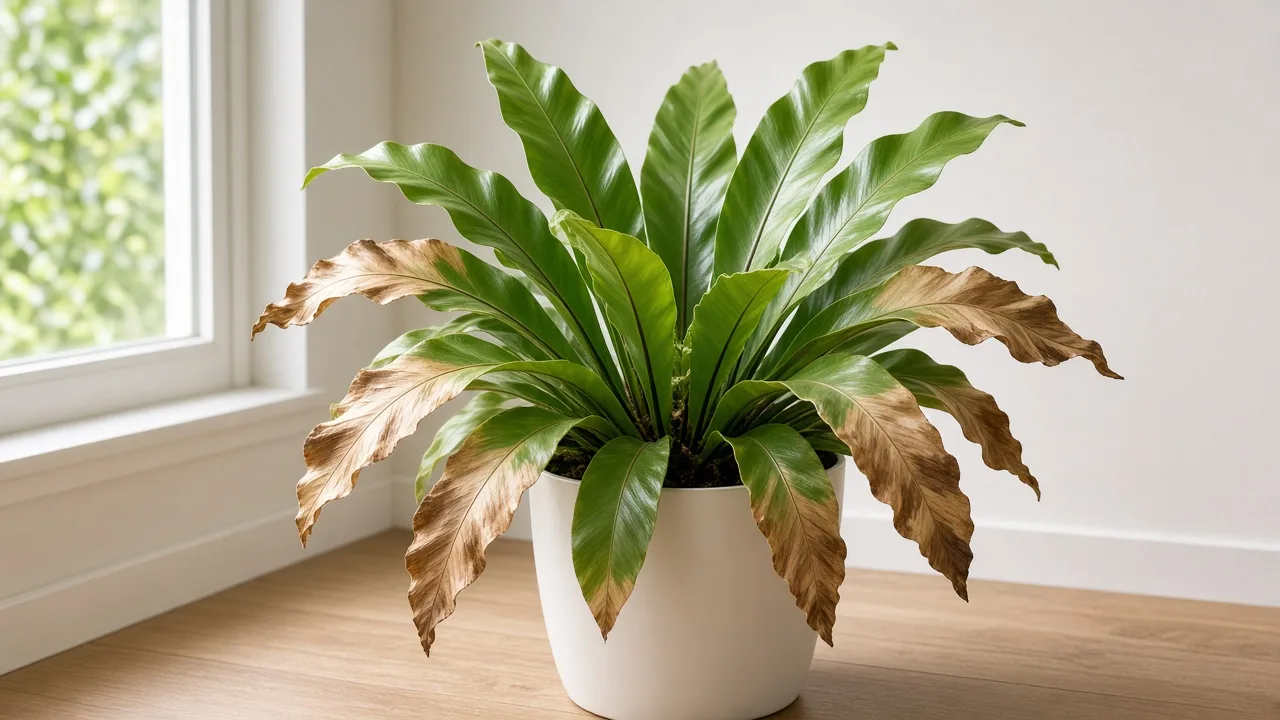
Brown Leaves on Bird's Nest Fern: Causes, Checks & Fixes
This guide covers brown leaves on Bird's Nest Fern. See also the general Brown Leaves guide, watering, and light pages for this plant.
Brown Leaves on Bird's Nest Fern: Causes, Checks & Fixes
Quick answer
Brown leaves on Bird’s Nest Fern (Asplenium nidus) mean more than a crispy edge—whole strap-shaped fronds or large tan-to-brown patches are dying while the rosette still sits in your room. That pattern is different from brown tips, where margins crisp while most of the frond stays green.
For how brown foliage develops on houseplants in general, see our brown leaves guide. On Bird’s Nest Fern, the urgent split is crown versus frond: soft brown tissue at the nest center after wet soil points to crown failure, while dry papery brown on lower outer fronds with a firm crown usually means thirst, sun scorch, cold shock, or one frond reaching the end of its life.
First step: press the rosette center gently with a clean finger. Soft, wet, or sour-smelling brown at the nest means stop watering into the center and move to overwatering and root rot checks. A firm dry crown with brown only on outer or lower fronds means read soil moisture at the pot edge and light exposure before you change anything else.
When to use this page vs other Bird’s Nest Fern guides
- Brown tips — crispy margins or tips on mostly green fronds; humidity and water quality first
- Yellow leaves — whole-frond yellowing, often with too much sun or wet roots
- Overwatering — heavy wet pot, limp fronds, crown pooling
- Underwatering — light pot, dry mix, stiff curled fronds
- Low humidity — dry winter air when soil is moist but foliage still stresses
- Bird’s Nest Fern problems hub — full symptom list for this species
What brown leaves look like on Bird’s Nest Fern
Bird’s Nest Fern carries broad, undivided strap fronds in a funnel-shaped rosette—not the finely divided pinnae of a Boston fern. When whole leaves brown, you are usually looking at large sections of a single frond or entire older fronds turning dull tan, then papery brown, while younger inner fronds may still look green for a time.
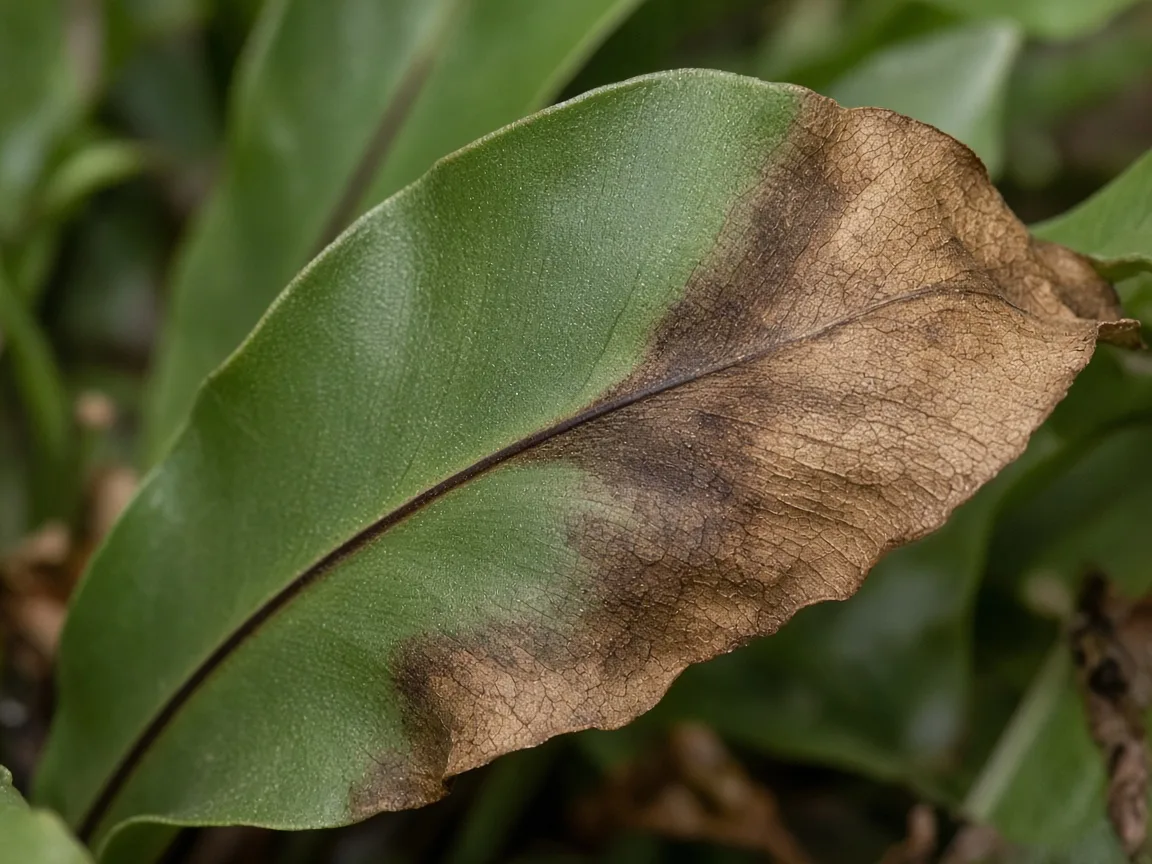
Brown leaves on Bird’s Nest Fern—tan-brown dried tissue along a strap frond margin and mid-blade, with healthy green tissue still visible for comparison.
Common patterns:
- One or two lowest fronds brown from the tip downward or evenly dull, while the nest produces firm new growth — often normal senescence; groom when fully dry
- Brown or yellow-tan patches on the frond face (not just the edge) after a move toward sun — direct sun stress; fronds may stop expanding
- Lower fronds dull yellow-brown, limp, with mix that stays damp many days — wet-root stress overlapping overwatering
- Outer fronds stiff, dry, uniformly brown, pot light, top inch dusty — underwatering or extreme low humidity desiccation
- Brown spreading from the nest center, soft tissue, sour smell — crown rot; margin fixes will not help
- Straight herringbone brown lines on frond undersides only — healthy spore sori, not a disease to treat
What it is not: Narrow crispy margins on green fronds belong on brown tips. Solid yellowing of newer fronds under bright glass often fits yellow leaves and light stress routing—not this page alone.
Why Bird’s Nest Fern develops brown fronds
In the wild, Asplenium nidus grows as an epiphyte whose funnel rosette catches litter and holds moisture around shallow roots. Indoors, that same rosette shape traps irrigation if you pour into the center—while the wide fronds transpire heavily in dry air. Brown leaves usually mean one side of the moisture balance failed: roots could not supply water, roots failed in wet mix, or the frond surface lost tissue to sun, salt, or age.
Too much sun turns fronds yellow-brown
UF/IFAS notes that in sunnier locations fronds turn yellow and growth stops. Behind south or west glass, that yellowing can advance to tan patches and brown dead areas on the frond face while the nest still looks intact. Bird’s Nest Fern wants bright indirect light—see the light guide before you increase watering on a scorched plant.
Wet mix and crown moisture brown from the base up
NC State describes rich, moist, porous soil—and no tolerance for dry spells—but evenly moist is not soggy. When mix stays waterlogged, roots lose function and lower fronds yellow-brown while staying limp. Clemson HGIC advises watering along the outer pot edge so water does not pool in the nest—a leading crown-rot trigger that shows as brown collapse at the center, not just dry edges.
Dry-down and draft shock whole outer fronds
Because the plant does not tolerate drought, a forgotten dry cycle or a frond pressed against a cold window can brown an entire outer leaf while inner fiddleheads still look fine. That is different from slow margin burn on brown tips—here the blade may feel papery through much of its length.
Spore sori vs sick brown on strap fronds
Mature Bird’s Nest Fern fronds carry brown herringbone lines on the underside—reproductive spore cases, not fungus. UF/IFAS illustrates brown sori on the frond underside as a normal feature of healthy plants.
Use this quick split before you spray or cut:
| What you see | Location | Action |
|---|---|---|
| Straight brown lines in rows | Underside only | None—healthy sori |
| Irregular brown patches | Upper surface or spreading across blade | Diagnose light, water, or rot |
| Soft brown at nest | Center rosette | Crown rot pathway—dry down, inspect |
| One dry brown lowest frond | Outer skirt, firm crown | Often senescence—remove when fully dead |
If you treat sori as disease, you will damage fronds that were still photosynthesizing.
Reading the nest: crown collapse vs outer-frond browning
The central nest is where every new frond unfurls. Bird’s Nest Fern does not branch from nodes like a pothos—if the crown fails, the whole plant stalls.
Crown-involved browning feels soft or wet under light pressure, may smell sour, and often follows water sitting in the rosette or a pot that never dries. Pair with overwatering and root rot pages.
Outer-frond browning with a firm crown means the growing point is still alive. Your job is to identify whether that frond died from age, sun, thirst, or wet roots using soil and light checks—not to flood the nest “for humidity.”
Lookalike symptoms
| Pattern | Soil / crown | Likely cause | First direction |
|---|---|---|---|
| Single lowest frond dry brown | Firm crown, normal moisture | Old frond senescence | Remove when fully dry; watch new fiddleheads |
| Face patches, recent sun move | Firm crown | Sun scorch | Pull back from glass; filter light |
| Several lowers yellow-brown, limp | Wet, heavy pot | Overwatering / root stress | Pause water; edge-water only after dry-down |
| Outer fronds stiff brown | Dry top inch | Underwatering | Edge-water; see watering guide |
| Crispy margins only | Moist soil, low RH | Low humidity / salts | Brown tips page |
| Soft brown nest | Wet center | Crown rot | Stop center moisture; inspect roots |
How to confirm the cause
Work through these checks once. Stop when one row in the table above fits clearly.
- Crown touch test — firm and dry? Continue. Soft, wet, or odorous? Switch to rot pathway immediately.
- Soil at the pot rim — not the nest bowl. Probe the top inch. Clinging wet days after watering supports wet-root browning. Dusty and pulling away supports thirst.
- Light history — did the plant move closer to south/west glass or a grow light in the last two weeks? Face patches strongly suggest scorch.
- Frond age — is only the oldest outer skirt brown while a glossy fiddlehead is emerging? Senescence is likely.
- Water source — if margins and large sections crisp with moist soil and good light, consider fluoride or salt from tap water or fertilizer; Iowa State Extension notes fluoride does not leave tap water when left overnight.
The first fix to try
After the crown test, apply one correction matched to the dominant pattern:
- Firm crown + dry soil + stiff brown outer fronds — edge-water along the pot perimeter until excess drains; empty the saucer. Do not pour into the nest. Re-check in 48 hours.
- Firm crown + wet soil + limp yellow-brown lowers — stop watering until the top inch dries; confirm drainage. Do not mist the crown.
- Firm crown + sun patches on frond faces — move 3+ feet from direct sun or add sheer curtain; do not compensate with extra water.
- Firm crown + single dry lowest frond — wait until the frond is fully papery, then cut at the base with clean shears. Watch the next fiddlehead.
If the crown is soft, the first fix is blot visible moisture from the nest and withhold water until you complete a root inspection—not fertilizer, not repotting on the same day.
Step-by-step recovery
Once the immediate cause is addressed:
- Stabilize placement — medium indirect light, away from radiator blasts and cold glass contact.
- Water at the edge only on a dry-down cycle matched to your pot; details in the Bird’s Nest Fern watering guide.
- Raise humidity at frond height if air is dry—humidifier or pebble tray with the pot base above water, not crown misting that pools in the nest.
- Remove fully dead fronds when they detach easily—UF/IFAS recommends grooming old brown or yellow fronds.
- Pause fertilizer until new growth looks healthy for two weeks; salts worsen browning on sensitive ferns.
Recovery timeline
Bird’s Nest Fern is a slow grower. Brown tissue on existing fronds will not revert to green. Expect two to six weeks to judge whether new fiddleheads emerge clean after you fix water, light, or humidity. One browned senescent frond removed from an otherwise healthy rosette may be the full “recovery” for that issue.
Signs you are winning:
- New fronds unfurl without embedded brown
- Crown stays firm under gentle pressure
- Browning stops at older fronds; no march inward toward the nest
Signs you are losing:
- New fiddleheads abort or emerge already brown
- Crown softens while soil stays wet
- Multiple fronds brown from the center outward within a week
Mistakes to avoid
- Watering into the rosette to “help” brown fronds—invites crown rot on this species
- Moving a scorched fern into deeper shade without fixing water rhythm—can hide sun damage while roots stay wrong
- Repotting, pruning, and feeding the same week—stacking stress on a fern that signals slowly
- Cutting living green tissue because one section browned—remove only fully dead fronds
- Treating underside sori with fungicides—damages healthy reproductive tissue
How to prevent brown fronds next time
Anchor prevention to how Asplenium nidus actually grows: moist porous mix at the roots, humidity at the fronds, and no direct sun on the strap leaves.
- Water when the top inch at the pot edge dries—see watering and soil guides for mix that holds moisture without stagnation
- Keep the plant in bright indirect light per the light guide
- Use filtered or rainwater if tap water leaves sharp edge burn that progresses to larger brown sections
- Groom spent lowers before they harbor pests in the rosette skirt
- Review the Bird’s Nest Fern overview when you change pot size, room, or season—match one variable at a time
When to worry
Escalate immediately if the nest center collapses, smells sour, or new growth stops while soil remains wet—those patterns need root-level decisions on the root rot page.
A single dry brown lowest frond on a plant pushing a healthy fiddlehead is usually routine. Several fronds browning from the center outward on a wet pot is not.