Pale Leaves on Bird's Nest Fern: Light, Water & Nutrient
Quick answer
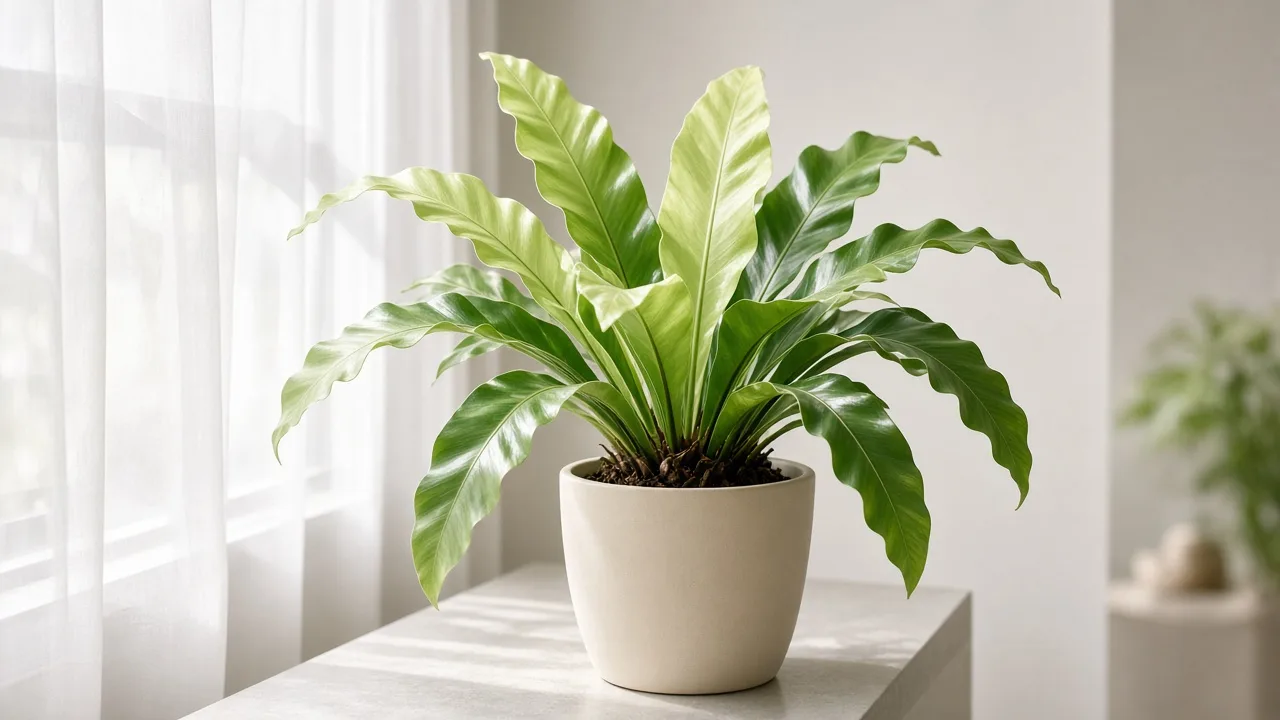
Pale leaves on Bird's Nest Fern look lime-green, dull, or thin instead of the glossy apple-green straps a healthy rosette shows. First step: compare the newest fiddlehead at the central nest with a mature outer strap on the same plant, then note whether the wash-out followed a move toward harsh window sun or into a dim corner.
Pale Leaves on Bird's Nest Fern: Causes, Checks & Fixes
This guide covers pale leaves on Bird's Nest Fern. See also the general Pale Leaves guide, watering, and light pages for this plant.
Pale Leaves on Bird's Nest Fern: Causes, Checks & Fixes
Quick answer
Pale leaves on Bird’s Nest Fern (Asplenium nidus) lose the glossy, deep apple-green color healthy rosettes show on broad, undivided strap fronds. Instead, foliage looks washed-out, lime-green, dull, or thin yellow-green across one or more fronds—or only on the newest fiddlehead spiraling from the central nest.
First step: compare the color and size of the newest fiddlehead at the nest center with a mature outer strap on the same plant, then note whether the pale wash followed a recent move toward harsh window sun or into a dim corner. That single comparison separates sun bleach, low-light stall, and nutrient patterns before you change watering or feed.
For how chlorosis and faded foliage work on houseplants in general, see our pale leaves hub. On Bird’s Nest Fern, pale straps usually tie to the light–watering trap in a funnel rosette, direct sun on glossy fronds, dry air, or selective nutrient loss—not a generic “feed it” fix.
When to use this page vs other Bird’s Nest Fern guides
| Pattern | Read next |
|---|---|
| Whole rosette washed-out after a window move; small dull new fiddleheads | Pale leaves (this page) or not enough light |
| Bleached or yellow straps on a sunny sill; growth stalled | Too much sun—pull back; compare yellow leaves |
| New central fiddlehead pale with dark green veins | Iron deficiency |
| Lowest outer straps dull yellow first | Nitrogen deficiency |
| Banding on older mid-rosette straps | Magnesium deficiency |
| Pale straps on mix that stays wet; soft crown | Overwatering or root rot |
| Crisp pale edges, light pot, dry top 2–3 cm for days | Underwatering |
| Dull straps in a heated room with dry tips | Low humidity |
What pale leaves look like on Bird’s Nest Fern
Healthy Asplenium nidus forms a funnel-shaped rosette of smooth, glossy strap fronds with wavy margins and a dark midrib. New growth uncurls from the central nest as a tight fiddlehead. Pale leaves break that color depth in patterns you can read on the rosette—not on random houseplant leaves.
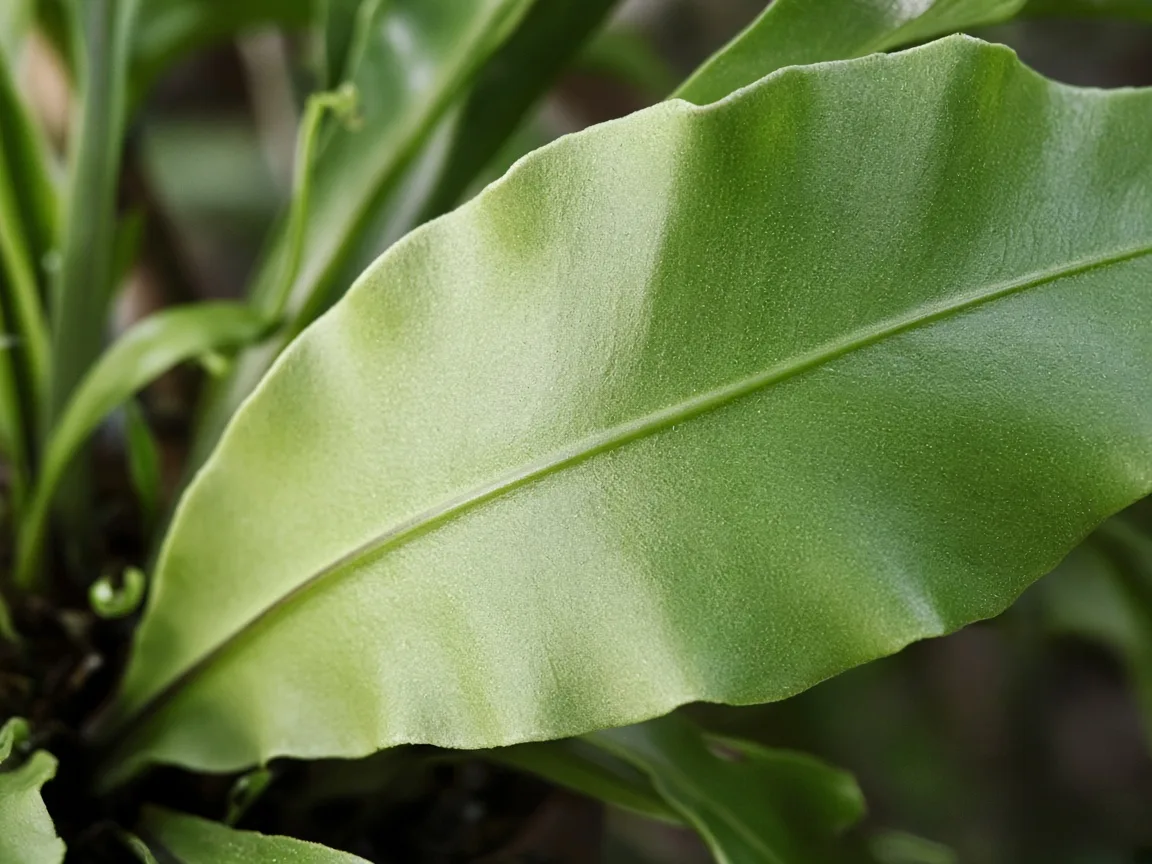
Lime-green, dull strap tissue beside deeper green on the same frond—compare nest fiddlehead color to outer straps before you fertilize or repot.
Too much light (common on window sills):
- Uniform yellow-green or bleached wash on fronds facing the glass, sometimes with dry brown scorch at tips or along midribs
- Stalled or smaller new fiddleheads even though the plant looked “happy” in the shop greenhouse
- UF/IFAS notes that in sunnier locations fronds turn yellow and the plant stops growing—pale wash often precedes full yellowing
- NC State warns too much sun may turn Bird’s Nest Fern yellow or stop growth without the green-vein pattern iron deficiency shows
Too little light (common in dim corners):
- Small, pale, or dull new straps that unfurl slowly while older outer fronds still look green
- Strong lean toward the brightest direction
- Mix stays damp longer than in summer because transpiration is slow—see not enough light for the full low-light checklist
Dry air or underwatering:
- Dull, thin, sometimes crispy-edged straps; pot feels light and top 2–3 cm stays dry for many days
- Bird’s Nest Fern does not tolerate dry conditions the way succulent-tolerant houseplants do
Nutrient-related wash-out (after light and water are ruled out):
- Green veins on pale new nest fiddleheads → iron deficiency
- Lowest outer straps fade first → nitrogen deficiency
- General pale yellowing with poor vigor on exhausted mix → RHS chlorosis guidance and the fertilizer guide
Reading pale color on the nest fiddlehead
Unlike divided ferns, Bird’s Nest Fern shows stress on whole strap blades emerging from one coiled center. The youngest leaf is always the central fiddlehead, not the lowest frond in the pot.
Work at eye level with the nest:
- Color depth — Is only the opening fiddlehead lime-green while the next-oldest strap is glossy deep green? That pattern fits light stress or iron more than whole-pot drought.
- Vein contrast — Pale tissue between darker veins on the newest blade points to iron uptake issues; uniform wash without veins points to sun, shade, or drought.
- Frond age ring — Pale outer straps with a firm green center often means normal aging or nitrogen loss on old tissue; pale center only means the plant cannot fuel the current flush.
This rosette logic is why copying a generic “yellow leaves” checklist from another species fails on Bird’s Nest Fern overview pages.
Why Bird’s Nest Fern gets pale leaves
Bird’s Nest Fern is marketed as shade-tolerant, but indoors that often means surviving in less light than it needs—not maintaining glossy color. UF/IFAS recommends bright, indirect light for houseplant culture, and RHS advises bright indirect light with moist but not soggy compost—filtered brightness, not a hallway glow six feet from glass.
Species-specific drivers:
- Magnified window sun — South or west glass concentrates rays on glossy straps. Pale wash and stalled growth follow before crisp scorch appears.
- The light–watering trap — In dim spots, soil stays wet; roots lose oxygen while fronds look dull and pale. Wet mix plus pale straps is overwatering risk even if you water “lightly.”
- Epiphytic moisture rhythm — In nature the nest traps litter and humidity; indoors you must supply moisture at the root zone without flooding the crown. Chronic dry air pulls water from fronds faster than roots replace it—pair with low humidity fixes.
- Skipped micronutrients in small pots — NC State recommends dilute liquid fertilizer during active growth for containers; pale new straps on an otherwise well-lit plant may reflect depleted iron or nitrogen after a season of leaching.
- Misread iron or nitrogen — Iron hits the newest nest fiddlehead with green veins; nitrogen fades lowest outer straps first. Uniform pale wash after a window move is usually light, not feed hunger.
How to confirm the cause
Run these checks in order—stop when one pattern clearly fits.
Light and placement
- Note window direction and whether direct sun touches fronds between 10 a.m. and 4 p.m.
- Compare newest fiddlehead to outer strap color on the same plant (your first-step test).
- If the rosette leans strongly, suspect insufficient usable light per light placement.
Water and crown
- Press the top 2–3 cm of mix—dry for many days with a light pot suggests underwatering; wet for 10+ days in a warm room suggests overwatering in low light.
- Confirm you water along the pot edge, not into the nest center (see next section).
- Sniff the drainage hole—sour odor means root stress, not a feed deficiency.
Humidity and pests
- In heated winter air, check for crispy margins with otherwise pale straps.
- Backlight fronds for stippling or webbing—spider mites dull color in dry rooms; see spider mites if dots appear.
Nutrients (only after light and moisture stabilize)
- Green-vein pale new fiddlehead → iron guide.
- Lowest outer straps yellowing first → nitrogen guide.
- White crust on pot rim → flush before feeding again.
Never water pale straps through the nest center
Bird’s Nest Fern’s common name describes a central funnel that collects debris in the wild. Indoors, pouring water into that cup keeps the crown wet while roots elsewhere may still dry—roots function poorly, and new fiddleheads stay pale or fail.
Correct edge watering matches watering dry-down: soak the outer root zone until a little drains, then let the top 2–3 cm dry before the next drink. Keep the nest dry unless you are briefly rinsing dust off mature outer fronds with a soft shower—not a daily habit.
If pale fronds appeared after you started “filling the nest,” switch to edge watering for four weeks and judge the next unfurling fiddlehead only.
The first fix to try
After your fiddlehead-vs-outer-strap comparison:
If fronds face direct sun or look bleached on the window side: pull the pot 12–24 inches back from the glass or hang a sheer curtain so light is bright but filtered. Hold feed and repotting for two weeks.
If the newest fiddlehead is small, dull, and slow in a dim spot: move 12–24 inches closer to your brightest safe window (east or filtered north/south/west). Do not jump from a dark shelf to a scorching sill in one day—acclimate over 10–14 days.
If the pot is very light and top mix is dusty-dry: one thorough edge watering until drainage runs, then resume the normal dry-down—do not mist the nest as a substitute.
Pick one of those corrections, then wait for the next central fiddlehead before stacking fertilizer, repotting, or pesticide.
Step-by-step recovery
- Stabilize light using the first-fix branch above; rotate the pot weekly for even exposure.
- Lock watering to edge drinks and top 2–3 cm dry-down—empty cachepot water after 30 minutes.
- Raise humidity to 50–70% if heaters run—humidifier or grouped plants beat occasional mist on straps alone.
- If light and water are stable for three weeks and new straps stay pale with green veins, follow one chelated iron drench per the iron deficiency guide.
- If lowest outer straps fade while the center stays small, address nitrogen per the nitrogen deficiency page after confirming drainage.
- Repot only when roots circle the base and dry-down is erratic—use airy, slightly acidic mix in spring, not as day-one pale-leaf therapy.
Recovery timeline
Bird’s Nest Fern grows slowly; pale straps you are staring at today may be weeks old.
- Light correction: expect a firmer, greener fiddlehead within 2–4 weeks in warm months; winter may take longer under short days.
- Water rhythm fix: one good wet–dry cycle can stop spreading dull color within 7–10 days; regained gloss appears on new tissue only.
- Nutrient correction: after iron or nitrogen fixes, judge the next one or two nest fiddleheads over 3–6 weeks—not old strap color.
Full outer-ring refresh on a large specimen may take one warm season because the plant adds fronds slowly.
Mistakes to avoid
- Fertilizing a pale rosette on soggy mix—salts worsen stress before roots recover.
- Misting the nest daily instead of fixing soil moisture and humidity.
- Repotting and pruning the same week you move windows—ferns stall when stacked.
- Assuming “low-light plant” means a bathroom with no window—pale new growth is the tell.
- Treating all pale straps as iron deficiency without green-vein pattern on the newest fiddlehead.
How to prevent pale leaves next time
- Place the fern 1–4 feet from an east window or behind shear on bright south/west per light.
- Water edges only; keep the nest dry; follow summer vs winter dry-down in the watering guide.
- Maintain 50–70% humidity in heated rooms.
- Feed dilute complete liquid with micronutrients monthly in late spring and summer when fiddleheads are active—see fertilizer.
- Flush salts occasionally if white crust builds on the rim.
- Repot every ~2 years when roots circle and the pot dries unevenly.
When to worry
Higher urgency:
- Soft, sunken crown on wet mix with spreading yellow—root rot risk regardless of pale color.
- Three successive pale or failed fiddleheads after light and water fixes.
- Rapid bleaching on most straps within days of a window move—pull back from sun immediately.
Lower urgency: one outer strap slowly losing gloss while new nest growth stays firm and green—that is routine aging. Browse the problems hub if multiple symptoms overlap.
Related Bird’s Nest Fern guides
Scope note: Use this page when multiple straps or the whole rosette look washed-out after a light, water, or humidity change. Use iron deficiency when only the newest nest fiddlehead shows green-vein yellowing, not enough light when new fronds stay small and slow in a dim spot, and overwatering when the crown softens on wet mix.
Related tool
Use the Plant Problem Diagnosis Tool to narrow causes for pale leaves on this plant before changing multiple variables at once.