Whiteflies on Bird's Nest Fern: Frond Underside Checks
Quick answer
Whiteflies on Bird's Nest Fern show up as a white cloud from frond undersides and the nest cup lip—often with sticky honeydew on glossy lower fronds. First step: isolate the pot and blast frond undersides with firm water along the pot edge, keeping the central rosette from holding standing water.
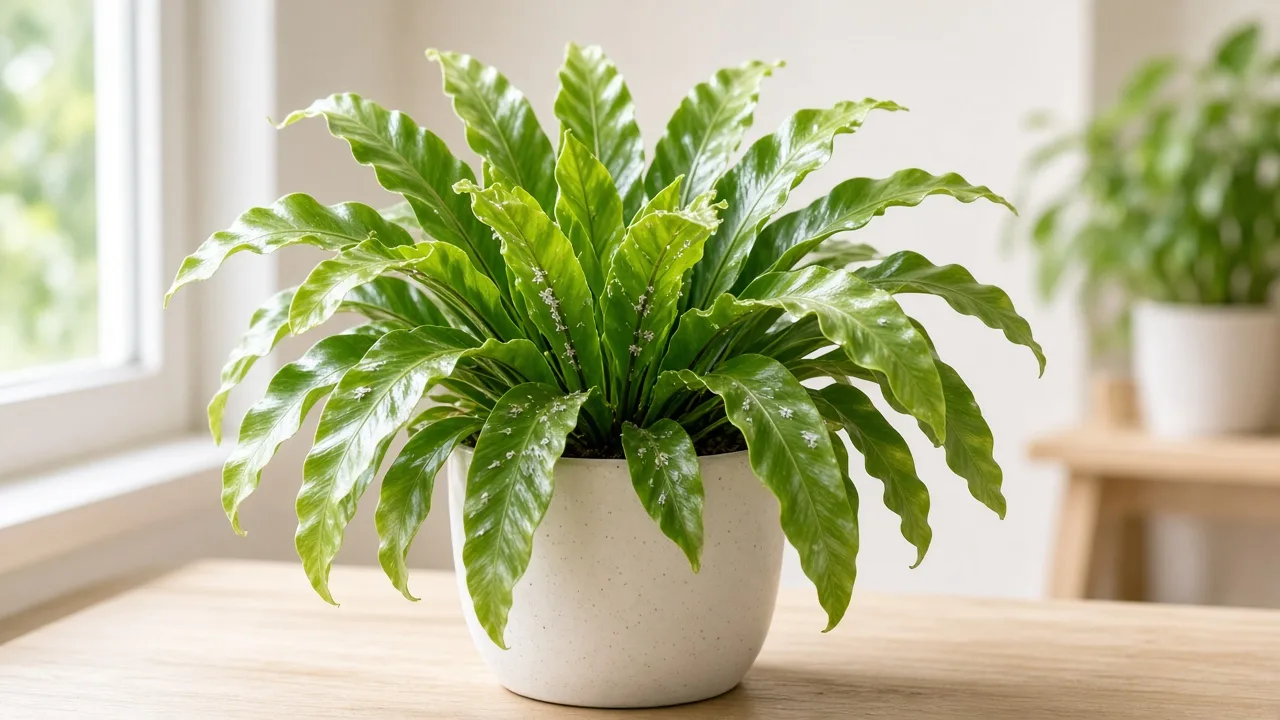
Whiteflies on Bird's Nest Fern: Causes, Checks & Fixes
This guide covers whiteflies on Bird's Nest Fern. See also the general Whiteflies guide, watering, and light pages for this plant.
Whiteflies on Bird's Nest Fern: Causes, Checks & Fixes
Quick answer
Whiteflies are tiny, sap-sucking insects that fly when disturbed. On Bird’s Nest Fern (Asplenium nidus), adults look like miniature white moths tucked under broad, wavy fronds and along the nest cup lip where outer leaves overlap. Brush past the rosette and a white cloud rises before insects resettle on undersides. Immobile nymphs look like flat pale disks glued to the same surfaces.
For how whitefly life cycles work, why yellow sticky traps catch adults, and when insecticidal soap helps in general, see our whiteflies pest guide. On Bird’s Nest Fern, the practical pattern is warm-season colonies on lower frond undersides and the sheltered nest cup, sticky shine on glossy foliage in humid rooms, and flying insects when you adjust the pot or mist nearby plants.
First step: isolate the fern away from other houseplants, then blast frond undersides with a firm stream of water along the pot edge—without pouring water into the central rosette. A soft, collapsing nest cup on constantly wet mix is a different emergency—see overwatering on Bird’s Nest Fern before you treat pests.
Bird’s Nest Fern is non-toxic to cats and dogs; still keep pets away while soap or oil treatments dry.
When to use this page vs other Bird’s Nest Fern guides
This page is the pest-first entry for flying white sap feeders on glossy fern fronds.
| What you see | Read next |
|---|---|
| White cottony tufts at frond bases or in the nest cup | Mealybugs on Bird’s Nest Fern |
| Hard brown bumps without flying adults | Scale insects on Bird’s Nest Fern |
| Fine webbing and stippled yellow dots | Spider mites on Bird’s Nest Fern |
| Silver streaks and black specks on young fronds | Thrips on Bird’s Nest Fern |
| Soft pear-shaped insects on new growth | Aphids on Bird’s Nest Fern |
| Yellow fronds, wet mix, sour soil smell | Overwatering on Bird’s Nest Fern or root rot on Bird’s Nest Fern |
| Brown herringbone lines on undersides, no honeydew | Normal sporangia—not pests; see Bird’s Nest Fern overview |
Browse all issues on the Bird’s Nest Fern problems hub.
Why Bird’s Nest Fern rosettes attract whiteflies
Broad, undivided fronds offer large underside feeding zones. Asplenium nidus grows as a stemless rosette with strap-shaped fronds that unfurl from a tight center. Large whitefly colonies often develop on leaf undersides—on this fern, that means the lower surface of outer fronds and the overlap zone at the nest cup, not the smooth upper blade you see from across the room.
The nest cup traps humid, still air. Bird’s Nest Fern wants steady moisture and indirect light in the 50–70% humidity range many living rooms already provide. Those same conditions let whiteflies build quickly in warm weather when natural enemies are scarce and fronds stack in a sheltered rosette—similar to the protected crown pockets mealybugs exploit, but whiteflies fly and resettle on undersides after disturbance.
Epiphyte ancestry means pests ride in on new plants. NC State notes Asplenium nidus as an epiphyte that can grow on trees or in loose mix. Nursery benches, shared greenhouse carts, and unquarantined ferns beside infested vegetables are the usual entry routes—not correct edge watering alone.
Ants and honeydew accelerate outbreaks. Whiteflies excrete sticky honeydew that drips onto lower fronds and pot rims. Ants harvesting that sugar protect colonies from lady beetles and lacewings, so populations climb faster on a fern sitting on a crowded plant shelf.
What whiteflies look like on Bird’s Nest Fern
Healthy Bird’s Nest Fern fronds are glossy, wavy, and undivided—unlike lacy maidenhair ferns where pests hide among pinnae. Whiteflies exploit the flat underside of each strap frond and the nest cup architecture where several fronds touch.
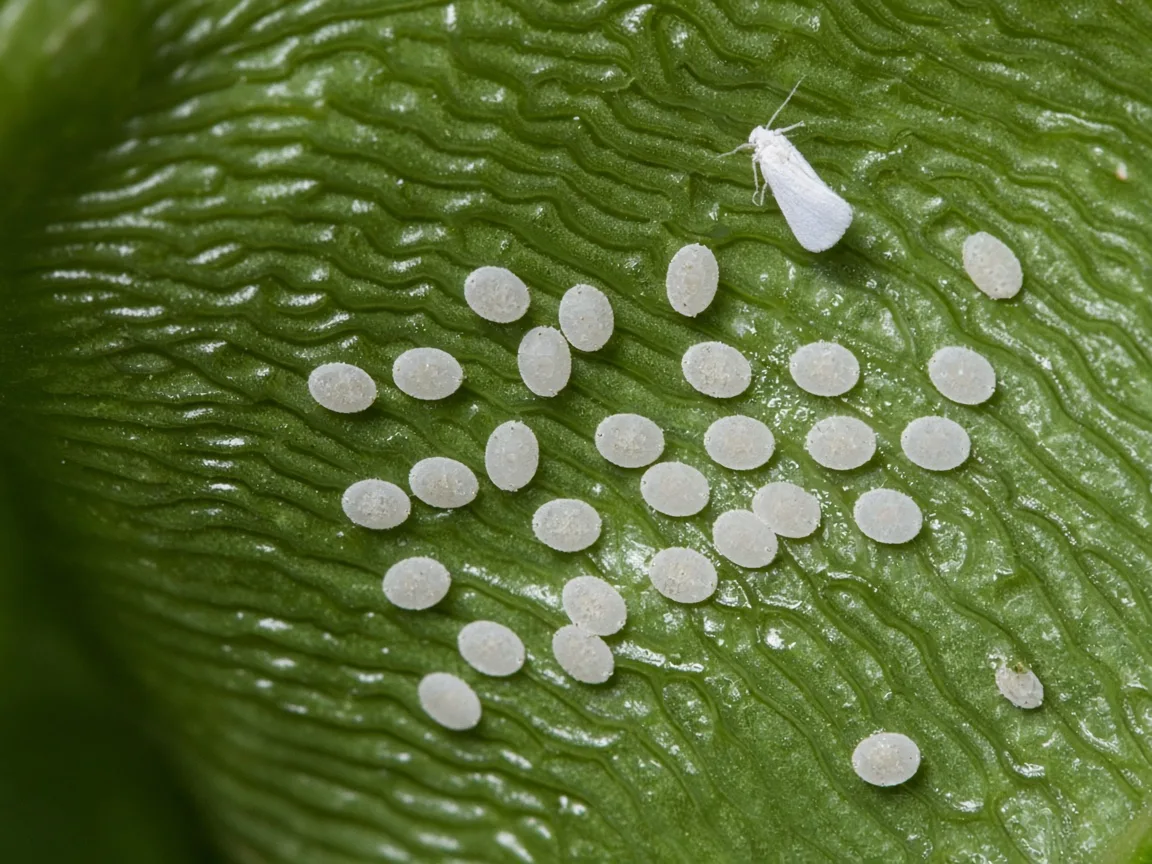
Flat pale whitefly nymph disks on a Bird’s Nest Fern frond underside—compare with the glossy green blade above.
Typical signs on Asplenium nidus:
- A sudden white cloud when you move the pot, mist nearby plants, or lift an outer frond
- Tiny moth-like adults, about 1/16 inch long, resting on frond undersides
- Flat, oval, pale nymphs glued to the same surfaces after crawlers settle
- Sticky honeydew on lower fronds, the pot rim, or cachepot lip beneath the rosette
- Ants climbing the pot toward the nest cup
- Yellowing or dulling of outer fronds while the center still pushes new growth
- Sooty black mold on sticky frond surfaces if honeydew has been present for days
Do not confuse the fern’s normal brown sporangia lines on mature frond undersides with pests. Those lines run in herringbone rows from midrib to margin, are stationary, and are not accompanied by honeydew, flying adults, or ants. Whitefly nymph disks are irregular pale ovals and smear when crushed.
Because damage concentrates on outer frond undersides, the rosette can look fine from above while the lower third is already sticky—unlike yellow leaves from root stress, which often start at the base of older fronds.
Where to inspect on the nest rosette
Whiteflies on Bird’s Nest Fern do not distribute evenly. Work through this order—specific to a rosette fern, not a vining houseplant:
- Undersides of the outer third of fronds — Lift each broad blade gently and check the lower surface, especially where two fronds overlap.
- Nest cup lip — Peer into the crevice where new fronds emerge; adults resettle here after disturbance.
- Newest unfurling frond — Soft tissue at the center attracts crawlers within hours of settling.
- Pot rim and bench surface — Honeydew drips and slow-moving nymphs travel between neighboring pots.
- Plants on the same shelf — Check other ferns and leafy companions before assuming one pot is the only source.
Hold white paper under a frond and tap the blade. Flying white insects that resettle on undersides confirm active adults—not just old honeydew spots.
Confirm whiteflies vs mealybugs, scale, thrips, mites, and wet mix
| What you see | Likely cause | Key check |
|---|---|---|
| White cloud when fronds are bumped | Whiteflies | Undersides for nymph disks and honeydew |
| White cottony masses at frond bases | Mealybugs | Stationary wax; adults do not fly in clouds |
| Hard immobile bumps on midribs | Scale insects | Shell unchanged when scraped |
| Fine webbing and yellow stippling | Spider mites | Dry air stress; no flat glued disks |
| Silver streaks on young fronds | Thrips | Slender fast insects; not moth-like adults |
| Soft nest cup, sour wet mix | Overwatering / root rot | No nymph disks; soil never dries at top 2–3 cm |
Confirmed diagnosis — Flying adults plus flat nymph disks on undersides and sticky honeydew with firm lower frond bases. Suspected — One or two flying insects with no nymphs visible; recheck in two days with a lens before spraying the whole rosette.
First fix: isolate and rinse frond undersides with water
Move the fern away from other plants and rinse every frond underside with firm water pressure along the outer pot edge.
Set the pot in a shower, sink, or outdoor hose station where runoff will not splash clean neighbors. Spray frond undersides and overlap zones until adults fly off and nymphs rinse away. UC IPM lists hosing adults off with a strong stream of water as an early cultural step—on Bird’s Nest Fern, tilt the rosette so water runs outward and down the pot sides, not into the central nest cup where standing moisture invites crown rot.
Do not apply soap, neem, or oil the same hour unless water alone failed on reinspection. UF/IFAS notes that insecticides are typically damaging to ferns, so exhausting contact rinses first protects the glossy fronds you are trying to save.
Rinse timing in humid rooms
After blasting, let fronds dry in bright indirect light with airflow. Bird’s Nest Fern tolerates steady root-zone moisture but dislikes water sitting in the nest cup overnight in still, enclosed rooms—improve airflow after rinsing and avoid misting directly into the center the same evening.
Repeat the water blast every three to four days until two inspections find no flying adults and no fresh nymph disks on sampled undersides.
When to add soap or neem
If colonies remain after two or three weekly rinse cycles, apply insecticidal soap or neem oil labeled for ornamentals. Soaps and oils control only whiteflies they directly contact, so coat undersides until product runs off. Epic Gardening recommends repeating soap treatments on a short cycle until populations drop—typically every five to seven days for two to three rounds on a single pot.
Critical rules for Bird’s Nest Fern:
- Spray when fronds are cool and temperatures stay under 90°F.
- Patch-test one frond and wait 24 hours before treating the whole rosette.
- Avoid broad-spectrum pyrethroids that kill natural enemies and let whiteflies build resistance.
Hang one yellow sticky trap level with the rosette to catch flying adults and monitor whether numbers fall between rinses. Traps alone will not clear a fern, but they help you read progress.
Remove and bag only the few fronds that carry most nymph disks—do not strip the entire outer ring unless collapse is already advanced and you have confirmed roots are still firm.
What not to do the same day
Do not pour rinse water or soap solution into the nest cup to “wash pests away.” Do not increase watering because fronds look dull—check whether the top 2–3 cm of mix is actually dry first. Do not apply oil in hot afternoon sun on a windowsill. Do not ignore ants—they protect whitefly colonies from beneficial insects.
Recovery timeline and new frond flush
Within 24–48 hours of a thorough underside blast, you should see fewer flying adults and less fresh honeydew on frond bases.
One to three weeks of repeated rinses or soap cycles is typical before the center pushes clean new fronds. Yellowed or honeydew-coated fronds will not fully green up once they harden. Judge success by the next frond unfurling from the rosette, not by reopening damaged tissue.
Firm frond bases and steady new growth from the center are good signs. Softening at the nest cup on wet mix means rot—not whiteflies—and needs a different response immediately.
Worsening signs: white clouds from multiple fronds after treatment, sooty mold spreading across the rosette, stalled new fronds that stay deformed after two treatment cycles, or whiteflies jumping to every neighbor pot—those mean escalation, not patience.
How to prevent whiteflies on Bird’s Nest Fern
Quarantine every new fern for two weeks before placing it on a shared shelf. Inspect frond undersides weekly during spring and summer active growth. Blast undersides occasionally when you water at the pot edge, especially after moving plants between indoors and a humid bathroom.
Keep care aligned with the Bird’s Nest Fern overview—indirect light, aerated mix with bark or coir, and moisture that matches how fast the pot dries. Manage ants on pot rims before they establish whitefly “farms” under overlapping fronds.
Inspect new plants for whiteflies before introducing them to a collection—UC IPM recommends pre-introduction checks because nymphs are easy to miss on glossy undersides.
When to escalate
Escalate if nymph disks coat most outer frond undersides after three full rinse-and-soap cycles, if sooty mold covers most foliage, or if ants make colonies impossible to rinse away. Chronic feeding during warm months can stall new fronds even when roots are healthy.
For heavy recurring infestations, a local extension office can confirm the species and discuss options. Systemic insecticides move through plant sap and can damage sensitive fern tissue—contact rinses and soaps are usually safer first choices on Asplenium nidus.
Whiteflies alone rarely kill a mature Bird’s Nest Fern with firm frond bases, but they can ruin a flush of new growth and open the door to crown stress if you respond with extra water into the rosette or heavy oil sprays on a hot windowsill.