Whiteflies on Calathea (Prayer Plant): Causes, Checks &
Quick answer
Whiteflies on Calathea show as a white cloud from leaf undersides when disturbed, with flat pale nymph disks glued beneath patterned blades. First step: isolate the plant the same day you see flying insects, then wash every reachable leaf underside with lukewarm water.

Whiteflies on Calathea: Causes, Checks & Fixes
This guide covers whiteflies on Calathea. See also the general Whiteflies guide, watering, and light pages for this plant.
Whiteflies on Calathea: Causes, Checks & Fixes
Quick answer
If brushing your Calathea sends up a white cloud of tiny moth-like insects from leaf undersides, you are likely dealing with whiteflies—not dust, not mineral spray residue. Adults are wedge-shaped and powdery white; nymphs look like flat pale disks glued to the underside. For general whitefly biology and life cycle, see our whiteflies guide. On Calathea prayer plants, pests often hide on rolled new leaves still unfurling, patterned leaf undersides, and crowded Marantaceae shelf groupings—places quick top-down checks miss.
First step: isolate the plant the same day you see flying white insects, then wash every reachable leaf underside with lukewarm water.
When to use this page vs other Calathea guides
| Pattern | Read next |
|---|---|
| White cloud when disturbed | This page |
| Cottony wax in crown axils | Mealybugs |
| Fine stippling with webbing | Spider mites |
| Silver streaks on blades | Thrips |
| Sticky leaves, no flying insects | Scale insects |
| Yellow leaves, wet soil, no pests | Overwatering |
What whiteflies look like on Calathea
Calathea carries broad, thin, patterned blades—pink stripes on Goeppertia ornata, peacock rounds on G. makoyana, medallion markings on G. veitchiana. Whitefly damage shows on both the decorative top surface and the purple or burgundy undersides where nymphs feed.
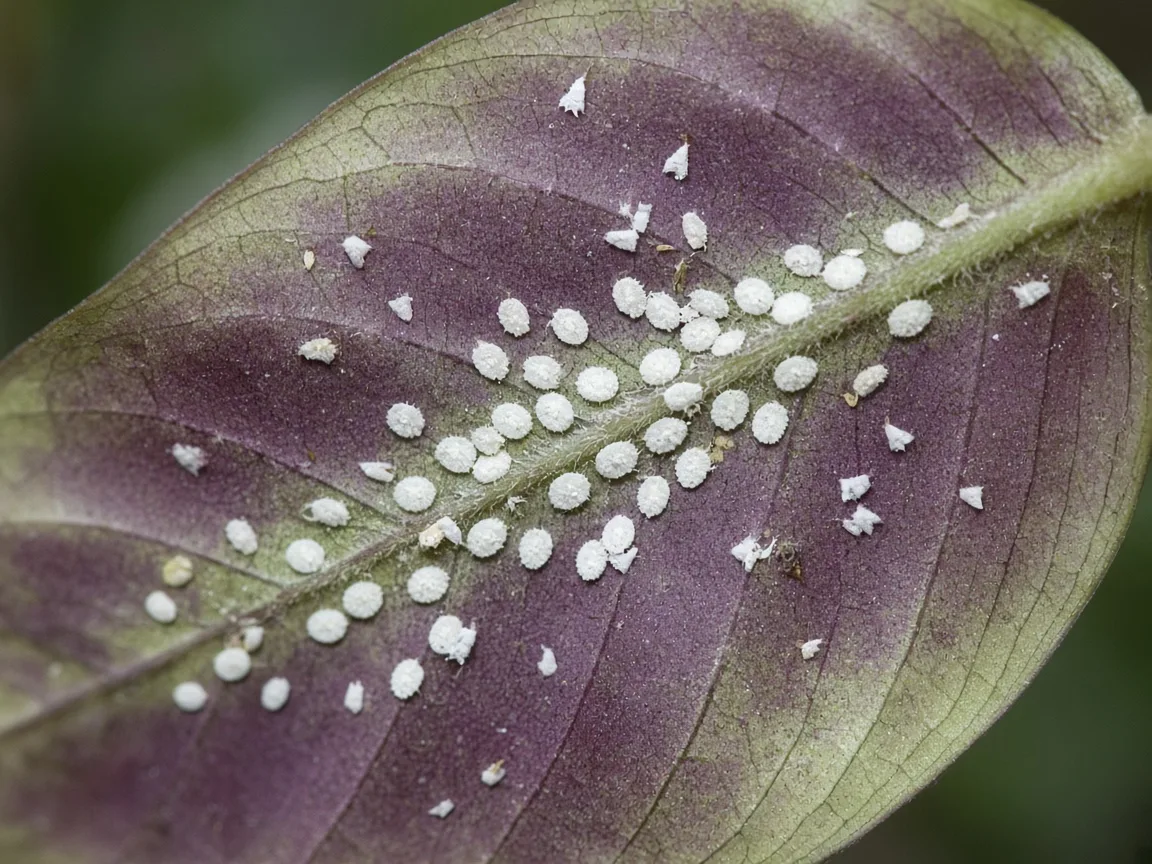
Flat nymph disks and powdery white adults on a Calathea leaf underside—compare with clean tissue on an older lower blade from the same stem.
Early signs:
- A brief white cloud when you water, mist, or move the plant
- Flat, immobile pale disks on leaf undersides along midribs and veins
- Shiny, sticky honeydew on upper leaf surfaces or the pot rim below
- Slight dulling of pattern contrast on blades that looked crisp last week
Established infestation:
- Black sooty mold growing on honeydew—not on the leaf tissue itself
- Yellowing or mottled patches where sap feeding is heavy
- Stunted or distorted new center rolls opening with stippling already present
- Ant trails on the pot exterior harvesting honeydew
Unlike spider mites, whiteflies do not produce fine webbing or uniform stippling unless mites are also present. Unlike mealybugs, you will not see cottony wax clusters—adults fly when disturbed and nymphs stay flat against the leaf.
Damaged patterned tissue does not fully revert. Judge recovery by clean new rolled leaves from the crown, not by old blades regaining their original contrast.
Why prayer plants get whiteflies
Calathea belongs to Marantaceae—the prayer plant family alongside Maranta, Ctenanthe, and Stromanthe. These plants evolved in humid tropical understory and grow as upright clumps with overlapping blades that fold upward at night. Indoors they need bright filtered light, evenly moist soil, and high humidity—conditions that also describe many heated rooms where whiteflies thrive year-round.
Whiteflies are piercing-sucking insects that feed on leaf undersides. Homes and greenhouses stay warm enough for year-round reproduction, and indoor plants lack the natural enemies that control them outdoors.
Calathea-specific risk factors:
- Rolled new leaves - Calathea pushes new blades tight like cigars before they open. Whitefly nymphs feed inside that sheltered cylinder days before adults appear on the striped surface.
- Nyctinastic folding - Blades lift at dusk and hide undersides from casual daytime inspection. A plant that looks clean from across the room can harbor colonies on folded purple backs.
- Dense Marantaceae groupings - Shelves of calatheas, marantas, and ctenanthes trap pests between overlapping foliage and let adults drift pot to pot.
- Nursery hitchhikers - Pests arrive on new stock hidden in crown axils and rolled tips.
- Sticky honeydew on patterned foliage - Sooty mold shows clearly against pink stripes and dark purple undersides, but by then colonies are usually established.
Stress does not cause whiteflies, yet a Calathea already struggling with dry air or recent repotting has fewer resources to outgrow feeding damage. Treat the insects first, then address separate care stress once populations drop.
Rolled prayer leaves: where Calathea hides whiteflies
Calathea’s newest growth arrives as a tight rolled spear at the crown. Whiteflies exploit that cylinder the same way thrips and mealybugs do: nymphs attach to the inner surface while the leaf is still closed, and adults emerge onto neighboring open blades once the roll unfurls.
Work systematically during treatment:
- Gently unroll or peel back the outer layer of each new spear with bright light—not so forcefully that you tear thin tissue.
- Inspect purple undersides along midribs on lower mature leaves where nymph disks cluster.
- Check where petioles meet the rhizome crown in the dense center of the clump.
- Tilt the pot and look upward into overlapping blades—the view from below catches colonies top-down checks miss.
One rushed pass over visible leaf tops will not reach the feeding sites that matter on prayer plants.
Lookalike symptoms
| What you see | Likely cause | How to tell apart |
|---|---|---|
| White cloud when disturbed | Whiteflies | Adults fly; flat disks on undersides |
| Cottony wax in axils | Mealybugs | Wax tufts smear pink when crushed |
| Fine stippling + webbing | Spider mites | Paper-tap test; worse in dry winter air |
| Silver streaks, no flying insects | Thrips | Scrape test on leaf surface |
| Brown oval bumps | Scale insects | Stationary; no white cloud |
| Even yellow leaves, wet soil | Overwatering | No honeydew or nymph disks |
How to confirm the cause
Work through these checks before spraying anything:
- Disturbance test - Tap a suspect leaf or run lukewarm water across undersides. A white cloud of adults rising from foliage confirms whiteflies over dust or hard-water residue.
- Underside inspection - Use bright light and a hand lens. Nymphs look like flat immobile disks glued to the leaf back—not cottony wax or moving mites.
- Honeydew check - Sticky, shiny residue on upper blades or the saucer below feeding sites supports sap-feeder diagnosis. Black sooty mold on that stickiness is a secondary sign, not the primary pest.
- Rolled-leaf check - Inspect unfurling center spears and folded undersides in the evening when blades lift per Calathea’s daily rhythm.
- Neighbor plants - Check other prayer plants on the same shelf. Whiteflies rarely stay on one pot once honeydew appears.
- Soil moisture - Press a finger into the top 2 cm of mix per your normal watering rhythm. Uniform yellow leaves with wet soil and no pest signs point to overwatering instead.
If no adults fly, no nymph disks appear, and honeydew is absent, rule out thrips, mealybugs, and environmental yellowing before treating for whiteflies.
First fix for Calathea
Isolate the plant the same day you see flying white insects, then wash every reachable leaf underside with lukewarm water.
Move the Calathea away from healthy Marantaceae immediately. Adults drift on air currents; nymphs spread as crawlers before they settle. Carry the pot to a sink or shower and spray undersides with moderate pressure—enough to dislodge nymphs, not so hard that you tear thin patterned blades.
Calathea-specific cautions during washing:
- Keep water from pooling in the crown - dense prayer-plant clumps hold moisture at the leaf base; wet crowns overnight in cool stagnant air invite fungal spotting unrelated to the pests.
- Reach rolled new leaves - part each unfurling spear gently and rinse the inner surface where nymphs hide.
- Let foliage dry the same day - do not rinse late evening if the plant sits in a cold room with poor airflow.
- Wash the pot exterior and tray - honeydew and crawlers can shelter on container rims.
Washing leaf undersides helps control nymphs when you reach the hidden crevices sprays miss on calathea. One wash is not a cure—whiteflies overlap life stages and generations can complete in about 18 days indoors—but isolation plus thorough washing is the correct opening move.
Step-by-step recovery
- Complete the first fix on every affected section, including rolled spears and folded undersides.
- Repeat physical washing on a five-to-seven-day schedule through at least three life cycles. Nymphs and pupae on undersides are easy to miss on the first pass.
- Add yellow sticky traps near the pot—not inside the crown—to catch flying adults without touching foliage. Adults are attracted to yellow.
- Apply insecticidal soap or horticultural oil only after confirming active pests. Test one older lower leaf, wait 24 hours, and check for bleaching before treating patterned blades. Spray undersides thoroughly; top-surface-only sprays fail on whiteflies.
- Inspect neighbors on the same shelf and treat or isolate any matching signs before returning the Calathea to a shared display.
- Two clean weeks - no flying adults, no fresh honeydew, no new nymph disks—before grouping the plant with other prayer plants again.
Whiteflies are extremely difficult to control once established. Expect four to five treatment passes at five-to-seven-day intervals rather than a single spray. Do not stack repotting, heavy pruning, and pesticide on the same day on a stressed Calathea.
Mistakes to avoid
- Do not assume a quick glance at patterned tops is enough—inspect folded undersides and rolled spears.
- Do not mist foliage as pest control—wet blades in a dense crown spread fungal problems on humidity-sensitive prayer plants.
- Do not fertilize a heavily infested plant to “help it recover”—fix pests first.
- Do not return the plant to a Marantaceae grouping after one wash—two clean weeks of inspections matter.
- Do not confuse honeydew stickiness with normal hard-water mineral crust on pot rims—whiteflies leave tacky residue on leaf surfaces too.
Recovery timeline
Physical control shows results within days on small colonies—fewer adults in the white cloud, fewer fresh nymph disks on washed undersides. Full treatment usually takes two to four weeks of repeated passes because overlapping life stages hatch on different days.
Judge recovery by:
- Clean new rolled leaves opening flat during the day without stippling
- No fresh honeydew on upper blades or the saucer
- Firm rhizome and steady watering rhythm without new yellowing
Old honeydew-stained or mottled blades may stay marked until they age out. Success means the next crown flush looks clean, not that every existing leaf regains perfect pattern contrast.
Prevention
- Quarantine new plants two to three weeks before placing them among prayer plants.
- Inspect undersides weekly during normal care—especially rolled spears and folded backs in winter when heating runs.
- Avoid overcrowding Marantaceae on one shelf; leave space to tilt blades and see purple undersides.
- Keep baseline care steady per the light guide and watering guide so yellowing from stress does not mask early pest signs.
- Check nursery purchases at the crown before assuming patterned tops mean a clean plant.
Related Calathea guides
- Calathea overview
- Calathea watering
- Calathea light
- Calathea soil
- Spider Mites
- Mealybugs
- Thrips
- Brown Tips
- Calathea problems hub
Conclusion
Whiteflies on Calathea mean sap feeders found the sheltered undersides and rolled spears that prayer plants provide. Isolate, wash every reachable leaf back—including unfurling center rolls—repeat on a five-to-seven-day schedule, and judge recovery by clean new foliage, not by old blades regaining perfect stripes.