Whiteflies on English Ivy: Causes, Checks & Fixes
Quick answer
Whiteflies on English ivy show as tiny powdery white adults on leaf undersides—a brief white cloud rises when you mist or move trailing vines. First step: isolate the plant away from other houseplants, then rinse every leaf underside with lukewarm water before any spray.
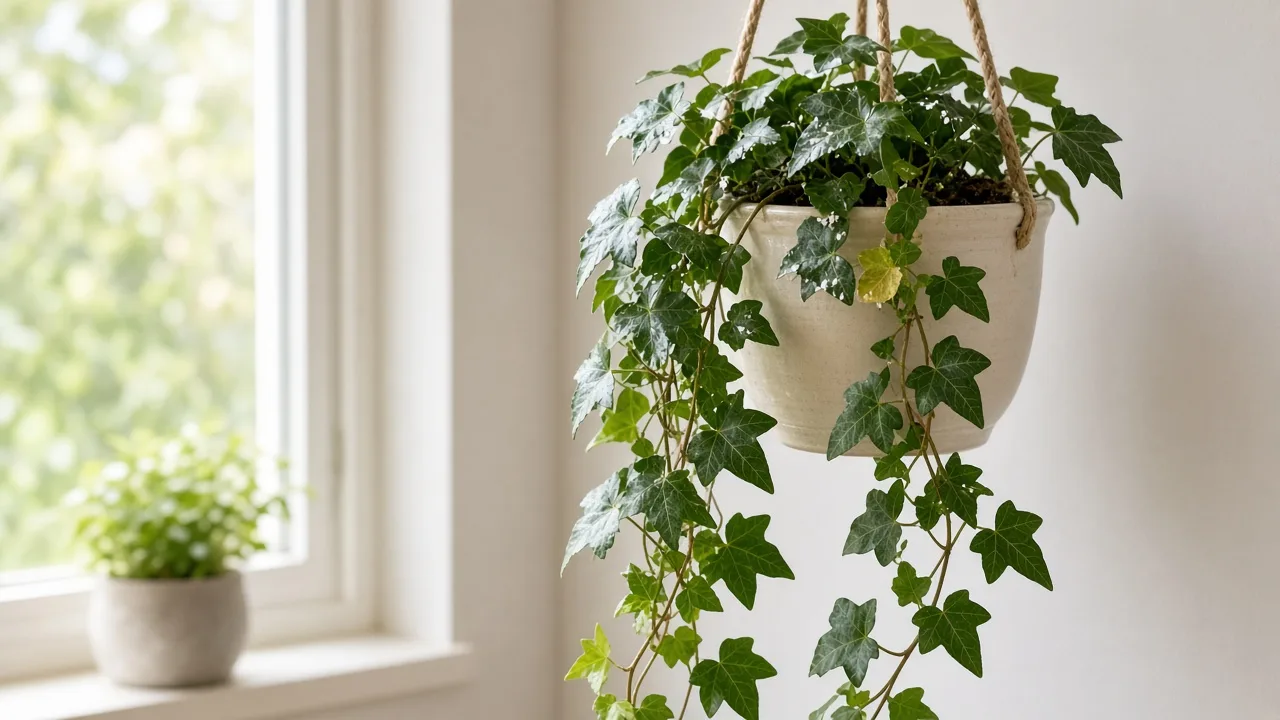
Whiteflies on English Ivy: Causes, Checks & Fixes
This guide covers whiteflies on English Ivy. See also the general Whiteflies guide, watering, and light pages for this plant.
Whiteflies on English Ivy: Causes, Checks & Fixes
Quick answer
Whiteflies on English ivy (Hedera helix) are sap-sucking insects that colonize the undersides of lobed leaves along trailing vines and in the dense inner canopy where a quick glance at the cascade misses them. Disturb the plant and adults rise in a white cloud before resettling—one of the clearest pest signals on a hanging or shelf-trailing ivy.
Immature nymphs look like flat disks stuck to leaf undersides and do not fly. Both stages drain sap, leave sticky honeydew, and can support black sooty mold on upper leaf surfaces or the floor below a basket.
For how whiteflies behave on houseplants in general, see our whiteflies guide. On ivy, the urgent pattern is flying adults plus flat nymphs under the newest trailing tips and along veins on overlapping inner leaves.
First step: isolate the plant the same day you see flying white insects. Move it away from pothos, ferns, and other collection plants before you rinse, trap, or spray. Once isolated, wash every leaf underside with lukewarm water or a damp cloth to knock down nymphs and dislodge adults.
Wear gloves when handling wet vines for long rinses—English ivy sap can irritate skin, and ivy is toxic to cats and dogs if chewed, which matters when trailing stems hang at pet height.
What whiteflies look like on English Ivy
Adult whiteflies are about 1/16 to 1/10 inch long, wedge-shaped, and powdery white. On ivy they cluster on sheltered undersides of lobed leaves, especially on soft new growth at vine tips and on leaves stacked in the center of a full hanging basket.
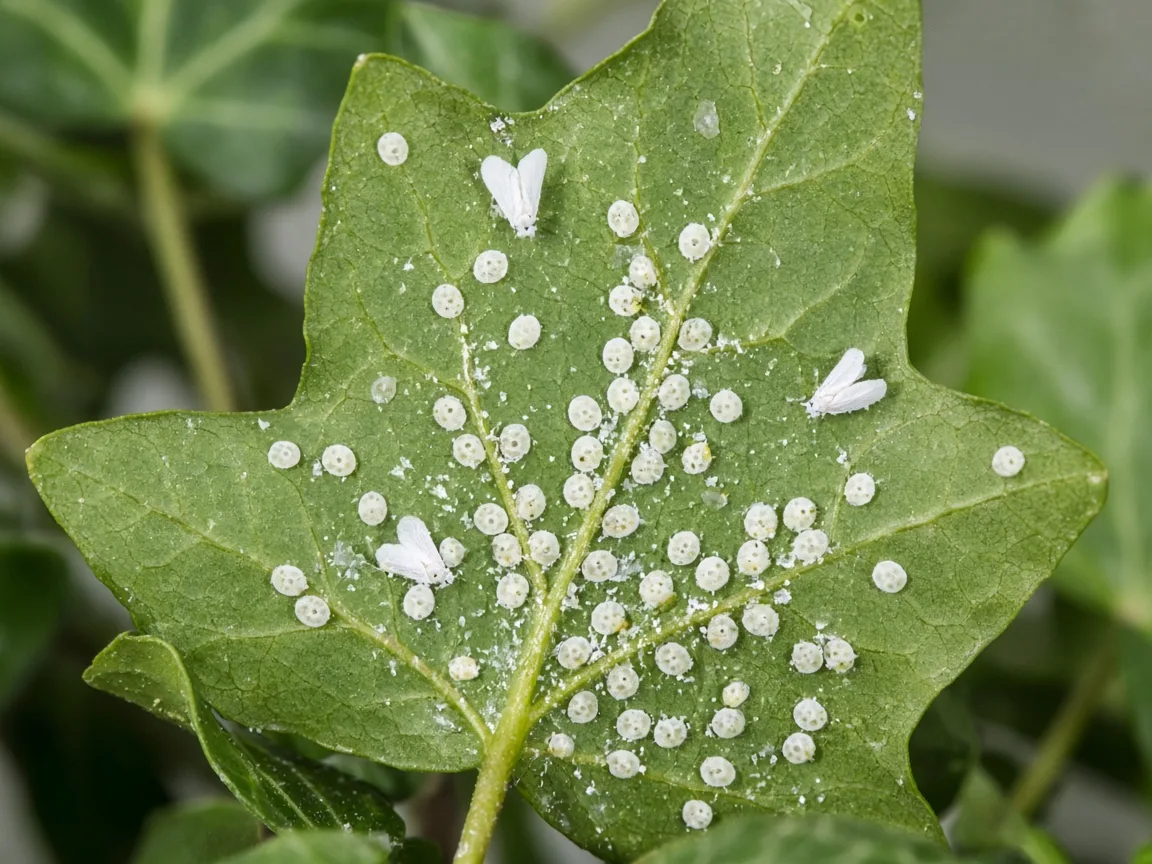
Flat pale nymphs and tiny white adults on an ivy leaf underside—lift trailing stems and inspect the midrib zone before honeydew drips onto lower leaves or furniture.
Typical signs on trailing ivy:
- A white cloud rising when you water, mist, or bump the pot
- Flat immobile specks on leaf backs, especially on newest tips and along veins
- Sticky honeydew on upper leaf surfaces, pot rims, or the shelf or floor below hanging vines
- Black sooty mold on honeydew-coated foliage (mold grows on the residue, not inside leaf tissue)
- Yellowing or dulling on heavily fed blades while older inner leaves may still look green
- Slow tip growth when feeding concentrates on the softest unfolding lobes
On ivy specifically, damage often shows first on the outer trailing edge and on lower leaves in a basket, because gravity carries honeydew downward before the upper cascade looks wrong. A mantel ivy pressed against a wall can harbor nymphs on the back side of leaves you never see during top-down watering.
Unlike aphids on English Ivy, whiteflies fly when disturbed and lack tight pear-shaped clusters on growing tips. Unlike mealybugs, they do not form cottony wax in axils. Unlike fungus gnats, they stay on foliage, not at the soil surface.
Why English ivy gets whiteflies
Whiteflies are closely related to aphids, mealybugs, and scale and feed by sucking sap from leaf undersides. They are not caused by one watering mistake—they arrive on contaminated stock, summer patio placements, open windows, or infested neighbors, then exploit ivy’s constant new growth indoors.
English ivy–specific risk factors:
- Trailing architecture creates layers of overlapping leaves with extensive protected undersides a casual rinse never reaches.
- Hanging baskets place colonies above furniture; flying adults bridge to nearby pots on shared plant stands in one afternoon.
- Steady vine tips in bright indirect light push soft lobed leaves whiteflies and aphids both prefer—ivy is less commonly the first host for whiteflies than for aphids or spider mites in dry air, but mixed collections can harbor both.
- Dense displays on bookshelves and mantels group ivy with pothos and ferns; adults are attracted to yellow sticky traps but will colonize any nearby soft-leaved host.
- Warm indoor rooms let whiteflies reproduce year-round with few natural enemies inside.
Chronic overwatering on English Ivy does not create whiteflies, but weak, yellowing vines are harder to inspect and slower to replace damaged leaves after treatment.
How to confirm the cause
Work through these checks before reaching for spray:
- Disturbance test — Tap a trailing stem or mist the foliage. Whiteflies fly up briefly; mealybugs and scale stay attached.
- Underside sweep — Lift vines and scan leaf backs with a hand lens. Nymph disks line midribs and veins; adults resettle within seconds.
- Tip vs inner pattern — Newest vine tips plus lower basket leaves often show colonies first. Uniform stippling with webbing points to spider mites, not whiteflies.
- Honeydew check — Sticky upper surfaces, pot saucers, or shelves below the plant support whitefly diagnosis. Clear guttation beads at leaf margins after heavy watering lack insects and widespread stickiness.
- Trap clue — Yellow sticky cards near the pot catch powdery adults if populations are building.
- Neighbor scan — Inspect other pots on the same shelf; whiteflies spread by flight and on contaminated tools or hands.
If you see flying white insects and flat nymphs on undersides with honeydew, whiteflies are confirmed. If you see soft green clusters only on new tips, use the aphids guide instead.
First fix for English Ivy
Isolate the plant and rinse every leaf underside and vine tip with a firm stream of lukewarm water.
Move the ivy away from other houseplants immediately. In a sink, shower, or outdoors in shade, support the pot so mix stays contained, wrap the pot in plastic if needed, and spray upward through trailing vines so water hits undersides and stem joints directly. Let foliage dry in bright indirect light the same day.
This single step dislodges adults, washes honeydew, and exposes surviving nymphs before you commit to sprays. Repeat rinsing every few days in the first week—one pass rarely clears overlapping generations because eggs hatch in about a week and all life stages overlap indoors.
Hang one yellow sticky trap vertically beside the pot to catch flying adults during isolation. Traps monitor and reduce light infestations; they do not replace underside rinsing on dense ivy.
Step-by-step recovery
After isolation and the first thorough rinse, escalate only as needed:
Light infestations (a few adults, scattered nymph disks)
- Rinse undersides every three to four days for two weeks
- Keep one yellow trap per pot until catches drop to near zero
- Wipe honeydew from upper leaves with a damp cloth so sooty mold does not block light to inner foliage
Moderate infestations (multiple vines, sticky leaves, sooty mold)
- Continue rinsing, then apply insecticidal soap or neem oil labeled for houseplants
- Coat undersides until runoff—contact products only kill insects they touch
- Plan four to five applications at five- to seven-day intervals because eggs and non-feeding pupae survive single sprays
- Treat every ivy and nearby host in the display, not only the pot that flew adults first
Heavy infestations (cloud on every disturbance, multiple collection plants)
- Prune out the most coated trailing sections; bag cuttings for trash, not indoor compost
- Consider discarding a severely weakened basket if reinfestation continues after four weekly cycles
- Address ants if they are farming honeydew along shelf legs—ants protect sap feeders
Do not repot on day one. Whiteflies feed on foliage, not roots. English Ivy repotting adds shock without removing nymphs glued to leaves. Do not fertilize during active infestation—lush new tips feed the next generation.
Recovery timeline
Expect fewer flying adults within the first week of isolation, rinsing, and traps. Honeydew stops accumulating once feeding slows; wipe existing stickiness so you can tell whether new deposits appear.
Judge recovery by clean new lobed leaves at vine tips for two to three consecutive weeks, not by old yellowed or sooty inner leaves. Those older blades may never look perfect—trim them once tips stay pest-free.
If adults reappear on every new tip after four weekly treatment cycles, look for untreated neighbors, a second ivy in the same display, or baskets whose inner leaf layers never received direct rinse contact.
Lookalike symptoms
Aphids — Soft pear-shaped clusters on newest vine tips with honeydew, but insects do not rise in a white cloud. See aphids on English Ivy.
Spider mites — Stippling, bronzing, and fine webbing in dry warm air; mites are nearly microscopic. See spider mites on English Ivy.
Mealybugs — White cottony masses in leaf axils without flight response. See mealybugs on English Ivy.
Thrips — Silvery scrape marks and distorted young leaves; adults are slender and fast, not powdery white moths. See thrips on English Ivy.
Guttation — Clear sap beads at leaf edges after heavy watering; no insects, no progressive yellowing tied to undersides.
Dust or hard-water film — Dry chalky residue on upper leaves without stickiness or nymph disks below.
Mistakes to avoid
- Returning the plant to a shared shelf before two weeks of clean new tips—flying adults reinfest neighbors overnight
- Spraying only the top of cascading vines while inner undersides stay coated with nymphs
- Treating once and stopping; overlapping life stages need repeat applications
- Using dish soap not labeled for plants—harsh detergents scar ivy leaves
- Applying soap or oil to ivy in hot direct sun or while wilted from drought
- Fertilizing heavily during treatment, which pushes soft shoots whiteflies prefer
- Ignoring honeydew on the floor below a basket—it signals active feeding even when upper vines look fine
English Ivy care cross-check
Whitefly treatment works better when baseline care is stable. After isolation and rinsing, confirm:
- Light — Medium to bright indirect light per our light guide supports recovery without the hot dry stress that favors spider mites.
- Watering — Water when the top inch of well-draining mix dries; soggy soil stresses roots and slows new tip growth—the signal that treatment succeeded.
- Humidity — Moderate humidity helps rinsed foliage recover; extreme dryness favors mites more than whiteflies but weakens rebound.
- Airflow — Trailing stems pressed against walls trap moisture and hide pests; give vines slight space to dry after rinsing.
How to prevent whiteflies next time
- Quarantine new ivy and cuttings for at least two weeks before integrating; inspect undersides every few days during isolation
- Check leaf backs during weekly watering—whiteflies are easiest to rinse off before adults fill the room
- Hang yellow sticky traps near hanging baskets as early monitors in warm months
- Keep trailing vines from touching neighboring pots—flying adults need only a short hop
- Avoid excess nitrogen fertilizer during indoor growth; use half-strength feeds only when the plant is clearly active
- Rinse dust from undersides during regular care so flat nymph disks are visible early
Prevention is inspection habit on undersides, not a single product. Ivy’s layered trailing growth hides whiteflies until a cloud appears—catching flat nymphs on one vine tip costs minutes; treating a honeydew-coated shelf display costs weeks.
When to worry
Escalate quickly if:
- Multiple plants in one display show flying adults or sticky leaves within days
- Sooty mold coats large sections of trailing vines, blocking light to inner leaves
- New tips stop unfolding despite fewer adults—look for combined drought, root stress, or yellow leaves from another cause
- Reinfection continues after four weekly cycles on every host in the room
English ivy rarely dies from whiteflies alone if stems stay firm and new lobed tips eventually emerge clean. Severe, ignored infestations can defoliate trailing sections and weaken the plant enough that recovery takes a full growing season. Honest discard of one basket is better than months of flight between every shelf plant.
Conclusion
Whiteflies on English ivy are a visible, treatable pest when you isolate early and rinse every underside on cascading growth before sprays. The plant’s trailing habit explains both why colonies hide and why disturbance produces a dramatic white cloud. Isolate, rinse thoroughly, use yellow traps to monitor adults, then add labeled soap or neem only as needed with five- to seven-day repeats. Recovery shows up as clean new leaves at vine ends—trim old honeydew-coated sections once those tips stay pest-free, and keep weekly underside checks so the next generation never reaches your floor.
When to use this page vs other English Ivy guides
- English Ivy watering guide — Use for routine moisture checks before assuming whiteflies is the main issue.
- English Ivy problems hub — Browse all common issues on this species.
- Aphids on English Ivy — Soft tip clusters without a white cloud on disturbance.
- Mealybugs on English Ivy — Cottony wax in axils without flying adults.
- Spider mites on English Ivy — Stippling and webbing in dry air without powdery flying insects.