Brown Leaves on Fiddle Leaf Fig: Causes, Checks & Fixes
Quick answer
Brown leaves on Fiddle Leaf Fig are dead tissue—existing violin-shaped blades do not re-green. First step: touch the brown area (soft and dull versus crispy and papery) and check whether the top 2 inches of mix at center depth are wet or dry before you change humidity, light, or watering.
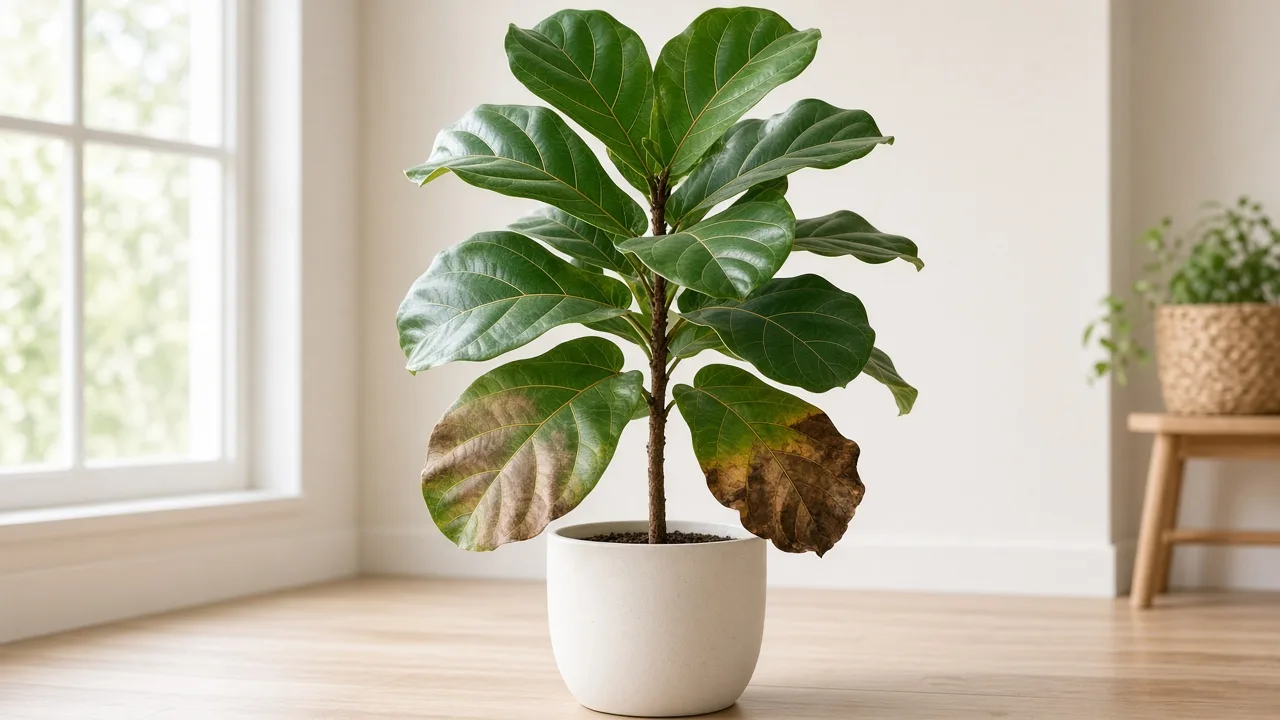
Brown Leaves on Fiddle Leaf Fig: Causes, Checks & Fixes
This guide covers brown leaves on Fiddle Leaf Fig. See also the general Brown Leaves guide, watering, and light pages for this plant.
Brown Leaves on Fiddle Leaf Fig: Causes, Checks & Fixes
Quick answer
Brown leaves on Fiddle Leaf Fig (Ficus lyrata) mean tissue has died—whether from root failure, drought, sun scorch, cold drafts, relocation shock, salt buildup, or normal aging of the lowest trunk leaves. On this upright Moraceae tree with large violin-shaped blades, one browned leaf can look dramatic even when crown tips still push healthy new growth. For general whole-leaf browning mechanics, see our brown leaves guide. On fiddle-leaf fig, texture and pot weight matter more than color alone: soft dull brown differs from crispy papery brown on a light dry pot.
First step: touch the brown area and check soil moisture at the top 2 inches in the center of the pot while noting whether the container feels heavy or light. Crispy, papery brown with a feather-light pot points to severe thirst, chronic low humidity at leaf margins, or a cold draft after a recent move. Soft dark brown on cool wet mix with limp lower leaves points to overwatering on Fiddle Leaf Fig or root stress. Tan patches only on the window-facing side of stiff leathery leaves point to direct sun—not a humidity fix.
What brown leaves look like on Fiddle Leaf Fig
Healthy fiddle-leaf fig holds large alternate violin-shaped leaves on a woody upright trunk. Browning breaks that pattern in distinct ways:
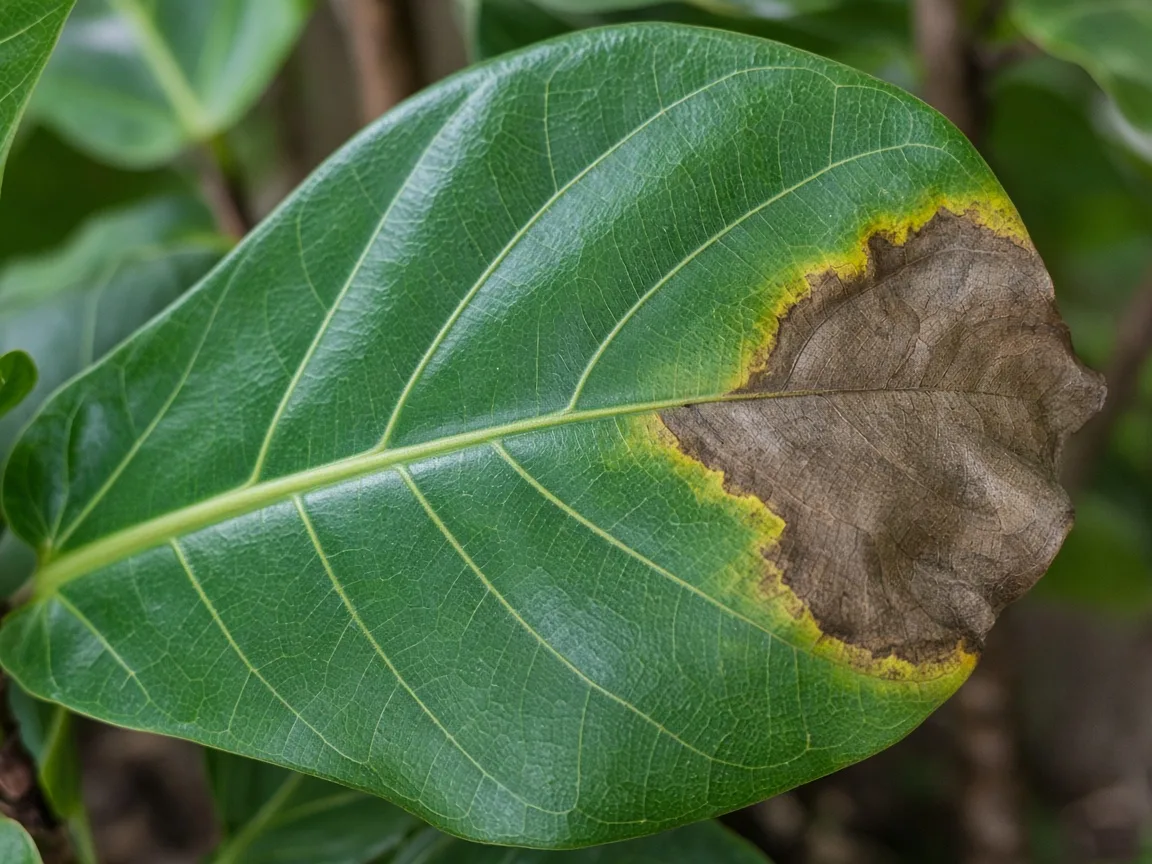
Brown leaf symptoms on Fiddle Leaf Fig—compare soft dull necrotic patches with yellow halos against healthy green tissue on the same blade.
- Soft dull brown patches on lower leaves, wet heavy soil — Limp foliage even though mix feels damp at depth. Often spreads from margins with yellow halos. Root oxygen loss from chronic wet mix on a species sensitive to overwatering.
- Crispy brown edges or dry patches mid-blade, light dry pot — Tissue feels like thick paper. Severe underwatering on Fiddle Leaf Fig or uneven partial watering that never re-wets the center of the root ball.
- Tan or papery brown on the window-facing side only — Bleached areas where afternoon rays hit shade-adapted foliage. Leaf scorch can occur with too much direct sunlight on Ficus lyrata.
- Brown after a move, repot, or cold draft — Several leaves fail at once while soil moisture looks normal. Fiddle-leaf fig reacts to placement change before it reacts to slow nutrient decline—overlaps with leaf drop.
- Crisp margin brown creeping from tips — Often starts as brown tips in dry winter air before whole edges necrose. See low humidity when margins desiccate on firm stems.
- Single lowest leaf on the trunk turning brown slowly — Often normal senescence while crown tips stay green and firm.
Always check newest leaves at crown tips and branch nodes. Brown on new growth is more urgent than one aging lower blade fading out.
Reading brown on large violin-shaped Ficus lyrata leaves
Fiddle-leaf fig leaves are very large, leathery, and stiff—often 12 to 18 inches long indoors—with a raised midrib and prominent lateral veins. That anatomy changes how brown reads:
Margin-first crispiness: Because each blade is thick, the outer edge and tip desiccate first when humidity drops or watering swings. Crispy brown that stops at the margin while the center stays green usually means environmental stress—not active root rot.
Soft brown in the leaf center: Dark brown patches in the middle of the blade or spreading inward from edges with yellow halos, on a heavy wet pot, point to compromised roots. Damaged roots cannot supply water evenly to large canopy leaves—lower blades fail first while crown tips may still look green until rot advances.
Window-side bleaching: Stiff leathery tissue scorches into tan papery patches on the side facing hot glass. The opposite side may stay green—unlike drought brown, which usually affects margins all around the blade.
Bottom-canopy senescence: On a tall upright fiddle tree, one or two lowest leaves may brown and drop while the top stays glossy. That pattern is low urgency if new crown leaves continue emerging firm.
Move shock and draft sensitivity on Ficus lyrata
Fiddle-leaf fig is one of the houseplants that reacts to change before it reacts to bad care. NC State Extension notes brown spots may occur with fluctuation in room temperatures from heating or cooling vents, and leaf drop may occur from too much or too little water—but sudden environmental shifts often brown foliage first.
After a move, repot, sharp rotation, or HVAC season change, you may see several leaves brown within days even when watering has not changed. Cold air from a door, window, or register below about 55°F (13°C) can brown then drop leaves before you notice soil problems.
Do not stack fixes on day one after a move. Stabilize placement first: move the tree away from draft paths, keep bright indirect light consistent, and resume the normal dry-down rhythm from the watering guide. If brown continues on wet soil after two weeks in a stable spot, shift to root inspection—not another relocation.
Winter semi-dormancy and wet-soil brown patches
Fiddle-leaf fig slows growth in fall and winter and uses less water. Many brown-leaf cases in cold months trace to overwatering on semi-dormant roots in dim light, not dry air alone.
When growth is slow and days are short, the top 2 inches of mix may stay wet for weeks if you keep summer watering frequency. Lower leaves turn dull brown or yellow-brown while the pot feels heavy. NYBG recommends checking the top 2 to 3 inches before watering—the same summer rhythm waterlogs mix in October through February when low light slows uptake.
Winter fix path:
- Pause watering until the top 2 inches of mix dry at center depth.
- Confirm drainage holes are open and empty cachepots after every soak.
- Keep the tree in the brightest indirect light available so soil does not stay cold and stagnant.
- Unpot only if brown spreads after a full dry-down cycle.
Details: root rot on Fiddle Leaf Fig when stems soften at the base.
Why Fiddle Leaf Fig gets brown leaves
Root injury from overwatering
Compromised roots fail to supply water evenly to large canopy leaves. Lower leaves turn soft dark brown while mix stays damp—the classic wilt-on-wet-soil paradox. Dark brown spots often appear in the middle of the leaf or spread from margins with yellow halos. See overwatering and root rot.
Severe dehydration
Extended dryness on large leathery leaves causes irreversible margin death before the whole blade browns. The pot feels noticeably light; mix is dusty dry 2 inches down. Soil may pull slightly away from pot sides on chronic drought.
Sun scorch on shade-adapted foliage
Fiddle-leaf fig wants bright indirect light with protection from afternoon sun. Baking glass bleaches exposed tissue into tan necrotic patches on stiff blades. See the light guide.
Low humidity and heat drafts
Winter heating desiccates leaf edges until whole sections necrose on firm stems with otherwise appropriate watering. Large violin-shaped surface area browns at margins first. Often overlaps with brown tips before whole leaves fail.
Salt and fertilizer burn
Chronic overfeeding or skipped flushing leaves salts in mix. Advanced burn can involve larger brown patches on older leaves after margins crisp.
Pests and disease progression
Spider mites on Fiddle Leaf Fig stipple tissue until patches brown in dry heat. NC State lists scale, aphids, mealybugs, thrips, and spider mites to monitor on this species, with potential bacterial or fungal leaf spots on wet foliage. Untreated lesions can merge into larger necrotic areas.
How to confirm the cause
Work through this checklist in order—do not skip to fertilizer or repotting.
- Texture — Crispy and papery = dry stress, sun, or salts. Soft and dull = rot, overwatering, or wet-root failure.
- Top 2 inches at center depth — Push a finger or chopstick into mix near the trunk, not just the pot edge. Damp cool soil vs. dusty dry confirms wet vs. dry branches.
- Pot weight — Lift the container by the rim. Heavy for days after watering suggests slow dry-down. Noticeably light means drought stress.
- Position on the stem — Lowest leaf only, slowly = senescence. Multiple lower leaves on wet soil = roots. Brown on crown-tip new growth = escalate.
- Leaf location on the blade — Window-facing patches = sun. Uniform margins vs. whole-blade dull brown vs. center soft spots.
- Recent changes — Moved near a vent, skipped winter watering reduction, repotted into oversized pot, heavy fertilizer dose, added direct afternoon sun.
- New growth — Firm green crown tips = lower urgency on one lower leaf. New leaves opening brown = urgent.
Write down crispy vs. soft, heavy vs. light, and recent move yes/no before choosing a fix.
First fix for Fiddle Leaf Fig
Touch the brown tissue and check the top 2 inches at center depth—then match treatment to crispy-dry versus soft-wet, not to panic over one browned leaf.
- If dry and crispy: Water thoroughly once until a little runs from drainage holes, empty the saucer within 20 to 30 minutes, and move out of direct hot sun while rehydrating.
- If wet and soft: Stop watering until the top 2 inches of mix dry at center depth. Improve bright indirect light if the tree sat in shade; unpot only if browning spreads after appropriate dry-down.
- If sun-facing patches only: Move to bright indirect light; add a sheer curtain on south or west glass. See light guide.
- If brown followed a move or draft: Stabilize placement away from cold air; do not repot and prune the same week.
Do not fertilize burned or rotting foliage on day one.
Trimming brown leaves and latex sap safety
When you remove necrotic tissue, milky latex sap runs from cut surfaces on Ficus lyrata. Wear gloves—sap irritates skin and the plant is toxic to cats and dogs if chewed.
- Use sharp clean shears; wipe sap from blades after each cut.
- Remove fully brown leaves at the petiole base; keep partially green blades unless soft wet lesions are spreading.
- Blot cuts with a damp cloth if sap drips onto stems or pot rims.
Do not mist sap onto furniture or skin.
Step-by-step recovery
Drought recovery
- Soak dry mix thoroughly until drainage runs, then empty all runoff.
- Trim fully brown leaves; leave partial green tissue in place.
- Resume watering when the top 2 inches dry at center depth—full rhythm on the watering guide.
- Raise humidity modestly if margins were crisp in heated winter air.
Wet-root recovery
- Stop watering; empty saucers and cachepots.
- If brown spreads on still-wet soil after a week of corrected dry-down, inspect and trim mushy roots.
- Repot into fresh airy mix only if tissue is actively rotting—same size or one step up, not a huge decorative pot. See soil guide.
- Hold fertilizer until new crown growth looks healthy for two weeks.
Sun scorch recovery
- Relocate to filtered light within several feet of an east window or shaded south exposure.
- Trim fully necrotic patches if unsightly; green tissue will not refill bleached areas.
- Acclimate gradually if increasing light later—never jump from deep shade to hot afternoon glass.
Draft and move-shock recovery
- Keep the tree in one stable bright spot for at least four weeks.
- Maintain normal dry-down watering—do not compensate with extra soaks.
- Remove fully brown dropped leaves; watch crown tips for firm new growth.
Recovery timeline
Thirst brown: Existing crisp tissue stays brown; turgor often returns in 12 to 48 hours after a thorough soak. The next leaf from a crown tip should open glossy within one to two weeks.
Overwatering brown: Spread should halt within three to seven days once mix dries appropriately. Root-trim repots may need two to four weeks before confident new growth.
Sun scorch: Bleached patches are permanent; new leaves should avoid scorch within two to three weeks in corrected light.
Move shock: Leaf browning may continue for one to four weeks after stabilization; firm new crown tips confirm recovery.
Normal senescence: One lower leaf browning while crown tips stay green needs no recovery timeline beyond routine care.
Judge success by new leaves at crown tips staying firm and adequately sized, not by old blades recovering color.
Lookalike symptoms
| Pattern | Likely cause | Page |
|---|---|---|
| Brown tips only, firm leaves | Dry air, salts, uneven water | Brown tips |
| Yellow before brown, wet soil | Overwatering | Overwatering |
| Crisp edges, dry soil | Underwatering | Underwatering |
| Several leaves fail after a move | Move shock / drafts | Leaf drop |
| One old lowest leaf on upright trunk | Normal senescence | No action if crown tips green |
| Pale stretched stems, weak indirect light | Too little light | Not enough light |
| Yellow leaves without crisp texture | Wet vs. dry diagnostic overlap | Yellow leaves |
When to use this page vs other Fiddle Leaf Fig guides
Use this page when whole blades or large patches have turned brown necrotic tissue and you need to read texture, pot weight, and blade position before acting.
Use brown tips when only margins or tips are crisp while the leaf center stays green.
Use yellow leaves when chlorosis precedes browning or wet-vs-dry soil is unclear.
Use leaf drop when leaves detach after a recent move even if brown was minimal.
Use root rot when the crown feels soft on saturated mix or roots are mushy through drainage holes.
What not to do
- Do not assume all browning means underwatering and soak a plant in wet soil.
- Do not move the tree repeatedly trying to fix post-move brown—stabilize one spot first.
- Do not leave scorched plants in afternoon direct sun hoping leaves will recover color.
- Do not fertilize a browning fiddle-leaf fig when soil is wet, after a recent move, or while crown tissue is soft.
- Do not repot and prune heavily the same week unless root rot is confirmed.
- Do not trim every brown leaf on day one before you know whether roots, light, or drafts caused the damage.
How to prevent brown leaves on Fiddle Leaf Fig
Prevention follows the same discipline as good fiddle-leaf fig care: check the top 2 inches at center depth before every pour, soak until drainage runs, empty all runoff, and adjust interval for season and light.
- Keep the tree in bright indirect light most of the day so it uses water at a reasonable rate.
- Use a right-sized pot with open drainage and fast-draining mix—oversized containers hold excess wet mix around roots.
- Pause calendar schedules in winter when low light slows uptake.
- Minimize moves once the tree is placed; acclimate new purchases gradually.
- Keep temperatures stable above about 55°F and away from heating and cooling blasts.
- Flush salts occasionally if you feed regularly during the growing season.
- Remove spent lower leaves promptly so pests cannot hide in dying tissue.
For the full workflow, see watering, light, and the overview.
When to worry
Most brown-leaf problems on indoor fiddle-leaf figs are manageable once you match the fix to crispy vs. soft tissue and wet vs. dry soil. Escalate if:
- Crown tips feel soft or mushy while soil is wet—advancing rot, not thirst
- Multiple leaves brown within one to two weeks on wet heavy soil with sour smell
- Brown climbs upward toward active crown buds while mix stays damp
- Roots are brown and mushy when you inspect through drainage holes
- Brown continues four-plus weeks after relocation with no firm new crown growth
- New leaves open already brown at crown tips—active stress, not aging
A mature tree with firm wood and several healthy leaves below the problem zone almost always survives corrected watering or light once roots are intact. Loss becomes likely when the crown collapses on waterlogged mix or repeated environmental shocks stack without recovery time.
Fiddle Leaf Fig care cross-check
Brown leaves often mean another care pillar is out of sync:
| Care factor | Fiddle-leaf fig baseline | Brown-leaf link |
|---|---|---|
| Light | Bright indirect; protect from afternoon sun | Direct glass scorches stiff blades |
| Water | Top 2 in. dry at center before soak | Wet soil soft-browns lowers; dry soil crisps edges |
| Temperature | Stable; avoid below ~55°F | Vents and drafts brown before drop |
| Placement | Stable spot; minimize moves | Relocation shock browns fast |
| Pot / mix | Drainage holes; fast-draining mix | Oversize wet pots fail lower canopy |
| Humidity | 30–65% helps large leaves | Low humidity browns margins first |
Related Fiddle Leaf Fig guides
- Overwatering — wet heavy pot, soft dull lower leaves
- Underwatering — light dry pot, crispy brown margins
- Root rot — soft crown on saturated mix
- Leaf drop — relocation shock overlap
- Brown tips — margin-only browning before whole-blade necrosis
- Not enough light — slow dry-down worsens wet-root brown
- Watering — top 2 inch rule and seasonal rhythm
- Overview — species biology and placement basics