Caterpillars on Hoya: How to Identify and Remove Them
Quick answer
Caterpillars are not caused by a Hoya's watering or light routine. If you find a live segmented larva or fresh chewing with frass or a silk-bound leaf, first hand-pick the caterpillar and isolate the Hoya for inspection; do not spray based on holes alone.
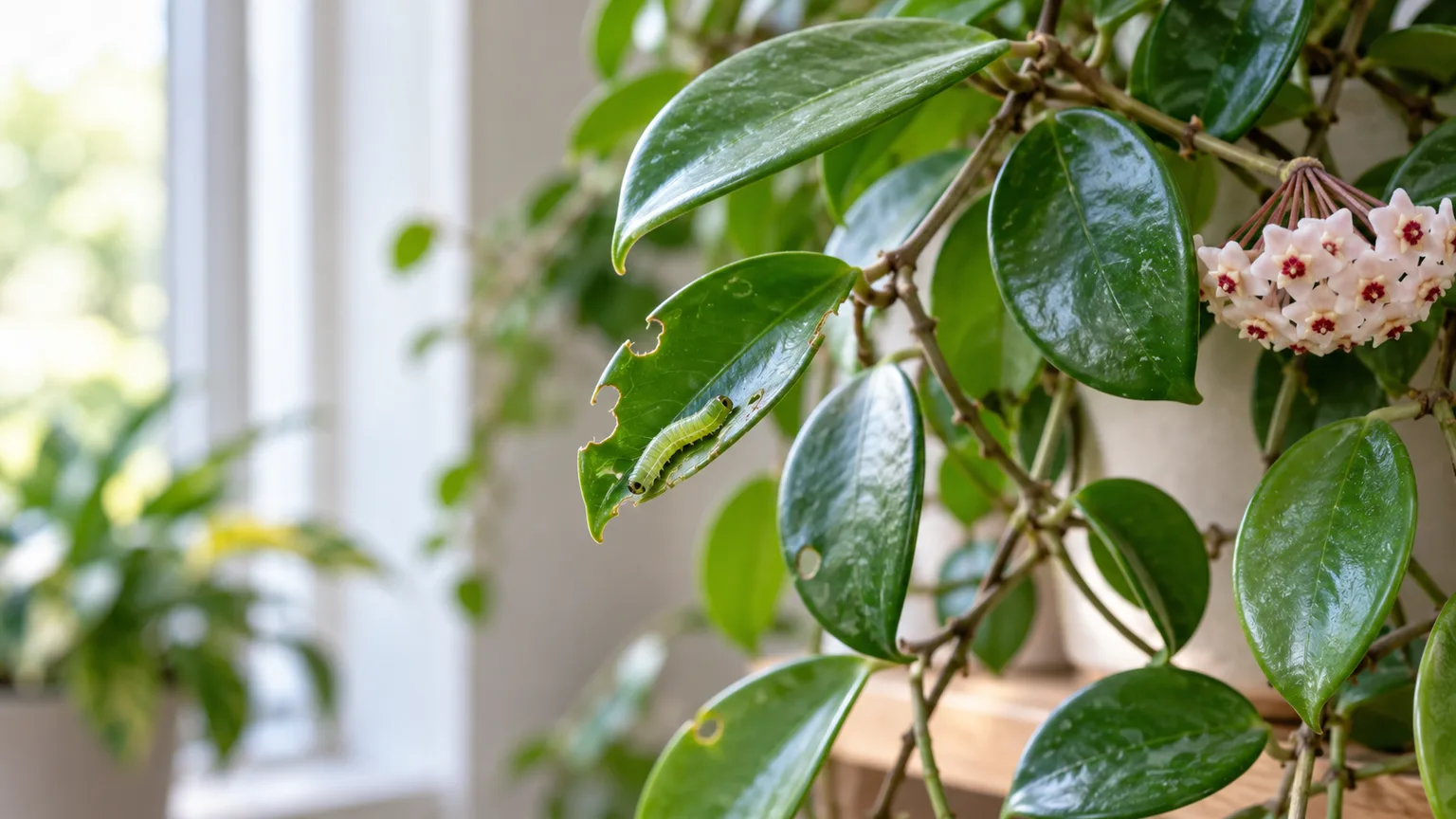
Caterpillars on Hoya: Causes, Checks & Fixes
This guide covers caterpillars on Hoya. See also the general Caterpillars guide, watering, and light pages for this plant.
Caterpillars on Hoya: Causes, Checks & Fixes
Quick answer
Caterpillars can chew Hoya leaves, but a caterpillar infestation is not a result of underwatering, excess water, or dim light. If you see a live segmented larva, fresh irregular chewing, or a folded leaf tied with silk, first hand-pick the larva you can see and move the Hoya away from nearby plants while you inspect the rest of the vine. UC IPM lists feeding holes, frass, eggs, caterpillars, and webbed or rolled leaves as useful signs of leaf-feeding caterpillars rather than relying on a leaf mark alone.
Hoya leaves are thick, leathery, and waxy, and the plant grows as a trailing or climbing vine. A small bite can be easy to overlook against the glossy surface, while overlapping leaves and joints make good places to inspect. The NC State profile describes Hoya carnosa’s fleshy leaves and vining habit; it also notes that wax plants may spend summer outdoors, where a fresh infestation can arrive before the plant returns inside for fall and winter.
This guide is for confirmed chewing larvae on Hoya. For broad caterpillar identification and general treatment options across plants, see the caterpillars guide. Do not apply a pesticide just because you see a hole: first confirm whether feeding is active and whether a larva is present.
What caterpillar damage looks like on Hoya
The clearest sign is new tissue missing from a leaf edge or surface. Caterpillars chew leaves, flowers, shoots, and other plant parts; some hide in rolled foliage or among leaves, so you may find the damage before you see the insect or its eggs.
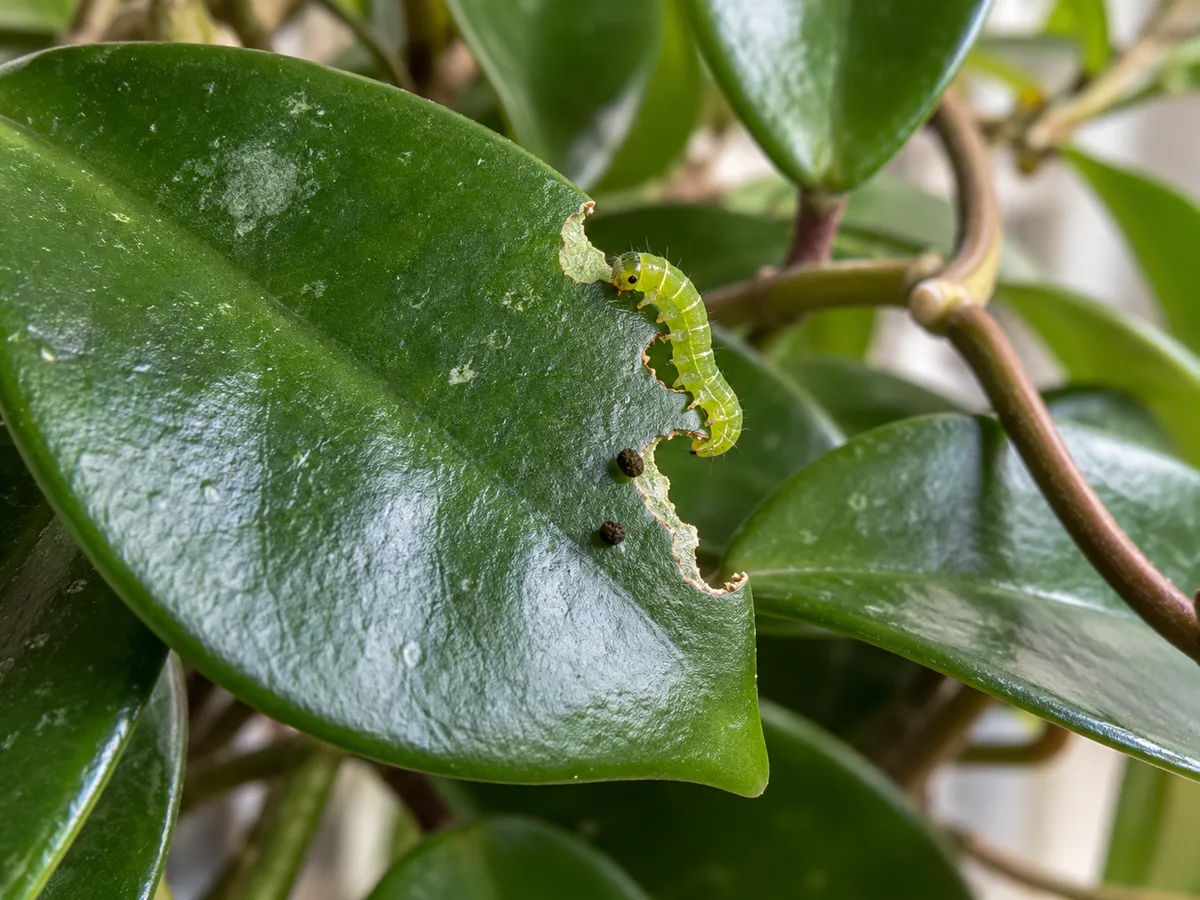
Fresh edge-chewing, a visible larva, and frass together are stronger evidence than a single old hole.
A Hoya leaf is leathery and often glossy, so look for a fresh, pale edge where tissue has been removed rather than interpreting every spot as a bite. Check whether the edges are newly ragged, if the damaged area is close to small dark pellets, and whether a larva moves when the leaf is gently turned. Frass, or caterpillar droppings, may sit on the leaf below where the larva fed. The location of the pellets can help you search the leaf above, the next joint, and the underside of neighboring foliage.
Some caterpillars bind leaves together with fine silk and feed inside the fold. The affected area may later dry or turn brown; the RHS describes tortrix caterpillars on indoor and outdoor ornamental plants forming silk-bound shelters and feeding within them before they are noticed. That pattern is a reason to open the fold gently and inspect inside, not a reason to assume every Hoya with a curled leaf has the same pest.
Check the whole Hoya vine, not only the newest leaf
Follow each stem from its pot to the growing tip. Hoya’s leaves can overlap along a trailing stem, and a folded pair can hide a small larva or silk. Turn the pot and inspect the back of the plant as well as the sides facing the room. Look at both leaf surfaces, the petiole attachments, and the places where a leaf meets a stem. If your Hoya is trained on a support or hanging close to a wall, check where stems rest against the support and where the leaves overlap.
A caterpillar may not stay in one place. If you find one larva, do not assume it is the only one; UC IPM recommends looking for eggs, webbed leaves, and other caterpillars in addition to the visible feeder. A single old hole without fresh edges, frass, a larva, or silk does not prove an active infestation. Mark the damaged leaf with a photo or a quick note, then check the same part of the vine again for new feeding.
First fix: hand-pick the confirmed caterpillar
Stop active feeding before you change Hoya care. If you find a caterpillar, pick it off gently with a gloved hand, tissue, or tweezers and place it in a closed container. Then move the Hoya away from other houseplants while you complete the inspection. The UC IPM guide recommends hand-picking caterpillars and removing rolled or webbed leaves when they contain larvae; Savvy Gardening also describes hand-picking as a physical control for caterpillars on garden plants.
If the larva is tucked inside a silk-bound leaf, open the fold slowly so you can remove the insect without tearing the healthy stem. When a leaf is tightly rolled and occupied, remove only that leaf or the smallest damaged section needed to reach the caterpillar. Use clean scissors and keep the cut away from Hoya’s flower spur. Do not cut an entire healthy vine just to remove one larva.
If you cannot find a live caterpillar, do not start spraying. Search again for eggs, frass, silk, and fresh edges, especially behind and beneath the chewed leaf. If none appear and the old mark does not change, monitor rather than treating a guess. If new chewing continues but the pest remains hidden, take a clear photo of the larva or damage and seek identification from a local extension service or plant clinic.
Why Hoya’s shape changes the inspection
Thick leaves can hide small bites
Hoya carnosa’s fleshy, leathery leaves are an adaptation that makes the plant look different from a thin-leaved herb. Small notches may not immediately cause a whole leaf to droop, so base your decision on fresh damage and active larvae, not on whether the leaf still feels firm. A deep hole or missing edge will remain as a physical gap; the original leaf does not fill the tissue back in. Remove a badly damaged leaf only if it is mostly eaten, drying, or concealing a larva you cannot safely reach.
This is also why old damage should be separated from current feeding. A clean-edged hole that stays the same size is not proof that a caterpillar is still present. A new pale edge, fresh frass, or a folded leaf that was not there during the previous check is a better reason to inspect again. The Hoya overview gives the plant’s normal growth and leaf context, so you can compare the affected area with healthy foliage on the same vine.
Outdoor summers and new plants are the likely exposure points
Hoya carnosa can be grown outdoors on a shaded patio during warm weather, then brought back inside as nights cool. That seasonal move creates a practical inspection point: before bringing the pot back indoors, examine the undersides of leaves, the stems, and any folded or touching leaves. The NC State profile specifically describes outdoor summer placement and bringing wax plants indoors before cool nights for this species.
Also inspect Hoya plants that have just arrived from a nursery, greenhouse, or a friend’s collection. This does not mean a particular caterpillar is a normal Hoya pest; it means plant movement can carry eggs or larvae that were not visible in a quick top-side check. Keep the suspect plant separate until you have inspected it closely. If it lived outside, check nearby patio plants too, especially those that touch the Hoya or share a support.
Protect the Hoya flower spur while removing damaged leaves
Hoya flowers can return from the same persistent peduncle, or flower spur. The NC State profile advises against pruning that spur because it can bloom repeatedly over several years. When trimming a silk-bound or badly eaten leaf, identify the leaf stalk and stem before cutting. Leave the bare flower spur intact, even if the caterpillar was close to it. The Hoya pruning guide can help distinguish a removable leaf or stem tip from a structure you want to keep.
Confirm a caterpillar before treating the plant
Use evidence that points to chewing. A caterpillar is the larval stage of a moth or butterfly, and the damage comes from eating plant tissue. That makes holes, missing margins, frass, eggs, a visible segmented larva, or a silk-bound leaf more useful than general yellowing or limpness. UC IPM lists these signs for leaf-feeding caterpillars and notes that larvae may be hidden in rolled leaves or among foliage.
| What you notice | How to interpret it | Next step |
|---|---|---|
| Fresh irregular holes or missing leaf margins with frass nearby | Active chewing is likely | Search the leaf above and nearby folded leaves for a larva |
| Leaf edges or adjacent leaves bound with silk | A leaf-rolling caterpillar is possible | Open the fold carefully and inspect inside |
| One old hole with no new feeding, frass, silk, eggs, or larva | Current caterpillar activity is unconfirmed | Photograph it and check again before treating |
| Cottony clusters, fixed bumps, or insects gathered at joints | Not the usual pattern of a chewing caterpillar | Identify the insect before choosing a pest treatment |
| Yellowing or wilting without missing tissue | The caterpillar diagnosis is weak | Review Hoya water, light, and root conditions first |
Hoya has other pests. The NC State Hoya profile notes mealybugs and occasional spider mites, while Gardening Know How also lists mealybugs, aphids, and scale among common Hoya pests. Those are not caterpillars, so do not use a caterpillar product to treat them. If you see a different pest pattern, go to the Hoya problems hub and identify the symptom before choosing a treatment.
A staged treatment plan for a Hoya with caterpillars
Remove what is present, then inspect again
After hand-picking the visible larva, inspect both sides of every leaf and the joints along the vine. Remove visible eggs only if you can identify them confidently; do not scrape the waxy leaf surface based on a speck that might be dust or dried residue. If you find a webbed fold, open it and remove the caterpillar. UC IPM recommends removing caterpillars early and pruning rolled or webbed foliage only when it contains the pest, which avoids taking more plant tissue than necessary for control.
Check the plant again over the next several days for new frass or feeding. The RHS recommends frequent checks on susceptible plants to prevent a damaging caterpillar population from building, and notes that low levels of garden damage may be tolerated. For an indoor Hoya, you can protect the collection while accepting that one or two old holes are cosmetic: keep the plant separate during the follow-up check and return it only when you no longer find active larvae or fresh feeding.
Escalate only if fresh feeding continues
If you see new damage after repeated hand removal, do not jump straight to a broad insecticide. First document what you found and ask an extension service or local plant clinic to identify the caterpillar. Product choices depend on the insect and the place the product is labeled for. UC IPM says any insecticide should be reserved for intolerable damage after nonchemical methods have failed, and emphasizes that a caterpillar-specific product must be eaten by the larva to work on a feeding caterpillar.
If a labeled product is eventually appropriate, follow the current product label for indoor ornamental plants and the identified pest. Do not use a product merely because its packaging mentions caterpillars, and do not spray a Hoya that has no confirmed active larva. This guide does not give a concentration or retreatment interval: those are product-specific label directions, not universal Hoya care instructions.
Keep Hoya care steady while the leaves recover
Caterpillars are an insect problem, not a signal to water more often or move Hoya into direct sun. Keep the plant in its usual bright, indirect light and water according to the moisture in its pot. NC State recommends bright indirect light and allowing the Hoya mix to dry between waterings; the watering guide explains how to check the pot without switching to a calendar.
Hoya needs a fast-draining mix, so do not repot solely because you found a caterpillar. Repot only if the potting mix or container has a separate problem, such as poor drainage or a compacted root zone; the soil guide and repotting guide cover those decisions. Making unrelated care changes at the same time can make it harder to see whether the pest removal worked.
Expect damaged sections to stay visible. Success means no fresh holes, no new frass, no live larvae, and clean new leaves as the vine grows. A Hoya can continue growing with a small amount of cosmetic damage, but widespread chewing, several occupied leaf rolls, or repeated new larvae means you need to inspect the entire collection and identify the source before returning the plant to its usual shelf.
Prevent caterpillars from returning
- Inspect before bringing Hoya back indoors. Check the leaf undersides, stems, and flowers after outdoor time. Look for silk-bound leaves, eggs, and fresh feeding, not just the top surface.
- Check new plants before they join the collection. Give the Hoya a separate spot while you inspect the whole vine. A quick glance at the largest leaf can miss larvae tucked near a joint.
- Keep adjacent vines from becoming one continuous canopy. Hoya trails and climbs; leaves from neighboring pots can overlap. Leave enough room to see and inspect each plant.
- Keep an inspection note. Record where you found the larva and which leaves were damaged. At the next check, look first at the same joint and the leaves directly above and below it.
- Maintain normal Hoya conditions. Bright indirect light and a well-drained mix support the plant, but neither fertilizer nor extra water removes a caterpillar. Use the light guide to keep its placement stable while you monitor.
Related Hoya guides
- Use the Hoya overview for normal foliage, vining growth, and the flower spur.
- Use the watering guide if leaves are limp or the mix stays wet; those signs need a moisture check rather than caterpillar treatment.
- Use the light guide if the plant has been moved into direct sun or a dim location.
- Use the soil guide and repotting guide if drainage or the root zone is a separate concern.
- Use the pruning guide before removing leaves or stems near a flower spur.
- Use the Hoya problems hub when the damage does not match chewing larvae.
Related tool
Use the Plant Problem Diagnosis Tool to compare fresh chewing, frass, silk-bound leaves, and other Hoya symptoms before choosing a treatment.