Magnesium Deficiency on Hoya: Causes, Checks & Fixes
Quick answer
Magnesium deficiency on hoya shows as yellow tissue between dark green veins on older lower wax leaves while new vine tips may look normal. First step: confirm interveinal chlorosis on firm older leaves—not soft mushy yellow from overwatering.
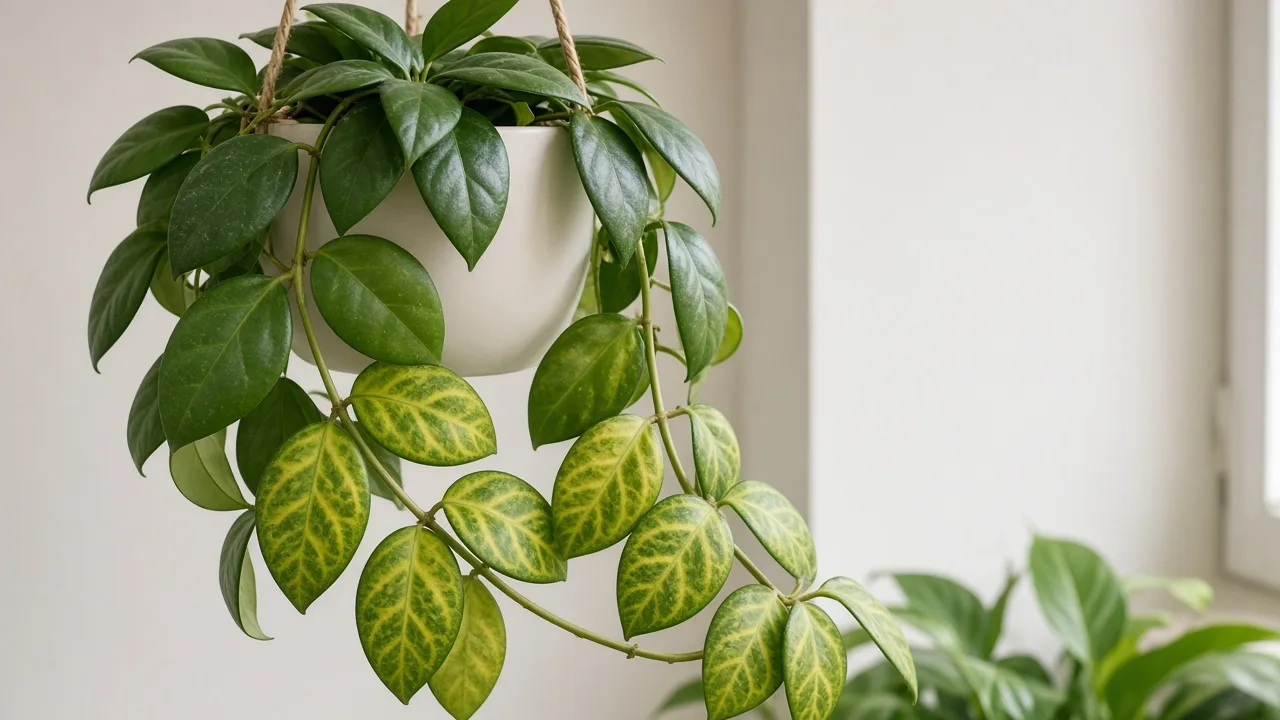
Magnesium Deficiency on Hoya: Causes, Checks & Fixes
This guide covers magnesium deficiency on Hoya. See also the general Magnesium Deficiency guide, watering, and light pages for this plant.
Magnesium Deficiency on Hoya: Causes, Checks & Fixes
Quick answer
Magnesium deficiency on hoya (Hoya spp.) shows as yellow tissue between dark green veins on older lower wax leaves while new vine tips may look normal. Magnesium is a mobile nutrient and chlorosis appears on mature leaves first because the vine strips magnesium from older tissue to supply new growth.
See our magnesium deficiency guide. On trailing hoya, inspect oldest lower wax leaves on firm vines—interveinal yellowing there is classic magnesium, not soft mushy overwatering yellow.
First step: confirm interveinal chlorosis on firm older leaves, not soft yellow leaves on wet epiphytic mix.
When to use this page vs other Hoya guides
| Pattern | Read next |
|---|---|
| Firm old leaves yellow between green veins | Magnesium deficiency (this page) |
| Soft mushy yellow leaves on wet mix | Overwatering |
| Uniform pale old leaves, no vein pattern | Nitrogen deficiency |
| Margin scorch on old wax leaves | Potassium deficiency |
| New tip leaf distorted | Calcium deficiency |
| New leaf yellow with green veins | Iron deficiency |
What magnesium deficiency looks like on hoya
Hoya’s thick wax-coated leaves make magnesium banding visible—dark green veins on firm leaves with yellow between them on oldest lower vine sections. The waxy cuticle keeps leaves firm, which is the key texture clue against overwatering.
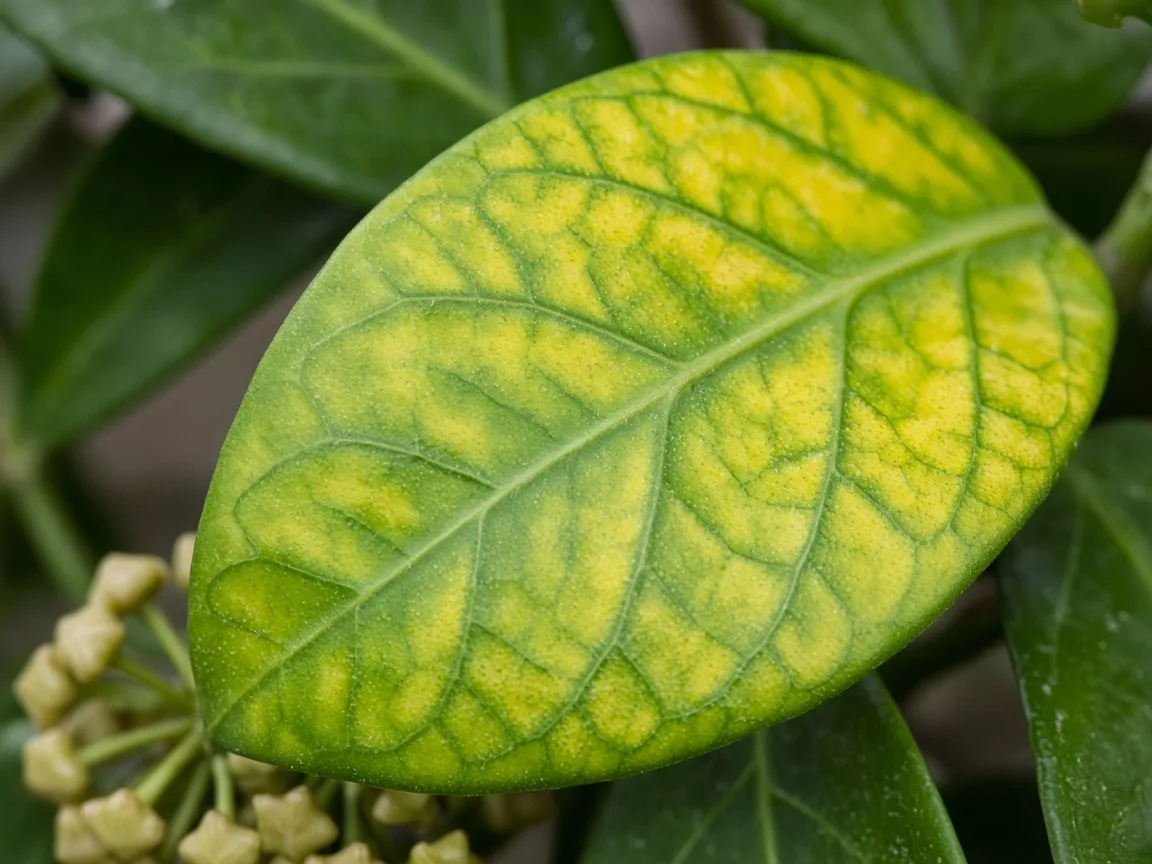
Interveinal chlorosis on an older hoya wax leaf—veins stay dark green while tissue between them yellows; leaf texture remains firm.
Typical signs:
- Yellow or pale green between dark green veins on older lower wax leaves (interveinal chlorosis is the hallmark pattern)
- Veins stay relatively green on firm thick leaves
- New vine tips may look normal initially
- Firm leaf texture unlike soft overwatered hoya
- Slow spread up the vine over months
- Peduncles may still form on otherwise chlorotic lower sections
Not magnesium deficiency:
- Soft mushy yellow leaves — overwatering
- Uniform pale old leaves — nitrogen deficiency
- Scorched margins — potassium deficiency
- New leaf distortion — calcium deficiency
- New leaf yellow with green veins only — iron deficiency
Why hoya gets magnesium deficiency
Hoya grows in coarse epiphytic mix with infrequent watering. Years of light nitrogen or phosphorus-heavy bloom fertilizer without micronutrients depletes magnesium. Old bark mix in pot-bound plants shows interveinal chlorosis on lower wax leaves.
Hoya-specific causes:
- Bloom-boost fertilizer without micronutrients — Promotes peduncles while magnesium depletes on lower foliage.
- Years in same bark-perlite mix — Depleted without repot or complete feed. Epiphytic container plants need micronutrient replacement over time.
- Blocked uptake from overwatering — Overwatering on epiphytic mix limits absorption.
- Skipped feeds for years — Assumption that slow hoya needs no fertilizer.
- Confusion with soft yellow leaves — Mushy overwatered foliage vs firm interveinal chlorosis.
- Confusion with nitrogen deficiency — Uniform pale vs vein pattern.
Interveinal chlorosis on firm wax leaves
Hoya’s thick succulent wax leaves store water, so owners often under-feed for years—but oldest lower leaves still show magnesium banding when the nutrient runs out. Unlike overwatering, which yellows and softens leaves on wet mix, magnesium chlorosis keeps firm leaf texture with a clear vein skeleton pattern.
Owners switching to high-phosphorus bloom fertilizer to force peduncles often trigger magnesium deficiency on lower foliage—complete micronutrient feeds support both leaves and flowers. The split canopy pattern—healthy new tips above chlorotic lower wax leaves—is common on pot-bound hoyas in the same bark mix for three or more years.
Bloom fertilizer and the magnesium trade-off
Hoya owners often chase peduncle formation with phosphorus-heavy bloom boosters while lower foliage shows interveinal chlorosis. Magnesium is essential for chlorophyll in wax leaves that photosynthesize energy for flowering. Starving lower leaves to push blooms creates a vine that flowers briefly on depleted reserves, then stalls.
Feed complete balanced nutrition first per the fertilizer guide, then optimize light for peduncle formation. Hoya is a slow epiphytic vine that responds to light dilute corrections—not full-strength rescue doses.
Lookalike symptoms
| Pattern | Likely cause | Key difference on Hoya |
|---|---|---|
| Firm old leaves yellow between veins | Magnesium deficiency (this page) | Vein-retention on firm wax leaves |
| Soft mushy yellow leaves | Overwatering | Leaf texture soft; wet bark mix |
| Uniform pale old leaves | Nitrogen deficiency | Whole-leaf washout, thin new tips |
| Margin scorch | Potassium deficiency | Edge burn, weak peduncles |
| New tip distortion | Calcium deficiency | Expanding tip leaves only |
How to confirm
- Vein pattern on firm older leaves — Interveinal chlorosis with green veins.
- Leaf texture — Firm wax vs soft mushy overwatered leaves.
- Fertilizer type — Complete micronutrients vs bloom-only for months.
- Watering rhythm — Dry-down per watering guide vs chronic wetness.
- Pot age and mix condition — Depleted bark after years without refresh.
- Uniform pale vs interveinal — Nitrogen vs magnesium leaf-age and pattern.
- Peduncle context — Bloom-only feeding history supports magnesium lack on lower leaves.
First fix for Hoya
One light soil drench with Epsom salt at 1 tablespoon per gallon of water, or one quarter-strength complete fertilizer containing magnesium—after confirming firm roots and appropriate dry-down.
Hoya prefers dilute treatment—do not full-strength Epsom on slow epiphytes. Fix overwatering before repeated drenches on soggy bark mix.
Step-by-step recovery
- Switch to complete balanced fertilizer at quarter to half strength through active growth per the fertilizer guide.
- Apply one Epsom drench at 1 tablespoon per gallon if interveinal yellowing is clear—repeat once after four weeks only if pattern persists.
- Repot into fresh epiphytic mix if mix is years old and chlorosis continues after two corrections.
- Correct overwatering if any leaves are soft—magnesium uptake requires healthy roots.
- Balance bloom boosters with complete feeds—do not bloom-only all season.
- Monitor new wax leaves for clean green without interveinal banding over four to eight weeks.
Recovery timeline
Judge recovery on new wax leaves, not old chlorotic tissue:
- 2–4 weeks: Interveinal spread on lower leaves should stop
- 4–8 weeks: New leaves emerge with uniform green—main success signal on slow hoya
- 8+ weeks: Two clean new flushes confirm magnesium is adequate
Older chlorotic wax leaves rarely fully re-green. Success means firm new leaves without vein banding.
Mistakes to avoid
- Diagnosing overwatering when leaves are firm. Soft texture is the overwatering clue; firm interveinal chlorosis is magnesium.
- Full-strength Epsom drenches on slow epiphytes. Light dilute corrections match hoya metabolism.
- Bloom-only fertilizer all season. Peduncle chasing depletes magnesium on lower foliage.
- Repeated Epsom on soggy bark mix. Fix drainage before second supplement.
- Expecting old wax leaves to re-green. Judge new vine tips.
- Ignoring years without any feed. Pot-bound hoyas deplete micronutrients even when growth is slow.
Prevention
- Use complete balanced fertilizer with micronutrients during active growth per fertilizer guide
- Refresh old bark-perlite mix at repotting every two to three years
- Balance bloom boosters with potassium- and magnesium-complete feeds
- Maintain dry-down watering rhythm per watering guide
- Avoid assuming slow growth means zero fertilizer need
- Light monthly feeds through spring and summer on established vines
Related Hoya guides
- Hoya overview
- Hoya fertilizer
- Hoya watering
- Hoya soil
- Nitrogen deficiency
- Potassium deficiency
- Overwatering
- Hoya problems hub
Conclusion
Yellow between green veins on firm older hoya wax leaves signals magnesium depletion in depleted epiphytic mix—confirm firm texture rules out overwatering, apply one light Epsom drench or complete feed, and monitor new vine tips for uniform green over four to eight weeks.
Related tool
Use the Fertilizer Dilution Calculator to measure Epsom salt or quarter-strength complete fertilizer for magnesium deficiency recovery on this plant before changing multiple variables at once.