Pale Leaves on Hoya: What to Check and How to Fix Them
Quick answer
Pale Hoya leaves can be normal cultivar color or a sign of changing light, root-zone stress, nutrient availability, or pests. First compare the affected leaves with the same vine, then check the top half of the mix and pot weight before watering or feeding.
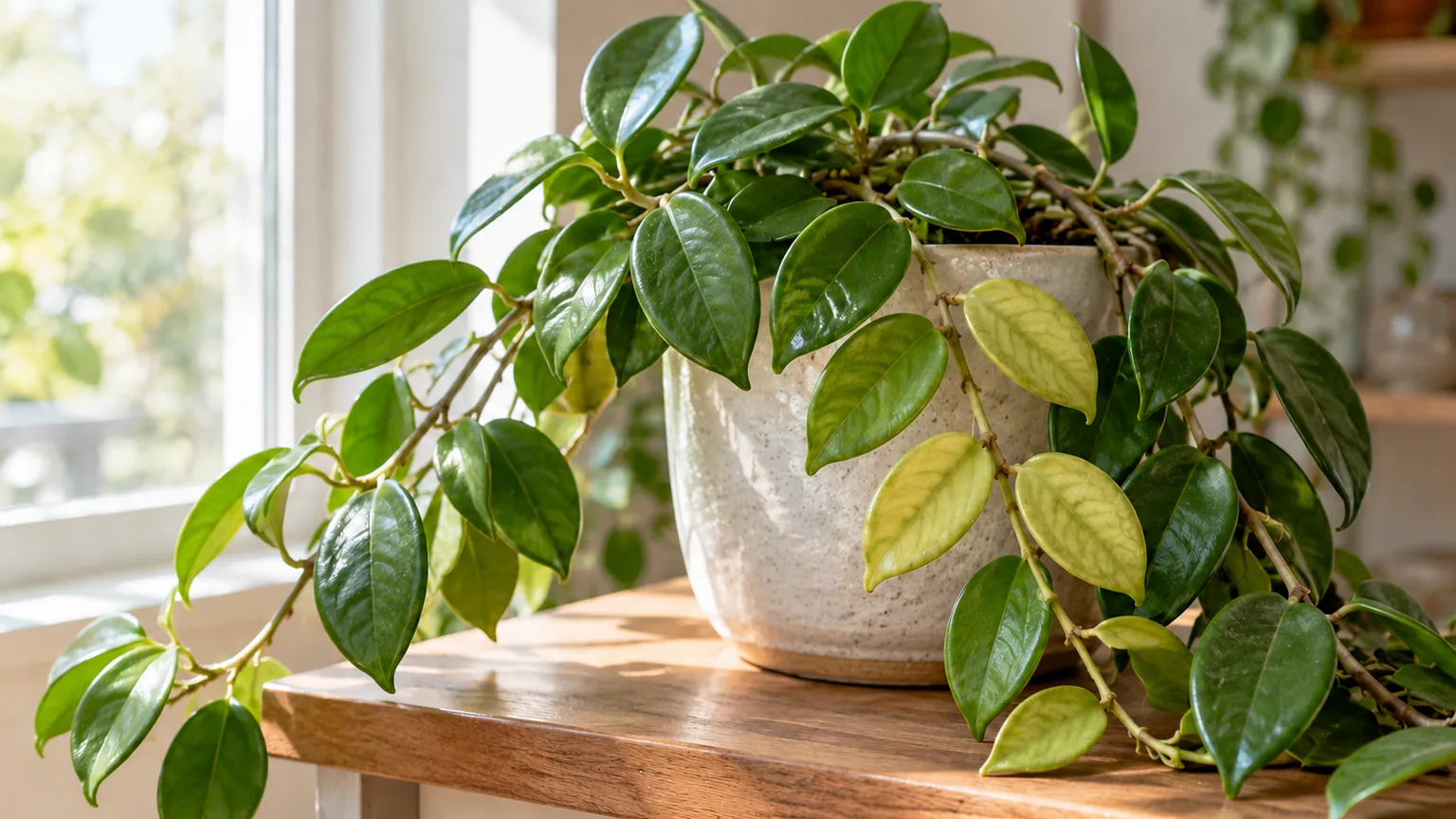
Pale Leaves on Hoya: Causes, Checks & Fixes
This guide covers pale leaves on Hoya. See also the general Pale Leaves guide, watering, and light pages for this plant.
Pale Leaves on Hoya: Causes, Checks & Fixes
Quick answer
Pale leaves on Hoya are a clue, not a diagnosis. First ask whether the color is part of the cultivar or a recent change on leaves that used to be green. Then check the top half of the potting mix and lift the pot before watering or feeding. If the mix is damp and heavy, do not add water; if it is dry through the root zone, water thoroughly and let the pot drain. Hold fertilizer until the pattern points to a nutrient issue and the roots are functioning.
A Hoya with a few established cream or pink patches may simply be showing its cultivar markings. A green-leaved plant that suddenly fades across several leaves needs closer inspection. The position of the pale area, whether it affects young or old leaves, and what is happening at the roots are more useful than color by itself.
What pale leaves look like on a Hoya
Hoya foliage is often thick and waxy, so a pale leaf can remain firm even when its color has changed. On the common wax plant, Hoya carnosa, leaves are succulent and arranged along trailing or climbing stems. Some named cultivars have stable cream, white, or pink variegation; an irregular pale pattern is not automatically disease or hunger. NC State Extension’s Hoya carnosa profile describes the thick leaves and several variegated cultivars, as well as bright indirect light and a freely draining growing mix.
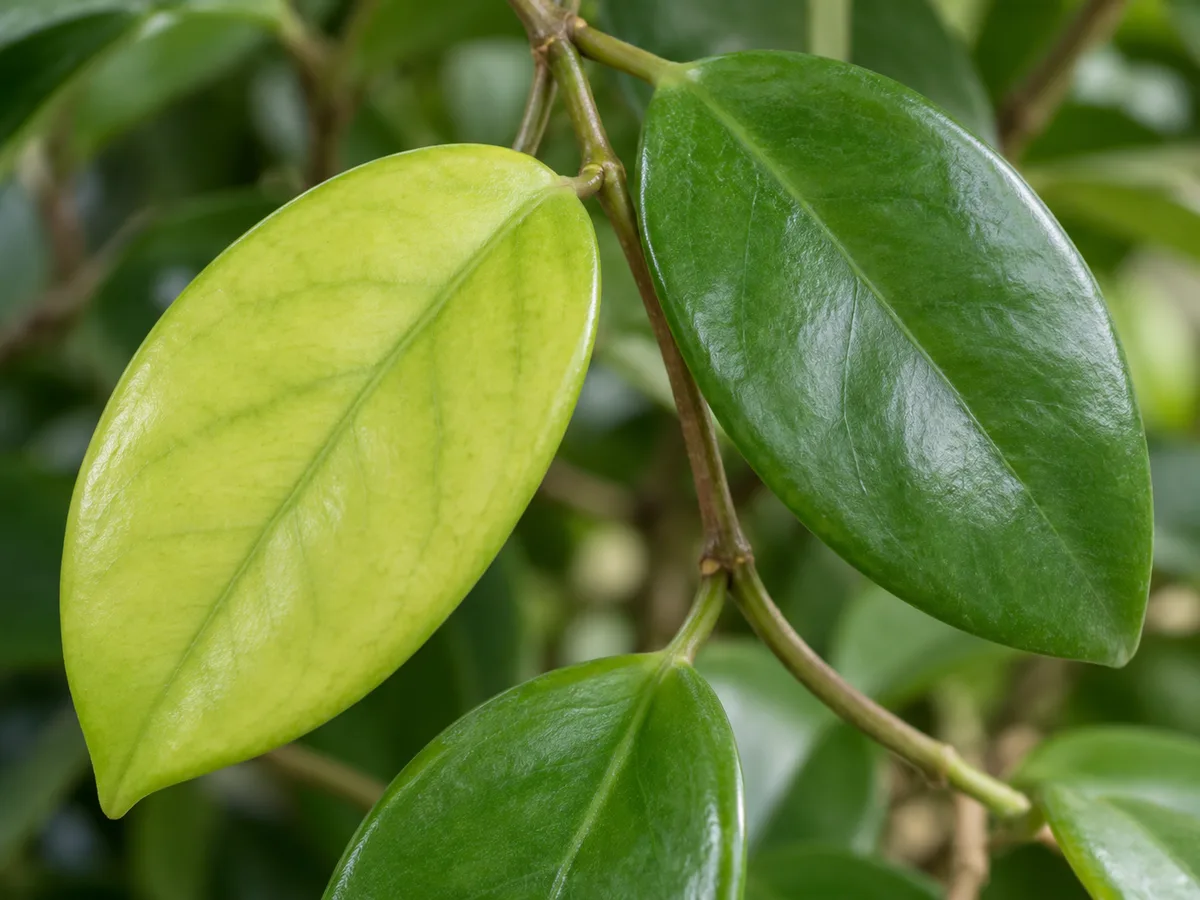
A pale leaf is a clue, not a diagnosis; compare its pattern and position before changing care.
A stress-related change usually breaks the plant’s previous pattern. It may begin on leaves facing a window, appear across several new leaves, or affect older leaves while the newest tip stays green. Some leaves also look washed out before they become clearly yellow, while direct-sun injury may add tan or papery areas. Look at both leaf surfaces and the stem rather than labeling every light-colored patch “chlorosis.”
For the general symptom patterns and causes that apply across many plants, use our pale-leaves symptom guide. The checks below narrow that broad symptom to the way a Hoya grows and stores water.
Hoya leaf colour varies by cultivar
Before correcting anything, compare the plant with its label, purchase photo, or older growth. Hoya carnosa cultivars such as ‘Krimson Queen’ and ‘Variegata’ can carry cream or white leaf margins, while ‘Krimson Princess’ can show pink or white variegation on green leaves. Some varieties may have pink-tinged margins. In a variegated plant, the pale part can be a normal feature when it repeats in the same position and the leaf stays firm. Do not treat that as nutrient deficiency or try to make it green by feeding more.
A new pale area on a formerly solid-green leaf is different. Note whether the color follows a stable margin, forms a regular central patch, or has spread unevenly across the blade. A stable cultivar pattern tends to repeat on comparable leaves. Damage is more likely when the pattern is new, changes from leaf to leaf, and arrives with weak growth, drooping, dry-down changes, or visible pests. Cultivars vary, so use the actual plant’s own older leaves as the comparison rather than relying only on online photos.
Read a Hoya’s opposite leaf pairs along the vine
Check where the pale leaves sit on the stem. On Hoya carnosa, paired leaves emerge at nodes along a long vine, so comparing the oldest pair near the pot with the youngest pair at the tip gives a useful timeline. One older leaf fading as the tip continues to produce healthy growth may be ordinary turnover. A sequence of pale pairs moving toward the tip, or several newly formed leaves emerging pale, is harder to explain as simple aging.
Take a photo of one affected node and one healthy node in the same light. Mark which side of the vine faced the window and whether the leaf is near the growing tip or farther back. This simple record can separate a location pattern from a plant-wide pattern without pulling the Hoya out of its pot or changing its routine prematurely. NC State Extension’s diagnostic handbook likewise emphasizes identifying the plant and comparing where symptoms occur, which leaves are affected, and whether the change appears on young or old growth before choosing a cause.
The first check: Hoya moisture before water or fertilizer
First, check the root-zone moisture and pot weight before adding anything. Push a clean finger or wooden skewer into the top half of the Hoya mix, then lift the pot. A light pot and dry mix through the upper root zone point toward thirst; a heavy pot with cool damp mix means the next watering should wait. Pot weight is a useful cross-check in the Gardening Know How houseplant guide. This is one check with two clear outcomes, and it avoids responding to pale color with a blind drink or fertilizer dose.
This matters because Hoya’s thick, succulent leaves may keep their shape even when the root-zone condition still needs checking. A wilted or pale look does not prove that the plant needs water. NC State’s wax-plant profile recommends letting the soil dry between waterings and notes that soil that is too wet or too dry can lead to leaf drop. If the pot remains heavy long after watering, empty any cachepot or saucer and review the plant’s watering routine before adding more. For a more complete baseline of wax-plant needs, compare the symptom with the Hoya care overview.
Do not unpot the plant merely because one leaf is pale. Check the mix first. If it stays wet unusually long or is paired with multiple soft leaves, inspect the roots; firm roots are a better sign than brown, hollow, or mushy tissue. NC State Extension’s disease-diagnosis chapter describes root decay as a diagnostic clue and cautions that some plants naturally have dark roots, so judge tissue condition as well as color. If the mix is dry and leaves are wrinkled or rubbery, water once until runoff appears, then let it drain. Avoid changing the pot, fertilizer, and light on the same day, because several simultaneous corrections make it impossible to see which one helped.
Match the pattern to the next check
| What you see on the Hoya | What it may point to | Check before acting |
|---|---|---|
| Cream, white, pink, or silvery areas repeated in the same cultivar pattern | Normal variegation or cultivar markings | Compare older leaves and the plant label; look for firmness and ongoing growth |
| Several leaves pale on the side facing the window, with tan or papery patches after a move | Too much direct light or a sudden exposure change | Compare the window-facing side with the shaded side and recall recent placement changes |
| Pale growth in a dim corner, with long gaps between leaf pairs and slow drying mix | Insufficient light may be reducing vigor; compare the Hoya not-enough-light guide | Check how bright the vine is through the day and whether the whole plant leans toward the window |
| New leaves pale between veins while veins stay greener | Possible nutrient-availability problem, including iron; compare the Hoya iron-deficiency guide, but do not treat this pattern as confirmation | Confirm that the mix drains and roots are healthy; do not apply an iron product from this clue alone |
| Older leaves fade gradually while the tip remains healthy | Normal turnover or a chronic care issue; use the Hoya yellow-leaves guide if leaves are turning fully yellow | Track how many leaves are affected and whether the pattern continues up the vine |
| Fine stippling, scattered tiny pale dots, webbing, cottony patches, or sticky residue | Possible sap-feeding pest | Inspect leaf undersides, leaf joints, and tender tips with a bright light or hand lens |
| Pale leaves plus a pot that stays wet and limp foliage | Root stress or poor drainage deserves attention; see the Hoya root-rot guide if roots are decaying | Check the top half of the mix and drainage holes; inspect roots if decline continues |
The pattern is a sorting tool, not a laboratory diagnosis. NC State’s diagnostic handbook recommends evaluating symptom distribution and age of affected tissue, while the Royal Horticultural Society’s chlorosis guide describes chlorosis as a symptom with multiple possible causes, including nutrition, environmental stress, pests, disease, and natural leaf turnover. That is why a single color cue should not trigger a concentrated fertilizer or a repot.
Check Hoya light at the leaf, not just the room
Hoya needs bright indirect light. In a dim room, the vine may stretch toward the nearest window, leaf spacing may lengthen, and new growth can look weak compared with foliage that developed in brighter conditions. A pale canopy on the shaded side, slow dry-down, and longer gaps between leaf pairs make low light more plausible than a sudden nutrient shortage. The NC State plant profile recommends bright indirect light, and Gardening Know How’s Hoya growing guide also warns against harsh direct exposure.
The opposite pattern points elsewhere. If pale or bleached patches appeared on the window-facing side shortly after the plant was moved closer to a hot pane, test whether the plant is receiving direct midday or afternoon sun. Better Homes & Gardens’ indoor-plant troubleshooting notes that pale or white foliage can follow excessive sun exposure in houseplants generally. For a wax plant, keep useful brightness while filtering the hottest rays; do not solve bleaching by placing it in a dark corner.
Move a Hoya gradually if it needs brighter conditions. Shift it closer to a bright window over several days, use a sheer curtain where direct sun is strong, and keep the same orientation for a few weeks while you observe the next leaves. If the main issue is elongated growth with little light reaching the canopy, use the Hoya light guide or the plant-specific not-enough-light guide to choose a better position. A pale patch on an old leaf will not necessarily regain its original color after placement improves; judge the move by the next leaves and by whether new fading stops.
Separate root stress from a nutrient shortage
A Hoya in a dense, moisture-retentive mix can stay wet for much longer than its thick leaves suggest. When the root zone remains damp, roots may lose vigor and stop supplying the canopy reliably. The leaves can then look pale, limp, or dull even though the pot is not dry. By contrast, a plant that is dry through the root zone usually has a lighter pot and may develop softer, wrinkled foliage before leaves drop. In both cases, read the soil and leaf texture together rather than watering by calendar.
Check the drainage hole and the mix. If water runs straight down the pot sides but the center stays dry, the mix may have become difficult to re-wet; if the center remains cold and wet for days, the medium may be too compact or the pot too large for the remaining roots. Hoya is commonly grown in loose, fast-draining media, and NC State’s profile notes that drainage matters for this epiphytic plant. The Hoya soil guide explains how bark and perlite help create an open mix; the repotting guide is the better route only when the medium has broken down, drainage has failed, or roots are actually damaged.
Do not assume that every pale Hoya is iron-starved. Interveinal chlorosis—yellow tissue between greener veins—can fit an iron-availability problem in many plants, especially when it begins on young leaves. But nutrient patterns vary by element, and waterlogged roots, poor root function, pH, and other stresses can create overlapping symptoms. The NC State nutrient handbook describes different age and vein patterns for iron, magnesium, and other deficiencies, but visual symptoms alone do not prove which nutrient is short.
University of Wisconsin–Madison Extension’s chlorosis guide describes interveinal chlorosis and the need to confirm nutrient and soil conditions before treatment in landscape trees and shrubs. Its soil-acidification and micronutrient treatment advice is not a recipe for Hoya in a pot: container mixes differ from outdoor soil, and guessing at iron or pH can add salts or further upset the root zone. If a stable, healthy root system and consistent care still leave repeated pale new growth, review the Hoya fertilizer guide and use a measured diagnosis before changing the feeding routine. Never add concentrated iron just because one leaf looks light.
Look for pests on the waxy leaf undersides and nodes
Pests are a better possibility when the pale color is stippled or speckled rather than evenly washed out. Use a bright light to examine the underside of each affected leaf, the midrib, and the tight joint where each leaf meets the vine. Tiny moving dots, fine webbing, cotton-like clusters, or sticky residue are stronger evidence than a pale leaf alone. NC State lists aphids, mealybugs, and mites among insect problems recorded for Hoya carnosa in its wax-plant profile. Gardening Know How’s general houseplant guide also describes sap-feeding pests as a cause of spotted or yellowing foliage.
If you find insects, isolate the Hoya from other plants and identify the pest before choosing a treatment. Wipe the leaf surfaces gently and monitor the same nodes again; repeat inspections matter because eggs or hidden individuals may remain. Do not choose a spray until the pest is identified, and follow the product label for any treatment. The pale areas already present may remain after pests are gone, so look for clean, firm new leaves and a reduction in fresh stippling instead of expecting old tissue to become dark green again.
Choose one correction, then wait for a new leaf
Once the pattern points to a likely cause, make one targeted change and keep other care steady:
- If the mix is wet and the pot heavy, pause watering. Empty standing water and let the mix dry toward the normal Hoya dry-down. Inspect roots only if wetness persists or decline spreads.
- If the mix is dry through the root zone, water thoroughly once. Let the pot drain completely, then restart the top-half dry check rather than repeating a fixed interval.
- If bleaching tracks direct sun, filter the hot exposure. Keep the plant bright, but move it back from the pane or add a sheer barrier. Do not move it into a dim spot.
- If the vine is stretched in weak light, increase brightness gradually. Hold the new position stable long enough to judge subsequent leaves.
- If visible pests are present, isolate and identify them. Choose a treatment only after the pest is confirmed and follow the product label.
- If a repeated nutrient-like pattern persists after root and light checks, verify before feeding. Avoid a strong fertilizer or iron dose as an experiment.
This order deliberately keeps repotting and fertilizing late. A stressed Hoya usually benefits more from a stable root zone and a corrected light or watering mismatch than from a rapid succession of treatments. If inspection shows firm roots and the plant is continuing to grow, correcting a single environmental factor is often safer than disturbing the whole pot.
Recovery: watch the next Hoya leaves
A bleached or fully pale leaf may not return to its former color. Damaged tissue can remain as a permanent record of the earlier conditions, and cutting it off does not repair the cause. Keep any leaf that is still firm and functioning unless it is mostly dead or pest-covered; removing too much healthy Hoya foliage at once can reduce the plant’s ability to recover.
For the next few weeks, check whether the pale pattern spreads, whether the pot follows a sensible dry-down, and whether new leaves emerge firmer and closer to the plant’s usual color. In active growth, new foliage is a better scorecard than the older pale leaves. A new leaf may not appear promptly after a correction, especially when the plant is not actively growing, so judge the change by stable foliage and a sound dry-down rather than by rushing to water or feed. Do not respond to slow winter growth with extra water or fertilizer.
Escalate the inspection if several leaves pale quickly, the vine loses firmness, stems darken near the soil, roots smell sour, or the plant stops holding water normally. These signs suggest a larger root or pest problem than simple color variation. If only one old leaf fades and the vine tip remains healthy, photograph it and watch the next node before taking drastic action.
Prevent pale leaves with a Hoya-specific routine
Keep the Hoya in bright indirect light where the vine receives useful brightness without a sudden blast of hot sun. Turn or reposition the plant only when needed, and make changes gradually. If a room looks bright to you but the plant develops long spaces between paired leaves, use growth form—not the room’s appearance—to decide whether it needs a brighter position.
Use the pot as part of the moisture reading. Allow the top half of the mix to dry before watering again, then water fully and empty the saucer or cachepot. The interval changes with light, pot size, season, and mix; the care guidance for Hoya is about the actual dry-down, not a universal weekly date. Keep drainage open and avoid a container so large that the surrounding wet mix remains saturated after the roots have taken up what they need.
Feed only when the Hoya is actively growing and its roots and light conditions are stable. Use a complete houseplant fertilizer according to its label rather than diagnosing color by memory. If pale foliage recurs after a routine change, record the product, dilution, timing, water source, and which leaves changed. That history is more useful than adding several nutrients at once. Clean leaves gently so dust does not hide stippling or make a healthy waxy surface look dull, and inspect the undersides and nodes during routine watering checks.
When to use this page vs other Hoya guides
Use this guide when the main question is why Hoya foliage looks unusually pale and you need to sort cultivar color from care stress. If the leaves are turning fully yellow and dropping, use the Hoya yellow-leaves guide to compare senescence and broader yellowing patterns. Use the Hoya root-rot guide only when the mix stays wet and roots show decay; use the light guide when bleaching follows a placement change. If you find insects, start with the specific pest rather than treating the color symptom alone. The Hoya problems hub helps route the next check when the leaf pattern does not fit pale foliage.
Related Hoya guides
- Hoya overview — use for the plant’s baseline growth habit and care needs.
- Hoya watering guide — use when soil moisture, pot weight, or watering frequency is unclear.
- Hoya light guide — use when fading or bleaching follows a placement change.
- Hoya soil guide — use when the mix stays wet, compacts, or drains poorly.
- Hoya repotting guide — use when roots or failed medium make repotting necessary.
- Hoya fertilizer guide — use after a nutrient diagnosis, not as a first response to pale leaves.
- Hoya yellow-leaves guide — use when the color has shifted to full yellowing or leaves are dropping.
- Hoya iron-deficiency guide — use when new leaves repeatedly show an interveinal pattern after root and light checks.
- Hoya root-rot guide — use when wet mix and decaying roots confirm a root problem.
- Hoya problems hub — use when symptoms point to a different issue.
Related tool
Use the Plant Problem Diagnosis Tool to compare Hoya’s leaf pattern, watering history, light, and root-zone clues before making another care change.