Caterpillars on Jade Plant: Identify Leaf Damage
Quick answer
A hole in a Jade Plant leaf does not prove a caterpillar is present. Look for fresh ragged chewing, frass, eggs, a rolled leaf, or a visible larva; inspect the pot at dusk and check undersides and branch joints. If you find a caterpillar, remove it by hand or with tweezers and monitor for new damage before considering a pesticide.
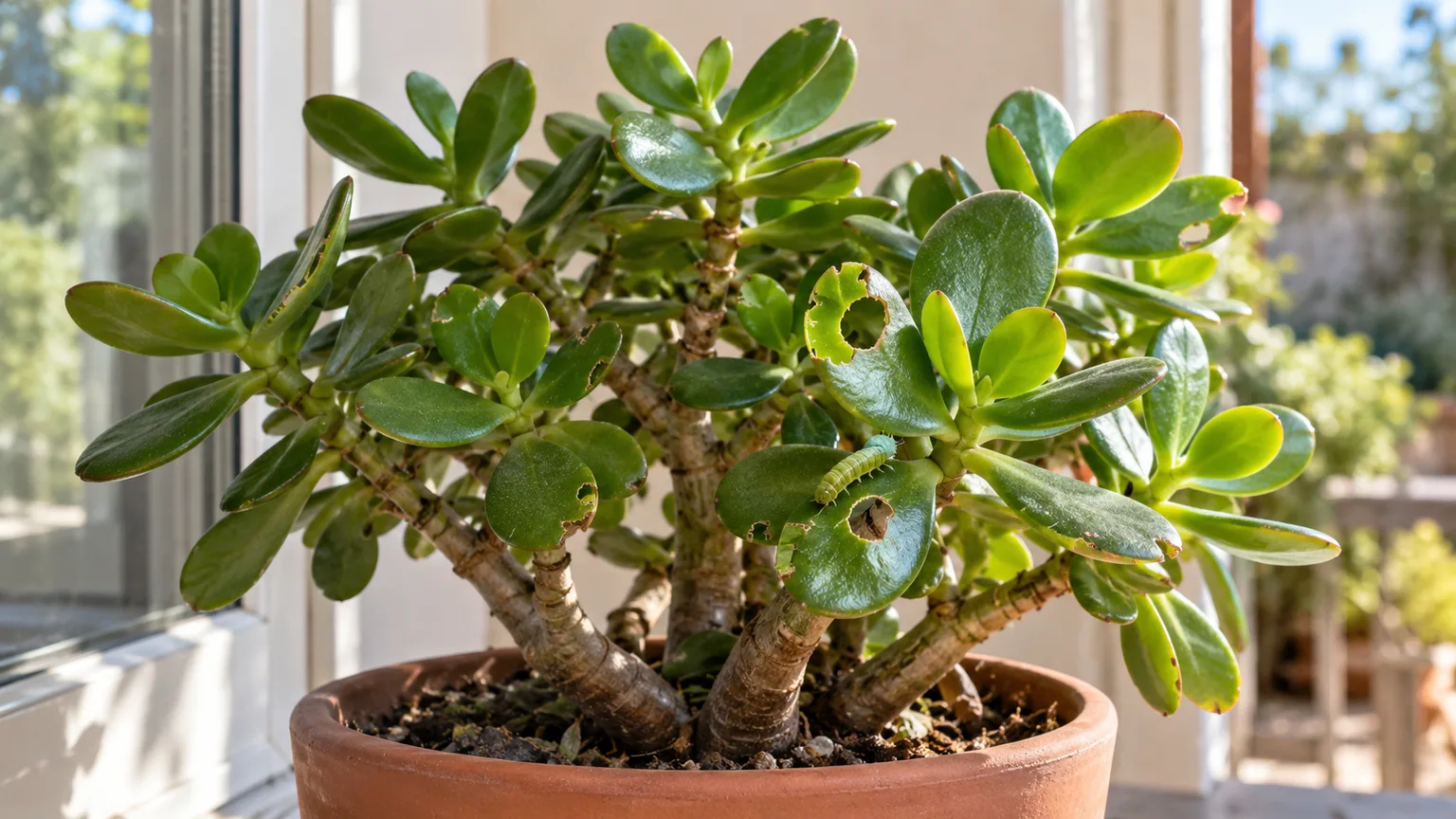
Caterpillars on Jade Plant: Identify Chewing and Stop Fresh Damage
This guide covers caterpillars on Jade Plant. See also the general Caterpillars guide, watering, and light pages for this plant.
Caterpillars on Jade Plant: Identify Chewing and Stop Fresh Damage
Quick answer: remove a confirmed larva, not just a damaged leaf
Start by checking for an active caterpillar. Look at the underside of the chewed leaves, branch tips, forks in the stems, and the rim of the pot. If you find a larva, lift it away with tweezers or gloved fingers; if you cannot identify it, keep it in a closed container long enough to take a clear photo or ask a local extension office. Do not reach for neem, soap, or a general insect spray based only on a hole.
Jade Plant (Crassula ovata) has rounded, fleshy leaves and stems that store water, a trait described by University of Wisconsin Extension and Gardening Know How’s Jade guide. That succulent growth habit changes how you should respond: a few old holes may be cosmetic, but repeated feeding on the newest tips can remove developing leaves. UC IPM guidance notes that a few leaf-feeding caterpillars are often not a concern, so judge the damage by whether fresh feeding continues. Holes alone are not a caterpillar diagnosis. Look for fresh chewing, frass, eggs, rolled leaves, or the insect itself, then choose the smallest effective response.
What caterpillar damage looks like on Jade Plant
On Jade Plant, feeding may leave an irregular bite at the edge of a leaf, a hole through the blade, or a missing section where tissue was eaten. UC IPM’s foliage guide notes that caterpillars chew holes in foliage and may fold or roll leaves into shelters; Southern Living’s garden guide also identifies leaf holes, frass, and eggs under leaves as clues to inspect. Those signs are useful, but none identifies a caterpillar by itself.
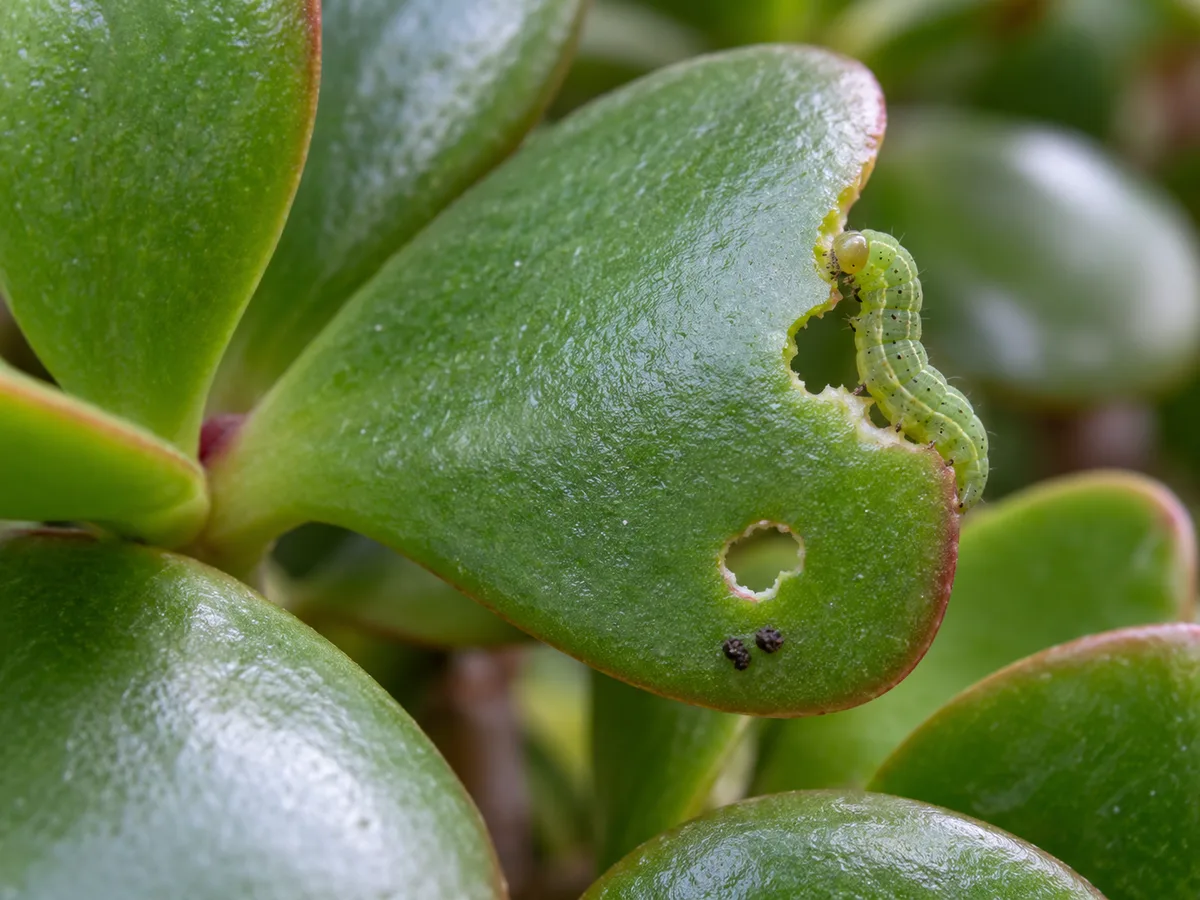
A fresh bite plus a visible larva is stronger evidence than a hole on its own; check nearby leaves for frass and additional feeding.
The damage can be easy to overread because the Jade Plant’s rounded, glossy leaves stay visible for a long time. A hole remains after the insect has left, so the plant can show old feeding even when no treatment is needed now. Wisconsin Extension’s Jade profile notes that the fleshy leaves can be damaged by sun, frost, or insecticide exposure; a damaged Jade leaf does not always point to a pest. The Missouri Botanical Garden profile likewise describes Crassula ovata as a succulent shrub with fleshy evergreen leaves and recommends well-drained soil.
Check whether the edge looks newly torn or dry and healed, whether the spot is truly missing tissue, and whether similar damage appears on several leaves. Fresh frass under a new hole or a larva tucked near the growing tip makes current feeding more likely. One old hole on a firm leaf, with no droppings, eggs, or new injury, is a reason to monitor rather than spray.
How caterpillars reach a Jade Plant
Jade Plant is commonly grown in a pot indoors, but it can also spend part of the warm season outside. Wisconsin Extension says houseplants can be moved outdoors for summer after gradual acclimation to stronger light. Each move changes the plant’s exposure to moths, butterflies, eggs, and other garden insects. If damage begins soon after a patio stay or after bringing the pot inside, inspect the whole plant and nearby foliage rather than assuming the caterpillar hatched indoors.
This is an exposure check, not proof that Jade Plant is a preferred host for a particular caterpillar. Host preferences vary among caterpillars; Southern Living’s host-plant note explains that many species feed on particular plants. Identify the larva on the plant before assigning it a species name or choosing a chemical treatment.
Confirm active feeding before you treat
Inspect the plant in bright light so you can see the undersides of its leaves. A useful check takes a few minutes and avoids unnecessary pruning or pesticide use:
- Look below fresh holes. Check the next leaf down, the soil surface, and the shelf for frass. Caterpillar droppings can fall below the feeding site; UC IPM’s inspection guidance recommends checking holes, excrement, eggs, and larvae together.
- Check leaf undersides and folds. Some larvae feed out of sight, and others shelter in a folded or rolled leaf. Use a phone light or magnifier without shaking the plant hard.
- Inspect branch joints and the growing tip. Jade has stout branches with leaf pairs clustered along them. A small larva may blend against a stem or hide where leaves meet.
- Repeat at dusk or after dark. Some cutworms hide in soil during the day and feed above ground at night; the RHS cutworm guidance describes this behavior. A second look when the room or patio is quiet can reveal a larva missed in a quick daytime scan.
- Compare old and new damage. Photograph the affected branch and check it again the next day. If no edge has changed and no fresh frass appears, the damage may be inactive.
Moth and butterfly caterpillars are the feeding larval stage; the adult insect does not chew the Jade Plant. UC IPM’s life-cycle guidance explains that moths and butterflies lay eggs on or near host plants and that larvae may feed singly or in groups. Finding a moth near the window, however, does not confirm eggs or larvae on the Jade. Base the diagnosis on plant evidence.
Caterpillars versus other Jade Plant marks
Not every hole or blemish means a caterpillar. Use the shape and texture of the damage to pick the next check instead of treating all marks as chewing.
| What you see | What it may mean | What to check next |
|---|---|---|
| Irregular missing tissue, fresh frass, or a larva on the leaf | Active chewing is plausible | Inspect undersides, folds, and nearby leaves; remove a confirmed larva |
| Pale winding track inside the leaf rather than an open bite | A leaf-miner pattern may fit better | Compare the Jade Plant leaf-miners guide and look for a larva within the track |
| Raised, corky blister-like marks with no missing tissue | Jade Plant edema or another tissue disorder is more likely than chewing | Check recent watering and compare the Jade Plant edema guide |
| Dry brown patch or split along a leaf edge, with no frass or fresh feeding | Physical damage, sun or cold injury, or old damage may be involved | Review recent moves and inspect for new feeding before changing care |
The difference matters because caterpillars are managed by finding or targeting the larva, while edema and environmental damage need a care review. The Jade Plant watering guide explains the plant’s dry-down pattern if the leaves are soft or the mix stays wet; watering changes will not close chewing holes. If you see a track rather than a bite, use the leaf-miner route instead of applying a caterpillar treatment.
First fix: pick off a confirmed caterpillar
For one or a few visible larvae, hand removal is the most direct first step; UC IPM recommends handpicking caterpillars from plants. Hold the branch gently so you do not snap the succulent stem. Use tweezers or gloves to lift the insect into a closed container. If you are confident it is a plant-feeding caterpillar and want to remove it, dispose of it away from the Jade Plant and other potted plants. If it is unfamiliar, avoid bare-handed handling and ask for identification from a clear photo.
After removal, inspect the rest of the plant and any Jade Plants or susceptible ornamentals that shared the outdoor area. You do not need to strip every leaf, wash the entire plant, repot, and prune on the same day. Those actions add stress, obscure whether feeding has stopped, and do not help if the insect was already gone. If you find a folded or webbed leaf with a larva inside, remove only that small shelter if handpicking is impractical; do not shear the Jade’s healthy growing tips.
Keep a potted Jade Plant in its familiar bright spot while you check for more larvae. Moving it suddenly from shade into direct sun can scorch foliage; Wisconsin Extension recommends gradual acclimation, and the Jade Plant light guide covers the same transition. If the plant is outdoors, move the container away from a dense cluster of infested plants only if you can keep its light conditions reasonably steady.
When to consider a caterpillar treatment
Consider a treatment only if you confirm a caterpillar, fresh feeding continues, and hand removal is not keeping up. UC IPM’s treatment guidance advises insecticides only when damage is intolerable and nonchemical methods have not worked. That is a useful threshold for a Jade Plant: a few old holes on a mature, otherwise firm plant do not justify spraying the whole collection.
Some products containing Bacillus thuringiensis subsp. kurstaki (Btk) are directed at susceptible caterpillars. UC IPM’s Btk guidance notes that caterpillars must eat treated leaves and that smaller larvae are generally easier to control with Btk. It does not work as a contact spray for every insect that might be near the plant, and a product label may not include Jade Plant or indoor use. Check the exact product label for the plant, target pest, and application site before considering it; do not increase the rate or use a product because it is called “organic.”
If the Jade Plant has been outdoors and a caterpillar could be a butterfly or moth larva you want to protect, identify it first. UC IPM’s butterfly-garden warning explains that treating such plants can kill caterpillars that will become butterflies. The goal is to stop a confirmed problem, not erase every larva from the garden. Handpicking and continued inspection are often enough for a single container plant.
Protect Jade Plant leaves from unnecessary sprays
Jade’s fleshy leaves can show product injury. Gardening Know How’s Jade care article advises caution because insecticides can cause phytotoxicity. Do not apply neem oil, insecticidal soap, or a broad garden spray by default. If an appropriate labeled product is still warranted, test it on a small part of the plant only when its label allows that use, wait the interval stated on the label, and follow all directions and precautions.
Avoid spraying a sun-warmed Jade Plant or coating the plant just to be thorough. The label decides whether a product can be used indoors, on succulents, and around pets or people; never infer those permissions from another plant’s treatment advice. If no label clearly covers the Jade Plant and the actual caterpillar, continue manual removal and ask a local extension service to identify the insect and recommend a suitable option.
Help Jade Plant recover without changing everything
Once fresh feeding stops, return to normal succulent care. Do not water more often to make holes disappear and do not fertilize to force replacement leaves. The Jade Plant overview describes the bright-light, fast-draining conditions that support steady growth. Keep its potting mix on the normal dry-down cycle; if you changed the soil or the plant is staying wet, use the Jade Plant soil guide to address that separate issue.
Leave firm leaves with small holes attached. Removing every damaged leaf reduces the plant’s remaining foliage without removing a pest. Prune only tissue that is fully dead, rotting, or holding a confirmed larva that cannot be removed safely. If a branch was heavily eaten, cut back to healthy growth with clean pruners and avoid taking a large portion of the plant at once.
The damaged area will not grow back into the leaf. Look for the problem to stop spreading, then watch the next growing tip for normal, undamaged leaves. Jade Plant is a relatively slow-growing succulent, as Wisconsin Extension describes, so new growth can take longer than it would on a fast-growing tropical foliage plant. A scarred older leaf can remain as a record of past feeding after the caterpillar is gone.
Prevent another caterpillar episode
Inspect the plant when it comes home from a nursery and whenever it moves between indoors and outdoors. Look under leaves, around branch forks, and near new growth for eggs, larvae, fresh holes, or frass. A short check before the Jade joins a shelf of houseplants is easier than trying to separate several plants later.
When placing Jade Plant on a patio for summer, acclimate it gradually to stronger outdoor light and recheck the leaves during the first few weeks. This helps limit sunburn while giving you a chance to spot an unfamiliar insect before bringing the pot back inside. Avoid taking the Jade through repeated moves between shade and strong sun solely because you saw one hole.
Keep the normal plant conditions stable. Jade grows best with bright light, well-drained mix, and a dry period between deep waterings, as summarized by the Missouri Botanical Garden’s Jade Plant profile. These habits do not prevent every caterpillar, but they reduce the chance that a feeding injury becomes confused with overwatering, edema, or light damage. For routine care, use the watering and light guides rather than adding fertilizer or moisture as a pest remedy.
Record the date and branch where damage first appeared. If fresh bites return, note whether the Jade had been outside, whether another plant was nearby, and whether you found a larva or only old holes. That brief record helps an extension specialist distinguish a one-time visitor from an insect that is repeatedly feeding on the plant.
When to ask for an identification
Ask a local extension office, botanical garden, or qualified plant clinic for help if feeding continues after repeated hand removal, the larva is hairy or unfamiliar, or the plant is losing several growing tips. Include a clear photo of the whole Jade Plant, the damaged leaf, both sides of the larva if visible, and a scale such as a ruler. Note whether the plant was indoors or outdoors and when the damage started.
If you cannot find a larva and the damage pattern does not fit, do not label it as caterpillar damage in a treatment log. A leaf miner, edema, old mechanical injury, or a different chewing insect may need another response. The Jade Plant problems hub and the caterpillars hub provide different starting points: the first keeps the diagnosis tied to this succulent, while the second covers general caterpillar clues across plants.
When to use this page vs other Jade Plant guides
Use this page when a Jade Plant has fresh holes or missing leaf edges and you need to confirm a caterpillar. For winding trails inside a leaf, compare the leaf-miners guide. For corky marks without missing tissue, see the edema guide. If stems or leaves are soft while the mix stays wet, start with the watering guide instead of treating for a pest.
The Jade Plant overview covers the succulent’s baseline care, and the problems hub routes other symptoms. Use the soil guide if drainage is poor and the light guide if the plant was recently moved outdoors. These are separate care questions; changing them will not remove a caterpillar.
Related Jade Plant guides
- Jade Plant overview — return to the plant’s bright-light, succulent-care baseline after the feeding stops.
- Jade Plant watering — check watering when leaves are soft or the mix stays damp, not as a treatment for holes.
- Jade Plant light — use when moving the plant between indoor and outdoor light.
- Jade Plant soil — improve drainage only when the mix or pot is causing a separate root-zone issue.
- Jade Plant leaf miners — compare winding trails inside leaves with open chewing damage.
- Jade Plant problems hub — find another species-specific guide if the pattern does not fit caterpillars.
Related tool
Use the Pest Identifier Tool to compare the insect you found before you choose a treatment.
Conclusion
Confirm fresh feeding, remove a caterpillar you can identify, and monitor Jade Plant before escalating to a spray. A few old holes do not need a rescue routine; keep normal succulent care steady and judge recovery by the next healthy leaves.