Syngonium Three Kings Repotting: When and How
Syngonium Three Kings Repotting: When and How
Syngonium Three Kings Repotting: When and How
Syngonium Three Kings repotting is less about buying a prettier pot and more about resetting a root zone that a fast grower outpaces faster than most owners expect. Syngonium podophyllum ‘Three Kings’ — the creamy-tricolor arrowhead sold as nephthytis or African evergreen — fills small containers quickly, drinks on a steady rhythm when the mix is healthy, and wilts just as fast when roots run out of room or old peat turns to mud. The goal is simple: refresh degraded soil, give roots functional space, and restore drainage without jumping two pot sizes, bare-rooting a plant that recovers best with minimal disturbance, or stacking repotting on top of a fresh move from the nursery.
Get timing, pot size, and mix right and recovery often takes one to two weeks in spring. Oversize the container, repot in deep winter, or fertilize the day after the move and you may watch variegated leaves yellow, stems soften, and new growth stall while the root zone sits wet and oxygen-poor. The sections below cover when to act, what to use, how to handle the root ball, and the mistakes that cause the most preventable damage on this cultivar.
If symptoms persist, see the Leggy Growth on Syngonium Three Kings guide.
Why Repotting Matters for This Variegated Arrowhead
Most houseplant advice treats repotting as optional maintenance you can defer indefinitely. For Syngonium Three Kings, that deferral has a shorter runway than on slow-growing species because this cultivar pushes new leaves regularly during warm months when light and water are consistent. In a typical indoor setting it trails or climbs as stems lengthen and can outgrow a 12 cm nursery pot within 12 to 18 months if care is steady — a pace the Missouri Botanical Garden associates with an actively growing 3 to 6 foot (0.9 to 1.8 m) climbing vine indoors. That speed is an asset when you want a full plant, but it also means roots explore available soil volume quickly and organic components in standard potting mix break down into finer particles that hold water longer and hold air less.
Fast Growth and Soil Breakdown
Repotting matters because roots and soil age together. Fresh, chunky mix drains in minutes, holds oxygen between waterings, and gives fine root hairs room to absorb moisture. Old mix compacts, develops hydrophobic dry pockets on top while staying wet at the bottom, and accumulates soluble salts from tap water and fertilizer. A Three Kings in degraded soil may look like a watering problem — yellow lower leaves, soft stems, fungus gnats — when the real issue is a root zone that no longer dries on a healthy cycle. NC State Extension notes that repotting every few years and trimming the root system can keep arrowhead vine manageable indoors, which is especially relevant on a cultivar that otherwise wants to climb.
Repotting is also your best opportunity to inspect roots for rot, trim dead tissue, and divide an overcrowded clump into two pots if you want to keep the plant compact without aggressive pruning. Catching brown mushy roots during a planned spring repot is far easier than emergency surgery in winter.
Variegation and Root Stress
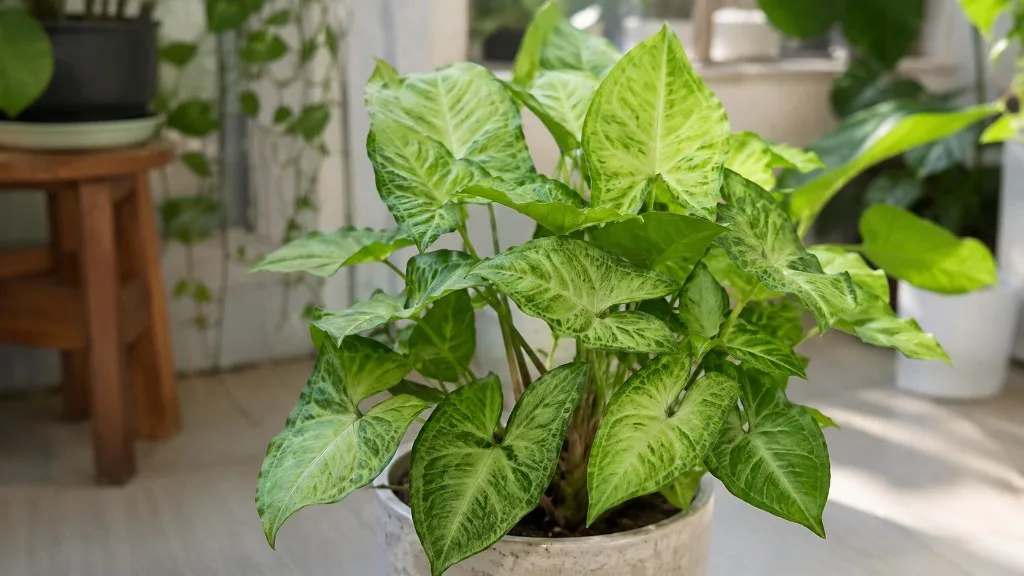
Three Kings leaves show creamy white margins on medium green — a pattern that needs more stable bright indirect light than solid-green arrowhead forms to maintain contrast, as variegated Syngonium cultivars in the RHS plant profile illustrate for the species generally. After repotting, the plant directs energy toward root repair before leaf production. Stress during recovery can push new growth toward solid green as the plant prioritizes photosynthetic area. That reversion is not always permanent, but it is one reason to repot in spring when light is increasing, to avoid unnecessary root trauma, and to return the plant to its brightest stable indirect light spot once the first week of recovery passes.
When Syngonium Three Kings Needs Repotting
How often should you repot Syngonium Three Kings? For most indoor specimens, every one to two years is realistic — but the decision should follow plant signals, not a calendar. A Three Kings in a small pot under strong grow lights may need attention closer to 12 months. One in moderate light in an appropriately sized container may go two years or longer before the mix fails. Repot when two or more diagnostic signs appear together, not because a single root tip peeked through one drainage hole.
The most reliable triggers are functional, not cosmetic. Roots circling thickly at the bottom when you slide the plant out, water that runs straight through in seconds while the plant wilts a day later, soil that dries so fast you are watering every two days in winter, or growth that stalls through an entire spring despite good light and regular feeding — each points to a root zone that has outgrown its setup or a mix that no longer holds moisture and nutrients properly. A planned repot also makes sense when you are addressing confirmed root rot, when the soil smells sour, or when salt crust covers the surface and flushing has not helped.
Root-Bound and Mix-Failure Signs
Signs your Syngonium Three Kings is root bound include patterns you can verify with a two-minute inspection. Lift the pot after watering the day before and gently slide the plant out. Roots circling the bottom in a dense mat, wrapping around themselves, or growing out of multiple drainage holes at once indicate the plant has used most of its available volume. Rapid drying — needing water every one to two days when you previously watered weekly — happens because roots occupy so much of the pot that little mix remains to hold moisture. Water channeling is the opposite failure mode of old, compacted soil: you pour water and it races through gaps between a hard root ball and the pot wall without evenly re-wetting the center.
Above-ground signals matter too but are less specific. Stunted new leaves — smaller than older ones, slow to unfurl, or mostly green with reduced white margin — can mean root constriction or nutrient exhaustion in old mix. Yellowing lower leaves combined with wet soil may indicate rot; combined with soil that dries in a day, think root-bound. A wobbling plant where the stem moves freely because roots no longer anchor the mix suggests the root ball is mostly roots and little substrate. The RHS repotting guide warns that a mass of roots spiralling at the bottom can prevent water draining properly and lead to root rot — the same physics apply indoors.
When You Can Safely Wait
Not every root sighting demands action. One or two thin roots exiting a single drainage hole on an otherwise healthy plant that drinks on a normal schedule is exploratory, not an emergency. If new leaves are full-sized with good variegation, the soil smells neutral, water absorbs evenly, and you last repotted within 18 months, waiting until spring is reasonable even if you see light circling at the bottom. Top-dressing — scraping out the top 3 cm of degraded soil and replacing it with fresh mix — can bridge a plant through winter without a full repot if the root ball is still healthy.
Also wait if the plant is already stressed from a recent move, pest treatment, or severe underwatering. Repotting a wilted, dry plant adds a second shock on top of the first. Stabilize it for two weeks — consistent moisture, bright indirect light, no fertilizer — then repot. The exception is active root rot with mushy roots and sour smell. That situation overrides the wait rule because contaminated mix will keep damaging roots until you replace it.
Best Time of Year to Repot
When is the best time to repot Syngonium Three Kings? Spring and early summer, when the plant is entering or already in active growth, give the best results. Lengthening days, warmer room temperatures, and rising humidity align with the natural rhythm of this tropical understory vine from Central and northern South America. Roots regenerate fastest when the plant is metabolically active, and new soil integrates with living root tips more readily than in dormant months.
Spring and Early Summer Timing
Schedule your repot for the point when you see consistent new leaf production — not the very first bud in late winter when nights are still cool. For many homes that means March through June, with regional variation. Repotting in this window gives four to six months of active growth for root establishment before shorter days slow the plant. If you missed spring and the plant is clearly root-bound with multiple symptoms, early summer is still acceptable. Avoid mid-to-late summer repots in hot, dry climates if the plant sits near an AC vent or a west-facing window where leaf scorch and rapid soil drying compound transplant stress.
Winter Repotting Risks
Can you repot Syngonium Three Kings in winter? Avoid it unless the situation is urgent — severe root rot, a pot so root-bound that water cannot penetrate, or a plant tipping over because roots displaced all soil. Winter repotting works against you because growth slows, root repair takes longer, and wet fresh mix stays cold and oxygen-poor longer in dim rooms. The Missouri Botanical Garden recommends reducing watering from fall to late winter on Syngonium podophyllum, which also signals slower root activity — fresh mix will not dry at the same rate your summer routine expects. If you must repot in winter, use a slightly chunkier mix than usual, water lightly rather than soaking, keep the plant in its brightest stable location without direct sun, and expect recovery toward three or four weeks instead of one or two.
Choosing Pot Size and Container Type
Pot choice on Three Kings is less about aesthetics and more about moisture physics. This aroid wants evenly moist — not soggy — soil during active growth, with enough air in the root zone that fine roots do not suffocate between waterings. The container determines how fast the mix dries and how much unused wet soil surrounds a modest root system after repotting.
Always use a pot with at least one drainage hole. Decorative cache pots without holes force you to guess whether standing water sits at the bottom, and arrowhead plants are not forgiving of perched water at the root crown. Terracotta dries faster and suits growers who tend toward heavy watering. Glazed ceramic and plastic retain moisture longer — helpful in dry homes if you adjust watering downward.
The One-Size-Up Rule
What size pot should you use when repotting Syngonium Three Kings? Go up one size only — roughly 2 to 5 cm (1 to 2 inches) wider in diameter than the current pot. If the plant is in a 12 cm pot, move to 14 or 15 cm, not 20 cm. Excess soil volume holds water the root system cannot absorb quickly. In an oversized pot, the center stays wet while the top looks dry, anaerobic conditions develop, and root rot follows even if you water “correctly” by finger-testing the surface.
Measure against the root ball, not necessarily the nursery pot label. Sometimes plants arrive in pots already one size too large for their roots. If you slide the plant out and see more soil than roots, the old pot size may already be correct — you only need fresh mix in the same container. That is a same-size refresh, not an upsize, and it is the right call when the issue is degraded soil rather than constriction.
Terracotta vs Plastic for Three Kings
For a trailing Three Kings, a slightly wider pot is often better than a deep narrow one because roots spread horizontally before they dive deep. A pot that is too tall with empty mix below the root ball creates a wet basement the roots never reach. Weighted ceramic or a wider base paired with a moss pole reduces wobble that damages fresh roots when the plant is bumped during recovery.
Best Soil Mix for Repotting
What soil should you use when repotting Syngonium Three Kings? A well-draining, airy aroid mix is non-negotiable. This plant evolved on the forest floor and on tree trunks where water passes through quickly and roots breathe. Heavy peat-based indoor mixes compact within a year, especially under frequent watering. The goal is a blend that holds moisture in the middle range — damp but never soggy — and drains within minutes after a thorough watering.
The Missouri Botanical Garden recommends a soil-based potting mix for Syngonium podophyllum with regular growing-season watering. Commercial indoor potting mix amended with perlite and orchid bark works well. Avoid garden soil, pure peat, or moisture-control mixes loaded with water-retaining crystals unless you are experienced at calibrating dry-back time.
Aroid Blend Recipe
A reliable starting recipe:
- 2 parts quality indoor or peat-based potting mix
- 1 part perlite or pumice
- 1 part orchid bark or coco chips
This ratio creates macro-pores for airflow while the potting mix retains enough moisture that you are not watering daily in a 15 cm pot. In very humid homes or dim corners where evaporation is slow, increase perlite or bark. In hot, dry rooms with strong light, the base recipe is usually fine. Repotting is your chance to reset how your specific mix dries — not to follow a universal calendar.
Optional additions: a small handful of horticultural charcoal per liter of mix improves drainage and reduces sour odors. Worm castings (no more than 10 percent of total volume) add gentle organic nutrition without the salt spike of synthetic fertilizer at repot time.
Adjusting for Your Home Environment
When switching blends, match the new mix as closely as practical to the old drainage behavior so your watering rhythm stays predictable. Skip fertilizer mixed into repotting soil for the first month, and do not rely on gravel at the bottom of the pot — drainage comes from holes and mix structure, not decorative layers that reduce usable root volume.
Step-by-Step Repotting Process
The full process takes 20 to 40 minutes for a single plant. Work on a surface you can wipe clean — Syngonium podophyllum sap contains insoluble calcium oxalate crystals that irritate skin and are toxic to cats and dogs if ingested. Wear gloves if you are sensitive, wash hands after handling, and keep pets away from discarded trimmings.
Before you start: Water the plant 24 hours before repotting so the root ball holds together. Gather a new pot one size up, fresh mix, sterilized scissors, a chopstick or pencil, and a watering can. Cover the drainage hole with a coffee filter or mesh to keep mix from washing out without blocking drainage.
Preparing the Root Ball
Turn the pot on its side and press gently on the sides to loosen the root ball. Slide the plant out — do not yank the stem. If it is stuck, run a flexible spatula around the inner edge. Once out, look at root color: white to tan and firm is healthy; brown, black, mushy, or sour-smelling indicates rot.
Tease circling roots at the bottom and outer edges with your fingers. You are loosening the spiral, not combing the entire ball bare. Remove only dead or mushy roots with clean scissors. If the root ball is a dense brick with almost no visible soil, make two or three shallow vertical scores on the sides with a clean knife to encourage new roots to grow outward into fresh mix. Do not bare-root the plant unless rot forces you to wash away contaminated soil.
Remove loose, degraded old soil from the top and outer layer if it crumbles away easily. Keep the core intact. Trim any yellow or damaged leaves now so the plant does not waste energy on tissue it cannot repair — but do not remove more than one or two leaves unless they are clearly rotting.
Settling Into the New Pot
Add 3 to 5 cm of fresh mix to the bottom of the new pot. Set the root ball so the crown sits at the same depth as before — burying the stem deeper invites stem rot on aroids. Hold the plant centered and fill around the sides, tapping the pot gently or using a chopstick to settle mix into gaps without compacting it into concrete. Leave 1 to 2 cm below the rim for watering space.
Water thoroughly until runoff exits the drainage hole, then empty the saucer. Some growers wait 24 to 48 hours before the first water if they trimmed significant roots; for a routine repot with minimal trimming, watering immediately is standard. Place the plant in bright, indirect light — the same spot or slightly dimmer for the first week, never direct sun on a stressed plant. Hold fertilizer for three to four weeks minimum so tender new root tips are not burned.
Division and Cuttings at Repot Time
Repotting is the easiest time to divide a multi-stemmed Syngonium Three Kings or take stem cuttings if you want a fuller pot or a second plant. NC State Extension lists division and stem cuttings among recommended propagation strategies for arrowhead vine. Mature specimens often produce several stems from one root mass. If you see natural separation points where stems emerge from distinct root clusters, gently pull or cut the clump into two portions, each with roots and at least one healthy stem with leaves.
For stem cuttings, take sections with one or two nodes, root them in water or moist mix, and pot up after roots reach 3 to 5 cm — see the full propagation guide for timing. Division is faster because established roots already exist. After division, pot each section in a container appropriate to its root size — not an oversized pot because you want the plant to grow big quickly. Both divisions and cuttings need the same post-repot care: stable moisture, no fertilizer for several weeks, and bright indirect light.
Common Repotting Mistakes on Three Kings
Jumping two pot sizes is the headliner. More soil means more retained water relative to root mass. Three Kings leaves turn yellow from the bottom up, stems soften, and growers often respond by withholding water — which stresses an already compromised root system further. Stick to one size up or a same-size refresh.
Bare-rooting or over-teasing strips fine root hairs that do most of the water absorption. You may see dramatic wilting within 24 hours even though the remaining roots look white and healthy. Keep most of the original root ball intact unless rot requires washing.
Repotting into heavy, unamended potting mix recreates the compaction problem within months. If you only have standard mix on hand, add perlite until the texture looks visibly chunky.
Fertilizing immediately after repotting burns new root tips and can trigger salt damage on variegated sections that are already stressed. Wait until you see new growth — a fresh leaf unfurling is your green light to resume half-strength feeding per the fertilizer guide.
Repotting in direct sun or deep shade after the move extends shock. Direct sun dehydrates leaves faster than damaged roots can replace water. Deep shade slows root regeneration. Bright indirect light is the recovery zone.
Ignoring toxicity during cleanup puts pets at risk. Sap on discarded leaves or tools can still irritate mouths if chewed. Bag trimmings and wipe surfaces.
Aftercare and Recovery Timeline
Is transplant shock normal after repotting Syngonium Three Kings? Yes — mild wilting, slight leaf droop, or a brief pause in new growth for one to two weeks is common and usually resolves without intervention if the root zone is not staying wet. Do not panic-fertilize or move the plant repeatedly. Keep moisture lightly even — the top 2 to 3 cm should approach dry before the next water, not bone dry for days and then flooded.
Full root re-establishment typically takes four to six weeks in spring. New growth is the clearest recovery signal: a leaf unfurling at normal size with reasonable variegation means roots are working. Old yellow leaves will not green up again — remove them once dry. If wilting worsens after two weeks, slide the plant out and check for rot in the new mix (usually oversized pot or overwatering) or desiccation (underwatering a root-reduced ball).
Resume half-strength balanced liquid fertilizer after three to four weeks if new growth is visible. Skip winter feeding if you repotted in fall and the plant is not actively growing. Increase humidity slightly if leaf tips brown during recovery — a pebble tray or grouping plants helps without wetting foliage.
Linking Repot to Watering and Light
Repotting resets the watering rhythm. Fresh, chunky mix in an appropriately sized pot dries more slowly than a root-bound brick that channeled water, but faster than degraded mud in an oversized container. For the first two to three weeks, check moisture deeper than the surface — new mix on top can look dry while the center near healing roots stays damp. Adjust your schedule based on pot weight and finger depth, not the old calendar from the previous pot.
After repotting, return the plant to the brightest indirect spot it tolerated before — ideally where new leaves had strong variegation. Moving it to a darker corner to “reduce stress” often causes more stress through reversion and slower root recovery. Stability in light, moisture, and temperature matters more than coddling in dim conditions.
Conclusion
Syngonium Three Kings repotting comes down to a short list of decisions: repot when two or more signs confirm the need — circling roots, channeling water, rapid drying, or stalled growth — not on autopilot every spring. Time the move for spring or early summer when possible, choose a pot one size up with a drainage hole, and fill it with chunky aroid mix that drains in minutes and holds air between waterings. Handle the root ball with restraint, trim only what is dead, water thoroughly once, and give the plant three to four weeks without fertilizer while it settles.
Most failures trace back to oversized pots, heavy soil, and impatient feeding — all avoidable. Watch for new leaves as your recovery benchmark, keep pets away from sap during the process, and treat repotting as soil renewal and modest spatial relief for a fast grower that will repay good drainage with wing-shaped, variegated foliage for seasons to come.
When to use this page vs other Syngonium Three Kings guides
- Syngonium Three Kings overview — Start here for whole-plant context before deep-diving this topic.
- Syngonium Three Kings problems hub — Jump to symptom-specific fix guides when this care topic does not resolve the issue.