Table of Contents
What a Pebble Tray Is
A pebble tray is a shallow tray or saucer filled with stones and a small amount of water, placed under or near a plant to create a slightly more humid pocket of air. The idea is simple: as the water evaporates, it adds moisture to the air right around the plant instead of trying to humidify the whole room. That matters because many indoor tropicals come from environments where the air holds far more moisture than a heated living room in winter. Reputable gardening sources still recommend pebble trays as one tool for raising local humidity, but they frame them as modest helpers, not miracle fixes. (RHS)
The phrase that matters here is local humidity. A tray does not rewrite the climate in your apartment. It changes a very small zone around the pot, and even that benefit depends on the tray’s width, the plant’s size, and how quickly air moves through the room. If you treat a pebble tray like a low-cost microclimate tool, you’ll use it well. If you expect it to mimic a humid greenhouse, you’ll be disappointed.
How Evaporation Helps Tropical Plants
Tropical houseplants lose water through their leaves in a process called transpiration. When indoor air is dry, plants can lose moisture faster than roots can replace it, which is one reason you see crisp leaf edges, browning tips, curled margins, and stalled growth. The Royal Horticultural Society explains that low humidity speeds water loss from leaves, while the University of New Hampshire Extension notes that most houseplants do well at 40–60% relative humidity, with more tropical species often preferring 70–80%. Missouri Botanical Garden gives a similar benchmark, saying most houseplants grow well around 50% RH, while some need 70–80%. (RHS)
That does not mean every tropical plant in your home needs rainforest conditions. A lot of common indoor growers—philodendrons, pothos, many monsteras—handle average home humidity better than people assume. The plants that complain first are usually the thinner-leaved, more delicate, humidity-hungry types. For those plants, even a small humidity bump can reduce stress, especially if the plant is already getting the basics right: decent light, correct watering, and no hot draft blasting across the leaves.
Do Pebble Trays Actually Work?
Yes, but only within limits. That is the honest answer. Horticulturist Justin Hancock of Costa Farms told Better Homes & Gardens that pebble trays can work, but indoor air circulation disperses that moisture quickly, which shrinks the effect. University and RHS guidance lines up with that: pebble trays can contribute to a more humid microclimate, but they are one part of a humidity strategy, not a full-room solution. (Better Homes & Gardens)
This is where a lot of online advice goes wrong. Some pages oversell pebble trays as if a handful of stones can solve chronic dry-air issues for every tropical plant you own. Other pages swing too far the other way and dismiss them completely. The better view is more useful: pebble trays help a little, and sometimes a little is enough. If your room is only somewhat dry and your plant is compact, healthy, and placed well, that small increase may be all it needs to avoid crispy edges. If your home is extremely dry, drafty, and heated all winter, the tray will rarely move the needle enough on its own.
When a Pebble Tray Helps
A pebble tray is most effective when the setup favors slow moisture loss into the surrounding air rather than instant dispersal. UNH Extension says plant grouping and similar microclimate methods work best in small rooms with low airflow, because moisture is less likely to spread uselessly through the whole space. Better Homes & Gardens adds that wide trays are more useful for small, low-growing plants, because the humid pocket stays closer to the foliage. (Extension | University of New Hampshire)
That makes pebble trays a practical choice for compact tropicals on a shelf, tabletop, or clustered plant stand. They also make sense when you want a low-maintenance, zero-electricity option that is easy to build from what you already have. If the tray is wider than the pot, the leaves sit relatively close to the moisture source, and the room is not aggressively ventilated, the tray has a fighting chance to help.
Where a Pebble Tray Falls Short
A pebble tray fails when the plant is too tall, the room is too large, or airflow strips the moisture away faster than the plant can benefit from it. Hancock makes that point directly: the taller the plant or pot, the less likely it is to get meaningful humidification from the tray. Research on indoor plants and humidity supports the same logic at a broader level. A 2024 study in the Journal of Building Engineering found that indoor plants can make a small but significant contribution to room moisture under certain conditions, but air exchange had a greater impact on relative humidity than the plants themselves. In plain English: airflow often beats your humidity hack. (Better Homes & Gardens)
That is why a large monstera in a dry, heated room often keeps crisping up even with a tray underneath. The tray is not useless; it is just outmatched. This is also why people say, “Pebble trays don’t work,” after trying one under a floor plant in front of a vent. The method was wrong for the situation. A tray is a localized tool. Once you ask it to behave like a room humidifier, it loses.
Which Tropical Houseplants Benefit Most
The best candidates are small, low-growing, humidity-appreciating plants. Better Homes & Gardens specifically points to plants such as fittonia, selaginella, creeping ficus, and hemigraphis as better matches for pebble trays because their foliage sits closer to the humid zone. That logic also extends to many small ferns, prayer plants, baby calatheas, compact begonias, and juvenile alocasias, especially when they live in clusters instead of alone. (Better Homes & Gardens)
The common thread is not just “tropical.” It is size plus sensitivity. A compact plant with thin leaves and higher humidity preferences can get more from the tray than a thicker-leaved, more adaptable plant. That is why a small Fittonia albivenis may show improved leaf turgor and fewer crispy edges with a tray, while a mature Monstera deliciosa barely notices. If you think in terms of plant geometry, the method gets easier to judge. The closer the leaves are to the water source, the more realistic the payoff.
Plants That Usually Need More Than a Pebble Tray
Some plants tolerate average room humidity just fine, so a tray is optional rather than necessary. Others are so humidity-sensitive that a tray may not be enough. Large calatheas, mature alocasias, big ferns, some anthuriums, and tall prayer plants often want more stable moisture than a passive tray can provide, especially in dry winters. RHS guidance also suggests alternatives such as steamy bathrooms or frequent humidity support for tropicals that need more. (RHS)
If your plant already has repeated brown margins, distorted new growth, and a spot near a heating vent, do not make the tray your only fix. That is usually a sign to improve the whole environment: move the plant, reduce hot airflow, group plants, check actual humidity with a hygrometer, and upgrade to a humidifier if the room is chronically dry. Pebble trays are useful, but some plants need stronger support than passive evaporation can provide.
Materials You Need
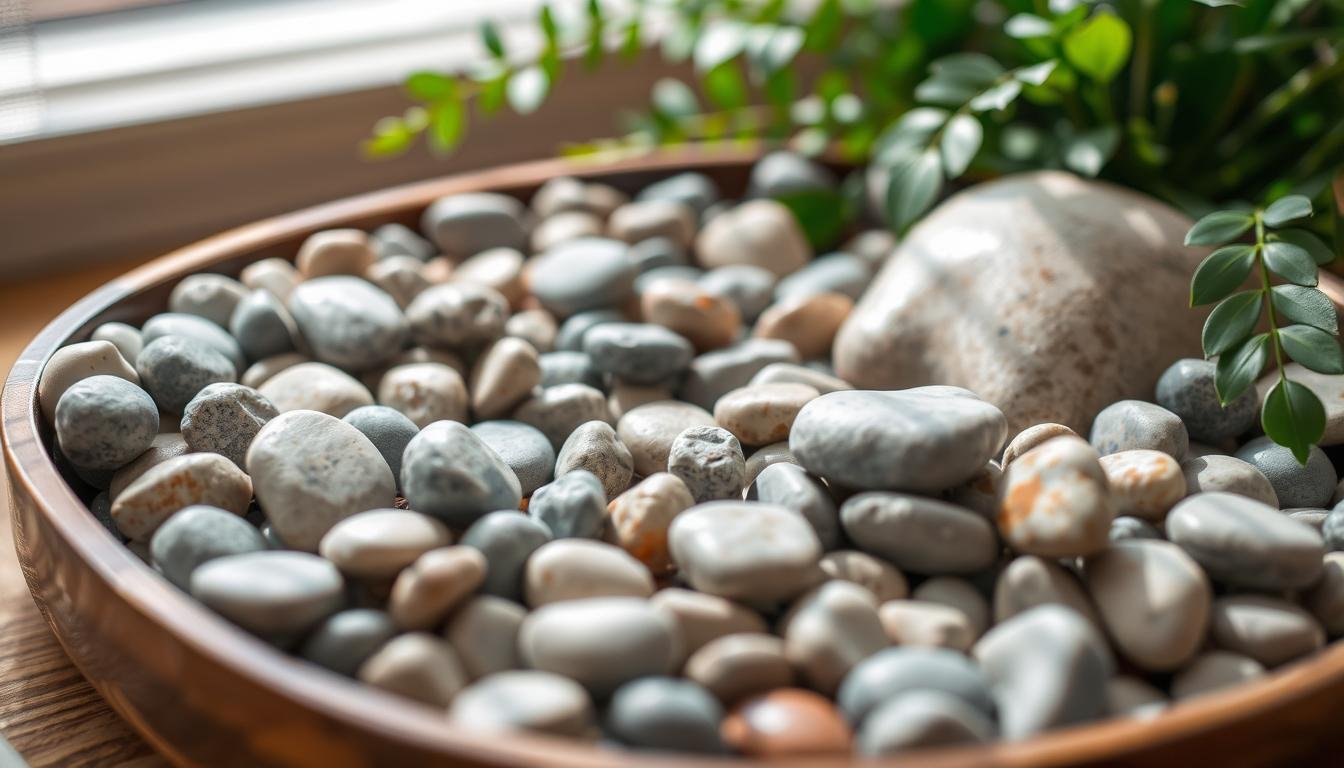
The materials are basic, but the details matter. You need a wide, shallow waterproof tray or saucer, clean pebbles, aquarium gravel, glass marbles, or LECA/hydroleca, clean water, and a pot with drainage holes. The tray should be wider than the base of the pot so there is enough exposed wet surface area to evaporate moisture. Better Homes & Gardens recommends a low, wide tray several inches wider than the plant pot, and RHS suggests placing the pot on a saucer over moist gravel or hydroleca. (Better Homes & Gardens)
Avoid absorbent or messy materials that stay slimy, wick water into furniture, or collapse into mud. Pebbles should be clean and stable enough to hold the pot above the waterline. If you want a more polished indoor look, decorative river stones or neutral LECA work well. What matters most is function: the pot must sit securely, and the roots must never rest in standing water.
How to Make a DIY Pebble Tray
This is one of the easiest plant-care projects you can do, but it pays to build it correctly the first time. A sloppy tray can invite algae, mineral crust, fungus gnats, and root problems. A well-made tray becomes low-effort background support that quietly helps the plant.
Step 1: Choose the Right Tray
Pick a tray that is shallow, waterproof, and wider than the pot—not barely the same size. The wider the tray, the more exposed water surface you have, which gives evaporation more room to happen. For a small tropical plant in a 4- to 6-inch nursery pot, a tray a few inches wider on all sides works well. For grouped plants, use a larger tray so multiple pots can share one humid pocket. Better Homes & Gardens and multiple plant-care sources emphasize width because tray size directly affects usefulness. (Better Homes & Gardens)
A tray that is too tight defeats the point. It may still catch runoff, but it will not create much additional humidity. You also want enough depth to hold stones and water without splashing, but not so much depth that the setup starts looking like a bucket of rocks.
Step 2: Add Pebbles or LECA
Fill the tray with a layer of clean stones deep enough to keep the pot base elevated. Evenly sized pebbles are easier to work with than random chunky rocks because they make the pot sit more level. LECA also works well because it is lightweight and designed for plant setups, and RHS specifically mentions hydroleca as an option for humidity support. (RHS)
Rinse the material before use. This step is boring, but skipping it leaves you with dust, grit, and mineral residue that turns the tray ugly fast. If you use decorative pebbles from outdoors, wash them thoroughly first. Clean material keeps the tray looking better and reduces the chance of cloudy water and buildup.
Step 3: Add Water to the Correct Level
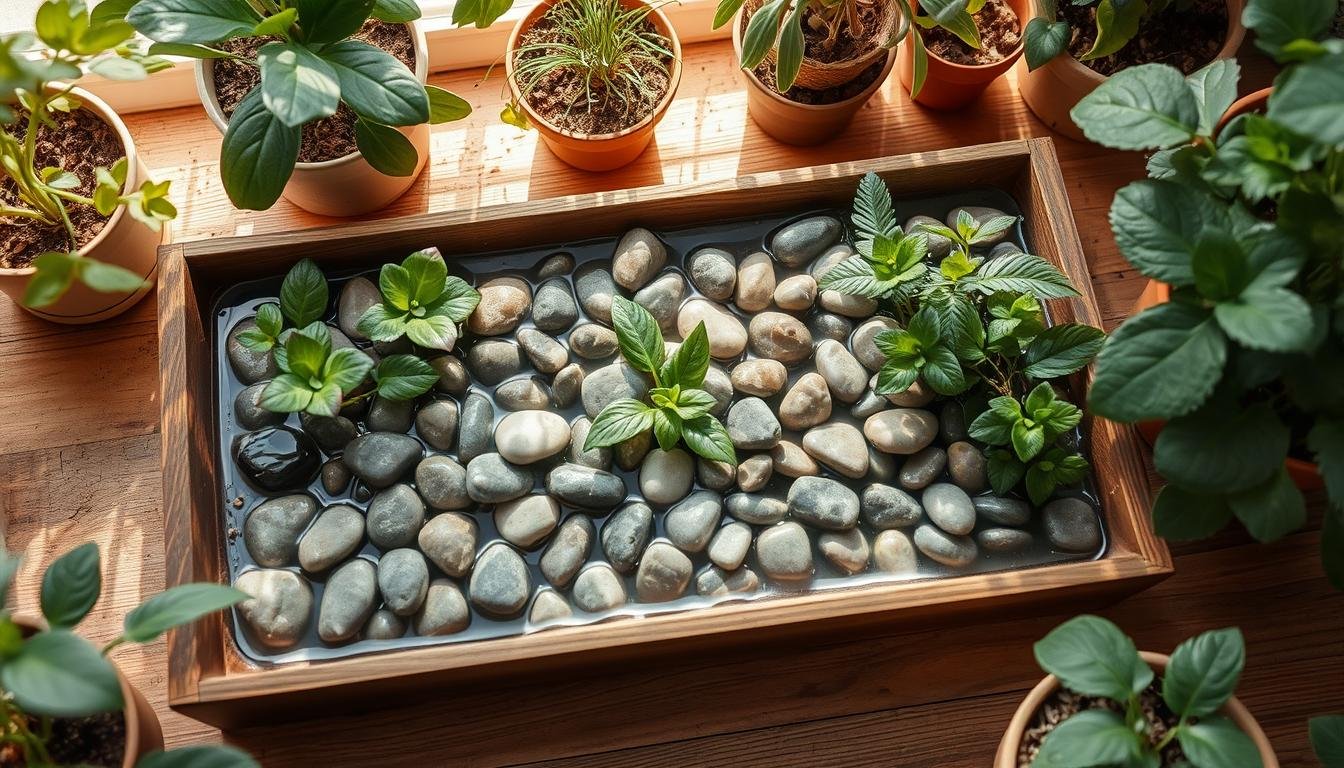
Pour in enough water so it sits below the top of the stones. Better Homes & Gardens recommends stopping the water line just below the top of the pebble line, which gives you evaporation without letting the pot sit directly in water. That distinction is the entire method. You want moisture entering the air, not saturating the soil from below. (Better Homes & Gardens)
This is the mistake that turns a pebble tray from helpful to harmful. If the water level is too high, the pot base or roots can stay wet for too long, which encourages rot, fungus, and a constantly soggy mix. Keep the water low enough that it never climbs into the drainage holes.
Step 4: Set the Pot Above the Waterline
Place the pot on top of the pebbles so it sits stable and lifted, with the drainage holes safely above the water. RHS is clear that containers need good drainage and should not sit in water for long periods, and Better Homes & Gardens makes the same point for pebble trays specifically. (RHS)
If your pot is heavy or oddly shaped, test it before committing. The tray should not wobble. You do not want the plant sinking, tilting, or ending up with one side of the root ball constantly wet. Once the pot is stable, you are done. The tray now works passively in the background, and all you need to do is keep the water level topped up and the tray clean.
Placement Tips That Make the Tray More Effective
Placement changes everything. If the tray is next to a heating vent, ceiling fan, air conditioner, or drafty doorway, the added moisture will disperse too quickly to matter. UNH Extension specifically advises keeping plants away from heat vents, radiators, and outside doors when trying to preserve humidity, while suggesting that bathrooms and kitchens can be naturally better humidity zones if the light is adequate. (Extension | University of New Hampshire)
The best place for a pebble tray is where air is stable but not stagnant. You still want enough movement to avoid fungal issues, but not so much that every bit of evaporated moisture disappears instantly. A shelf corner, side table near bright indirect light, plant cabinet opening, or grouped plant stand usually works better than a wide-open room with constant air movement. Grouping plants can amplify the tray’s effect because transpiration from the plants adds to the local moisture. UNH Extension and Costa Farms both note that grouped plants can build a small microclimate. (Extension | University of New Hampshire)
A hygrometer is worth buying if you have more than one humidity-sensitive tropical. Not because you need to obsess over numbers, but because it ends the guessing. If your room sits around 45–50% RH, a pebble tray may be enough for many plants. If your room is dropping into the 20s or low 30s in winter, the tray is unlikely to carry the load for anything fussy. That single reading can save you weeks of trial and error.
Cleaning and Maintenance
Pebble trays are low maintenance, not no maintenance. Water evaporates, dust settles, fertilizer splashes, and mineral residue builds up. Better Homes & Gardens recommends refilling as needed and rinsing the tray and stones from time to time. That is the baseline. In practice, most indoor growers should check the water every few days in a warm, dry room and give the tray a more thorough rinse every couple of weeks, or sooner if the water gets cloudy or the stones start looking slimy. (Better Homes & Gardens)
Use plain water. Do not turn the tray into a fertilizer reservoir or an essential-oil experiment. The goal is simple evaporation, nothing more. If your tap water leaves white crust on pots and trays, occasional cleaning matters even more. Lift out the stones, rinse the tray, scrub away biofilm or mineral deposits, and reset it. A clean tray not only looks better; it is less likely to attract fungus gnats or create a stale, swampy smell around your plants.
If you keep several trays, match your maintenance to the season. Winter heating usually dries air faster, which means more refills. Summer may reduce the need, depending on your climate and air conditioning. Let the plant tell you what the environment is doing. If leaf edges stay clean and the tray dries predictably, your setup is probably working. If the tray stays gross, half-full, and forgotten, it is not helping much.
Common Mistakes to Avoid
The biggest mistake is letting the pot sit in water. That is not a humidity tray anymore; that is a root problem waiting to happen. Houseplant containers need drainage, and prolonged contact with standing water can deprive roots of air and increase the odds of rot. RHS says to let plants drain thoroughly and avoid leaving them in water-filled saucers, which applies here too. (RHS)
The second mistake is using a tray that is too small. A pebble tray the same width as the pot base does very little beyond catching drips. If you want evaporation to matter, you need exposed surface area. The third mistake is using a tray under the wrong plant. A tiny fittonia on a wide tray can benefit. A tall bird of paradise in a huge, dry room usually will not. Better Homes & Gardens makes this size mismatch point clearly, noting that pebble trays are most effective for small, low-growing plants. (Better Homes & Gardens)
Another common error is trying to solve every symptom with humidity. Brown leaf edges can come from dry air, yes, but also from inconsistent watering, excess salts, hard water sensitivity, root damage, or too much direct sun. If a tray does nothing, do not assume the tray method failed before checking the rest of the care. Humidity problems are often mixed with watering problems. That is why serious troubleshooting starts with the whole setup, not one trick.
One more mistake: expecting the tray to fix a room with heavy air exchange. The 2024 indoor-environment study found that air exchange had a larger impact on relative humidity than plant moisture contribution. If your HVAC runs constantly or a fan moves air all day, a passive tray will struggle. In that case, the honest fix is usually a humidifier, a better location, or both. (ScienceDirect)
Pebble Tray vs Other Humidity Fixes
A pebble tray is cheap, simple, silent, and good for localized support. A humidifier is far more reliable when you need to raise humidity across a larger area or support more demanding plants. UNH Extension says a portable humidifier offers more consistent control, especially when paired with a digital thermometer and hygrometer. Better Homes & Gardens also describes a humidifier as the single most reliable way to raise humidity around houseplants at scale. (Extension | University of New Hampshire)
Grouping plants sits somewhere in the middle. It costs nothing and can strengthen the microclimate around humidity-loving plants. UNH specifically notes that grouping works best with several plants and low airflow. For many growers, the best low-cost setup is not tray versus grouping. It is tray plus grouping in the right room. (Extension | University of New Hampshire)
Misting is popular because it feels active, but it is less dependable than many people think. RHS mentions spraying as potentially helpful if done frequently, which is the catch: it is brief and inconsistent unless you do it often enough to matter. A tray works more slowly, but it works passively all day. (RHS)
For the most humidity-sensitive plants, terrariums, cloches, and cabinets can outperform all of the above because they control the plant’s immediate environment more tightly. Missouri Botanical Garden suggests terrariums or small indoor greenhouse structures for plants that require very high humidity. Better Homes & Gardens says similar high-humidity spaces can suit ferns, fittonia, marantas, and calatheas. That is the upgrade path when a tray keeps falling short. (Missouri Botanical Garden)
Here is the clean way to think about it:
| Method | Best for | Main strength | Main limit |
|---|---|---|---|
| Pebble tray | Small tropicals, light humidity boost | Cheap, silent, easy | Local effect only |
| Plant grouping | Multiple plants together | Free, simple | Limited in high airflow |
| Misting | Temporary leaf moisture | Fast and easy | Short-lived, inconsistent |
| Humidifier | Whole room or fussy plants | Most reliable control | Costs more, needs cleaning |
| Terrarium/cabinet | High-humidity specialists | Strong environmental control | Less flexible, more setup |
Conclusion
A DIY pebble tray for tropical houseplants is worth using when you understand what it is and what it is not. It is not a replacement for a humidifier in a dry, drafty room. It is not a shortcut around bad watering, weak light, or a plant parked next to a heater. What it is, when used well, is a low-cost way to create a small humidity buffer around the right kind of plant.
That makes it a smart tool for compact tropicals, clustered setups, and homes where humidity is only a little lower than ideal. The tray works best when it is wide, clean, correctly filled, and placed where moving air will not strip away its effect. It works worse as the plant gets taller, the room gets larger, or the air gets drier. That tradeoff is not a flaw in the idea. It is just the reality of passive evaporation.
If your tropical plant has mild dryness issues, start with a well-built tray, sensible placement, grouped plants, and a hygrometer so you can stop guessing. If the room is truly dry or the plant is especially demanding, move quickly to stronger tools. The best plant care is rarely about hacks. It is about choosing the right tool for the actual problem.
FAQs
Do pebble trays actually increase humidity for tropical houseplants?
Yes, but the increase is usually small and localized. They are most useful for compact plants in low-airflow spaces, not for changing humidity across an entire room. (Extension | University of New Hampshire)
Should the bottom of the pot touch the water in a pebble tray?
No. The pot should sit above the waterline on the stones. If the pot or roots stay in standing water, you risk soggy soil and root damage. (RHS)
Which houseplants benefit most from a pebble tray?
Small, low-growing, humidity-appreciating plants usually benefit most, including fittonia, selaginella, small ferns, juvenile prayer plants, and some compact calatheas. Larger plants usually need more than a tray. (Better Homes & Gardens)
How often should I refill and clean a pebble tray?
Refill it whenever the water drops low, which may be every few days in a warm, dry room. Clean the tray and stones regularly, especially if you see mineral crust, cloudy water, or slime. (Better Homes & Gardens)
Is a pebble tray better than a humidifier?
Not if you need reliable humidity across a larger space. A pebble tray is cheaper and simpler, but a humidifier is more effective for dry rooms, tall plants, and humidity-sensitive collections. (Extension | University of New Hampshire)