Distorted Leaves on Adenium: Pest & Virus Checks
Quick answer
Distorted leaves on Adenium—cupping, twisting, puckering, or stunted new growth—usually mean sap-sucking pests, mosaic virus, or herbicide drift—not a watering calendar issue. First step: isolate the plant and inspect the newest leaves and undersides with a magnifier before changing water or fertilizer.
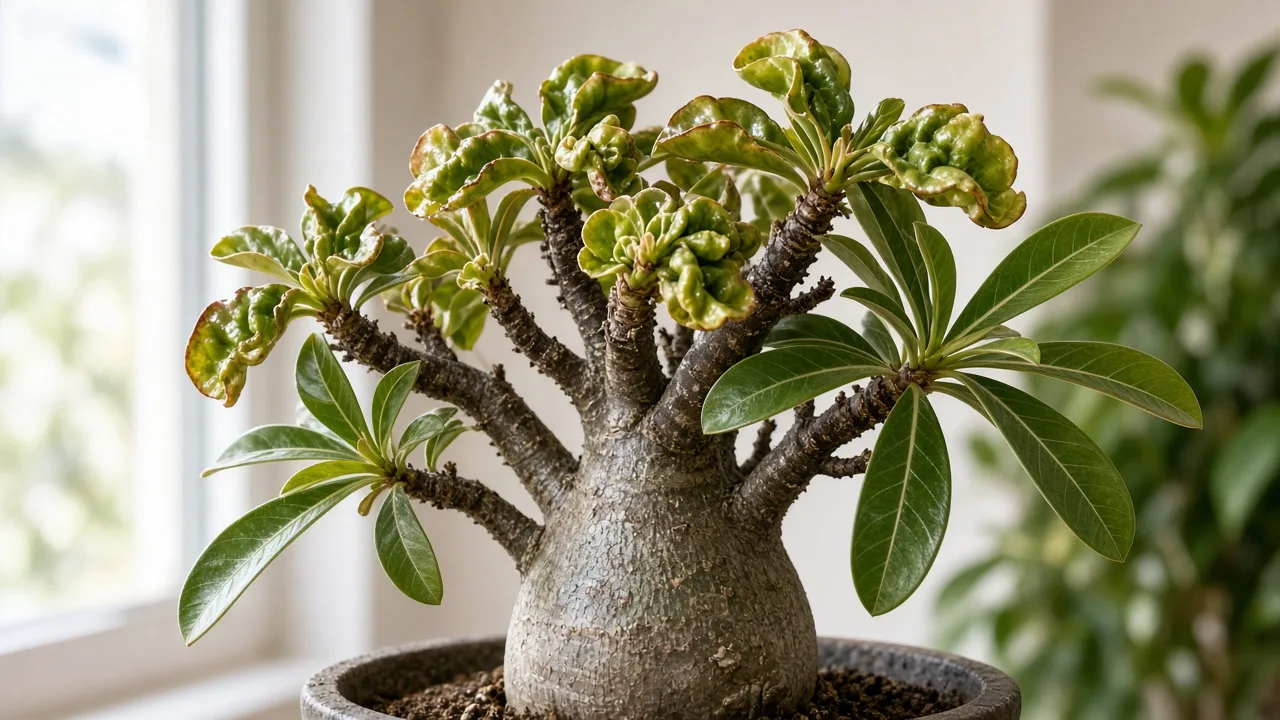
Distorted Leaves on Adenium: Causes, Checks & Fixes
This guide covers distorted leaves on Adenium. See also the general Distorted Leaves guide, watering, and light pages for this plant.
Distorted Leaves on Adenium: Causes, Checks & Fixes
Quick answer
Distorted leaves on Adenium obesum look like cupping, twisting, puckering, or stunted new blades that never flatten to the glossy oval shape healthy Desert Rose shows. For general leaf distortion mechanics, see our distorted leaves guide and the distorted leaves symptom hub. On Adenium, distortion almost always starts at the softest new growth at branch tips—inspect there first, not the caudex.
First step: isolate the plant and examine the newest leaves and undersides with a magnifier. Sticky residue, fine webbing, or clustered insects point to aphids or spider mites. Mottled yellow-green distortion without pests suggests mosaic virus.
When to use this page vs other Adenium guides
| Pattern | Read next |
|---|---|
| Curling with dry soil | Curling leaves |
| Pale washed-out color | Pale leaves |
| Mottled yellow-green mosaic | Mosaic virus |
| Sticky leaves + insects | Aphids |
| Fine webbing on tips | Spider mites |
What distorted leaves look like on Adenium
Healthy Desert Rose leaves are thick, glossy, and broadly oval with a slight central groove. Distortion changes that silhouette:
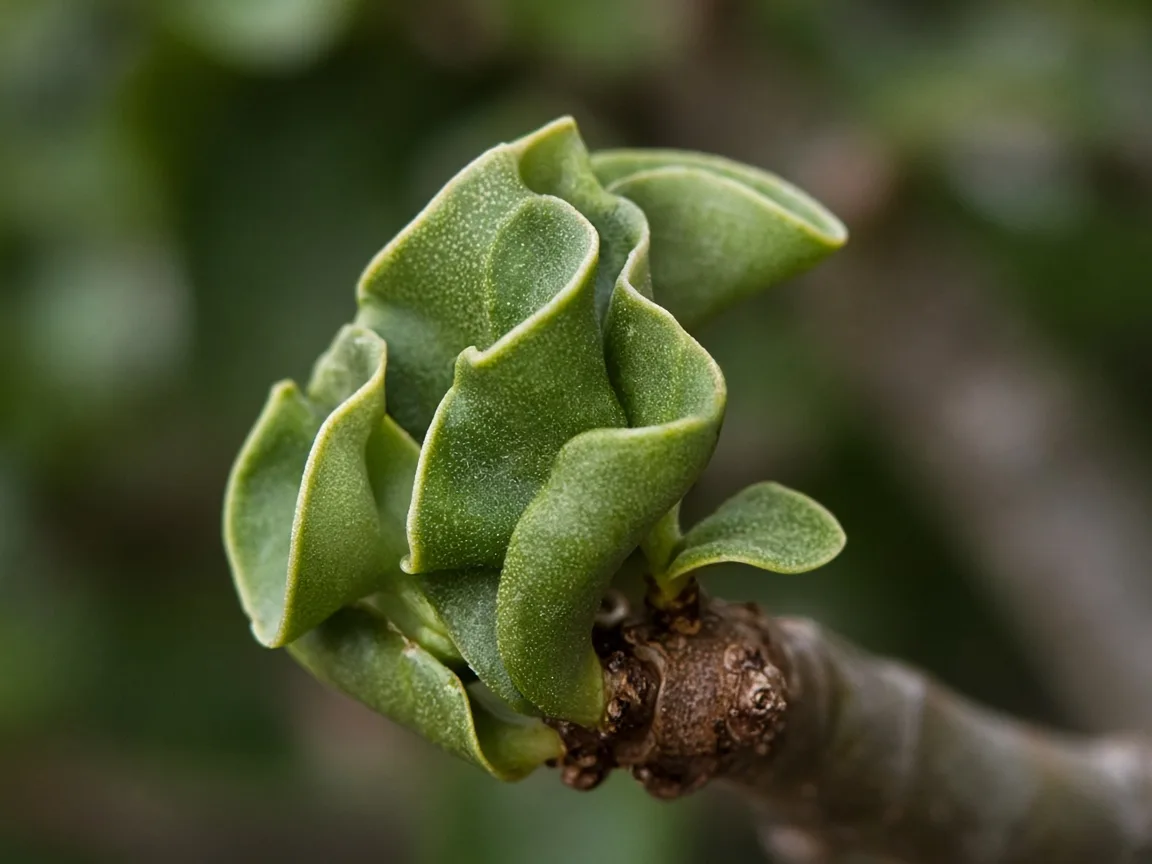
Twisted new Adenium leaf at a branch apex—inspect undersides for aphids, mites, or mosaic mottling.
- Twisted or cupped new leaves at branch tips — Often smaller than siblings; may unfurl partially. Classic aphid or mite feeding on tender growth.
- Puckered blades with yellow stippling — Upper surface dimpled; undersides show mite activity as outdoor pests on Adenium.
- Mosaic mottling plus warp — Irregular yellow-green patches with uneven thickness. Virus suspicion when pests are absent.
- One-sided distortion after spraying — New growth warped after herbicide or leaf-shine drift through an open window.
- Odd thickening on a single branch — Possible graft incompatibility or localized infection; compare to other branches on the same caudex.
Distortion on only the oldest leaves while new tips stay normal is often mechanical damage or old pest scarring—not an active emergency.
Why new-tip inspection matters on Desert Rose
Adenium pushes leaves in flushes during warm active growth. The youngest tissue is soft, high in sugars, and the first place aphids and mites concentrate outdoors. Unlike ferns or African violets, Desert Rose does not have a central rosette crown—branch apices are the diagnostic zone.
Run this tip-first check:
- Bend each active branch tip toward light and look at the underside of the smallest leaves.
- Wipe a white paper towel under a tip—red or green streaks confirm sap feeders.
- Compare distortion across branches on the same plant—virus often hits multiple shoots; localized warp may be one pest cluster.
Why Adenium gets distorted leaves
Sap-sucking pests. Aphids inject saliva that disrupts cell expansion on tender shoots. Spider mites cause stippling and puckering on new growth. On thick succulent leaves, the damage shows as permanent twist once the leaf hardens.
Mosaic virus. Spread by sap and tools; causes mottling plus stunted, warped growth. No cure—management is isolation and destruction of heavily affected stock.
Herbicide or chemical drift. Volatile weed killers near outdoor summer benches can cup new Adenium leaves within days. Distortion follows exposure pattern, not soil moisture.
Overfertilization on tender growth. Rare on Adenium, but concentrated fertilizer on stressed succulents can pucker margins. Pair with fertilizer burn if tips also crisp.
Not usually watering. Desert rose stores water in its caudex; distortion without pests or mottling is rarely fixed by changing water alone—do not soak a firm-caudex plant because leaves look odd.
How to confirm the cause
- Magnifier on newest leaves — Insects, webbing, or honeydew confirm pests.
- Pattern across branches — Virus-like mottling on multiple shoots vs one infested tip.
- Recent spray or move outdoors — Chemical drift timeline.
- Caudex and soil — Firm caudex and appropriate dry-down rule out rot as the driver of warp.
- Neighbor plants — Spread to collection suggests pests or virus, not individual stress.
First fix for Adenium
Isolate the plant and rinse branch tips under lukewarm running water, wiping undersides with a soft cloth—then re-inspect with a magnifier before any spray.
If pests are confirmed:
- Repeat rinses every two to three days for two weeks.
- Apply insecticidal soap or horticultural oil only after confirming no sun-stress on the same day—treat in evening on outdoor benches.
- See aphids or spider mites for species-specific follow-up.
If virus is suspected (mottling, no pests, multi-branch warp):
- Isolate permanently from other Apocynaceae and succulent collections that share pruning tools.
- Compare healthy branches on the same caudex—virus often hits multiple shoots while one branch stays clean only briefly.
- Do not propagate from affected tissue.
- See mosaic virus.
Do not fertilize distorted active growth. Do not repot unless roots are failing separately.
Evening insecticidal soap or horticultural oil treatments are safer on outdoor benches than midday applications on sun-stressed caudex plants. Rinse branch tips the next morning and re-inspect with a magnifier before declaring the infestation cleared—one missed cluster at an apex can re-distort the next leaf flush within days.
Outdoor summer benches vs indoor collections
Desert Rose on outdoor summer benches faces higher pest pressure than windowsill plants. Mites explode in dry heat; aphids cluster on soft branch tips after rain or heavy feeding. Bring outdoor plants indoors only after a magnifier check—distorted tips that traveled inside often spread mites to neighboring succulents within days. Quarantine new purchases two to three weeks before placing them beside established caudex plants.
Recovery timeline
Pest-cleared Adenium often pushes normal leaves on the next growth flush—allow two to four weeks in warm bright conditions. Permanently twisted old leaves can be trimmed for appearance once new growth is clean. Virus-affected plants do not recover normal form.
Documenting distortion for resale or shows
If you collect desert rose cultivars, photograph branch tips weekly during active growth. A single twisted leaf on one branch may be old pest scarring; mottled warp across multiple shoots without insects points to virus. Sterilize blades between plants and label cuttings from known-clean stock only—propagating from virus-suspected tissue spreads infection through an entire bench faster than aphids alone.
Mistakes to avoid
- Drenching with fungicide before confirming pests vs virus
- Pruning every distorted leaf before clearing insects
- Reusing shears between plants without sterilizing
- Ignoring outdoor summer benches where mites explode in heat
How to prevent distorted leaves next time
Quarantine new Desert Rose, inspect tips weekly during active summer growth, maintain airflow on outdoor collections, and sterilize tools between cuts. See Adenium overview, light guide, and problems hub.
Related Adenium guides
Conclusion
Distorted Adenium leaves are a new-growth diagnostic—inspect branch tips before changing watering. Clear sap feeders or isolate virus suspects; do not expect old twisted tissue to flatten. Clean apical leaves are the recovery signal.