Black Spots on Aglaonema Cutlass: Disease Checks
Quick answer
Black spots on Aglaonema Cutlass are dark lesions on narrow lance-shaped leaves—usually bacterial or fungal leaf spot from wet foliage in dim rooms, or scale honeydew stains. First step: stop overhead watering, dry the leaves, and check whether spots are water-soaked and spreading or dry with raised bumps underneath.
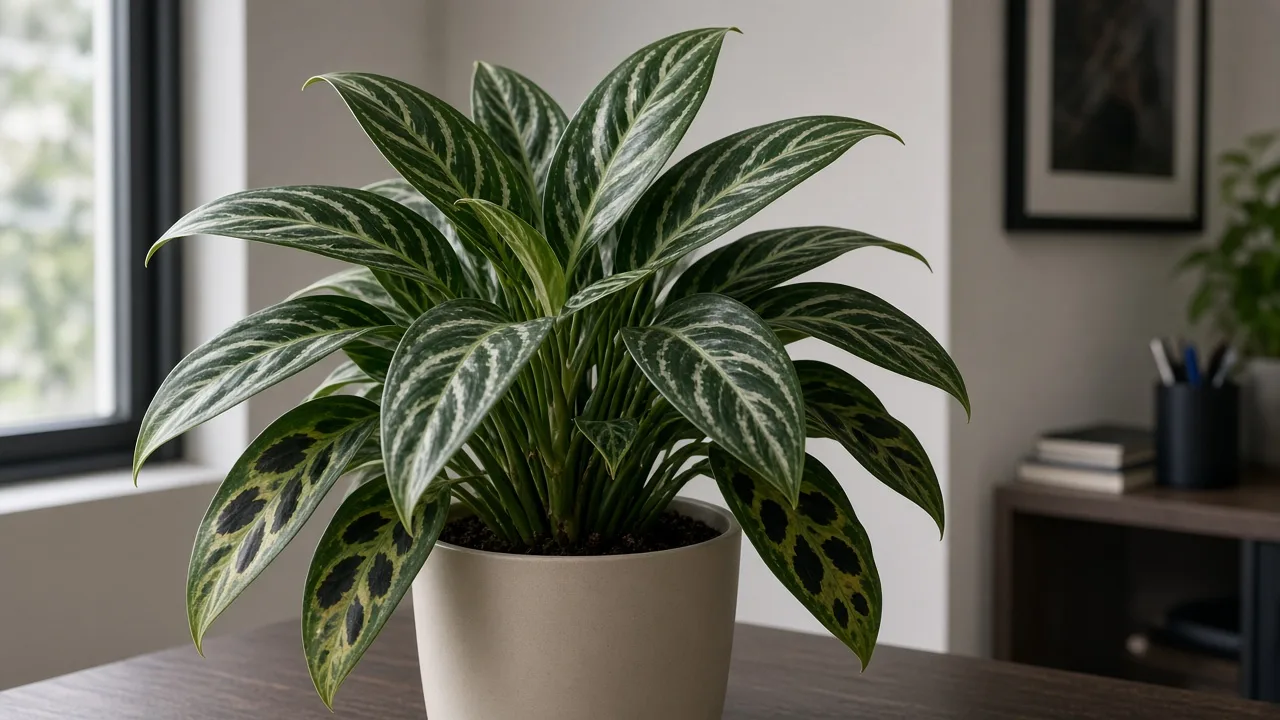
Black Spots on Aglaonema Cutlass: Causes, Checks & Fixes
This guide covers black spots on Aglaonema Cutlass. See also the general Black Spots guide, watering, and light pages for this plant.
Black Spots on Aglaonema Cutlass: Causes, Checks & Fixes
Quick answer
Black or dark brown spots on Aglaonema commutatum ‘Cutlass’ are localized tissue death on narrow ribbon leaves—not random soil mold or dust on silver veins. The most common indoor cause is bacterial or fungal leaf spot when lance-shaped blades stay wet in dim, stagnant air. Scale insects and cold injury on damp foliage are the main lookalikes.
First step: Stop misting and overhead watering onto leaves. Wipe blades dry, water at soil level only, and note whether spots are water-soaked with yellow halos or dry specks with raised bumps along midribs.
For general spot-disease mechanics, see our black spots guide. On ribbon-type aglaonemas kept in offices, wet narrow leaves dry slowly in low light—leaf spot spreads faster than on drought-tolerant succulents. Route to overwatering if spots coincide with soggy mix, yellow lower leaves, and a heavy pot that never lightens.
When to use this page vs other Cutlass guides
| Pattern | Read next |
|---|---|
| Wet soil, yellow lower leaves | Overwatering |
| Dry bumps on veins, sticky residue | Scale insects |
| Brown tips only, no round spots | Brown tips |
| Mushy crown, sour soil smell | Root rot |
| Mix stays wet weeks in dim corner | Not enough light |
What black spots look like on Aglaonema Cutlass
Cutlass leaves are long, narrow, and lance-shaped with dark green tissue feathered by silver along the veins. Spots often track the midrib or run in streaks rather than forming random circles—because water pools in the groove along each ribbon blade.
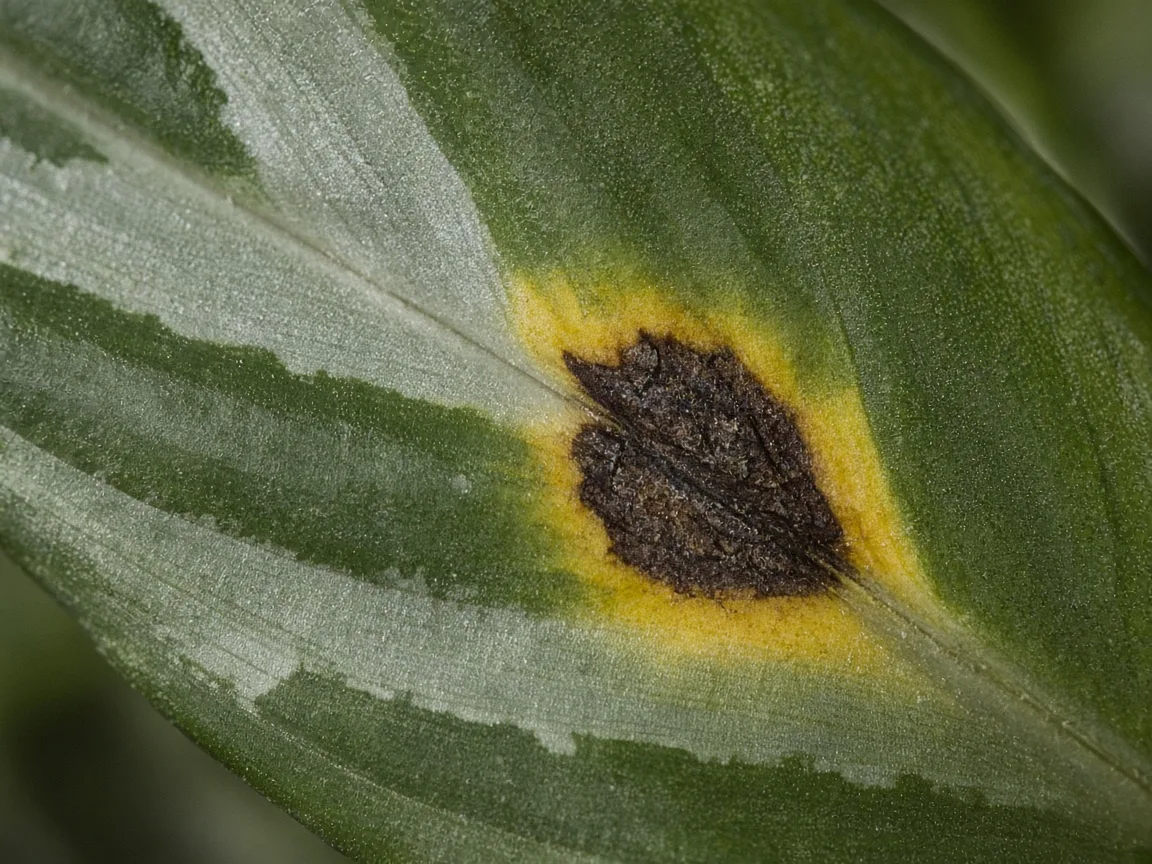
Leaf spot on a Cutlass ribbon blade—water-soaked halos follow wet foliage; dry bumps on veins suggest scale.
Fungal or bacterial leaf spot — Dark brown or black lesions, often with a yellow halo, starting on lowest lance leaves touching the pot rim. Worse after misting or splash in a cool office.
Scale insects — Dry specks on veins with raised waxy bumps underneath and sticky honeydew nearby.
Cold injury — Water-soaked patches after a draft on damp leaves. Chinese evergreens are sensitive to cold below about 55°F.
Fluoride burn — Starts at tips (brown tips), not isolated round spots.
The narrow-ribbon wet-leaf trap (Cutlass only)
Cutlass ribbons are thin enough to stay damp for hours after misting—yet grooved along the midrib enough to hold a water film. In a north cubicle, the pot dries slowly while leaves never fully air-dry. Spots often start on lowest leaves draped over the pot rim; silver veining makes early lesions visible but easy to confuse with normal marbling. Fix light or airflow before fungicide—Cutlass tolerates genuinely low indoor light but uses water slowly there. See not enough light if mix stays wet for weeks.
Why Aglaonema Cutlass gets black spots
Wet foliage + poor airflow is the primary fungal and bacterial pathway. Chinese evergreens prefer even soil moisture but suffer when leaves stay wet—and water on foliage encourages leaf spot diseases in the grooves along narrow blades.
Low-light slow dry-down stacks the risk—Cutlass survives dim offices but leaves and mix dry slowly, keeping ribbons damp in stagnant air.
Misting and overhead watering splash water into the leaf groove. Cutlass needs only average household humidity—not foliar wetting.
Scale on veins leaves dry specks; sap-feeding scale insects hide where ribbon leaves overlap.
Cold drafts on damp leaves darken tissue without halos. Root-zone weakness from overwatering invites secondary infection—root rot occurs when Aglaonema is overwatered.
Confirm the cause in five checks
- Watering method: Mist, spray bottle, or splash on blades—especially evening wetting?
- Halo test: Yellow ring → leaf spot. Dry speck with bump → scale.
- Spread speed: New spots after wet nights → cultural fix first.
- Temperature history: Cold window or AC blast before spots appeared?
- Undersides and soil: Sticky residue or insects → pest route. Wet mix 7+ days → overwatering. Soft crown → root rot.
First fix by confirmed cause
| Confirmed cause | First fix | After 10–14 days if stable |
|---|---|---|
| Leaf spot (wet foliage) | Stop foliar wetting; water soil only when top half dries; improve airflow | Remove worst spotted lance leaves with sterile shears |
| Scale | Isolate; wipe bumps with alcohol swab on a test leaf | Full scale insects protocol |
| Cold injury | Move to stable warmth off glass and vents | Trim only fully dead tissue |
| Root-zone weakness | Dry-down per watering guide | Overwatering if mix stays heavy |
One action first: dry the leaf routine—stop misting, wipe blades dry, and water at soil level only—before any fungicide or repotting.
If more than half a lance leaf is spotted or tissue is mushy, remove that leaf after you have stopped wetting foliage. Partially spotted firm leaves can stay if spread stops—they still feed the slow-growing clump.
Recovery timeline
Spotted tissue does not heal back to green. Spot-free new lance leaves from the crown are the recovery marker. In stable dry culture, expect clean silver-veined growth within two to four weeks; heavy outbreaks may need several lower leaves removed first. Escalate if spots appear on new crown leaves or the crown softens—see root rot.
What not to do
Do not mist Cutlass leaves, overhead-water in a cool office, or apply fungicide while foliage is still getting wet. Do not repot on day one unless the crown is soft. Do not confuse brown tips with round or streaked blotches along veins.
How to prevent black spots on Aglaonema Cutlass
Water at soil level when the top half of mix dries, empty saucers promptly, and give filtered bright indirect light when possible so ribbons and mix dry predictably. Space plants for airflow, quarantine newcomers, and inspect the dense ribbon cluster for scale monthly.
Related Aglaonema Cutlass guides
Conclusion
Black spots on Cutlass are wet-leaf and airflow problems first on narrow ribbon foliage—not mysterious blight. Stop foliar wetting, dry the lance blades, and watch whether new silver-veined leaves stay clean for two weeks. Scale and cold leave different patterns—match texture and history before spraying. Route to root guides if soggy mix stacks with crown softness or yellowing lowers.
Related tool
Use the Plant Problem Diagnosis Tool to narrow causes for black spots on this plant before changing multiple variables at once.