Whiteflies on Aglaonema Pink Dalmatian: Speckled Leaf
Quick answer
Whiteflies on Aglaonema Pink Dalmatian flutter from the undersides of speckled green-and-pink leaves and slow crown flush—often with sticky honeydew on pale spotted tissue. First step: isolate if needed, then wash every reachable leaf underside with lukewarm water before applying repeat treatments.
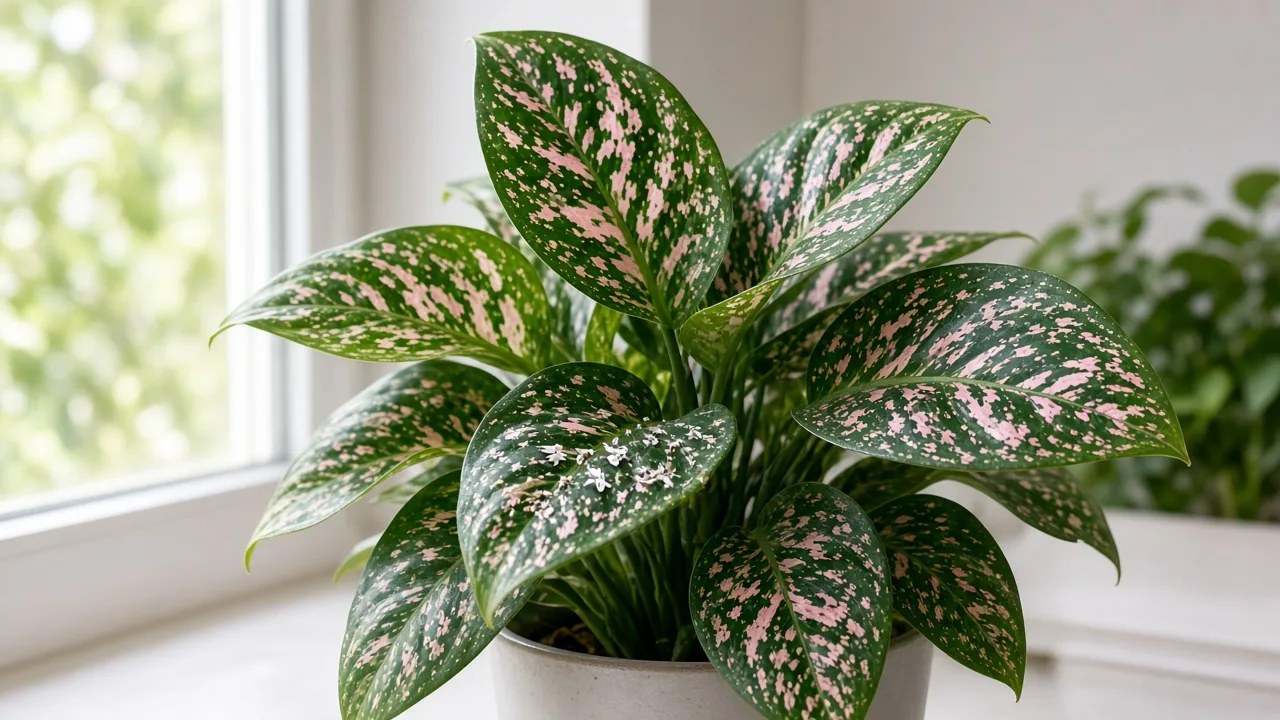
Whiteflies on Aglaonema Pink Dalmatian: Causes, Checks & Fixes
This guide covers whiteflies on Aglaonema Pink Dalmatian. See also the general Whiteflies guide, watering, and light pages for this plant.
Whiteflies on Aglaonema Pink Dalmatian: Causes, Checks & Fixes
Quick answer
Whiteflies are tiny, sap-sucking insects that fly when disturbed. On Aglaonema ‘Pink Dalmatian’, adults look like miniature white moths tucked under speckled green-and-pink blades. Disturb a leaf and a white cloud rises before insects resettle on undersides. Immobile nymphs look like flat pale disks glued to the same surfaces.
For general whitefly biology and life cycle, see our whiteflies pest guide. On Pink Dalmatian, pests concentrate on speckled leaf undersides, crown flush where new pink-spotted blades unfurl, and the protected axils between overlapping leaves—places a quick glance at the decorative spotted front faces will miss.
First step: isolate the plant if other houseplants sit nearby, then wash every reachable leaf underside with lukewarm water.
When to use this page vs other Aglaonema Pink Dalmatian guides
This page is the pest-first entry for flying white sap feeders on slow variegated growth.
| Pattern | Read next |
|---|---|
| Soft pear-shaped insects on newest crown leaves | Aphids |
| White cottony tufts in crown axils | Mealybugs |
| Fine webbing and stippling on speckled blades | Spider mites |
| Flat brown or tan bumps without flying adults | Scale insects |
| Distorted new leaves without confirmed insects | Distorted leaves |
| Silvery scarring on speckled blades | Thrips |
| Yellow lower leaves, wet mix, soft crown | Overwatering or root rot |
What whiteflies look like on Aglaonema Pink Dalmatian
Healthy Pink Dalmatian carries glossy green leaves flecked with pink speckles in a compact upright clump. Whiteflies exploit the flat undersides of those blades and the soft tissue at each crown center.
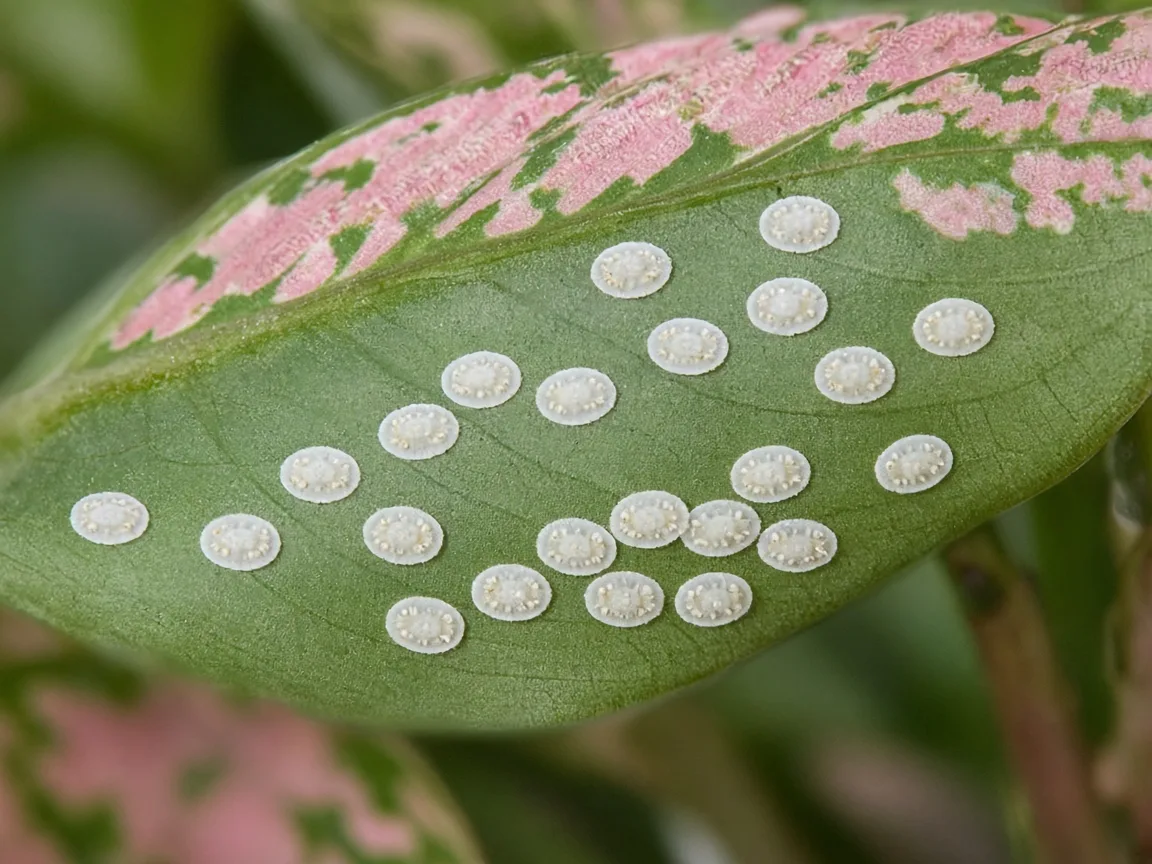
Flat pale whitefly nymph disks on a speckled leaf underside—distinct from the pink spotting visible on the upper blade and the firm green tissue along the midrib.
Typical signs:
- A sudden white cloud when you water, move, or tap a speckled leaf
- Tiny moth-like adults, about 1/16 inch long, resting on blade undersides
- Flat, oval, pale nymphs glued to the same surfaces after crawlers settle
- Sticky, shiny honeydew on young speckled foliage, pot rims, or shelves below—especially visible on pale pink spots
- Black sooty mold growing on honeydew-coated lower blades
- Yellowing or dull blades when feeding is heavy—while petioles stay firm
Whiteflies differ from mealybugs on Aglaonema Pink Dalmatian, which form cottony wax clusters in crown axils rather than flat disks and flying adults. They differ from aphids, which cluster as soft pear-shaped insects on tender crown tips without a white flying cloud. Spider mites cause fine stippling and silk without flying adults.
Unlike brown tips from dry air or salt, whitefly damage comes with live insects, stickiness, or sooty mold—not isolated edge burn on otherwise clean blades.
Where whiteflies hide on speckled undersides and slow crown flush
Variegated Chinese evergreens like Pink Dalmatian grow as a compact upright clump with one or more crowns. Whiteflies follow the protected undersides on each stem, not the pink-speckled faces owners admire from across the room.
Large colonies often develop on the undersides of leaves. On Pink Dalmatian, the equivalent hot zones are:
- Speckled leaf undersides — Where each blade attaches along the stem; nymphs hide from casual front-view inspection of pink spotting
- Crown center flush — Softest new leaves emerging with fresh pink flecks from the center of each stem
- Overlapping leaf axils — Where mature speckled blades stack tightly in a slow-growing clump
- Lower blades on tall stems — Hard to reach without tilting the pot; colonies build here undisturbed
- Soil line and pot rim — Adults fly short distances between nearby aglaonemas on shared shelves
This speckled-blade-and-crown inspection pattern is plant-specific. A fiddle-leaf fig guide tells you to search broad leaf backs; on Pink Dalmatian you trace each speckled blade on every crown, lifting overlapping leaves gently without snapping petioles.
Sticky honeydew vs fading pink speckles
Pink Dalmatian owners often worry about pale or washed-out pink spotting when light drops—see the not-enough-light guide for that pattern. Whitefly honeydew creates a different look that is easy to confuse with variegation stress.
Low-light pink fade usually shows as evenly dull speckling across several mature leaves, no stickiness, no flying insects, and no flat nymph disks on undersides. New leaves may emerge greener with weak spots, but the texture stays dry and matte.
Honeydew from whiteflies shows as shiny, tacky patches on pale pink spots or along midribs, often with ants on the pot rim or black sooty mold on lower blades. Tap the leaf: a white cloud confirms sap feeders, not a lighting problem.
Do not chase brighter light or extra fertilizer when the real issue is sticky residue and nymph disks underneath. Fix the pest first, then reassess speckle color once new crown flush opens clean.
Why Aglaonema Pink Dalmatian gets whiteflies
Whiteflies are not unique to aglaonemas, but this cultivar’s slow speckled growth, compact clump habit, and decorative upper surfaces make infestations easy to overlook.
Pink speckles hide leaf-back colonies. The same pink flecking that makes Pink Dalmatian distinctive draws the eye to upper surfaces while nymphs build on undersides. Honeydew collects in axil pockets where rinses miss on the first pass.
Slow crown flush keeps soft tissue available. Pink Dalmatian pushes new speckled leaves slowly year-round indoors, so tender crown tissue stays vulnerable longer than on fast-growing pothos. Tender new blades attract whiteflies before leaves mature and toughen.
Infrequent handling windows. Because Pink Dalmatian needs water only when the top half of soil dries—often every one to two weeks in office light—you may not handle the pot often enough to catch the first white cloud. Both whiteflies and spider mites benefit from dense clumps that sit undisturbed.
Indoor warmth with no predators. Homes stay warm enough for whiteflies to reproduce throughout the year. Outdoor natural enemies do not reach indoor variegated Chinese evergreens unless you deliberately release beneficials.
Nursery hitchhikers and crowded office shelves. New stock often arrives with eggs on speckled leaf undersides. Inspect new plants before placing them among others. Crowded desks of aglaonemas, pothos, and peace lilies let adults fly between pots on shared watering days.
Do not overwater in response. Honeydew on blades is not cured by soggy soil. Increasing water invites overwatering and soft crowns while whiteflies persist on dry upper foliage.
How to confirm the cause
Work through these checks in order:
- Disturbance test — Tap or gently shake a speckled leaf over white paper. Adults fly up and resettle on undersides. That cloud is the fastest whitefly confirmation on Pink Dalmatian.
- Blade tilt — Lift speckled leaves with bright sidelight. Look for flat pale nymph disks and powdery white adults along the midrib groove on the underside.
- Crown flush check — Inspect the softest new pink-flecked blades emerging from each stem center—colonies often start on tender tissue before spreading along mature speckled leaves.
- Honeydew and ants — Sticky residue on young blades or ant trails on the pot rim strongly support sap-feeder diagnosis.
- Neighbor scan — Check every houseplant on the same shelf. Whiteflies spread by flight and contact between touching foliage.
- Shake test vs aphids — Aphids fall as slow-moving specks without flying. A white cloud points here, not to aphids.
- Care cross-check — Confirm the top half of mix dries between waterings per the watering guide. Pest damage on a drowning crown needs moisture correction, not spray alone.
If you see flying white adults plus nymph disks on speckled leaf undersides with honeydew, whiteflies are confirmed. Treat before populations overlap multiple life stages across every crown.
First fix for Aglaonema Pink Dalmatian
Isolate the plant if other houseplants sit nearby, then wash every reachable leaf underside with lukewarm water.
Isolate infested plants away from others immediately—whiteflies fly short distances and hitchhike on hands, tools, and touching leaves.
Wash undersides systematically:
- Support each speckled blade from below so you do not snap petioles
- Rinse with lukewarm water strong enough to knock off crawlers and soft-bodied nymphs
- Work crown by crown on each stem, including overlapping axils and the softest new pink-flecked flush
- Tilt the pot so runoff does not flood the crown repeatedly—Pink Dalmatian hates wet crowns in dim light
- Wrap the pot in plastic or a bag if needed so mix does not get saturated during shower rinses
- Let foliage air-dry in bright indirect light the same day
Water sprays remove eggs and crawling juveniles when you reach the surfaces sprays miss on dense upright foliage. Repeat washing every few days before escalating to soap or oil.
Make this single correction before repotting, fertilizing, or pruning heavily—you need to see whether the population drops.
Pet and sap note: Pink Dalmatian is toxic to cats and dogs. Rinse in a sink away from pets, wash hands after handling, and avoid letting children chew treated leaves.
Step-by-step recovery
Once isolation and the first wash are done, follow this sequence:
- Day 0 — isolate, wash every speckled leaf underside, set yellow sticky traps near the canopy to catch adults and monitor decline
- Days 5–7 — repeat wash; apply insecticidal soap or horticultural oil labeled for whiteflies, coating undersides thoroughly. Good coverage of undersides is essential, and most less-toxic products control only insects directly sprayed
- Days 10–14 — third wash and spray cycle; inspect neighboring houseplants that were nearby before isolation
- Week 3 onward — if no adults fly on disturbance and undersides show no new nymph disks, move to weekly checks. If whiteflies persist, continue five- to seven-day intervals through at least three generations—one spray rarely finishes the job once colonies are established
- Manage ants — Break ant trails on pot rims so natural enemies can reach whiteflies
- Trim optional — once pests are gone, remove badly yellowed or sooty-coated speckled leaves for appearance; they will not green up again on the same petiole
Hold fertilizer until new crown flush looks firm for two weeks after the last flying adult. Nitrogen pushes soft shoots that attract the next generation—see the fertilizer guide before resuming feeds.
Prune only heavily infested, fully coated speckled leaves that block the crown and fail two rinse cycles. Pink Dalmatian grows slowly; see the pruning guide before removing more than one or two blades at a time.
Recovery timeline
Existing yellowed or honeydew-coated speckled leaves on Pink Dalmatian rarely return to perfect pink-spotted form. Expect visible marks on damaged blades for months—or until they are replaced by new growth. What you should see within two to three weeks of consistent treatment is no new yellowing on previously clean leaves, no fresh honeydew, and stable new blades at crown tips.
Mild cases on one crown often stabilize within two to three weeks of repeated washes. Moderate infestations coating several stems may need four to six weeks with washes plus two soap or oil cycles at five- to seven-day intervals.
Judge recovery by:
- No white cloud when you tap speckled leaves
- No new flat nymph disks on previously clean blade undersides
- Firm green petioles without crown softness
- Clean new speckled leaves with clear pink spotting on the next crown flush
Escalate if the crown softens, lower leaves yellow in waves, and mix stays wet for weeks—that pattern needs root rot diagnosis, not more foliar rinses alone.
Lookalike symptoms
| What you see | Likely cause | Quick check |
|---|---|---|
| Flying white adults + flat nymph disks | Whiteflies (this page) | White cloud on disturbance |
| White cottony tufts in crown axils | Mealybugs | Smears pink; wax coating |
| Soft pear-shaped clusters on new tips | Aphids | No flying cloud; slow-moving specks |
| Fine webbing + stippling | Spider mites | Dry heat; shake test on white paper |
| Flat brown bumps on petioles | Scale insects | Scrapes off as disk |
| Dull speckling, no stickiness | Not enough light | Weak pink on several new leaves |
| Yellow lower leaves, no stickiness | Yellow leaves | Normal aging or wet roots—check mix |
Mistakes to avoid
Do not soak the pot repeatedly while rinsing crown tips. Pink Dalmatian hates wet crowns in dim light—follow water when top half of soil dries after treatment and empty the saucer within 30 minutes.
Do not assume one shower clears a dense multi-crown clump. Hidden eggs and nymphs in lower axils and protected crown pockets restart colonies within days.
Do not spray horticultural oil on a cold-shocked or drought-stressed plant without a patch test on one speckled blade. Oils can damage sensitive tropical foliage in heat or on drought-stressed tissue.
Do not ignore ants while treating whiteflies only with water. Ants protect whiteflies from natural enemies and harvest honeydew on upper blades.
Do not increase fertilizer during an active infestation. Soft lush speckled shoots feed the next whitefly generation.
Do not strip every distorted lower leaf at once. Slow variegated aglaonema needs mature blades for photosynthesis—remove only heavily infested tissue.
Do not use broad-spectrum pyrethroids as a first response. They kill natural enemies and whiteflies quickly build resistance.
How to prevent whiteflies next time
Scout speckled leaf undersides weekly during winter heat—before adults are flying from every crown.
Quarantine new aglaonemas for two weeks and inspect crown tips before placing them in a shared office or shelf.
Preserve beneficial insects when possible. Lacewings, lady beetles, and parasitic wasps help control whiteflies when ants and pesticides do not disrupt them.
Keep pots spaced so dense clumps do not touch neighboring houseplants. Medium to bright indirect light and airy well-draining mix keep speckled pink leaves maturing quickly before whiteflies build large colonies in crown pockets.
Yellow sticky traps near new acquisitions catch hitchhiking adults before they spread through a collection.
When to worry
Treat promptly when honeydew coats multiple crown tips, ants farm the pot rim, or whiteflies appear on shelf mates. Warm indoor rooms let populations reproduce year-round.
A few adults on one crown during warm indoor growth is common on vigorous Pink Dalmatian and rarely threatens a firm clump if you isolate and wash early.
Seek help if repeated soap or oil cycles through six weeks fail, the crown softens while mix stays wet, or the whole clump loses multiple crowns despite firm roots—those patterns may need professional assessment beyond home sprays.
Related Aglaonema Pink Dalmatian guides
- Overview — speckled Chinese evergreen culture and pet toxicity
- Watering — avoid wet crowns during rinse treatments
- Light — hold pink speckling and firm crown growth
- Aphids — soft clusters without flying adults
- Mealybugs — cottony patches in crown axils
- Spider mites — webbing and stippling on speckled blades
- Problems hub — full symptom index
Conclusion
Whiteflies on Aglaonema Pink Dalmatian are a speckled-underside and crown-flush problem in most homes—not a mysterious whole-clump collapse. Tilt each pink-flecked blade, rinse undersides under lukewarm water, and keep the crown dry while you treat. Firm petioles and clean new speckled leaves on the next flush are the recovery signal; old sticky blades can stay imperfect without harming the slow upright clump.
Related tool
Use the Pest Identifier Tool to narrow causes for whiteflies on this plant before changing multiple variables at once.