Brown Leaves on Ajwain Plant (Indian Borage): Causes & Fixes
Quick answer
Brown leaves on ajwain (Indian borage, Plectranthus amboinicus) most often follow harsh afternoon sun on fuzzy foliage, a long dry spell that wrinkled thick leaves first, a cold snap below about 10°C, or dry papery spots enlarging from leaf spot—not mysterious herb failure. First step: squeeze a middle leaf, check whether browning followed a sun move or dry soil, and move the pot to morning sun or bright indirect light if margins turned papery tan after relocation.
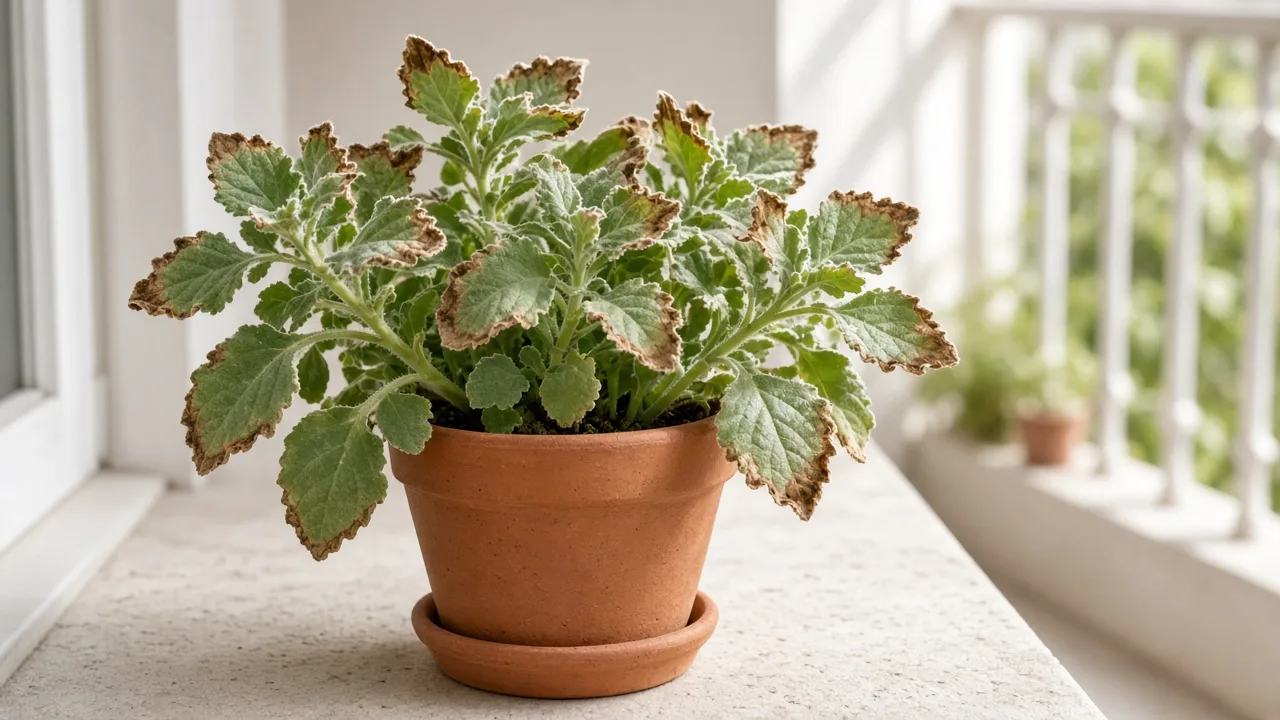
Brown Leaves on Ajwain Plant: Causes, Checks & Fixes
This guide covers brown leaves on Ajwain Plant. See also the general Brown Leaves guide, watering, and light pages for this plant.
Brown Leaves on Ajwain Plant: Causes, Checks & Fixes
Quick answer
Brown leaves on ajwain (Indian borage, Cuban oregano, Plectranthus amboinicus) usually mean sun scorch on fuzzy foliage, drought after thick leaves wrinkled, cold damage on frost-tender growth, or dry leaf-spot lesions turning brown—not a vague herb decline. Ajwain Plant overview is a semi-succulent mint-family herb with velvety scalloped blades on square stems; it stores water in those thick leaves but still bronzes when care swings too far. See our brown leaves guide for general symptom science; on ajwain, papery tan margins after a balcony sun move are the classic indoor pattern.
First step: squeeze a middle leaf and match timing. If margins turned dry and papery within days of moving into harsh afternoon sun, shift the pot to morning sun or bright indirect light—NC State notes full summer sun can burn ajwain leaves. If leaves feel slightly soft and soil is dry 2–3 cm down, give one thorough soak per your watering rhythm before changing anything else.
When to use this page vs other Ajwain Plant guides
| Pattern | Read next |
|---|---|
| Dry tan margins after sudden sun increase | This page (sun scorch) |
| Wrinkled soft leaves, very dry soil, lightweight pot | Underwatering |
| Wet soil, yellow lower leaves, limp stems | Overwatering or yellow leaves |
| Dark spots with yellow halos on wet fuzzy leaves | Black spots |
| Only tips crisp, rest of blade green | Brown tips |
| Soft square stems, sour smell at base | Root rot |
| Fine webbing, stippled bronzing on undersides | Spider mites |
| Uniform bronzing after cold night outdoors | This page (cold damage) |
This page covers brown or tan necrosis on leaf blades. If the whole plant is wilting with wet soil, start with wilting and root-zone checks instead.
What brown leaves look like on ajwain
On ajwain, brown damage rarely looks like a random houseplant mystery—it follows the plant’s thick, fuzzy leaf anatomy and sprawling harvest habit.
Sun scorch shows as dry tan-to-brown margins or patches on leaves that took the brunt of afternoon sun, often on the window-facing side. The tissue feels papery and crisp, not mushy. Inner shaded leaves on the same stem may stay green while exposed blades bronze—a strong sun signal.
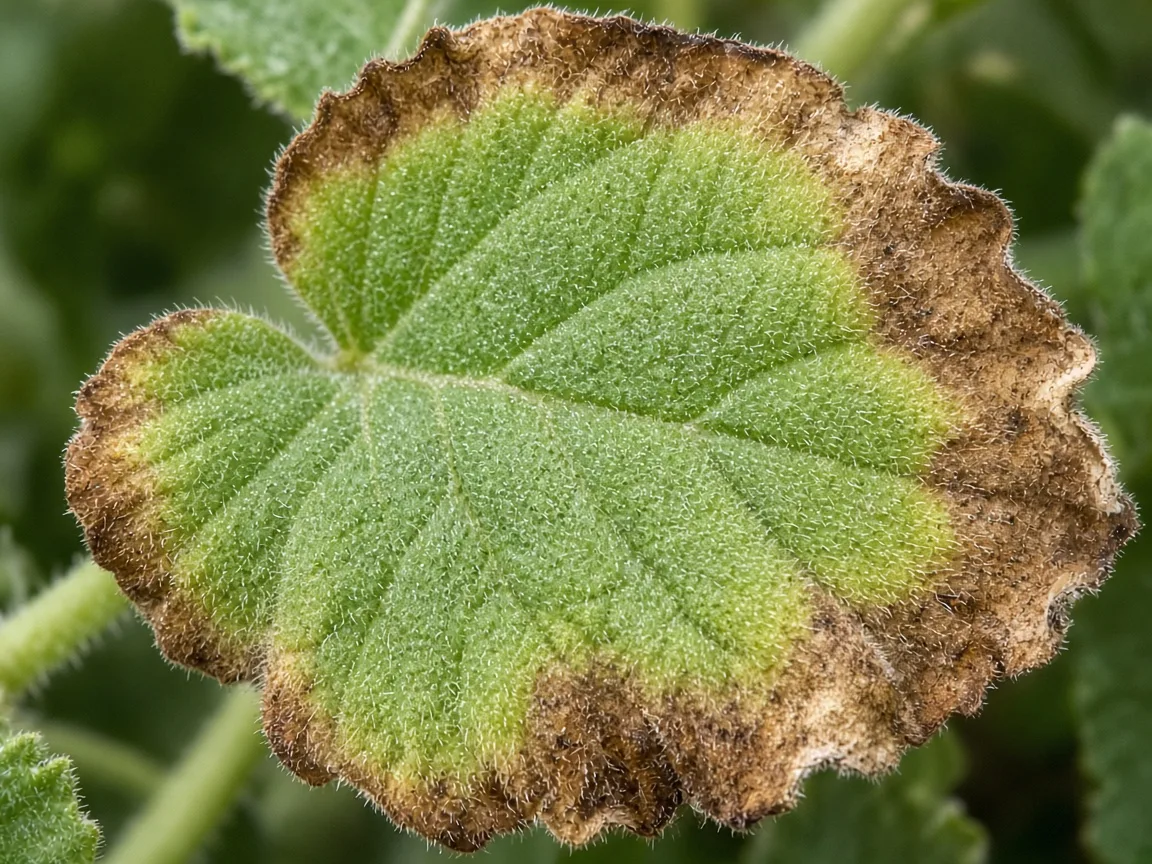
Sun scorch on ajwain—dry papery tan margins on velvety foliage, not water-soaked rot.
Drought browning often starts with slightly soft, wrinkled thick leaves, then progresses to crisp brown tips or whole-blade tan necrosis on outer sprawling stems while the pot feels very light. Ajwain stores water in foliage, so wrinkling appears before full wilt—unlike thin-leaf basil.
Cold damage after a chill night bronzes or blackens tender tip growth uniformly, sometimes across the whole exposed canopy. Frost-tender ajwain does not recover green from frozen tissue; new shoots emerge from firm stems below.
Advancing leaf spot begins as dark dots (see black spots) that enlarge into dry brown dead patches with possible yellow halos—usually on lower inner leaves where dew collects on trichomes.
Harvest-trail senescence is normal: after months of pinching, older leaves at sprawling stem bases turn yellow then brown and drop while tip growth stays vigorous. That pattern on a firm square stem base is ageing, not emergency rot.
The thick-leaf drought curve (ajwain-specific)
Ajwain’s semi-succulent leaves mask thirst longer than true oregano. The sequence matters:
- Soil dry 2–3 cm down for several days in peak heat
- Thick blades feel slightly soft and lose their plump snap
- Margins or tips turn tan, then fully brown and crisp
- Outer trailing stems fail first because they transpire hardest
This is not the same as underwatering wilting on day one—it is stored-water depletion on a plant that prefers occasional irrigation with good drainage. A lightweight pot, cracked dry soil surface, and bronzing on the longest stems together confirm drought browning before you assume disease.
Afternoon sun on a fuzzy leaf (why ajwain scorches easily)
Unlike smooth-leaf herbs, ajwain’s velvety trichomes can intensify heat at the leaf surface during harsh midday sun. NC State Extension recommends some protection from hot summer sun even though the species accepts partial shade to full sun in milder exposures.
Common indoor triggers:
- Moving a monsoon-shaded balcony pot to west-facing afternoon sun after cloudy weeks
- Sitting the pot against reflective glass where afternoon rays concentrate
- Bringing an outdoor summer plant indoors to a sudden hot windowsill without acclimation
Environmental leaf scorch browns margins on affected blades while stems stay firm—distinct from root rot mush at the soil line.
Why ajwain gets brown leaves
Beyond sun and drought, several ajwain-specific factors turn foliage brown:
Sudden light increases after leggy growth. Plants grown in dim corners develop soft leaves. A harsh move to direct sun without gradual hardening bronzes tissue within days. Pair correction with light review if stems were stretching first (leggy growth).
Cold snaps on outdoor pots. Winter balcony nights or AC drafts on a windowsill can bronze tips on frost-tender tropical growth. Damage appears within 24–48 hours of the chill event.
Leaf spot advancing to necrosis. Wet fuzzy foliage from misting or monsoon splash lets fungal leaf spot enlarge until patches turn dry brown. Firm square stems with spotty lower leaves point to foliage culture, not rot—unless soil is also soggy.
Spider mite bronzing. Dry indoor air plus dust on fuzzy leaves invites spider mites. Stippled silver-tan areas can read as “brown leaves” until you find fine webbing on undersides.
Salt or fertilizer edge burn. Heavy feed on dry soil can crisp margins on a fast-growing herb. Less common than sun or drought but worth noting if you fed recently—see fertilizer timing.
Normal lower-leaf drop on harvest plants. Frequent pinching for kitchen use leaves a brown skirt of old leaves at stem bases. If new tips are clean and stems are firm, trim the skirt and keep harvesting.
How to confirm the cause
Work through these checks before stacking fixes:
- Timing. Did browning follow a sun move, dry spell, cold night, or wet-leaf period? Match the event to the pattern.
- Leaf feel. Papery crisp margins on sun-exposed blades = scorch. Soft then crisp on dry soil = drought. Mushy = rot or bacterial issue—switch guides.
- Stem pinch. Square stem at soil line firm = leaf-level problem. Soft, blackening, or sour = root rot.
- Distribution. One-sided window burn vs uniform cold tips vs lower-inner leaf spots vs base-only senescence.
- Soil moisture. Finger 2–3 cm down. Bone dry supports drought; soggy supports rot overlap, not pure scorch.
- Undersides. Webbing or stippling = mites. Dry circles enlarging = leaf spot. Wipe test negative on tan margins = not sooty mold.
- New growth. Clean tips after one corrected week means your diagnosis is likely right.
The first fix to try
Match the most likely trigger from your timing check, then change only that one variable.
- Sun scorch suspected: Move the pot to bright indirect light or morning sun only (3–5 hours gentle direct, not harsh afternoon blast). Do not prune all damaged leaves the same day—let the plant settle in the new exposure.
- Drought suspected: Water thoroughly until a little drains from the bottom, then resume normal dry-down—let the top 2–3 cm dry before the next soak. Do not leave the pot in standing water.
- Cold damage suspected: Move to a stable warm room above 15°C (59°F) away from AC vents. Hold off heavy pruning until you see which stems are still firm.
- Leaf spot overlap: Stop wetting foliage and improve airflow—see black spots for the dry-leaf protocol before fungicide.
If you cannot tell sun from drought, default to light correction first when browning followed any recent move toward a brighter window—that is the most common ajwain balcony mistake.
Step-by-step recovery
After the first fix:
- Wait one week before adding secondary changes. Ajwain grows fast in warm weather; new tip color tells the story.
- Pinch or harvest from firm green stems to encourage branching—ajwain roots easily from cuttings if the mother plant is mostly cosmetic damage.
- Remove fully brown leaves only when they are dry and you want a cleaner look, or when harvesting that stem anyway.
- Improve airflow on crowded trailing pots so inner leaves dry—especially if mold on soil or humidity issues overlap.
- Repot only if roots are circling in hydrophobic dry mix (drought cycle) or rotting in wet mix—not as a day-one reflex.
For severe sun scorch on a balcony, harden gradually: add 30–60 minutes of morning sun per day over two weeks rather than jumping to full west exposure.
Recovery timeline
| Severity | What to expect |
|---|---|
| Mild sun scorch on a few blades | Stabilizes in 1–2 weeks; new tips stay green |
| Moderate drought bronzing | Perks within 3–5 days after one good soak; old crisp tissue stays brown |
| Cold tip damage | New shoots in 2–4 weeks if stems stayed firm |
| Leaf spot necrosis | 2–3 weeks after dry-leaf culture; spots do not green up |
| Base senescence only | Immediate cosmetic improvement after trimming old skirt |
Judge success by clean new growth at stem tips and a firm square stem base, not by old brown blades reverting.
Mistakes to avoid
- Moving straight into harsh afternoon sun after monsoon shade or a dim indoor corner
- Misting fuzzy leaves to “help humidity” when spots or scorch are present—wet trichomes worsen leaf spot
- Watering on a calendar without checking whether the issue was drought or soggy-soil rot
- Stripping every brown leaf while the plant is still stressed—ajwain needs some foliage to recover
- Fertilizing bronzed plants before light and water are stable
- Assuming all brown lower leaves mean disease on a heavy-harvest herb with a normal ageing skirt
When to worry
Escalate if:
- Square stems soften at the soil line with sour smell—rot, not scorch
- Browning climbs stems above leaf blades with mushy tissue
- New tip growth keeps bronzing after two weeks of corrected light and water
- Whole plant collapses with wet soil—see wilting and root checks
Pure leaf-level brown on firm stems is common and fixable. Stem-base failure is the line between cosmetic leaf damage and salvage propagation.
How to prevent brown leaves next time
- Grow in bright light with afternoon protection—east balconies or filtered west light work well in Indian tropical homes
- Let the top 2–3 cm of mix dry between waterings; use a well-draining soil mix
- Acclimate to more sun gradually after monsoon or indoor winter
- Water soil only, not fuzzy foliage; harvest in morning and shake sprigs dry
- Pinch regularly so ageing lower leaves do not pile up and trap moisture
- Bring pots indoors or cover when night temperatures drop near 10°C (50°F)