Alocasia Frydek Fertilizer: NPK, Schedule & Dormancy Rules
Alocasia Frydek Fertilizer: NPK, Schedule & Dormancy Rules
Alocasia Frydek Fertilizer: NPK, Schedule & Dormancy Rules
Why Alocasia Frydek Needs a Different Feeding Approach
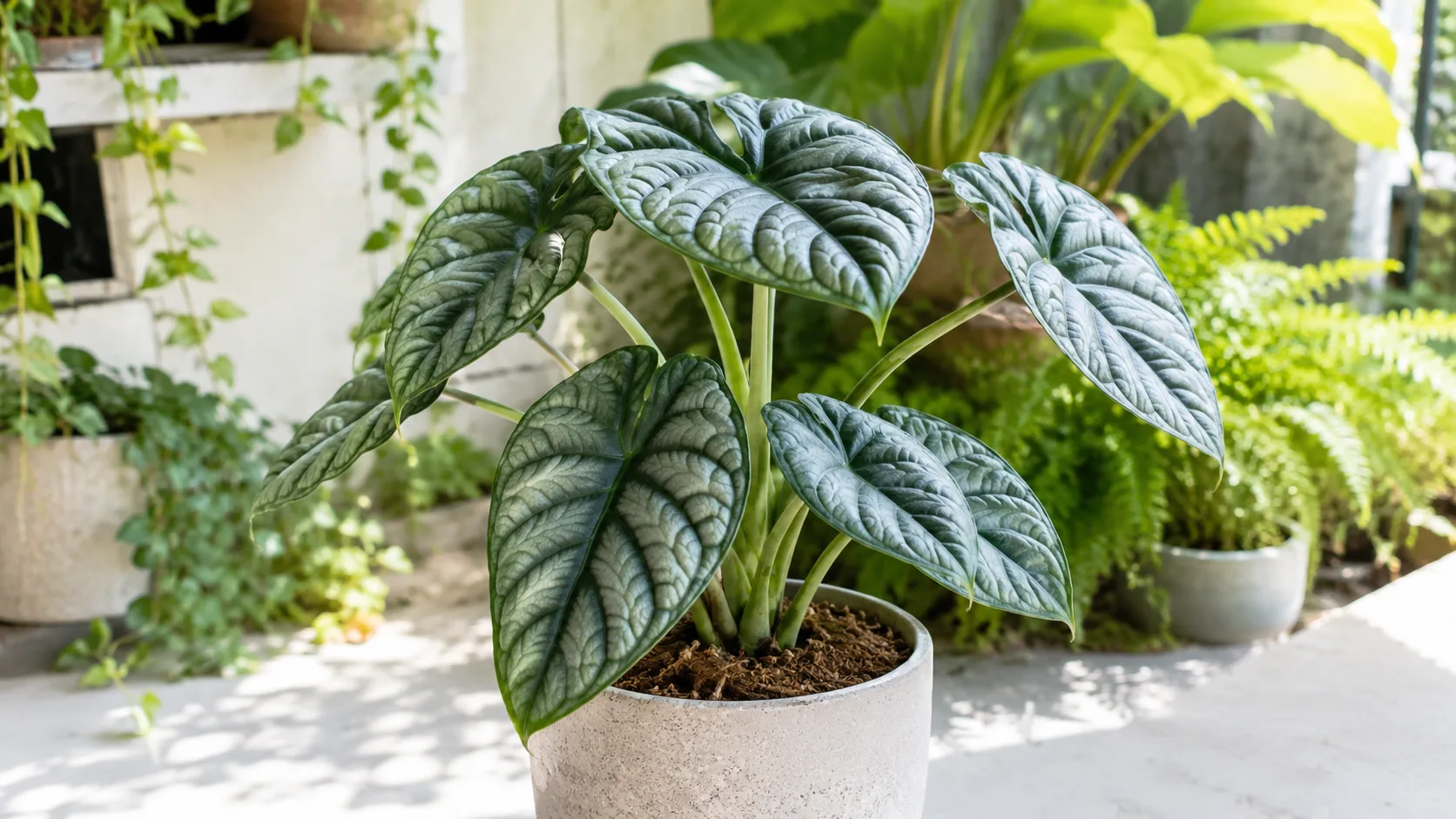
Alocasia Frydek (Alocasia micholitziana ‘Frydek’) is a compact jewel alocasia prized for its quilted, metallic leaves with stark white veins on dark velvet blades. The same texture and leaf architecture that makes it look sculptural also makes it unusually sensitive to fertilizer. In my own collection, I have watched a Frydek develop brown leaf margins within 48 hours of a standard half-strength feed that a neighbouring philodendron handled without complaint — that is how quickly this plant punishes a miscalculation.
Unlike the bigger, faster-growing Colocasia and many of the larger Alocasia amazonica hybrids, Frydek has fine, slow-growing roots, a small corm, and a velvet leaf surface that does not appreciate wet fertilizer sitting on it. That combination means a “more is better” approach backfires fast. Most of the problems that show up as brown leaf tips, crusty soil, or sudden leaf drop trace back to fertilizer choices, not light or water. The right approach is to match the plant’s natural rhythm: gentle, frequent, low-dose feeding during active growth and a complete pause through dormancy. Done correctly, fertilizer becomes a quiet background input rather than a weekly chore.
The Limestone-Habitat Background That Shapes Its Nutrient Needs
Alocasia micholitziana is native to the limestone karst regions of Luzon in the Philippines, where it grows in shallow, humus-rich pockets over calcium-rich rock (Kew Plants of the World Online). That origin matters for two reasons. First, the plant evolved with steady access to calcium and magnesium, so a fully soft-water or RO-only routine can leave it short on those ions, which then shows up as deformed new leaves. Second, soils in these habitats drain quickly and are biologically active, which means the plant is adapted to nutrients released slowly by microbes rather than dumped in a single strong dose. The implication for indoor care is that a complete, balanced fertilizer plus a light calcium source mirrors what the plant expects better than a high-nitrogen “bloom booster” or a constant low-dose feed.
Why Salt Sensitivity Is the Defining Feature of This Jewel Alocasia
Salt sensitivity is the single most important thing to understand before picking a fertilizer. The University of Maryland Extension describes how soluble salts from fertilizer pull moisture out of root tissues, producing marginal yellowing, leaf scorch, and wilting even when soil moisture is adequate. Jewel alocasias sit at the sensitive end of that spectrum. A full-strength pour-through leaves salt residue behind, and over a few weeks the electrical conductivity of the potting mix climbs high enough to burn root tips. The visible signs — brown, crispy leaf margins, a white crust on the soil surface, and stunted new growth — usually appear before the plant actually wilts, which is why attentive growers catch the problem early.
The good news is that salt sensitivity is easy to manage. Dilute the fertilizer more than the label suggests, water thoroughly between feeds to keep salts mobile, and flush the pot with plain water on a regular cadence. The plant’s job is to push out one beautifully textured leaf at a time; your job is to keep the soil chemistry calm.
Quick Reference: Frydek Feeding Checklist
| Task | When | How |
|---|---|---|
| Feed active plant | Spring–early fall while pushing new leaves | Balanced liquid 20-20-20 or 10-10-10 at quarter to half strength, every 4–6 weeks |
| Pre-feed check | Every feed day | Soil already moist; no white crust; plant not stressed or newly repotted |
| Dilution example | Each feed | ½ tsp per gallon for 20-20-20 if label says 1 tsp/gallon; ¼ tsp per gallon for 3-1-2 foliage formulas |
| Winter (dormancy) | Late fall–early spring | No fertilizer until at least one new leaf has fully hardened off |
| Post-repot hold | First 4–6 weeks after repotting | Skip feed — fresh mix often contains enough nutrients |
| Salt maintenance | Every 6–8 weeks in active season, or if crust appears | Flush with 3× pot volume of plain water until runoff runs clear |
| Pale new leaves | Before increasing feed | Rule out low light and watering issues first |
The Best NPK Ratio for Alocasia Frydek
NPK refers to the three macronutrients on every fertilizer label: nitrogen (N), phosphorus (P), and potassium (K). For Alocasia Frydek, almost every reputable care source lands on the same family of ratios: a balanced 1:1:1 such as 10-10-10 or 20-20-20, or a foliage-leaning 3-1-2 such as 9-3-6 or 12-4-8. Both work. The differences between them are about emphasis, not correctness.
A balanced 1:1:1 delivers nitrogen, phosphorus, and potassium in equal proportion, which suits a plant that is pushing out a steady cadence of mature leaves, holding onto roots, and building corm mass all at the same time. A 3-1-2 ratio puts slightly more weight on nitrogen, the macronutrient that drives chlorophyll production and leaf expansion. For a young Frydek that is unfurling small leaves on a tight schedule, that extra nitrogen shows up as faster leaf sizing. For a mature, well-rooted specimen that already produces full-size leaves, the difference is barely visible.
Balanced 20-20-20 vs a 3-1-2 Foliage Ratio
Most jewel-alocasia growers reach for a balanced 20-20-20 liquid because it is widely available, easy to dose, and the micronutrient package that comes with most 20-20-20 formulas (chelated iron, magnesium, and trace boron and zinc) covers the secondary deficiencies that most often appear on indoor aroids (NC State Extension). CompleteGrow, Dyna-Gro Foliage Pro (9-3-6), and Jack’s Classic 20-20-20 are all popular choices. The International Aroid Society and experienced aroid hobbyists broadly agree that Frydek tolerates a 1:1:1 better than it tolerates a high-phosphorus “bloom” formula, which is fortunate because Frydek is grown for its leaves, not its inflorescence.
A 3-1-2 foliage ratio is a perfectly good alternative, especially if you are already feeding aroids like Monstera or Philodendron with the same bottle. The trade-off is that a 3-1-2 carries a slightly higher nitrogen-to-potassium ratio, which can drive fast, soft growth if you also have bright light and warm temperatures. For most indoor conditions, that is a non-issue.
If you are growing Frydek in a terrarium or a grow tent with very high humidity and steady warm temperatures in the 75 to 82°F range, the slightly higher nitrogen in a 3-1-2 will be put to work building bigger leaves, and the potassium share is still enough to keep petioles firm. If you are growing Frydek in a cooler room that drops into the 60s at night, the higher nitrogen in a 3-1-2 can sit unused in the substrate as salts, so a balanced 1:1:1 is the safer pick. Matching the ratio to your conditions is more important than picking the “best” ratio in the abstract.
Micronutrients That Matter: Calcium, Magnesium, and Iron
The three micronutrients that show up in Frydek deficiency pictures are calcium, magnesium, and iron. Calcium matters at the growing point; a chronic shortfall produces torn, cupped, or deformed new leaves. Magnesium sits at the centre of the chlorophyll molecule, so a deficiency shows up as interveinal yellowing on older leaves first. Iron deficiency looks similar but appears on the newest growth and is usually a pH issue rather than a feeding issue — iron becomes unavailable above pH 6.5.
A complete 20-20-20 with chelated iron covers most of these. If you water with very soft, reverse-osmosis, or rainwater, add a Cal-Mag supplement at a low dose to compensate for the missing calcium and magnesium. A small amount of dolomitic lime in the aroid mix also buffers pH and adds both calcium and magnesium slowly over months, which suits a plant that evolved over limestone.
The limestone connection is worth pausing on. Alocasia micholitziana and its close relatives grow in calcium-rich pockets of soil over karst rock, so the substrate is naturally buffered in the 6.0 to 7.0 range, and tap water in many homes is also slightly alkaline. That combination is friendly to calcium availability. If you keep your potting mix on the acidic side — below pH 5.8 — calcium becomes less available even when it is technically present, and you may see torn new leaves or pinhole necrosis on unfurling foliage. A simple pour-through pH check once or twice a year is enough to confirm your mix is sitting in the right range. Most peat- and coco-based aroid mixes drift towards 5.5 over time, which is one reason growers add a small handful of dolomitic lime or oyster shell to the substrate at potting time.
How to Dilute Fertilizer So It Doesn’t Burn the Roots
Dilution is where most over-fertilization problems start. The University of Maryland Extension emphasises that fertilizer strength is more important than fertilizer type for avoiding salt injury. For a complete 20-20-20 liquid, a quarter-to-half-strength dilution is the safe band for Alocasia Frydek. For a 3-1-2 foliage formula, lean towards quarter strength because the higher nitrogen concentration makes the full-strength dose a real risk to fine roots.
A practical dilution: for a teaspoon-per-gallon label rate, mix half a teaspoon per gallon for a balanced 20-20-20, or a quarter teaspoon per gallon for a 3-1-2. Pour the solution into already-moist soil. Never apply fertilizer to bone-dry media, because concentrated salts then contact dry root hairs directly and cause chemical burn. Always water the plant the day before a feed, then apply the diluted fertilizer as the next drink, and follow with a plain-water pour-through a few days later to keep salts moving through the pot rather than accumulating near the surface.
The Clemson HGIC notes that water-soluble fertilizers at dilute strength reduce burn risk compared with concentrated applications, which is the principle behind the Frydek approach. A useful rule of thumb is to feed at roughly the dilution you would use for a young tomato seedling, even though Frydek is a mature plant. That puts most 20-20-20 liquids in the 0.5 to 1 ml per litre range, well below the 2 ml per litre “general purpose” dose on many labels. If you are using a TDS or EC meter, aim for a pour-through EC of 1.0 to 1.5 mS/cm right after a feed, drifting back down to 0.4 to 0.6 mS/cm between feeds. That range keeps nutrients available without ever pushing the substrate into the 2.0 mS/cm zone where root tip damage begins, as described by UMass Extension.
Alocasia Frydek Fertilizing Schedule by Season
A reliable, low-stress feeding rhythm tied to the Frydek’s growth cycle looks like this:
| Season | Growth signal | Feeding | Strength |
|---|---|---|---|
| Late winter–early spring | At least one new leaf fully hardened off | Start with one feed at quarter strength, then half strength | Quarter strength first |
| Spring (active growth) | Steady new leaf production every 3–5 weeks | Every 4–6 weeks with balanced 20-20-20 | Half strength |
| Summer (peak growth) | One new leaf every 2–4 weeks in warm bright conditions | Continue same rhythm; flush every 6–8 weeks | Half strength |
| Early fall | Slowing leaf production, longer intervals | One last light feed at half strength in early September | Half strength |
| Late fall–winter | No new leaves; soil stays wet longer | None — stop completely until spring | — |
Spring and Summer Active Growth Window
The Royal Horticultural Society recommends liquid fertiliser for alocasias from April through October during active growth. For Frydek specifically, feed every 4 to 6 weeks with a balanced 20-20-20 at half strength, or every third watering at quarter strength if the plant is in a warm, bright window and pushing leaves rapidly. Hot pots concentrate salts faster, so flush with plain water every 6 to 8 weeks regardless of feeding schedule.
There is one important disagreement among sources that is worth acknowledging honestly. Houseplant-focused guides often recommend every-two-weeks feeding for Alocasia in general, while aroid-specialist sources recommend every 4 to 6 weeks for Frydek specifically. The every-two-weeks approach works for fast-growing, well-rooted plants in bright light with heavy watering; the every-4-to-6-weeks approach is safer for slow-growing plants in typical indoor conditions. When in doubt, feed less often rather than more.
Another practical way to think about the schedule is to count leaves instead of weeks. A healthy Frydek in active growth pushes a new leaf every 3 to 5 weeks. Feeding once between each new leaf, after the previous one has fully hardened, naturally lands you in the every-4-to-6-weeks range and tracks the plant’s actual energy budget. If the plant is pushing a leaf every 2 weeks because it is in peak summer conditions under a grow light, you can feed at that faster cadence, but you should also flush the pot more often. If the plant is taking 6 to 8 weeks between leaves, feeding on a fixed every-2-weeks schedule will overload the substrate. Letting the leaf cadence drive the schedule is more reliable than any calendar.
Fall Taper and Winter Dormancy Pause
In early fall, drop to a single light feed at half strength in early September, then stop. Do not push a feeding into late October. NC State Extension notes that alocasias benefit from reduced watering in winter — and the same logic applies to fertiliser, since a plant that is not actively taking up water is not actively taking up nutrients either.
Dormancy Feeding: When to Stop and When to Restart
Dormancy is the single most important part of the Alocasia Frydek fertiliser plan, and the easiest part to get wrong. The plant does not always lose its leaves the way an Alocasia zebrina does, but it does slow its metabolism dramatically as light intensity drops in autumn. During this slowdown, root function drops with it, and the plant cannot pull nutrients out of the soil efficiently. Any fertiliser that is applied during dormancy simply sits in the pot, accumulates as salt, and damages fine roots.
Research on Alocasia dormancy from specialist growers (PDA Exotic Plants) confirms that the plant shifts into a low-metabolic state triggered by shorter photoperiods and cooler temperatures, during which nutrient demand falls essentially to zero. Extension guidance on indoor plant fertilising — including resources from the University of Maryland Extension and Clemson HGIC — consistently advises stopping all feeding when a houseplant enters a winter rest period. The practical rule is simple: stop fertilising when growth stops.
How to Tell Your Frydek Has Gone Dormant
Frydek dormancy is subtle. The plant does not always drop every leaf, but the visible signals are easy to read once you know what to look for. New leaf production stops entirely. Existing leaves hold their shape but stop getting larger. The newest leaf may stay tightly furled for weeks. The soil stays wet for noticeably longer between waterings because root uptake has slowed. By mid-winter, you may see one or two older leaves yellow from the outer edge inward and drop — that is the plant pulling nutrients back into the corm, not a sign of failure.
When you see these signs, stop fertilising, reduce watering to just enough to keep the corm from desiccating, and leave the plant in bright indirect light. Do not repot. Do not push growth with extra warmth. Patience is the only correct response.
Restarting Fertiliser in Spring Without Burning Fresh Roots
Spring restart is the moment when most growers accidentally burn a recovering Frydek. The temptation is to start feeding as soon as a single new leaf tip appears. The safer approach, used by experienced aroid growers including PDA Exotic Plants, is to wait until the plant has pushed at least one and ideally two fully unfurled, hardened leaves. The root system needs that leaf to signal that it is back online. Feeding before that point sends salts into a root zone that is not yet ready to use them.
When you do restart, lead with quarter strength for the first feed, then move to half strength on the next round, then settle into the regular every-4-to-6-weeks rhythm. If you see any browning on the new leaf margins after a feed, drop back a step in dilution and flush the pot.
Foliar Feeding Alocasia Frydek: Why the Textured Leaves Are Different
Foliar feeding — spraying diluted fertiliser directly onto the leaves — works well on smooth-leaved aroids. Frydek is the exception. The deeply textured, almost reptilian surface of Frydek leaves does not shed water or sprays evenly. Liquid pools in the ridges, sits there, and either leaves a mineral residue that dulls the leaf’s natural sheen or, worse, invites fungal growth along the veins. The velvet leaf surface is covered in fine hairs that trap water, making Frydek particularly susceptible to spotting from any sprayed liquid. The Royal Horticultural Society advises against wetting alocasia foliage unnecessarily.
If you do need a quick nutrient boost — magnesium for interveinal yellowing, for example — mist very lightly on the underside of the leaf in the early morning, at a very low concentration (under 1 ml per litre), and only when the leaf is already slightly damp. Treat the rest of the feeding plan as a soil-drench job, not a foliar one.
Organic vs Synthetic Fertiliser for Jewel Alocasias
Both approaches work, with different trade-offs that matter specifically for Frydek’s growing conditions. Synthetic balanced liquids like 20-20-20 give you precise, immediate nutrient availability. You know exactly what the plant is getting on the day you feed it, and the dose is repeatable. That precision is valuable for a slow-growing, sensitive plant like Frydek, where a miscalculation shows up on the leaves within days.
Organic options like fish emulsion, seaweed extract, and worm castings work more slowly. They improve the long-term biological health of the potting mix and add trace minerals that synthetic formulas sometimes miss, but they depend on microbial activity to release nutrients. Indoor aroid mixes that are mostly bark, perlite, and sphagnum are microbially lean compared with garden soil, so organic fertilisers release more slowly and less predictably than they would outdoors. Small pots — Frydek usually lives in a 4- to 6-inch container — further limit the microbial population that breaks down organic material.
A practical hybrid approach works well for Frydek: alternate one feed of balanced synthetic 20-20-20 with one feed of a high-quality, deodorised fish emulsion (about 1 tablespoon per gallon) every 4 to 6 weeks during the active season. The synthetic carries the macronutrients reliably, and the organic feeds the soil biology and adds micronutrients. Skip the fish emulsion in winter to avoid the smell in a closed-up room and to respect the dormancy rule. If you prefer a fully organic routine, use a pre-composted, liquid organic fertiliser designed for indoor use and expect it to act more slowly than the synthetic equivalent.
Signs of Over-Fertilization and How to Fix It
The first signs of over-fertilisation on Alocasia Frydek are usually on the leaves rather than the roots. Watch for:
- Brown, crispy leaf tips and margins that appear within a day or two of a feed.
- A white or yellow crust on the soil surface or along the inside of the pot rim.
- Yellowing or browning of older leaves that is faster than the seasonal turnover you would expect.
- Stunted or deformed new growth, especially if the new leaf comes in smaller than the previous one and the plant is otherwise healthy — see slow growth on Alocasia Frydek if the stall persists after you flush and pause feeding.
- Soft, dark, oversized leaves with reduced contrast between the veins and the interveinal surface, which is a sign of excess nitrogen specifically.
If you see any of these signs, treat it as a salt issue, not a watering issue. The University of Maryland Extension describes the white crust and leaf scorch patterns that characterise soluble salt buildup in container plants. Pause all feeding immediately and flush the pot. One subtlety worth knowing: a single late-season feed that goes onto a plant that has already started to slow down can produce these symptoms in late autumn, when growers do not expect them. That is a useful diagnostic clue — if you see salt-burn symptoms appearing in October or November on a plant that has been quietly fed all summer, the issue is usually that last feed of the season rather than the season-long programme, and the fix is to flush and then leave the plant alone until spring.
How to Flush Salts Out of the Pot
A proper flush uses three times the pot’s volume of plain, room-temperature water. For a 6-inch pot, that is roughly a gallon and a half. Pour slowly and evenly across the entire soil surface so the water percolates through the entire root ball, not just one side. Let it drain fully. Repeat once more if the runoff water is still visibly tinted. The University of California ANR describes the same leaching protocol for houseplants with salt buildup. Let the plant dry down to its normal watering weight before the next drink, and do not feed for at least 4 to 6 weeks. Most leaf burn on Frydek is permanent — the affected leaves will not heal — but the new leaves that come in afterwards will look clean if you have actually dropped the salt load.
Common Fertiliser Mistakes With Alocasia Frydek
The most expensive mistakes are the easiest to avoid. The first is feeding on a calendar instead of a rhythm: many growers feed every two weeks on autopilot, even when the plant is not actively pushing leaves. The second is feeding at full strength because the label says so — the label assumes a vigorous, well-rooted plant in a heated greenhouse, and Alocasia Frydek on a windowsill is none of those. The third is feeding a freshly repotted plant: wait at least 4 to 6 weeks after a repot so the disturbed roots have a chance to recover. The fourth is using slow-release pellets in a small pot — Osmocote and similar products release on a temperature- and moisture-driven schedule that is hard to predict in a 4- to 6-inch pot, and over-release is a real risk. The fifth is feeding in autumn to “tide the plant over” through winter, which is the exact opposite of what the plant needs.
One Frydek-specific mistake worth calling out is using a high-phosphorus bloom booster. Because Frydek is grown for its leaves, not its flowers, a bloom formula (often labelled 10-30-10 or similar) deposits unused phosphorus in the potting mix, where it binds with calcium and magnesium and makes both unavailable to the plant (MU Extension). The result is a deficiency in the very micronutrients that Frydek’s limestone-evolved biology depends on, showing up as deformed new growth and interveinal yellowing. Stick to a balanced 1:1:1 or a foliage 3-1-2 and skip the flowering fertilisers entirely.
The unifying principle is “less is more.” A Frydek that is slightly under-fed will tell you with smaller, paler leaves, and you can correct that in a single feeding cycle. A Frydek that is over-fed will show salt burn and may lose roots that take months to regrow. The asymmetry favours the cautious side.
Conclusion
Feeding Alocasia Frydek well is mostly about restraint. A balanced 20-20-20 liquid (or a 3-1-2 foliage formula) at quarter to half strength, applied to already-moist soil every 4 to 6 weeks from spring through early fall, is enough to power a full growing season of those signature velvet quilted leaves with stark white veins. Add a small calcium-magnesium supplement if your water is very soft, flush the pot with plain water every 6 to 8 weeks, and stop completely the moment the plant shows signs of dormancy in autumn. Resume only when a new leaf has fully hardened off in spring, and lead with quarter strength on that first feed back.
The Frydek evolved over limestone karst in the Philippines on a slow, steady trickle of nutrients — and the closer your indoor routine mirrors that rhythm, the more reliably it will push out the deeply textured leaves with painted-on white veining that made you bring it home in the first place. A well-fed Frydek leaf is dark velvety green with veins that look hand-painted; it is the cleanest confirmation that you have the feeding balance right.
When to use this page vs other Alocasia Frydek guides
- Alocasia Frydek overview — Start here for whole-plant context before deep-diving this topic.
- Alocasia Frydek problems hub — Jump to symptom-specific fix guides when this care topic does not resolve the issue.