Alocasia Maharani Fertilizer: NPK, Schedule & Dormancy Rules
Alocasia Maharani Fertilizer: NPK, Schedule & Dormancy Rules
Alocasia Maharani Fertilizer: NPK, Schedule & Dormancy Rules
Why Alocasia Maharani Needs a Gentle Feeding Plan
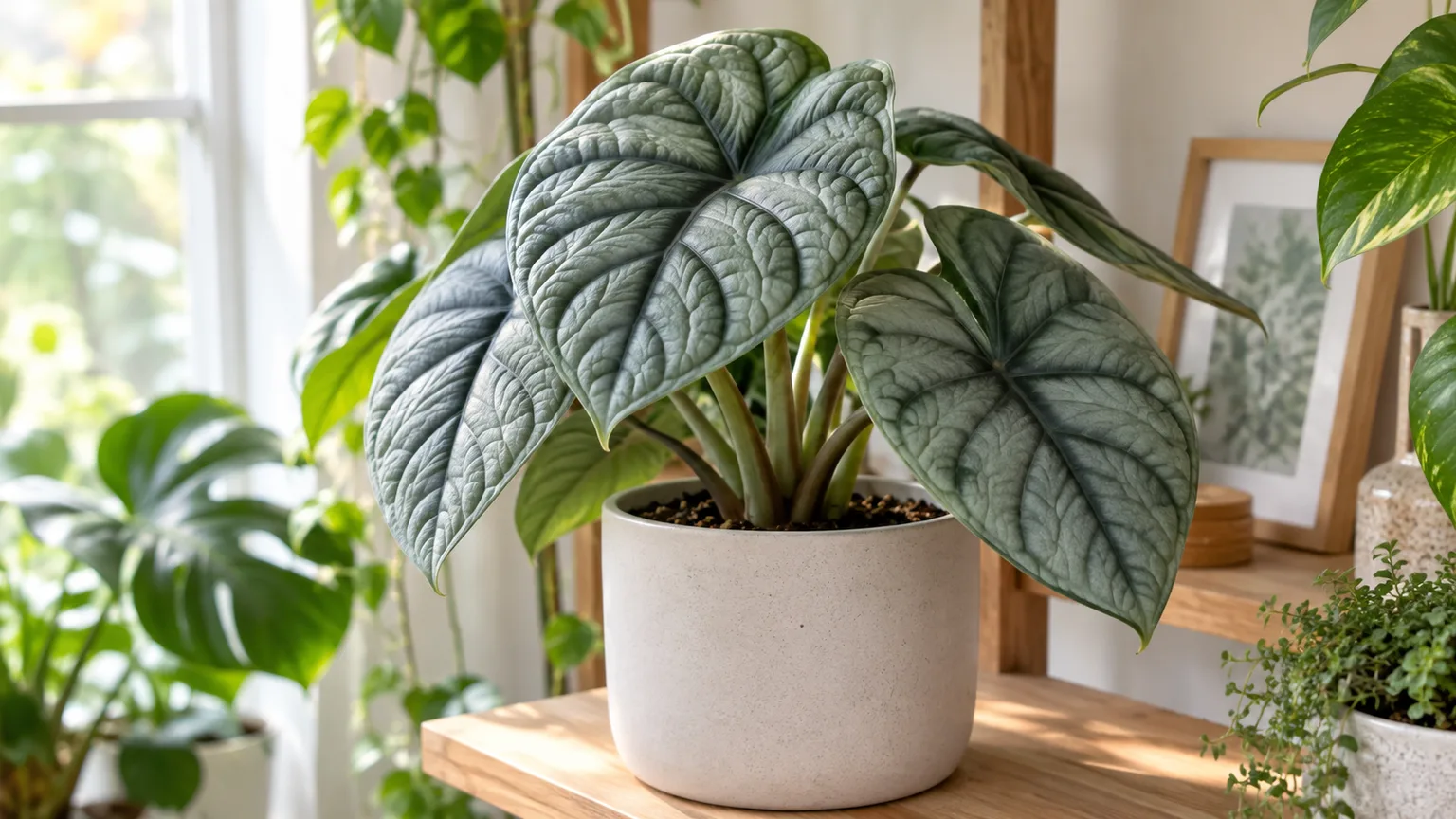
Alocasia Maharani — also sold as Grey Dragon — is a compact jewel alocasia prized for its thick, quilted, grey-green leaves. The same slow growth and textured foliage that make it collectible also make it one of the least forgiving alocasias when it comes to fertilizer. Unlike fast-growing Colocasia or large Alocasia amazonica hybrids, Maharani has fine roots, a small corm, and a leaf surface that holds liquid in its ridges. A heavy or frequent feeding program shows up quickly as brown tips on Alocasia Maharani, crusty soil, or stalled new growth — often before you notice any root damage.
The right approach matches the plant’s actual rhythm: low-dose feeding during active growth and a complete pause through dormancy. Done correctly, fertilizer stays in the background. Done wrong, it becomes the main problem on an otherwise healthy Alocasia Maharani overview plant.
What Makes Grey Dragon Different From Larger Alocasias
Maharani stays small — typically 20–35 cm tall — and pushes new leaves slowly, often every four to eight weeks indoors. That slow leaf cadence means the plant uses nutrients gradually. Extension guidance for Alocasia recommends regular feeding during active growth (NC State Extension), but “regular” for a 60 cm Alocasia zebrina in a bright greenhouse is not the same as regular for a compact Maharani on a windowsill. Treat Maharani like a slow jewel alocasia, not a fast foliage machine.
Parent-Species Habitat and Why It Matters for Nutrients
Alocasia ‘Maharani’ is a hybrid in the Alocasia melo × Alocasia rugosa lineage — a cultivated cross, not a wild species with its own native range. Parent species A. melo is native to Borneo (Sabah) per Kew POWO. That background helps explain two indoor feeding needs: steady access to calcium and magnesium (especially if you use very soft or RO water), and a preference for small, repeated low doses rather than single strong pours.
Salt Sensitivity on Slow, Fine Roots
Salt sensitivity is the defining constraint. The University of Maryland Extension explains that soluble salts from fertilizer pull moisture from root tissues, causing marginal yellowing, leaf scorch, and wilting even when the soil is moist. Jewel alocasias sit at the sensitive end of that spectrum. Full-strength fertilizer leaves residue that builds over weeks, and the first visible signs — crispy leaf margins, white crust on the soil, stunted new leaves — usually appear on the foliage before the plant wilts.
If symptoms persist after you adjust feeding, see the root rot on Alocasia Maharani guide — salt stress and rot can overlap when the mix stays wet.
The Best NPK Ratio for Alocasia Maharani
NPK refers to the three macronutrients on every label: nitrogen (N), phosphorus (P), and potassium (K). For Maharani, the safe family of ratios is a balanced 1:1:1 such as 10-10-10 or 20-20-20, or a foliage-leaning 3-1-2 such as 9-3-6 or 12-4-8. Both work; the choice is about emphasis, not correctness.
A balanced formula supports leaf production, root maintenance, and corm storage at the same time — appropriate for a plant building one textured leaf at a time. A 3-1-2 ratio adds slightly more nitrogen for chlorophyll and lamina expansion, which can help a young Maharani size up its leaves faster in warm, bright conditions.
Balanced 20-20-20 vs 3-1-2 Foliage Formulas
Most jewel-alocasia growers default to a balanced 20-20-20 liquid because it is widely available and most complete formulas include chelated iron, magnesium, and trace micronutrients. A 3-1-2 foliage ratio is a good alternative if you already feed other aroids from the same bottle — just dilute it more aggressively because the nitrogen concentration is higher.
In a warm, humid spot with bright indirect light (see the Alocasia Maharani light guide), a 3-1-2 formula can support slightly larger leaves. In a cooler room where nights drop into the low 60s °F, unused nitrogen is more likely to sit in the substrate as salts, so a balanced 1:1:1 is the safer pick. Match the ratio to your conditions, not a generic “best NPK” list.
Avoid high-phosphorus “bloom booster” formulas. Maharani is grown for foliage, not flowers, and excess phosphorus adds to salt load without benefit.
Micronutrients: Calcium, Magnesium, and Iron
The three secondary issues that show up on Maharani are calcium, magnesium, and iron shortfalls. Calcium problems appear at the growing point as torn, cupped, or deformed new leaves. Magnesium deficiency shows as interveinal yellowing on older leaves. Iron deficiency looks similar but hits the newest growth and is often a pH problem — iron becomes less available above pH 6.5.
A complete 20-20-20 with chelated iron covers most cases. If you water with very soft, reverse-osmosis, or rainwater, add a low-dose Cal-Mag supplement or a small amount of dolomitic lime in the Alocasia Maharani soil mix at repotting time. Maharani prefers slightly acidic mix around pH 5.5–6.5; mixes that drift too acidic can lock up calcium even when it is present in the substrate.
How to Dilute Fertilizer Without Burning the Corm
Dilution prevents most over-fertilization problems. The University of Maryland Extension emphasizes that fertilizer strength matters more than brand for sensitive houseplants. For a complete 20-20-20 liquid, use quarter to half strength on Maharani. For a 3-1-2 foliage formula, lean toward quarter strength.
Practical dosing: if the label calls for one teaspoon per gallon, mix half a teaspoon per gallon for balanced 20-20-20, or a quarter teaspoon for 3-1-2. Pour into already-moist soil — never onto bone-dry media, where concentrated salts contact dry root hairs directly. Water the day before a feed, apply diluted fertilizer as the next drink, then follow with a plain-water pour-through a few days later to keep salts moving through the pot.
If you use an EC meter, compare readings before and after feeding rather than chasing fixed targets — a common grower practice without extension-published numbers for Alocasia. Without a meter, clean leaf margins, no white crust, and steady (if slow) leaf production are the practical signals.
Alocasia Maharani Fertilizing Schedule by Season
A reliable rhythm for most indoor Maharani plants:
- Late winter to early spring (resumption): Start only after at least one new leaf has fully hardened. First feed at quarter strength; second at half strength.
- Spring (active growth): Feed every 4–6 weeks with balanced 20-20-20 at half strength, or every third watering at quarter strength if the plant is in a warm, bright window and pushing leaves steadily. The Royal Horticultural Society recommends liquid fertilizer from April through October for alocasias during active growth.
- Summer (peak growth): Continue the same rhythm. Flush with plain water every 6–8 weeks to prevent salt buildup in warm pots.
- Early fall (slowdown): One light half-strength feed in early September, then stop. Do not feed into late October.
- Winter (dormancy): No fertilizer. Resume only when new growth returns.
Houseplant guides often suggest feeding alocasias every two weeks. That cadence suits fast-growing, well-rooted plants in bright greenhouses. For slow Maharani in average home conditions, every 4–6 weeks is safer. When in doubt, feed less.
Matching Feeds to Leaf Cadence, Not the Calendar
Count leaves instead of weeks when possible. A healthy Maharani in active growth may push one leaf every four to eight weeks. Feeding once between each new leaf — after the previous one has hardened — naturally lands in the every-4-to-6-weeks range. If the plant takes two months between leaves, a fixed every-two-weeks schedule will overload the substrate and invite slow growth on Alocasia Maharani that looks like a nutrient problem but is actually salt stress.
Dormancy Feeding: When to Stop and When to Restart
Dormancy is the most important part of the Maharani fertilizer plan. The plant may slow dramatically or drop all of its leaves while the underground corm stays alive — a normal survival strategy, not a death sentence. During this slowdown, root uptake drops sharply. Fertilizer applied while the plant is resting sits in the pot, accumulates as salt, and damages fine roots and the corm (PDA Exotic Plants — Alocasia dormancy). The RHS likewise notes that alocasias need a dormancy period in cooler, drier winter conditions — and feeding during that rest period works against the plant.
Signs Your Maharani Has Gone Dormant
Maharani dormancy can be subtle or dramatic. Watch for: new leaf production stopping entirely; existing leaves holding size but not expanding; the newest leaf staying furled for weeks; soil staying wet longer between waterings; one or two older leaves yellowing from the edge inward (the plant pulling resources back into the corm). In severe dormancy, the plant may drop every leaf above the soil while the corm remains firm.
When you see these signs, stop fertilizing immediately. Reduce Alocasia Maharani watering to just enough to keep the corm from drying out. Do not repot or push growth with extra warmth.
Restarting Safely in Spring
The most common spring mistake is feeding as soon as a single leaf tip appears. Wait until the plant has pushed at least one — ideally two — fully unfurled, hardened leaves. The root system needs that foliage online before it can use nutrients safely.
Restart at quarter strength, move to half strength on the next round, then settle into the regular every-4-to-6-week rhythm. If new leaf margins brown after a feed, drop back one dilution step and flush the pot.
Foliar Feeding and Textured Leaves
Foliar feeding — spraying diluted fertilizer on leaves — works on smooth-leaved aroids but is a poor fit for Maharani. The deeply textured, almost reptilian leaf surface does not shed liquid evenly. Fertilizer pools in the ridges, leaves mineral residue that dulls the natural sheen, and can invite fungal issues along the veins. Keep the main feeding plan as a soil drench. If you need a quick magnesium correction for interveinal yellowing, a very light mist on the leaf underside in early morning at under 1 ml per liter is the upper limit — not a substitute for proper soil feeding.
Organic vs Synthetic Options for Indoor Jewel Alocasias
Synthetic balanced liquids like 20-20-20 give precise, immediate nutrient availability — valuable for a slow, sensitive plant where miscalculation shows on the leaves within days. Organic options such as fish emulsion or seaweed extract release nutrients more slowly through microbial activity. Indoor aroid mixes that are mostly bark, perlite, and sphagnum are often microbially lean, so organic release can be unpredictable indoors.
A practical hybrid: alternate one half-strength synthetic 20-20-20 feed with one diluted, deodorized fish emulsion feed (about one tablespoon per gallon) every 4–6 weeks during the active season. Skip organic feeds in winter to respect dormancy and avoid odor in closed rooms.
Signs of Over-Fertilization and How to Fix It
Watch for these signs after feeding or when resuming too early in spring:
- Brown, crispy leaf tips and margins appearing within days of a feed
- White or yellow crust on the soil surface or pot rim (University of Maryland Extension — salt deposits)
- Faster-than-normal yellowing of older leaves
- Stunted or deformed new growth smaller than the previous leaf
- Soft, oversized leaves with reduced vein contrast (excess nitrogen)
If you see any of these, pause all feeding and treat it as a salt issue, not a watering problem. A late-season feed on a plant already slowing down can produce these symptoms in October or November — flush and wait until spring rather than feeding again.
Flushing Salts From the Pot
Flush with three times the pot volume of plain, room-temperature water — the same leaching approach University of California Cooperative Extension recommends to rinse accumulated fertilizer salts from houseplant pots. For a 15 cm pot, that is roughly 4–5 litres total, poured slowly and evenly so water moves through the entire root ball. Let it drain fully; repeat if runoff is still tinted. Do not feed again for at least 4–6 weeks. Burned leaf tissue will not heal, but new leaves should emerge clean if the salt load has actually dropped.
Common Fertilizer Mistakes With Alocasia Maharani
The expensive mistakes are easy to avoid:
- Feeding on a calendar instead of watching leaf production — autopilot every-two-weeks schedules overload slow plants.
- Using full label strength — labels assume greenhouse conditions; Maharani on a windowsill needs half strength or less.
- Feeding after repotting — wait 4–6 weeks after Alocasia Maharani repotting so disturbed roots recover.
- Slow-release pellets in small pots — temperature-driven release is hard to predict in 10–15 cm containers.
- Winter feeding to “help” the plant — the exact opposite of what a resting corm needs.
The asymmetry favors caution: slight under-feeding shows as smaller, paler leaves you can correct in one cycle. Over-feeding causes salt burn and root damage that takes months to outgrow.
Conclusion
Feeding Alocasia Maharani well is mostly about restraint. A balanced 20-20-20 liquid (or a 3-1-2 foliage formula) at quarter to half strength, applied to moist soil every 4–6 weeks from spring through early fall, is enough to support its signature quilted leaves. Add Cal-Mag if your water is very soft, flush every 6–8 weeks in summer, and stop completely when dormancy signs appear in autumn. Resume only after new leaves have hardened in spring, leading with quarter strength on the first feed back.
If you take one rule from this guide: when in doubt, feed less, dilute more, and never feed a resting corm. Maharani’s parent species evolved on slow, limestone-filtered nutrient trickles — and the closer your indoor routine mirrors that calm chemistry, the more reliably Grey Dragon will push out the textured leaves that made you bring it home.
When to use this page vs other Alocasia Maharani guides
- Alocasia Maharani overview — Start here for whole-plant context before deep-diving this topic.
- Alocasia Maharani problems hub — Jump to symptom-specific fix guides when feeding adjustments do not resolve the issue.