Alocasia Maharani Care Guide: Light, Humidity, Soil
Alocasia 'Maharani'
Alocasia Maharani (Grey Dragon) care: bright indirect light, 65–80% humidity, chunky aroid mix, corm-safe watering, bullate leaf tips, and dormancy.
Alocasia Maharani Care Guide: Light, Humidity, Soil
Start with wateringThe most common care mistake for Alocasia MaharaniWatering guide →Alocasia Maharani care essentials
Light
bright indirect light
Water
Water when the top 2–3 cm of soil is dry; reduce sharply in winter dormancy. Avoid overwatering — the corm rots fast in wet mix.
Soil
Chunky, well-draining aroid mix with perlite and orchid bark; never use dense peat-heavy mix alone.
Humidity
65–80%
Temperature
18–26°C (65–80°F)
Fertilizer
Stop fertilizing, reduce watering to roughly every 3–5 weeks (just enough to keep the corm from desiccating), and keep the pot warm with bright indirect light.
About Alocasia Maharani
Alocasia Maharani is native to Hybrid (Alocasia melo × Alocasia rugosa lineage), typically reaches 20–35 cm tall; very compact indoors, with slow growth. Alocasia Maharani has a upright growth habit and part of the Araceae family. It is also known as Grey Dragon, Alocasia Grey Dragon, and Alocasia Maharani Grey Dragon.
| Detail | Information |
|---|---|
| Also known as | Grey Dragon, Alocasia Grey Dragon, Alocasia Maharani Grey Dragon |
| Native region | Hybrid (Alocasia melo × Alocasia rugosa lineage) |
| Mature size | 20–35 cm tall; very compact |
| Growth rate | Slow |
| Growth habit | Upright |
| Scientific name | Alocasia 'Maharani' |
| Family | Araceae |
Alocasia Maharani Care Guide: Light, Humidity, Soil
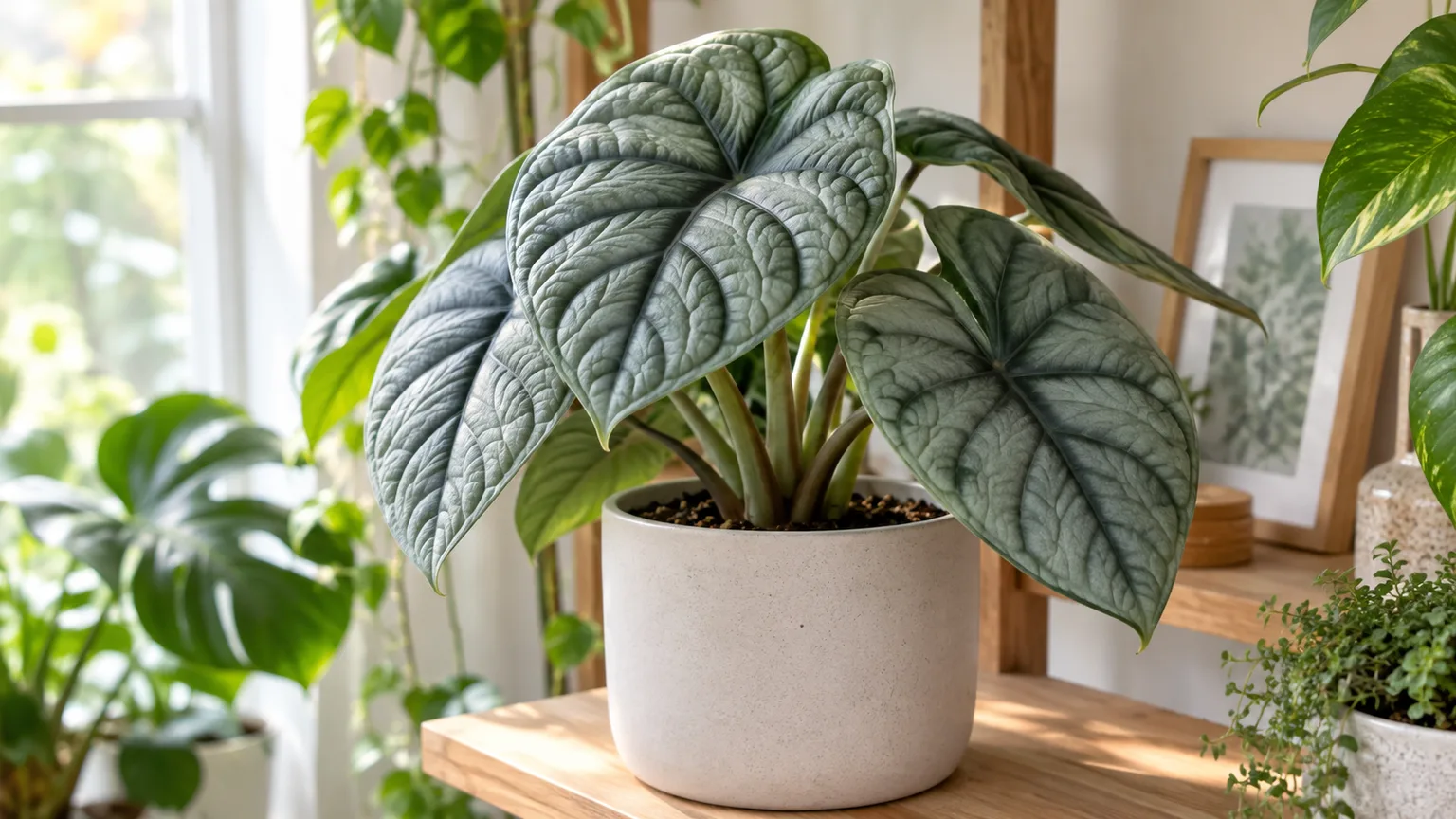
Alocasia Maharani sits in a narrow band between stunning and fussy. The thick, corrugated grey-green leaves — why collectors call it Grey Dragon — look carved from leather when conditions are right. When humidity drops, the mix stays wet, or winter dormancy catches you off guard, the same plant yellows, curls, and can drop every leaf above a still-living corm. This page is the hub: who Maharani is, what it needs day to day, and where to go when one variable (light, water, soil, pests) needs a deeper dive.
Reviewed by the LeafyPixels Review Board. Recommendations are checked against botanical and extension references, LeafyPixels plant-care data, and practical indoor growing constraints before publication.
What Is Alocasia Maharani (Grey Dragon)?
Alocasia ‘Maharani’ is a jewel alocasia — a compact group of slow-growing Bornean aroids prized for textured, bullate foliage rather than elephant-ear size. Trade labels include Grey Dragon, Alocasia Grey Dragon, and sometimes African mask Maharani. Most nursery pots are the selected cultivar, not a wild-collected type specimen. Related jewel alocasias in the same collector tier include Alocasia baginda ‘Dragon Scale’, Alocasia melo, and Alocasia reginula (Black Velvet); Maharani is often grouped with that lineage and shares their humidity and drainage demands.
Jewel alocasia identity and trade names
Jewel alocasias are defined in practice by small mature size, thick sculpted leaves, and slow offset production — the opposite of fast vining philodendrons or towering Alocasia macrorrhizos. Maharani typically tops out around 20–35 cm indoors with a tight clumping habit and a small fan of leaves at any one time. Do not expect a floor specimen; expect a terrarium-scale showpiece that punishes wet feet faster than a heartleaf philodendron ever will.
Botanical background and Borneo origins
Botanists A. Kurniawan and Peter C. Boyce formally described Alocasia maharani in 2011 from cultivated material linked to eastern Kalimantan, Indonesian Borneo, placing it among lowland humid-forest alocasias in the Araceae family (Kurniawan & Boyce 2011). Close relatives such as Alocasia melo share equatorial understory ecology on Borneo (Kew Plants of the World Online). LeafyPixels plant data notes hybrid ancestry in the melo × rugosa group; regardless of label nuance at the garden center, the indoor care contract is the same: warm, humid, bright-filtered light and fast-draining mix around a storage corm.
NC State Extension describes genus Alocasia as tuberous tropical perennials grown indoors for bold foliage — a useful frame for Maharani even though your pot will stay desk-sized.
Growth habit and mature size at home
Healthy Maharani carries three to six leaves at once, each stiff and deeply quilted. New spears emerge from the corm, unfurl slowly, and often look silvery before the cuticle darkens. Growth is slow compared with philodendrons; a new leaf every few weeks in good summer conditions is a win. Leggy, one-leaf plants usually mean weak light or chronic root stress — not “just how the plant grows.”
The underground corm and seasonal slowdowns
Maharani stores energy in an underground corm (sometimes called a tuber in trade guides). That corm is why the plant can survive a bad month — and why dormancy looks like death when it is not. In late autumn or winter, shorter days and cooler nights can trigger full leaf drop while the corm stays firm below the surface (PDA Exotic Plants dormancy guide). Never discard a pot that went bare over winter until you check the corm with a gentle unpot in spring.
Light: bright indirect as the default
Maharani evolved under a rainforest canopy. It wants bright, indirect light — strong enough to sustain thick new leaves, never hot midday sun on the blades. The RHS Alocasia growing guide states alocasias grow best in bright but indirect exposure; direct sun scorches foliage, while deep shade stalls growth.
Best windows, grow lights, and warning signs
Practical placements: east window with morning sun, north window with bright ambient bounce, or west window behind a sheer curtain. Rotate the pot weekly to prevent lean. For grow lights, start a full-spectrum LED 30–45 cm above the canopy for 10–12 hours daily; if leaves feel warm or bleach, raise the fixture.
Too little light: long weak petioles, dull veins, only one or two small leaves. Too much: bleached patches, crispy sun-facing margins. For placement math and FC ranges, see the dedicated Alocasia Maharani light guide.
Watering: when the top 2–3 cm is dry
The fastest way to kill Maharani is keeping the root zone soggy. The fastest way to stress it is letting the corm desiccate in a dry, overheated room. The workable band: water when the top 2–3 cm (about 1 inch) of mix is dry, then soak until runoff exits the drainage holes and empty the saucer (Proven Winners alocasia houseplant guide). Calendar rules like “every Tuesday” fail because light and humidity change how fast the pot dries.
Dormancy watering cuts and pot-weight checks
In active growth, many growers water every 7–14 days depending on pot size and season — but only after a finger, chopstick, or lift test confirms dryness. In dormancy, cut volume 60–70% and stretch intervals toward every 3–5 weeks; the goal is a firm corm, not new leaves. Chronic overwatering on Alocasia Maharani shows as yellow leaves and mushy petioles; underwatering shows as curl and crisp edges but is usually easier to reverse. Full rhythm and recovery steps live in the watering guide.
Humidity and temperature comfort zone
Maharani prefers warm, humid air during active growth — well above typical heated winter rooms. The RHS groups alocasias with medium-to-high humidity needs and warns that dry air browns leaf edges and favors spider mites. Target 18–26 °C (65–80 °F) for active growth.
Why misting alone fails on bullate leaves
Brief misting spikes humidity for minutes, leaves bullate surfaces wet, and does not change room averages. Reliable fixes: a humidifier on a hygrometer, a bright bathroom, grouping plants, or a ventilated glass cabinet. Keep plants away from AC vents and cold winter glass; the RHS recommends keeping alocasias above 10 °C (50 °F) always and above 16 °C (60 °F) during the growing season. Persistent low humidity drives brown tips and mite outbreaks.
Soil mix: chunky, airy, slightly acidic
Jewel alocasias need fast drainage with modest moisture retention — not dense peat-heavy tropical mix alone. NC State Extension recommends slightly acidic, moist, well-drained, humus-rich soil for genus culture; for Maharani’s slow roots, air matters as much as water.
A simple 1:1:1 aroid recipe
By volume: 1 part coco coir or peat-free potting compost, 1 part perlite, 1 part orchid bark. Target pH roughly 5.5–6.5. Avoid garden soil, pure peat, or fine sand that collapses pore space. Wrong mix is the hidden cause behind root rot and mold on soil. Recipe tweaks and repot links: soil guide and repotting guide.
Fertilizer, repotting, and propagation at a glance
Feed only during active growth: balanced liquid fertilizer at quarter to half label strength every 4–6 weeks spring through early autumn. Stop in dormancy, after repotting, and during pest or root recovery. Repot every 1–2 years in spring when roots circle or the pot dries unusually fast — one size up only.
Maharani does not root from leaf cuttings. Home propagation is division of offsets or corm propagation in spring; details and aftercare sit in the propagation guide. The RHS notes rhizome division in late spring/early summer as standard genus practice.
Common problems and where to go first
Most failures trace to moisture + light + humidity interacting, not random bad luck.
- Yellow leaves — often overwatering or dense mix; one old leaf dying with healthy new growth is normal turnover. See yellow leaves.
- Brown tips — usually low humidity or mineral-heavy tap water. See brown tips.
- Spider mites — hot dry air; inspect quilted leaf undersides. See spider mites.
- Wilting with wet soil — suspect root rot before you water again.
NC State Extension lists spider mites, aphids, mealybugs, root rot, and yellowing from overwatering, underwatering, or poor light as common genus issues — all apply to Maharani in warm, dry apartments.
Toxicity to pets and people
Every part of Alocasia ‘Maharani’ contains insoluble calcium oxalate raphides. The ASPCA lists Alocasia as toxic to dogs, cats, and horses, with oral irritation, pain and swelling of mouth and tongue, excessive drooling, vomiting (in dogs and cats), and difficulty swallowing. The RHS adds that alocasias contain toxic compounds and sap can irritate skin — wear gloves if you are sensitive.
If a pet or child chews the plant, call ASPCA Animal Poison Control at (888) 426-4435 or your veterinarian; do not induce vomiting unless instructed. Keep pots off floor level in pet homes or choose a non-toxic species instead.
Buying tips and the first 30 days
Choose plants with firm bullate leaves, clean undersides, and mix that does not smell sour. Avoid collapsed crowns, mushy petioles, or widespread yellow new growth. In the first month: do not repot, fertilize, or propagate unless pests or rotten roots force your hand. Quarantine two weeks, learn how fast your pot dries, and change one variable at a time if stress appears.
When to use this page vs other Alocasia Maharani guides
- This overview — Start here for identity, baseline light/water/soil/humidity, dormancy, toxicity, and problem routing.
- Watering — Dry-down methods, bottom vs top water, dormancy intervals, root-rot recovery.
- Light — Foot-candles, window maps, grow-light distance, metallic-sheen diagnostics.
- Soil and repotting — Mix recipes, pot sizing, when not to repot.
- Propagation — Division and corm steps.
- Problems hub — Symptom-first path when you already know something is wrong.
Related Alocasia Maharani guides
- Alocasia Maharani watering
- Alocasia Maharani light
- Alocasia Maharani soil
- Alocasia Maharani fertilizer
- Alocasia Maharani repotting
- Alocasia Maharani propagation
- Alocasia Maharani pruning
- Yellow leaves on Alocasia Maharani
- Root rot on Alocasia Maharani
- Spider mites on Alocasia Maharani
Conclusion
Alocasia ‘Maharani’ rewards growers who treat light, humidity, watering, and dormancy as one system tied to a corm — not four unrelated chores. Keep the mix airy, the top few centimetres dry between drinks, humidity above average room air, and winter care conservative when leaves drop. Lift the pot, check the corm once a year, and use sibling guides when a single symptom needs a deep fix. Get those habits boring, and Grey Dragon pushes new sculpted leaves on schedule.
How to care for Alocasia Maharani?
How much light does Alocasia Maharani need?
bright indirect light
- bright indirect light - bright indirect light.
When should you water Alocasia Maharani?
Water when the top 2–3 cm of soil is dry; reduce sharply in winter dormancy. Avoid overwatering — the corm rots fast in wet mix.
- Finger or chopstick to 2–3 cm depth; lift pot to gauge weight - Water when the top 2–3 cm of soil is dry; reduce sharply in winter dormancy.
- Drain excess water - Water when the top 2–3 cm of soil is dry; reduce sharply in winter dormancy.
What soil works best for Alocasia Maharani?
Chunky, well-draining aroid mix with perlite and orchid bark; never use dense peat-heavy mix alone.
- perlite - Chunky, well-draining aroid mix with perlite and orchid bark; never use dense peat-heavy mix alone.
- orchid bark - Chunky, well-draining aroid mix with perlite and orchid bark; never use dense peat-heavy mix alone.
- peat-free potting mix - Chunky, well-draining aroid mix with perlite and orchid bark; never use dense peat-heavy mix alone.
Grower notes for Alocasia Maharani
Dormancy and the corm
Alocasia Maharani may drop all leaves in winter while the underground corm stays alive. Reduce watering to every 3–5 weeks, stop fertilizer, and wait for spring growth — do not discard a pot that looks empty.
Bullate grey-green leaf care
The thick, corrugated grey-green leaf surface traps water and dust like Melo and Dragon Scale. Never mist foliage directly — use a humidifier instead. Wipe leaves gently with a damp microfiber cloth when dusty; avoid leaf shine products that clog stomata and dull the matte finish.
What matters most with Alocasia Maharani
Alocasia Maharani is easiest to grow when you judge the whole plant: new growth, root-zone moisture, light exposure, and how quickly the pot dries after watering. The care checkpoint is bright indirect light paired with chunky aroid mix in a snug pot — this dwarf hybrid rots faster than the taller Alocasia Polly when overpotted or overwatered.
Best placement in a real home
Alocasia Maharani belongs where bright indirect light is realistic for most of the day. Water when the top 2–3 cm of soil is dry; reduce sharply in winter when dormancy is likely. Humidity target: 65–80%. Temperature comfort zone: 18–26°C (65–80°F). A humid bathroom with good light or a glass cabinet is often ideal for this terrarium-sized plant.
Before you buy this plant
Choose Alocasia Maharani with firm bullate leaves, clear grey-green veining, clean leaf undersides, and soil that does not smell sour. Be cautious if you see collapsed crowns, mushy petioles, or a pot that stays wet in poor light. Also sold as Grey Dragon — verify the compact corrugated foliage, not a mislabeled Polly or Silver Dragon.
First month after bringing it home
Do not repot Alocasia Maharani on day one unless the mix is failing or pests are obvious. Quarantine it, learn how fast the pot dries, and keep care boring while it adjusts. If a leaf drops in week one, the corm below may still be fine — resist overwatering an empty-looking pot.
Is it pet safe?
Alocasia Maharani is toxic to cats and dogs and humans.
Contains insoluble calcium oxalate crystals causing oral irritation, drooling, and vomiting if ingested.
Watering Alocasia Maharani
For Alocasia Maharani, finger or chopstick to 2–3 cm depth; lift pot to gauge weight and water every 7–10 days in summer; every 2–4 weeks in winter. Reduce watering 60–70% in autumn/winter when dormancy is likely; keep corm from drying out.
| Detail | Information |
|---|---|
| How often | Every 7–10 days in summer; every 2–4 weeks in winter |
| How to check | Finger or chopstick to 2–3 cm depth; lift pot to gauge weight |
| Seasonal changes | Reduce watering 60–70% in autumn/winter when dormancy is likely; keep corm from drying out |
Signs of overwatering
- yellow leaves
- mushy petioles
- soggy soil
- root rot
Signs of underwatering
- drooping leaves
- dry crispy edges
- slow growth
Soil & potting for Alocasia Maharani
Use a mix of perlite, orchid bark, peat-free potting mix, coarse sand for Alocasia Maharani. Fast-draining; corm must never sit in saturated soil. Target soil pH around 5.5–6.5. Repot every 1–2 years, ideally in spring.
| Detail | Information |
|---|---|
| Recommended mix | perlite, orchid bark, peat-free potting mix, coarse sand |
| Drainage | Fast-draining; corm must never sit in saturated soil |
| Soil pH | 5.5–6.5 |
| Repotting frequency | Every 1–2 years |
| Best season to repot | Spring |
Signs it needs repotting
- roots circling pot
- rapid soil drying
- stunted growth
Humidity & temperature for Alocasia Maharani
Alocasia Maharani prefers 65–80%, though normal home humidity is usually fine. Keep temperatures around 18–26°C (65–80°F).
| Detail | Information |
|---|---|
| Humidity | 65–80% - normal home humidity is fine. |
| Ideal temperature | 18–26°C (65–80°F) |
Fertilizer & pruning for Alocasia Maharani
Use stop fertilizing, reduce watering to roughly every 3–5 weeks (just enough to keep the corm from desiccating), and keep the pot warm with bright indirect light. for Alocasia Maharani.
| Detail | Information |
|---|---|
| Fertilizer type | Stop fertilizing, reduce watering to roughly every 3–5 weeks (just enough to keep the corm from desiccating), and keep the pot warm with bright indirect light. |
Common problems on Alocasia Maharani
Yellow Leaves
MediumLikely cause: Common on this plant type; confirm with recent watering, light, and root checks.
Quick fix: Inspect the plant and correct the most likely care stressor before stacking treatments.
Full fix guide →Brown Tips
MediumLikely cause: Common on this plant type; confirm with recent watering, light, and root checks.
Quick fix: Inspect the plant and correct the most likely care stressor before stacking treatments.
Full fix guide →Root Rot
MediumLikely cause: Common on this plant type; confirm with recent watering, light, and root checks.
Quick fix: Inspect the plant and correct the most likely care stressor before stacking treatments.
Full fix guide →Overwatering
MediumLikely cause: Common on this plant type; confirm with recent watering, light, and root checks.
Quick fix: Inspect the plant and correct the most likely care stressor before stacking treatments.
Full fix guide →Underwatering
MediumLikely cause: Common on this plant type; confirm with recent watering, light, and root checks.
Quick fix: Inspect the plant and correct the most likely care stressor before stacking treatments.
Full fix guide →Spider Mites
MediumLikely cause: Common on this plant type; confirm with recent watering, light, and root checks.
Quick fix: Inspect the plant and correct the most likely care stressor before stacking treatments.
Full fix guide →Mealybugs
MediumLikely cause: Common on this plant type; confirm with recent watering, light, and root checks.
Quick fix: Inspect the plant and correct the most likely care stressor before stacking treatments.
Full fix guide →Aphids
MediumLikely cause: Common on this plant type; confirm with recent watering, light, and root checks.
Quick fix: Inspect the plant and correct the most likely care stressor before stacking treatments.
Full fix guide →Leggy Growth
MediumLikely cause: Common on this plant type; confirm with recent watering, light, and root checks.
Quick fix: Inspect the plant and correct the most likely care stressor before stacking treatments.
Full fix guide →Slow Growth
MediumLikely cause: Common on this plant type; confirm with recent watering, light, and root checks.
Quick fix: Inspect the plant and correct the most likely care stressor before stacking treatments.
Full fix guide →Wilting
MediumLikely cause: Common on this plant type; confirm with recent watering, light, and root checks.
Quick fix: Inspect the plant and correct the most likely care stressor before stacking treatments.
Full fix guide →Drooping Leaves
MediumLikely cause: Common on this plant type; confirm with recent watering, light, and root checks.
Quick fix: Inspect the plant and correct the most likely care stressor before stacking treatments.
Full fix guide →Low Humidity
MediumLikely cause: Common on this plant type; confirm with recent watering, light, and root checks.
Quick fix: Inspect the plant and correct the most likely care stressor before stacking treatments.
Full fix guide →Not Enough Light
MediumLikely cause: Common on this plant type; confirm with recent watering, light, and root checks.
Quick fix: Inspect the plant and correct the most likely care stressor before stacking treatments.
Full fix guide →Fungus Gnats
MediumLikely cause: Common on this plant type; confirm with recent watering, light, and root checks.
Quick fix: Inspect the plant and correct the most likely care stressor before stacking treatments.
Full fix guide →Mold on Soil
MediumLikely cause: Common on this plant type; confirm with recent watering, light, and root checks.
Quick fix: Inspect the plant and correct the most likely care stressor before stacking treatments.
Full fix guide →Curling Leaves
MediumLikely cause: Common curling leaves pattern on Alocasia Maharani under indoor care stress.
Quick fix: Inspect roots, watering, light, and pests; adjust one variable and monitor new growth.
Full fix guide →Brown Leaves
MediumLikely cause: Common brown leaves pattern on Alocasia Maharani under indoor care stress.
Quick fix: Inspect roots, watering, light, and pests; adjust one variable and monitor new growth.
Full fix guide →Black Spots
MediumLikely cause: Common black spots pattern on Alocasia Maharani under indoor care stress.
Quick fix: Inspect roots, watering, light, and pests; adjust one variable and monitor new growth.
Full fix guide →Holes in Leaves
MediumLikely cause: Common holes in leaves pattern on Alocasia Maharani under indoor care stress.
Quick fix: Inspect roots, watering, light, and pests; adjust one variable and monitor new growth.
Full fix guide →Pale Leaves
MediumLikely cause: Common pale leaves pattern on Alocasia Maharani under indoor care stress.
Quick fix: Inspect roots, watering, light, and pests; adjust one variable and monitor new growth.
Full fix guide →Distorted Leaves
MediumLikely cause: Common distorted leaves pattern on Alocasia Maharani under indoor care stress.
Quick fix: Inspect roots, watering, light, and pests; adjust one variable and monitor new growth.
Full fix guide →Scale Insects
MediumLikely cause: Common scale insects pattern on Alocasia Maharani under indoor care stress.
Quick fix: Inspect roots, watering, light, and pests; adjust one variable and monitor new growth.
Full fix guide →Thrips
MediumLikely cause: Common thrips pattern on Alocasia Maharani under indoor care stress.
Quick fix: Inspect roots, watering, light, and pests; adjust one variable and monitor new growth.
Full fix guide →Whiteflies
MediumLikely cause: Common whiteflies pattern on Alocasia Maharani under indoor care stress.
Quick fix: Inspect roots, watering, light, and pests; adjust one variable and monitor new growth.
Full fix guide →Leaf Miners
MediumLikely cause: Common leaf miners pattern on Alocasia Maharani under indoor care stress.
Quick fix: Inspect roots, watering, light, and pests; adjust one variable and monitor new growth.
Full fix guide →Caterpillars
MediumLikely cause: Common caterpillars pattern on Alocasia Maharani under indoor care stress.
Quick fix: Inspect roots, watering, light, and pests; adjust one variable and monitor new growth.
Full fix guide →Nitrogen Deficiency
MediumLikely cause: Common nitrogen deficiency pattern on Alocasia Maharani under indoor care stress.
Quick fix: Inspect roots, watering, light, and pests; adjust one variable and monitor new growth.
Full fix guide →Iron Deficiency
MediumLikely cause: Common iron deficiency pattern on Alocasia Maharani under indoor care stress.
Quick fix: Inspect roots, watering, light, and pests; adjust one variable and monitor new growth.
Full fix guide →Magnesium Deficiency
MediumLikely cause: Common magnesium deficiency pattern on Alocasia Maharani under indoor care stress.
Quick fix: Inspect roots, watering, light, and pests; adjust one variable and monitor new growth.
Full fix guide →Potassium Deficiency
MediumLikely cause: Common potassium deficiency pattern on Alocasia Maharani under indoor care stress.
Quick fix: Inspect roots, watering, light, and pests; adjust one variable and monitor new growth.
Full fix guide →Calcium Deficiency
MediumLikely cause: Common calcium deficiency pattern on Alocasia Maharani under indoor care stress.
Quick fix: Inspect roots, watering, light, and pests; adjust one variable and monitor new growth.
Full fix guide →