Alocasia Maharani Care Guide: Light, Water & Soil
Grow Alocasia Maharani with a root-safe watering routine, airy soil, bright filtered light, seasonal care, corm propagation, and clear fixes.
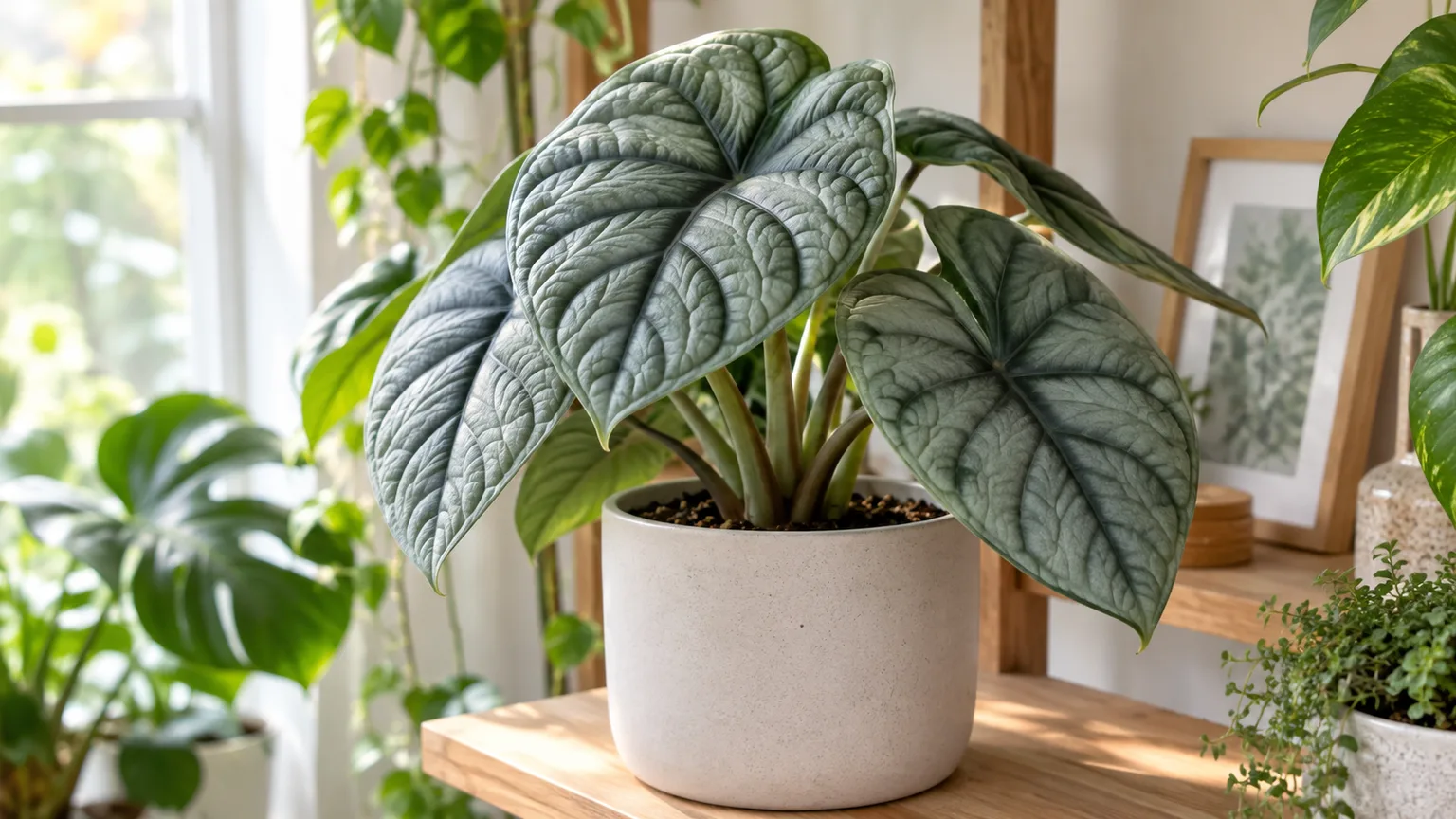
Alocasia Maharani, often sold as Gray Dragon, is a compact jewel Alocasia prized for thick, silvery gray-green leaves with a raised, almost armored texture. It looks like a collector plant, but its care becomes much less mysterious when you treat the underground storage organ and the roots as the center of the routine—not just the dramatic foliage.
The most reliable formula is bright filtered light, a warm and stable room, an airy mix that stays lightly moist, and a watering decision based on the top inch or two of soil. The plant does not want drought, but it is even less forgiving of a saturated pot that stays cold and airless. The NC State Extension Plant Toolbox describes Alocasia as tropical, tuberous plants that prefer moisture and good drainage, while the RHS Alocasia growing guide emphasizes warmth, indirect light, seasonal slowdown, and drier winter conditions.
What Alocasia Maharani Is—and Why Its Leaves Matter
Alocasia Maharani belongs to the arum family, Araceae, a group that includes many familiar tropical foliage plants. The genus comes from warm, wet regions of Asia and eastern Australia, but the plant sold under this name is a small indoor specimen rather than a giant outdoor elephant’s ear. Its appeal is the combination of a manageable footprint and unusually hard, textured leaves that catch light differently from smooth-leaved Alocasias.
Individual plants vary with age, pot size, light, and growing conditions, so do not treat a single published height as a guarantee. A healthy Maharani is usually a shelf- or tabletop-sized plant, but a crowded pot, weak light, or a recently divided offset may stay smaller for a long time. Slow growth after a move is not automatically a problem if the corm is firm, the roots smell fresh, and the newest leaf is holding its color.
The compact, corm-grown habit changes your routine
Maharani stores energy in a compact underground structure that growers commonly refer to as a corm or, more broadly, a storage organ. That reserve helps the plant survive a seasonal pause, but it also means the container can look deceptively fine while a wet root zone is damaging the plant below the soil line. The leaves are the report; the roots and corm are the business.
This is why a fixed “water every five days” schedule is a poor starting point. A small pot near a warm window may dry quickly, while the same plant in a cool, dim room can remain wet for weeks. Build the routine around soil feel, pot weight, temperature, and new growth, then use the calendar only as a reminder to check.
Place It in Bright, Filtered Light
Give Alocasia Maharani bright, indirect light for the best balance of compact growth and leaf color. An east-facing window is a straightforward choice; a south- or west-facing window can work if a sheer curtain or a little distance softens the hottest rays. The RHS recommends bright but indirect light and notes that strong sun can scorch foliage, while lower light slows growth.
Think of “indirect” as bright light with no prolonged, hot beam landing on the leaves. A plant can sit near a window without sitting on the glass. If the leaf surface feels hot in the afternoon, the plant is too close even if the room looks bright. Conversely, long petioles leaning toward the window, small new leaves, and wide gaps between leaves suggest the plant is asking for more usable light.
Rotate the pot a quarter turn every week or two so every side receives a similar view of the window. Rotation will not fix a plant that is genuinely too dim, but it can prevent one-sided leaning and helps the compact rosette keep its shape.
Acclimate it before moving it closer to a window
A nursery-grown Maharani may have lived under shade cloth, greenhouse glazing, or a grow light. Moving it straight into several hours of direct sun can bleach or scorch leaves that were perfectly healthy in their previous environment. Start in bright filtered light, then shift it closer to the window over one to two weeks while watching the newest and sun-facing leaves.
If a pale, crisp patch appears on the window-facing surface, pull the plant back rather than treating the damage as a fertilizer deficiency. Existing scorch will not turn green again. The useful goal is protecting the next leaf, not trying to repair the old one.
Water by Soil Condition, Not the Calendar
Water when the top 1 to 2 inches of the mix feel dry, but do not wait until the entire pot is bone dry or the leaves are collapsing. Insert a finger near the edge of the pot, where you are less likely to damage a corm or root, and check more than the surface crust. A wooden skewer, pot weight, or moisture meter can help, but use it as a second opinion rather than letting a single number replace observation.
When it is time, water slowly over the whole surface until a steady stream exits the drainage hole. Let the pot drain fully, then empty the cachepot or saucer. The aim is to moisten the whole root ball and flush out pockets of dry mix; it is not to leave the pot standing in runoff. Gardening Know How’s Alocasia guidance likewise recommends evenly moist soil without standing water and less watering during winter.
In active growth, a warm, bright Maharani may need checking every few days and watering roughly weekly. That is a starting observation, not a promise. In winter, lower light and cooler rooms slow evaporation, so the same pot may need water every 10 to 14 days or less. Always check the mix; a bright grow light, heated room, tiny pot, or very porous mix can shorten that interval.
The warning signs point in different directions. A plant that wilts while the mix is dry needs water and perhaps a better-sized pot. A plant that wilts while the mix is wet needs a root inspection, not another drink. Yellow lower leaves, a sour smell, fungus on the surface, and a pot that stays heavy for a long time all strengthen the case for poor drainage or root stress.
Build an Airy, Moisture-Holding Potting Mix
The best Alocasia Maharani soil is not the fastest-draining mix you can buy and not a dense all-purpose garden soil. It should hold enough moisture for fine roots while leaving air spaces after watering. A simple starting blend is 2 parts quality peat-free houseplant mix, 1 part fine orchid bark, and 1 part perlite or pumice.
Adjust the recipe to your room. If the mix is still wet a week after a thorough watering, add more coarse, porous material at the next repot. If it becomes dry and pulls away from the pot within a day or two, retain a little more moisture-holding mix or move the plant away from intense heat. The point is a repeatable dry-down, not a fashionable ingredient list.
Avoid adding a drainage layer of gravel inside the pot. It does not create a higher usable drainage zone; it simply takes up space and can leave the root ball sitting in a wetter layer above it. Use a pot with an actual drainage hole, a loose mix, and a saucer that can be emptied.
Balance Humidity, Temperature, and Airflow
Maharani appreciates medium to high humidity, but it does not need a sealed, stagnant terrarium to survive. A hygrometer at leaf height gives you a more useful reading than guessing from the weather app. Around 50 to 70% relative humidity is a practical indoor target; the plant may grow faster closer to 60 to 80%, but stable roots, good light, and airflow matter more than chasing a perfect number.
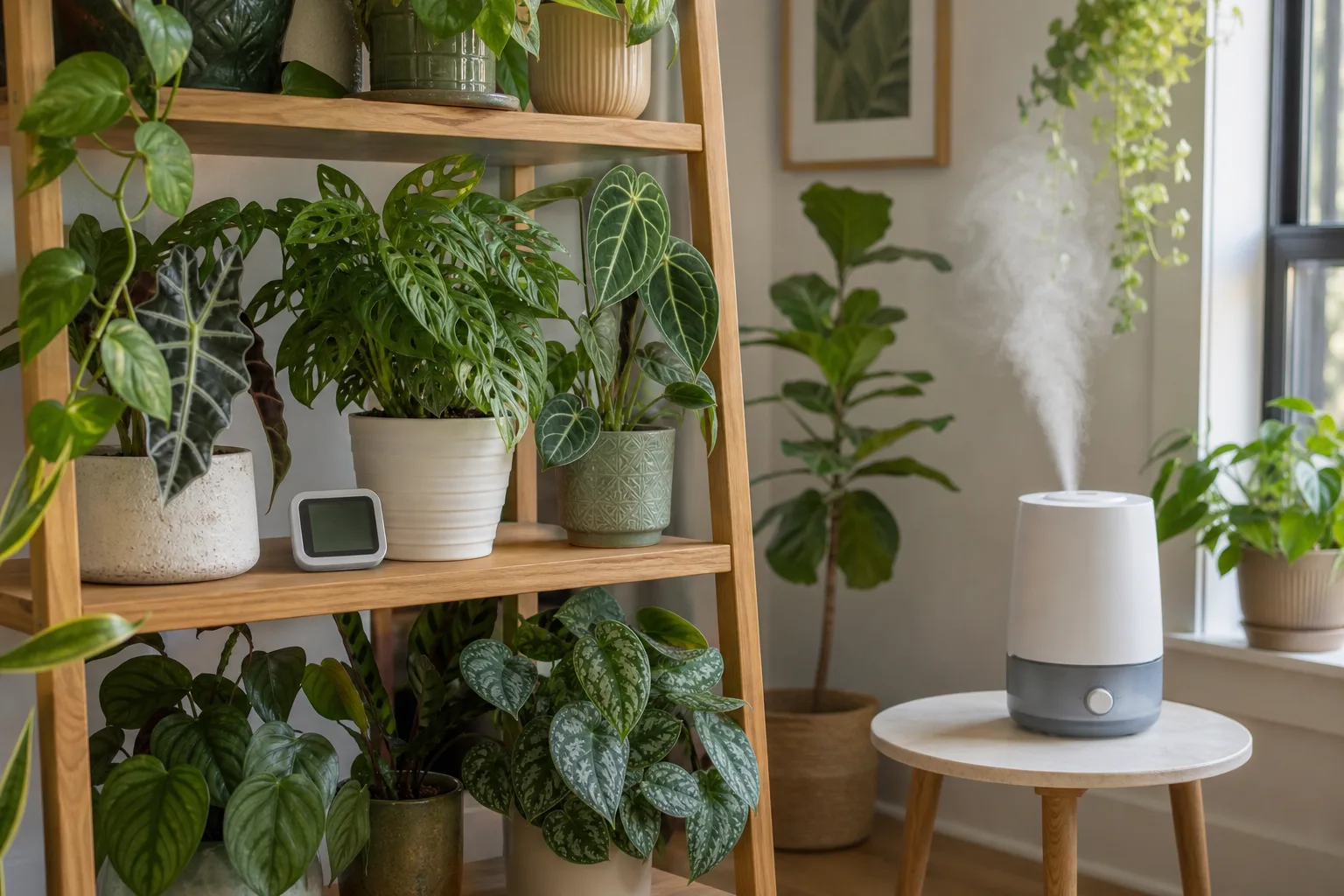
A dedicated humidifier is the most controllable option when winter air stays very dry. Grouping plants can create a modest local effect. A correctly built pebble tray—pot resting on pebbles with water below the stone tops—may help immediately around the pot, but it cannot humidify an entire room and must never leave the drainage hole submerged. Misting raises humidity only briefly; repeatedly wet leaves in still air can create a better environment for spotting than for healthy growth.
Keep the plant warm and away from sharp temperature changes. An actively growing Maharani is happiest around 65 to 80°F (18 to 27°C), with no cold draft from a door, window, or air-conditioning vent. The RHS recommends keeping Alocasias above 60°F during the growing season and above 50°F in winter. If the room is warm but the pot stays wet, improve light and airflow rather than simply adding more water.
You can move the plant outdoors for a warm-season holiday only when nights are reliably above about 60°F, the plant is shielded from wind, and it receives bright shade or filtered light. Make the move gradually and inspect for insects before bringing it indoors. In cooler climates, treat it as a container houseplant rather than a perennial landscape plant; tropical Alocasias are not frost plants.
Feed for Steady Leaves, Not Soft Growth
Feed only while the plant is actively producing leaves. A balanced liquid houseplant fertilizer diluted to half the label strength every three to four weeks is a reasonable starting rhythm in spring and summer. If the plant was just repotted into fresh, fertilized mix, wait several weeks before adding more.
The RHS advises feeding Alocasias with a general liquid fertilizer during the growing season, while practical grower guidance from Epic Gardening emphasizes starting when new spring growth appears and reducing fertilizer as winter dormancy approaches. Both points matter: active light and roots must be present for feeding to help.
Stop fertilizing when the plant is dormant, growing very slowly in low light, or recovering from root rot. Fertilizer cannot compensate for a dark room or damaged roots. If white crust forms on the soil or pot rim, flush the pot with plain water on a day when the mix is already draining well, then resume at a lighter rate after the plant stabilizes.
Choose a Snug Pot and Repot With a Root Check
Maharani likes a pot that supports the root ball without leaving a large reservoir of unused wet mix around it. Repot when roots circle densely, emerge from the drainage hole, the mix has collapsed, or the pot dries dramatically faster than it used to. If the plant is stable and the roots are not crowded, repotting just because a year has passed can create unnecessary stress.
Move up only 1 to 2 inches in diameter and keep the plant at the same depth. A nursery pot with drainage set inside a decorative cachepot is often easier to manage than a sealed container. The RHS specifically cautions against overpotting, and smaller increments also make it easier to tell whether the new mix is drying at a healthy pace.
Repot in spring or early summer when the plant is growing, unless an emergency root problem requires action sooner. Water the plant lightly before repotting if the root ball is dusty and brittle, but do not repot a pot that is waterlogged and cold without first letting excess water drain.
How to inspect the root zone before repotting
Slide the plant out while supporting the base, then brush away only enough mix to see the roots and the underground storage organ. Healthy roots are generally firm and pale tan, cream, or white. Rotting roots are soft, hollow, brown to black, or foul-smelling; the exact color varies with the mix, so texture and smell are more useful than color alone.
Trim only roots that are clearly dead with clean scissors. Repot into fresh, airy mix, use a clean pot with a drainage hole, and do not bury the corm or crown deeper than before. After an emergency repot, keep the plant warm in bright filtered light and let the top of the mix begin to dry before watering again.
Groom the Foliage and Handle Flowers Realistically
The large, textured leaves collect dust in their raised veins. Once every few weeks, rinse the plant gently with lukewarm water or wipe the leaf surface with a soft damp cloth. Support the leaf from below rather than dragging a cloth across it; new leaves can be surprisingly tender while they harden.
Remove a leaf only when it is fully yellow or brown, cutting the petiole near its base with clean tools. A fading lower leaf may be the plant reallocating nutrients as it grows a new one, while several yellow leaves at once suggest a root, water, light, or temperature problem. Cutting every partly yellow leaf can reduce the plant’s energy before you have diagnosed the cause.
Alocasias can produce a small spadix and spathe, but indoor Maharani is usually grown for foliage. A flower is not proof that the plant is healthier, and no flower is not a failure. If a bloom appears while the plant is otherwise stressed, remove it only if you need to conserve energy; do not disturb a stable plant simply because flowering is not part of your goal.
Propagate From Offsets or Corms
The most dependable way to multiply a Maharani is to separate a naturally formed offset during repotting. The offset should have its own growth point and, ideally, a few roots. A detached leaf or petiole without a node or underground growth point is not a complete new plant, so leaf-cutting experiments usually waste a healthy leaf.
Small corms can also be started, but they are a slower project and are easy to rot if kept constantly wet. RHS guidance identifies spring offsets and late-spring or early-summer division as practical propagation routes. Propagate only a vigorous parent that has enough roots and leaves to recover.
A low-risk propagation sequence
- Choose spring or early summer, water the parent lightly a day before, and prepare a small pot with fresh airy mix.
- Remove the plant gently and expose the base without tearing roots. Separate an offset at its natural connection with a clean, sharp blade.
- Keep the offset’s growth point above the mix and preserve every healthy root you can. Do not plant a tiny piece in a large pot.
- Water once so the mix settles, allow the container to drain completely, and place it in warm bright filtered light.
- Keep the mix lightly moist but never soggy. A loose clear cover can hold humidity during establishment, but vent it daily and remove it if condensation stays heavy or mold appears.
- Wait for firm new growth before returning to normal feeding. A baby plant may pause for weeks while it replaces damaged roots; tugging at it to check progress only adds stress.
If you are starting a corm with no leaves, keep its growth point at or just above the surface in a small, airy medium and provide warmth and filtered light. Do not seal it in a wet cup or bury it deeply. The first successful milestone is a firm corm with roots; the leaf comes later.
Plan for Winter Slowdown or Dormancy
RHS notes that Alocasias often need cooler, drier winter conditions and may lose foliage before returning to growth. Maharani does not always become completely leafless indoors, but a seasonal slowdown is normal when daylight drops. The plant may stop making leaves, yellow an older leaf, or take much longer to dry after watering.
In winter, move it away from cold glass and drafts while keeping it in bright filtered light. Check the mix less often, water only when the upper layer has dried, and stop fertilizer. If every leaf disappears, do not immediately discard the pot: check whether the corm is firm and odor-free, then keep the pot warm and only barely moist rather than repeatedly wet.
There is a crucial difference between dormancy and rot. A firm corm with dry, clean soil can wait for better conditions. A soft corm, sour smell, collapsing base, or persistently wet root ball calls for unpotting and inspection. Resume stronger watering and feeding only after new growth is visible and the plant is actively using water again.
Diagnose Yellow, Brown, Drooping, or Leggy Leaves
Leaf symptoms overlap, so start with the pattern and the soil before reaching for fertilizer. The NC State Extension plant profile lists overwatering, too little water, and inadequate light among causes of yellowing, which is a useful correction to the common assumption that every yellow leaf means “too much water.”

| What you see | First checks | First response |
|---|---|---|
| One old lower leaf slowly yellows | New growth, soil moisture, pests | Wait until it is mostly yellow, then remove it; monitor the next leaf. |
| Several leaves yellow while soil stays wet | Drainage, pot size, root smell and texture | Pause watering, inspect roots, and repot if roots are soft. |
| Yellowing with a dry, shrinking mix | Missed watering, hot window, roots circling pot | Water thoroughly, then check whether the pot is root-bound or drying too fast. |
| Brown crispy tips or edges | Humidity, dry roots, salts, hot sun, drafts | Check the hygrometer and roots, move from harsh sun, and flush salts only if drainage is good. |
| Whole plant droops in wet soil | Root oxygen and rot | Do not water again; unpot and inspect the root zone. |
| Long petioles and small, widely spaced leaves | Usable light and window direction | Increase filtered light gradually and rotate the pot. |
| Stippling, silvering, holes, or fine webbing | Leaf undersides, petiole joints, and new growth | Isolate the plant and inspect for mites, thrips, or other pests. |
Brown tips are not a humidity diagnosis by themselves. Dry air can contribute, but a salt crust, root damage, direct sun, hot airflow, or a dry root ball can create a similar edge. Correct the environment first and trim only the dead tissue; a brown section will not become green again.
Treat Pests and Root Rot as Separate Problems
Spider mites are more likely in hot, dry conditions, and thrips can hide in folds and new leaves. Mealybugs cluster at joints, while fungus gnats usually indicate persistently damp mix rather than a leaf-feeding infestation. Inspect both sides of every leaf, the crown, and the soil surface whenever you bring a new plant home or move a Maharani back indoors.

Isolate a suspect plant before treating it. Rinse foliage with a gentle stream if the leaves and roots are not already stressed, wipe visible insects with a damp cotton swab, and repeat inspections every few days. If you use insecticidal soap, horticultural oil, or another pesticide, choose a product labelled for the pest and plant, follow that label exactly, test a small area first, and keep people and animals away as directed. Do not improvise concentrated mixtures on textured leaves.
Root rot needs a different response from mites. Yellowing in wet soil, a soft base, foul smell, or dark mushy roots calls for a root check: remove the plant, cut away only dead tissue with clean tools, discard the saturated mix, and use a smaller clean pot if the remaining root ball is reduced. More humidity will not repair rotted roots, and more fertilizer can make recovery worse.
After treatment, keep the plant in bright filtered light with gentle airflow and avoid constant leaf wetness. A single clean-up rarely ends an infestation because eggs and hidden adults can remain. The plant is ready to return to its usual collection only when repeated inspections find no active pests.
Keep Pets Safe and Protect Your Skin
Alocasia is not a pet-safe plant. The ASPCA lists Alocasia species as toxic to dogs, cats, and horses because they contain insoluble calcium oxalates. Reported signs include oral irritation, pain and swelling of the mouth, tongue, and lips, drooling, vomiting, and difficulty swallowing.
Place Maharani where a cat cannot chew a leaf, a dog cannot knock over the pot, and a child cannot pull at the foliage. Wear gloves when pruning, dividing, or handling sap, and wash hands and tools afterward. Do not eat any part of an ornamental plant; cooking advice for edible taro relatives does not make a houseplant Alocasia safe to consume.
If a pet bites the plant, remove access and call your veterinarian or the ASPCA Animal Poison Control Center at (888) 426-4435 promptly. Do not induce vomiting unless a veterinary professional tells you to. If sap enters a person’s eyes or causes marked irritation, rinse with clean water and seek medical advice.
Use a Simple Weekly Care Loop
A short weekly check prevents most dramatic problems without turning Maharani into a high-maintenance project. Look at the newest leaf, feel the top of the mix, check the pot weight, and scan the leaf undersides. If the plant is growing quickly, repeat the soil check more often; if it is dormant, reduce the frequency but do not stop observing.
Use this loop:
- Light: Is the plant leaning, stretching, or receiving a newly harsh beam?
- Water: Is the upper mix dry enough to water, and does the pot drain freely?
- Roots: Is the pot staying heavy, smelling sour, or drying unusually fast?
- Air: Is a heater, air conditioner, or draft hitting the leaves?
- Leaves: Are there pests, dust, scorch, yellowing, or one normal aging leaf?
- Season: Is the plant actively growing, slowing down, or waking from dormancy?
Change one major variable at a time when possible. Moving the pot, repotting, adding fertilizer, and increasing watering all on the same day makes it impossible to tell which decision helped. Stable conditions for two to four weeks usually reveal more than a succession of emergency fixes.
Conclusion: Stable Roots Make a Better Gray Dragon
Successful Alocasia Maharani care is less about achieving rainforest perfection and more about keeping the root zone oxygenated while giving the leaves enough filtered light to work. Water when the mix has begun to dry, drain the pot completely, use a small airy container, and treat humidity as a support for good roots—not as permission to keep soil wet.
Watch the seasons, acclimate changes, inspect roots before guessing, and give dormancy a chance before calling a leafless plant dead. With a warm stable spot, clear safety boundaries, and a weekly check that catches problems early, Gray Dragon’s textured foliage can stay compact, healthy, and worth the attention it attracts.