Selaginella Kraussiana Care Guide for Indoor Growers
Keep Selaginella kraussiana lush with practical guidance on light, water, soil, humidity, repotting, propagation, and brown-tip troubleshooting at home.
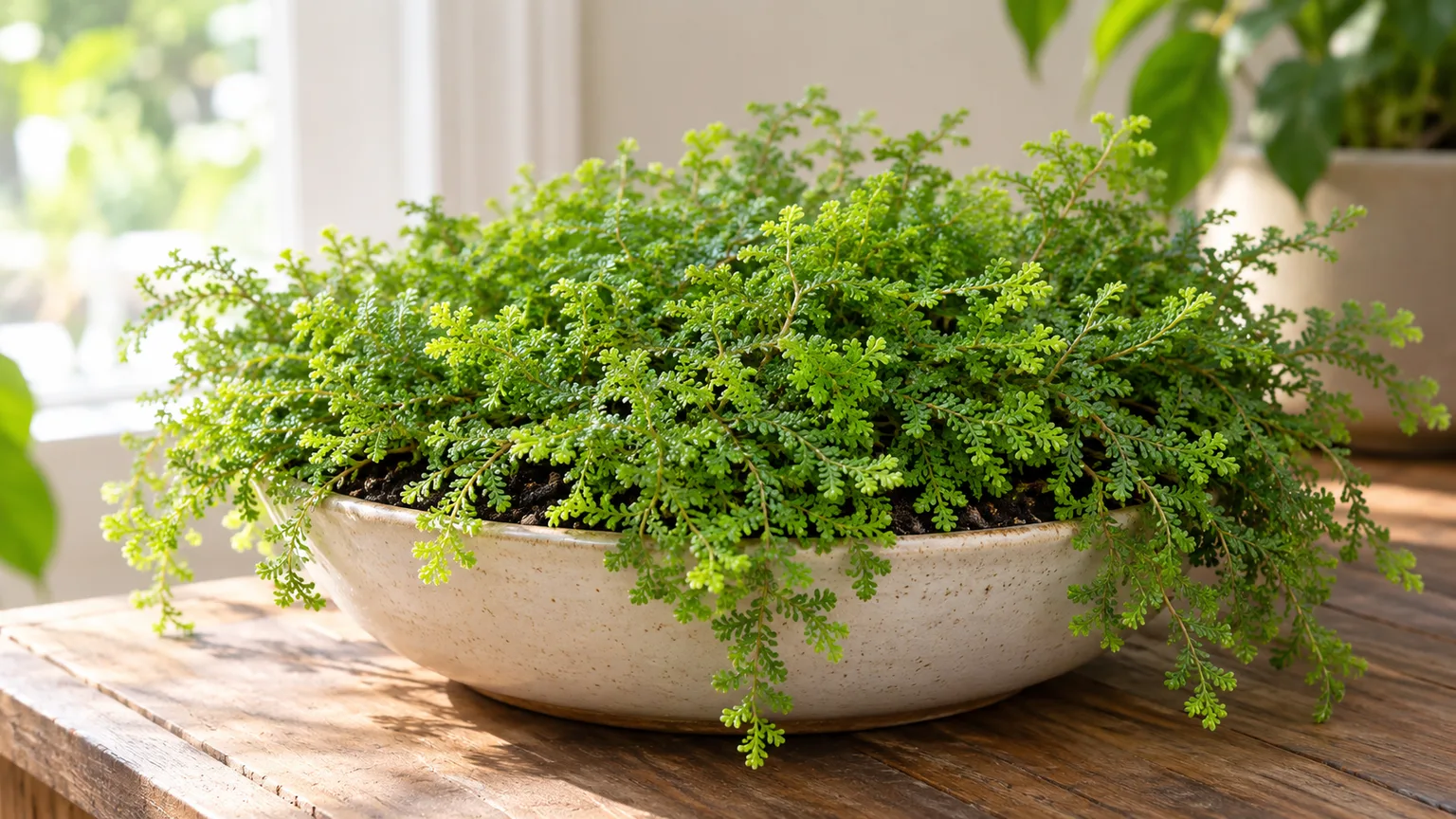
Selaginella kraussiana looks like a miniature fern softened into a mossy green carpet, but it behaves differently from the larger, fronded houseplants its common name suggests. Give it shade, steady moisture, and a root zone that can breathe, and its fine stems will creep into a dense mat; let a small pot dry hard or sit in stale water, and the same delicate foliage can turn brown quickly.
The trick is to manage moisture without stagnation. This guide gives you a simple way to choose its light and container, decide whether a terrarium makes sense, keep the mat within bounds, and propagate it without relying on spores.
| Care need | Practical target |
|---|---|
| Light | Bright indirect light or full to partial shade |
| Water | Keep the mix evenly moist; drain excess water |
| Soil | Humus-rich, moisture-retentive, and airy |
| Humidity | Moderate to high; protect it from dry drafts |
| Temperature | Warm, stable indoor conditions; protect from frost |
| Growth habit | Low, creeping stems that can root as they spread |
| Best starting setup | A shallow pot with drainage, or a carefully monitored terrarium |
What Is Selaginella kraussiana?
Krauss’s clubmoss is an evergreen, mat-forming lycophyte in the family Selaginellaceae. Its slender stems grow along the soil surface and root at branching points, while rows of small scale-like leaves give the plant a ferny texture. In the right conditions, it can form a spreading carpet rather than a single upright clump. The Royal Horticultural Society lists a possible spread of 1 to 1.5 metres outdoors, although a houseplant’s growth depends on pot size, light, and care.
The species grows naturally in moist, shaded places, including stream edges, damp cliffs, and forest margins. That habitat explains why it wants both moisture and protection from harsh sun. A bright room is useful; a dark corner is not the same thing as shade outdoors, because the plant still needs enough indirect light to produce compact, healthy growth. SANBI’s PlantZAfrica species profile describes its creeping, rooting stems and moist-shade habitat, while the RHS profile lists it as a mat-forming plant suited to terrariums.
Why the “frosty fern” label can be confusing
Despite the common names clubmoss and spikemoss, this plant is neither a true moss nor a true fern. It is a vascular plant in the lycophyte lineage, an older branch of the plant family tree. It does not produce flowers; its reproductive structures produce spores. The plant you buy may also be labeled “frosty fern,” especially when it has pale new tips, but the label can refer to more than one Selaginella species.
One common frosty form is S. kraussiana ‘Variegata’; S. martensii is another plant sold under similar names. Check the botanical name on the pot if you want to know exactly which one you have. Several of the species share a preference for shade and moisture, but don’t assume every plant sold as a frosty fern has identical cold tolerance or growth habits. Epic Gardening’s overview of frosty ferns discusses the naming overlap and distinguishes these commonly sold forms; SANBI identifies S. kraussiana among the lycophytes rather than as a fern.
Light: Bright Shade, Not a Dark Corner
Place the plant where daylight is abundant but does not fall directly on it for long stretches. An east- or north-facing window often works; near a brighter south- or west-facing window, move it back from the glass or filter the light with a sheer curtain. If your only window is dim, a grow light can help, set far enough away that the small foliage doesn’t heat up.
Use the color and shape of new growth as your guide. Pale, bleached, or yellowing tips after a move toward a sunny window point to excessive light; long, sparse stems and slow growth suggest the spot may be too dim. The species can tolerate brighter exposure outdoors when the soil stays very wet, but that is not a useful reason to place a potted indoor plant in direct sun: containers heat and dry faster than a shaded forest floor. SANBI notes that stronger light may make foliage yellowish, while its indoor guidance favors good light without direct sun.
Water: Keep the Root Zone Moist, Not Submerged
Check the pot rather than watering by weekday. Touch the mix near the center of the root ball; when the surface begins to lose its damp feel but the deeper mix is still slightly cool and moist, water thoroughly until a little drains from the bottom. Empty the saucer afterward. In a small, warm, or breezy room the plant may need more frequent checks than it does in a cool, humid terrarium, so let the pot—not a calendar—set the interval.
The goal is even moisture, not permanent standing water. A brief dry spell may be tolerated, but repeated full drying can leave the fine foliage brittle and brown. At the other extreme, a saturated mix in a pot with no drainage can deprive roots of air and invite rot. The National Parks Board of Singapore lists both moist and well-drained soils as tolerated conditions, and SANBI notes that the shallow-rooted plant can grow across a range of soil moisture when light and water are balanced.
Water from above slowly enough for the mix to absorb it; if the surface repels water, apply a little, wait, then water again. A dry root ball may shrink from the pot edges, so one quick pour can run down the sides without rewetting the center. If water pools on top or the pot remains heavy for days, pause and improve the drainage or substrate before adding more.
Soil and Container: Moisture With Air Around the Roots
Use a shallow, wide container with drainage holes. The creeping stems and roots don’t need a deep column of soil, and a very large pot holds wet mix around a small root system for longer than necessary. A pot only modestly wider than the existing mat is easier to manage; the plant can spread across the surface as it grows.
Choose a rich but open mix that holds some moisture while letting extra water escape. The RHS recommends a peat-free, loam-based compost with leafmould for growing the plant under glass. At home, a quality peat-free houseplant mix with added leafmould or coir can work; if it packs tightly after watering, blend in a modest amount of fine bark or perlite to keep it airy. Avoid turning the mix into a very coarse, fast-drying succulent blend, and don’t use dense garden soil in a small indoor pot.
A drainage hole is a useful safeguard because you can water thoroughly and remove the excess. A gravel layer at the bottom does not replace a hole or fix compacted soil. If you choose an ornamental cachepot, keep the plant in a draining nursery pot inside it, then pour out water that collects in the outer pot.
Humidity and Temperature
Selaginella’s fine foliage loses water quickly when it sits next to a heater, air conditioner, or cold dry draft. Keep it in a relatively stable room and group it with other plants or use a room humidifier if the air is persistently dry. Misting may wet the leaves briefly, but it does not keep humidity steady for long; treat it as optional, not as the main fix for brown tips.
Warm, sheltered conditions suit an indoor plant. Protect it from cold panes in winter and from sudden temperature swings. The RHS recommends a winter minimum of about 5 to 7°C for plants kept under glass in frost-prone areas, and SANBI advises avoiding frost-exposed outdoor sites unless the plant is protected. That minimum is a survival limit, not a target for a healthy indoor plant: ordinary warm room temperatures are a safer routine.
Terrarium or Open Pot? Choose by Your Room
A terrarium can be useful if your home is dry and you can keep the container out of direct sun. The enclosure slows moisture loss around the foliage, so you may water less often than in an open pot. Start with a small amount of water, watch for persistent heavy condensation or sour-smelling substrate, and vent the container when it stays wet and airless. A closed glass vessel can heat rapidly in sunlight, even when the room itself feels mild.
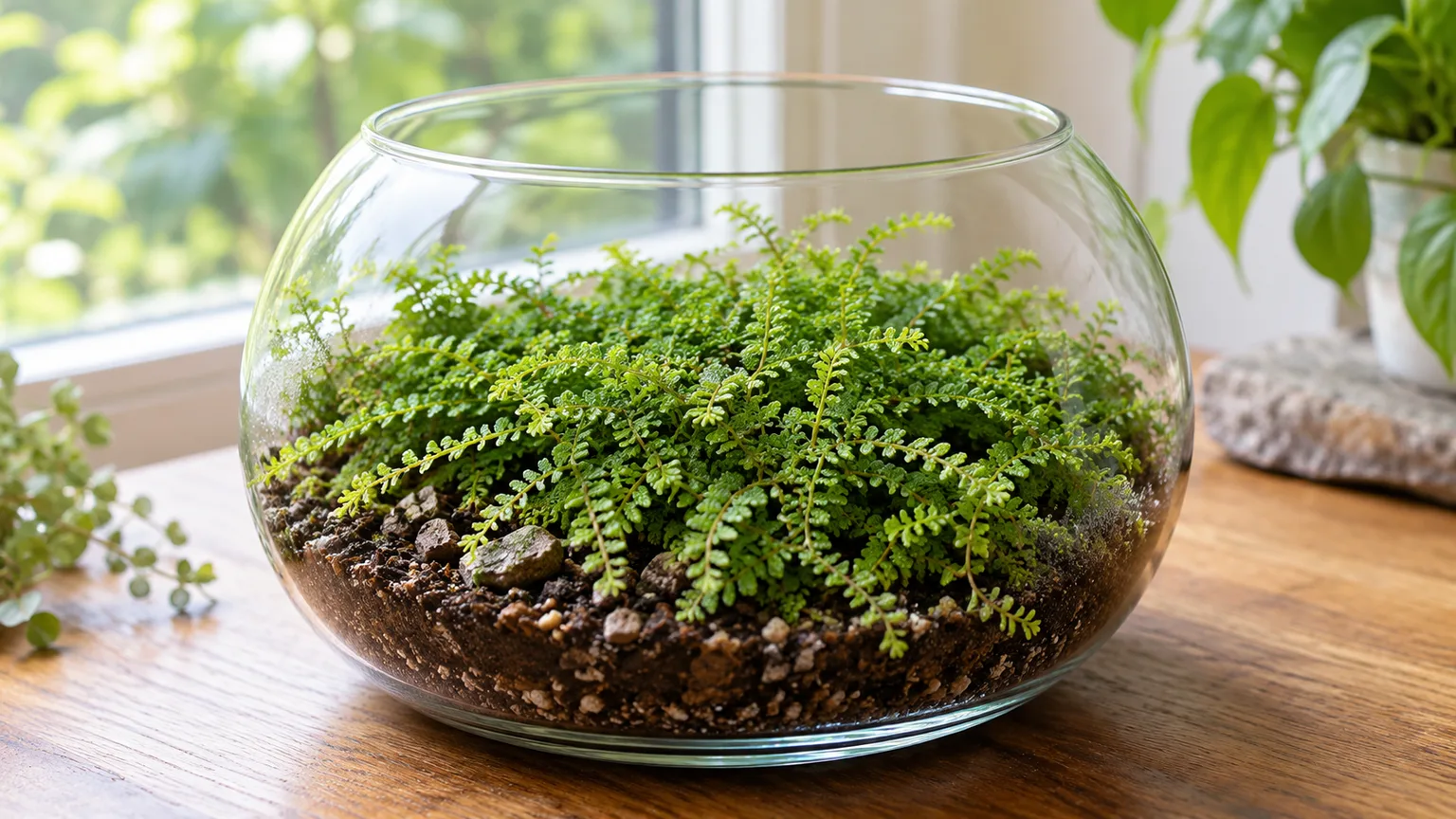
An open pot is easier to inspect and gives you more control over watering, but it exposes the leaves to room humidity and drafts. Choose it if you can check the soil regularly and the plant isn’t crisping between waterings. Choose a lidded or partly covered setup if the plant dries out despite an appropriate mix and a sensible watering routine. If you use a sealed vessel, open it periodically to exchange air and check the soil rather than watering on schedule.
The RHS identifies terrariums and bottle gardens as suitable uses for this species. NParks’ profile also lists terrariums and container planting, while Epic Gardening recommends adding airflow to humid propagation covers. These are options, not requirements: a well-watered open pot can succeed if the room and routine suit it.
Fertilizer: Feed Lightly, If at All
A rich fresh mix may supply enough nutrition for the first growing season. If the mat is growing slowly during spring and summer despite suitable light, moisture, and warmth, use a balanced liquid houseplant fertilizer at a diluted rate. Apply it to already moist soil, and stop feeding during the darker, slower part of the year.
Don’t use more fertilizer to solve yellowing or weak growth until you have checked light, roots, and watering. Excess salts can stress shallow roots and bleach delicate foliage, while root rot and chronic dryness can look like a nutrient problem. This is a low-feeding plant; if it is steadily producing healthy new stems, leave the fertilizer bottle closed. Epic Gardening similarly describes frosty ferns as light feeders and recommends restrained feeding during active growth.
Repotting and Trimming a Creeping Mat
Repot when the mat has filled the container, roots and stems crowd the surface, or the mix has broken down and no longer drains evenly. Spring is a convenient time because the plant can resume growth after the move. Lift the plant carefully from its shallow pot, keep rooted stems intact, and move it into a container only slightly wider than the old one.
You can also trim the edge of the mat to control its shape or remove damaged pieces. Use clean scissors and cut back to healthy green stems; save a sound piece with a rooted node for propagation. Routine pruning is not essential, and cutting the whole plant back at once removes foliage it needs to recover. The RHS lists no pruning as required, so trimming is mainly for shape, dead material, or propagation.
Growing Selaginella kraussiana Outdoors
In a warm, frost-free climate, this plant can cover a shaded patch where the soil stays reliably moist. Give it humus-rich ground beneath taller plants or beside a sheltered water feature, and keep it away from hot afternoon sun. In colder climates, use it as a seasonal container plant or bring it under protection before frost; SANBI specifically cautions against frost-prone outdoor sites unless plants are protected.
Think about its spreading habit before planting it into open ground. The stems root at branch points, and the RHS lists a mature spread of up to 1 to 1.5 metres. Kew’s Plants of the World Online records the species as introduced in many regions outside its native range, including parts of the United States, Australia, and Europe. That does not by itself establish that it is invasive or restricted where you live, but it is a good reason to check local guidance and keep the plant contained if its status is uncertain. Avoid discarding rooted pieces or potting mix into natural areas.
Propagation: Layering Is the Reliable Shortcut
For a home grower, vegetative propagation is simpler than raising spores. The creeping stems naturally form roots where they touch suitable soil, so you can root a runner in place or divide an established mat. Spring or summer, when the plant is actively growing, gives a new piece the best chance to establish before conditions slow down.
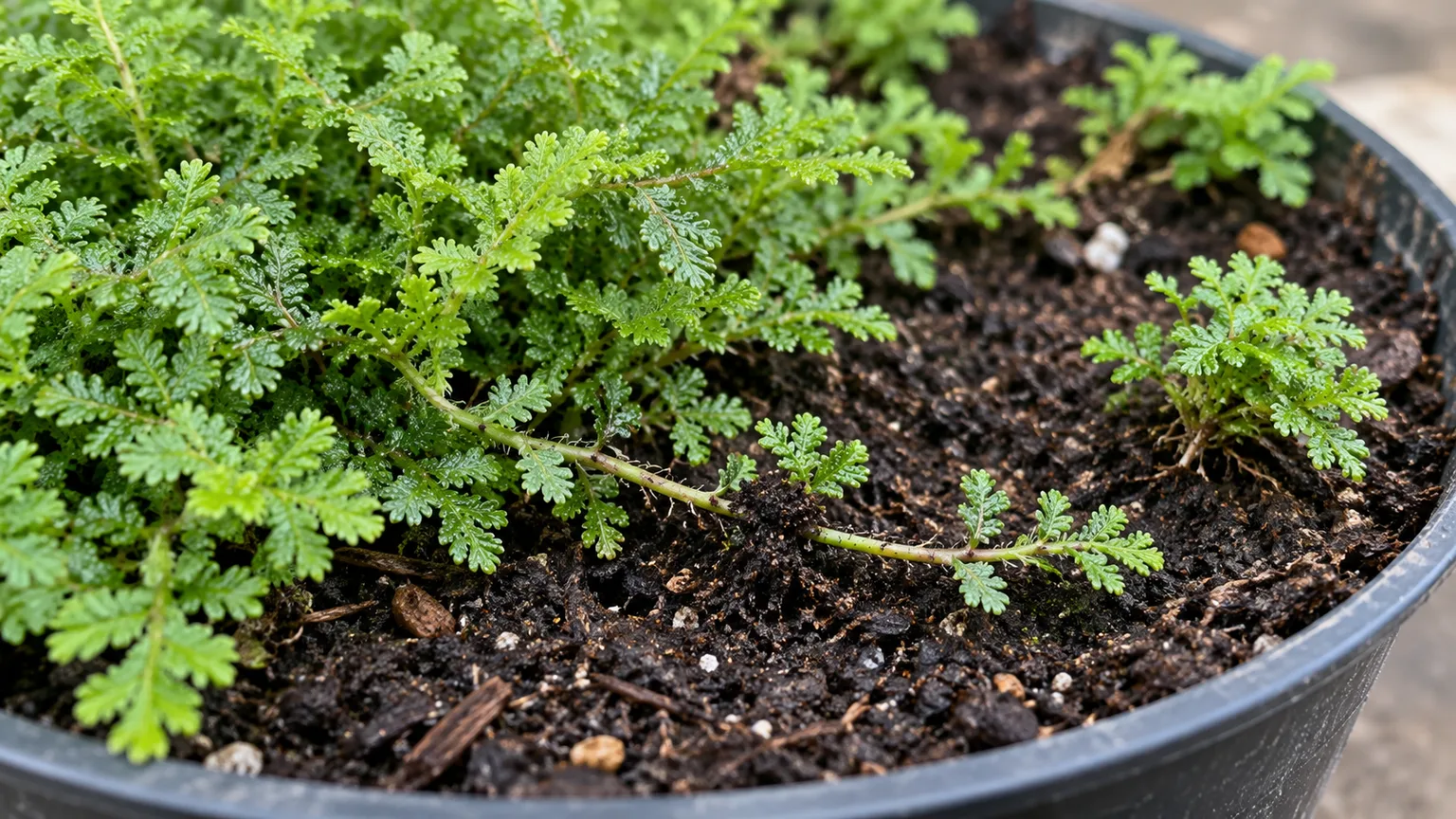
Layer a Stem into a New Pot
Set a small pot of moist mix next to the parent plant. Lay a healthy creeping stem across the new soil so at least one node touches the surface, then hold it lightly in place with a small bent wire or a pinch of mix. Keep both pots evenly moist and in bright indirect light; avoid burying the entire stem, which can trap moisture around its tiny leaves.
After the node has rooted and the new section resists a gentle tug, snip the connection to the parent. If the runner already has roots, you can skip the wait and plant that piece directly. SANBI describes layering and splitting established plants as preferred vegetative methods and notes that stems can be laid on soil and lightly covered while kept moist.
Divide a Mature Mat
Water the parent plant the day before dividing so the shallow root zone is easier to handle. Slide it from the pot and tease or cut the mat into sections, making sure each piece includes healthy foliage and some roots or rooted stems. Set each division at its original depth in a shallow pot, firm the mix gently, and water it in.
Keep new divisions out of direct sun while they adjust, and don’t compensate for transplant stress by leaving them in a waterlogged saucer. A small division may look unchanged for a while as it restores roots; steady moisture and stable light are better signs of care than a burst of fertilizer. If the plant is already sparse or declining, stabilize it first rather than dividing every piece.
Why Spores Are Not the Beginner Route
Selaginella produces spores, but that is not the fastest way to make another houseplant. Spores are tiny and the early growth is less straightforward to manage than a rooted runner or division. For a predictable home result, use a stem that already has roots or let one root into a neighboring pot.
SANBI’s species profile identifies spore-bearing structures and recommends vegetative propagation for cultivation. If you want to experiment with spores, keep the sowing surface consistently moist and protected from drying while still providing light; expect a slower, less certain process than layering. Most growers will get a fuller plant sooner by starting with a healthy piece of the mat.
Troubleshooting: Diagnose the Pot Before Blaming the Air
A browning plant can be too dry, scorched, or struggling with roots that stay wet too long. Check the growing medium first, then look at where the damage begins and whether stems feel firm. Make one change at a time, because increasing water, humidity, and shade all at once can hide the real cause.
Brown or Crispy Tips
If the soil is dry and the stems are still firm, water thoroughly and move the plant away from hot sun or a heating vent. Crispy edges often point to a dry root ball or dry air, particularly when the problem starts at the tips and the pot feels light. Improve the plant’s environment after rewetting the soil; watering more often cannot compensate for direct sun or warm drafts indefinitely.
If only the tips are brown but the rest of the mat remains green, trim off dead ends with clean scissors and watch the next growth. If entire sections have become brittle, those leaves may not turn green again. Preserve any flexible, green stems that have rooted at nodes, because they may continue to grow even after damaged tips are removed.
Yellowing, Soft Stems, or Collapse
Yellowing can follow too much direct light, but yellow foliage together with soft stems and persistently wet mix points more strongly to root trouble. Slide the plant partly out of its pot and check the roots and stem bases: healthy tissue should be firm, while rotten tissue is dark, mushy, or foul-smelling. If rot is limited, remove damaged material and repot the remaining healthy mat into fresh, open mix in a clean pot.
If the soil is not wet and stems are dry and limp, the plant may have dried too far. Rehydrate the pot slowly and raise humidity while it recovers, but don’t promise that crispy foliage will recover. If the entire mat is brown and brittle, check for living green nodes or roots before deciding whether any portion is worth saving. SANBI notes brief tolerance of slightly dry conditions, not immunity to prolonged drought.
Check for Pests Without Soaking the Plant
Inspect new plants and the undersides of the mat for fine webbing, small moving specks, or cottony clusters. Spider mites and mealybugs are reported on frosty ferns, and a dense creeping plant can hide pests close to the soil. Isolate an affected pot, remove badly damaged material, and rinse the foliage gently where practical; avoid blasting the delicate mat hard enough to uproot it.
Recheck every few days because one rinse may not reach insects tucked under overlapping stems. If you choose a treatment, confirm it is labeled for the plant and pest, then test a small section before treating the entire mat. Good light, steady moisture, and airflow help the plant stay resilient, but they do not replace inspection.
Conclusion
Selaginella kraussiana is a good choice if you enjoy a small, spreading plant and can keep its shallow root zone consistently moist. Give it bright indirect light, a rich but airy mix, and either stable room humidity or a carefully monitored terrarium; keep it out of hot sun, drafts, frost, and standing water.
Start with a shallow draining pot and check the soil whenever the surface begins to lose moisture. Once the plant settles in, let a creeping stem root into a neighboring pot or divide the mat when it fills its container. That routine gives you the lush, miniature groundcover look without turning moisture-loving into waterlogged.