Brinjal Care Guide for Pots and Gardens
Solanum melongena
Grow brinjal in full sun, fertile well-drained soil, and steady moisture. Learn how cultivar size changes container, support, and harvest needs.
Brinjal Care Guide for Pots and Gardens
Start with wateringThe most common care mistake for BrinjalWatering guide → →Brinjal care essentials
Light
Water
Keep the root zone evenly moist while flowering and fruiting, but never waterlogged. Water deeply when the upper 2–3 cm feels dry; containers may need daily checks in hot weather.
Soil
Fertile, moisture-retentive but well-drained loam or container mix. A mildly acidic pH of 5.5–6.8 suits brinjal.
Humidity
Temperature
Fertilizer
About Brinjal
Brinjal is native to Tropical Asia, from south-central China through mainland Southeast Asia, typically reaches Usually 60–120 cm tall and 30–90 cm wide; compact and vigorous cultivars vary indoors, with medium - commonly reaches harvest in about 105–133 days from seed growth. Brinjal has a herbaceous growth habit and part of the Solanaceae family. It is also known as Eggplant, Aubergine, Baingan, and Begun.
| Detail | Information |
|---|---|
| Also known as | Eggplant, Aubergine, Baingan, Begun |
| Native region | Tropical Asia, from south-central China through mainland Southeast Asia |
| Mature size | Usually 60–120 cm tall and 30–90 cm wide; compact and vigorous cultivars vary |
| Growth rate | Medium - commonly reaches harvest in about 105–133 days from seed |
| Growth habit | Herbaceous |
| Scientific name | Solanum melongena |
| Family | Solanaceae |
Brinjal Care Guide for Pots and Gardens
Brinjal is a sun-loving food crop, not a foliage plant that merely tolerates a bright balcony. To crop well, it needs direct light, warm roots, steady moisture, fertile but draining soil, and enough space and support for the cultivar you chose. The first useful step is therefore to read the seed packet or nursery label: a compact, small-fruited plant and a vigorous, heavy-fruited hybrid should not be given identical pots or staking.
In India, brinjal can be productive in a sunny terrace pot, a courtyard container, a raised bed or open ground. Success comes from matching care to the plant’s stage and the weather rather than following a fixed watering or feeding calendar. This overview explains the complete growing system; use the linked topic guides when you need a deeper diagnosis or step-by-step method.
Know the plant you are growing
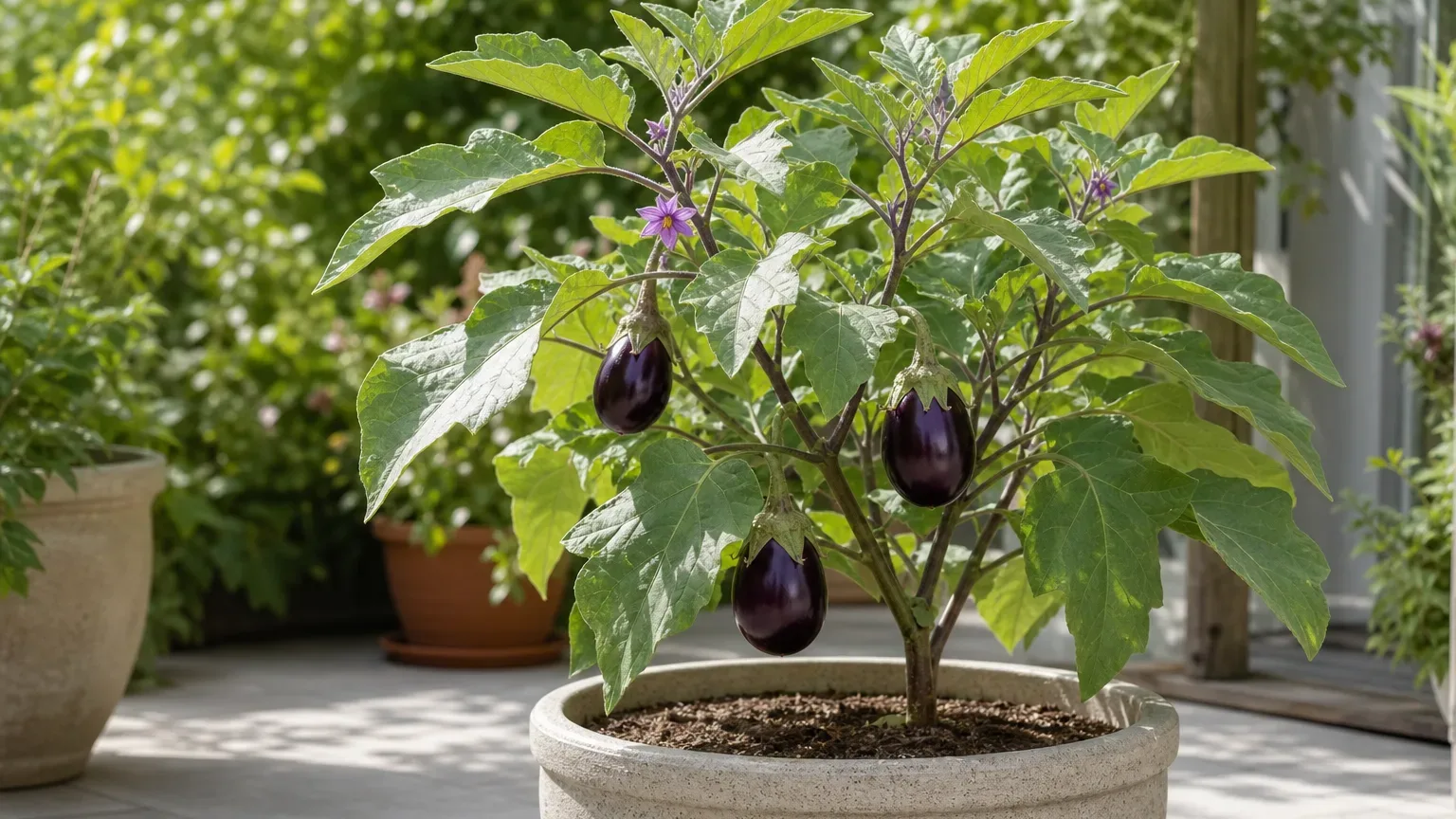
Brinjal, eggplant, aubergine and baingan are common names for Solanum melongena, a member of the nightshade family, Solanaceae. It forms a branching, often slightly prickly plant with violet or white-tinged flowers and fleshy fruits that botanically are berries. The NC State Extension profile describes plants about 60–120 cm tall and 30–90 cm wide, but that range is a starting point rather than a promise for every cultivar.
The crop is grown for immature culinary fruit. Its flowers are generally self-fertile, yet movement from wind or visiting insects helps release pollen; a sheltered balcony plant may benefit from a gentle shake of the flowering branch. Heat, cold, water stress and excessive leafy growth can all reduce fruit set, so a fallen flower is a symptom to investigate rather than proof that pollination alone failed.
Annual crop or short-lived perennial?
Solanum melongena is an annual or short-lived perennial according to climate. It is commonly managed as a one-season crop, while frost-free tropical conditions can let a healthy plant persist longer; the RHS species profile likewise distinguishes its perennial nature from annual cultivation in cold climates. Keeping an old plant is not automatically better, because pest pressure, woody growth and declining vigour can make a fresh seedling more productive.
For most home growers, plan around one main cropping cycle and judge extension only from plant health. Replace a plant that carries persistent disease or heavy borer damage rather than nursing it into another season. In a warm, clean, protected space, continued growth can be worthwhile if new shoots remain vigorous.
Size depends on the cultivar
Brinjal cultivars vary in height, branching, days to maturity and fruit load. Compact types suit restricted balconies, while vigorous field hybrids need more root room and stronger stakes; one named cultivar, ‘Bonica’, is described by the RHS cultivar profile as reaching about 1.2 m and carrying large glossy fruit. Do not use a dwarf plant’s container recommendation for a tall hybrid simply because both labels say brinjal.
Choose for your actual space and cuisine. A small-fruited cultivar may carry more individual fruits and distribute their weight across branches, whereas a large oval type may need ties beneath a few heavy fruits. Days-to-maturity figures are comparisons under the supplier’s conditions, not exact countdowns for a shaded balcony or a monsoon planting.
Fruit size, shape and colour are not care labels
Brinjal fruit may be round, oval, egg-shaped or long, and white, green, striped, pink-purple or nearly black. Penn State Extension’s cultivar comparison lists container-suitable miniature, oval and globe cultivars with markedly different colours and maturity times. Purple colour therefore does not indicate that a fruit is ripe, nor does a white or green cultivar need to “turn purple.”
Use the cultivar description to set expectations for mature fruit size. It also tells you whether the plant needs a broad pot, early staking and frequent picking. If the label has been lost, watch how the first fruits develop and harvest while they are glossy and firm rather than waiting for supermarket dimensions.
Brinjal quick care summary
Give brinjal at least six hours of direct sun, with more light usually improving sturdy growth and flowering where heat and moisture are managed. Use fertile, well-drained soil; keep the root zone evenly moist during flowering and fruit filling, but never leave a container standing in runoff. Stake early, feed in measured amounts, inspect tender shoots and leaf undersides, and pick fruit before the skin turns dull.
Warmth matters as much as the checklist. Brinjal grows poorly in cool conditions and is damaged by frost; Utah State University Extension advises waiting until soil has warmed and frost danger has passed because eggplant is very sensitive to cool temperatures. In tropical and subtropical India, the practical equivalent is choosing a warm growing window without forcing tender transplants through cold nights, severe waterlogging or the harshest exposed terrace heat.
Light: give it productive sun
Place the plant where it receives direct morning and midday light, not behind permanently shaded glass or a dense balcony screen. Full sun means six or more hours of direct light in the NC State light definition, and weak light commonly produces stretched stems, broad soft growth and few flowers. Rotate pots only if one side is heavily shaded; do not keep moving a fruiting plant between radically different exposures.
Very hot reflected afternoon light can overheat a pot even though the species likes sun. Keep the root ball moist, shade the container itself, and use temporary light shade only if leaves repeatedly scorch or fruit is exposed after foliage loss. See the Brinjal light guide for positioning, heat management and low-light warning signs.
Water: steady moisture without stagnant roots
Water deeply enough to wet the working root zone, then wait until the upper 2–3 cm begins to dry before watering again. A pot may need daily checking in hot, windy weather, while the same mix can remain wet much longer during cloudy monsoon humidity. Penn State Extension notes that hot-season vegetable containers may need at least daily watering, but checking the soil is safer than converting that observation into a fixed daily dose.
Uneven moisture during flowering and fruit filling can contribute to wilt, flower loss and poor fruit quality; prolonged saturation limits root aeration and invites decline. Water at the soil surface, empty saucers after drainage, and mulch garden beds once the soil is warm while keeping mulch away from the stem. Follow the Brinjal watering guide when the plant wilts despite wet soil or when you need to adjust for pot material and season.
Soil and feeding: fertile, airy and balanced
Brinjal performs in fertile loam or a quality vegetable potting mix that retains useful moisture while draining freely. Published pH recommendations differ by production context: NC State gives 5.5–6.8, while Tamil Nadu Agricultural University recommends organic-rich, well-drained soil at pH 6.5–7.5. For a home grower, structure, drainage and a soil test matter more than trying to force a healthy near-neutral soil to one exact number.
In a container, start with potting mix rather than dense garden soil and add mature compost without turning the pot into a heavy, airless bucket. Feed according to product directions or a soil test, and avoid repeatedly adding high-nitrogen fertilizer to a dark green plant that is making leaves but few flowers. The Brinjal soil guide covers mixes and pH; the fertilizer guide covers timing and excess-growth symptoms.
Growing brinjal in pots
Use one plant per container with unobstructed drainage holes. A compact cultivar can start with a pot around 30–35 cm wide, while a vigorous or large-fruited plant is easier to keep stable in a wider, deeper container with more mix. Penn State’s container guidance says peppers and eggplants can thrive in a 14-inch pot; treat that as a compact minimum, not the ideal ceiling for every Indian hybrid.
Set the final pot where sun, watering and harvesting are easy before it becomes heavy. Light plastic conserves moisture but can topple; terracotta dries faster; a broad heavy pot resists wind but may heat strongly on concrete. Move seedlings up without repeatedly oversizing them, as detailed in the Brinjal repotting guide, and insert the main stake early so it does not spear a mature root system.
Growing brinjal in garden beds
Choose a sunny bed that does not remain waterlogged after monsoon rain. Incorporate mature compost, correct only deficiencies shown by a soil test, and leave enough room for air movement and access to harvest. Cultivation recommendations vary by cultivar and system; spacing should come from the seed supplier, with extra room for broad, vigorous plants.
Avoid following tomato, chilli, potato or brinjal in the same small bed when rotation is possible because these nightshades share several soil-borne diseases and pests. Mulch after the soil has warmed, irrigate the root zone rather than wetting foliage late in the day, and remove severely infested shoots or fallen fruit. Garden soil buffers heat and drying better than a pot, but poor drainage is harder to correct once monsoon rain begins.
Flowers, support and fruit load
Stake the main stem while the plant is young, then add soft ties to fruiting branches as needed. Large-fruited cultivars may need each loaded side branch supported; compact small-fruited cultivars often need less structure but can still split in wind. Check ties weekly so they do not constrict expanding stems.
If flowers drop, assess the whole plant: new growth quality, night temperatures, root moisture, feeding and pest activity. A lush plant with few flowers may have too much nitrogen or too little sun; a wilted plant in dry mix needs water; a wilted plant in persistently wet mix needs a root-zone check. Avoid responding to every dropped flower with another fertilizer dose.
Harvest by maturity, not colour
Pick when the fruit has reached the expected cultivar size, the skin remains glossy, and the flesh feels firm with slight resilience. Utah State advises cutting glossy, fully coloured fruit with a knife or pruners rather than twisting it, and notes that over-mature fruit becomes dull, soft, seedy and bitter. Use gloves if your cultivar has prickles on the calyx or stems.
Frequent harvest redirects the plant away from ageing seed-filled fruit and makes branch loads easier to manage. Never wait for a white, green or striped cultivar to resemble a purple market brinjal. The seed supplier’s shape and size description, plus gloss and firmness, are the reliable combined test.
Seasonal care in Indian conditions
Local sowing windows differ because “India” includes cool northern winters, humid coasts, high-elevation areas and severe summer interiors. TNAU lists December–January and May–June sowing windows for one Tamil Nadu production context, but your local agricultural university or seed label should take priority. On a terrace, also account for reflected heat and hot wind that field schedules do not capture.
During pre-monsoon heat, check pots early and again late in the day without automatically watering wet soil. During monsoon, protect drainage holes, raise pots off flat floors and reduce watering as drying slows. In cool months, delay transplanting if growth stalls at night; cold-stressed seedlings do not become productive merely because daytime sun feels warm.
Common mistakes and warning signs
The most common system errors are too little direct sun, a pot that is too small for the cultivar, dense soil, calendar watering, excessive nitrogen and late staking. Pale stretched growth points toward inadequate light or nutrition; dark leafy growth without flowers points first toward shade or nitrogen excess. Yellow lower leaves in persistently wet mix, a soft stem base or wilt in damp soil require a drainage and root check, not more water.
Inspect leaf undersides and tender shoots for aphids, whiteflies, mites and eggs, and watch for chewed holes from beetles. In South Asia, dead shoot tips or bored fruit can indicate brinjal fruit and shoot borer; remove affected material promptly and use local integrated-pest guidance rather than repeated broad-spectrum spraying. The plant hub’s complete Brinjal profile helps you compare a symptom with the cultivar’s normal habit.
Brinjal toxicity: edible fruit does not mean an edible plant
The harvested fruit is the familiar food portion, but that does not make the whole growing plant edible or pet-safe. NC State identifies flowers, leaves, roots and stems as poisonous parts containing alkaloids including solanine. Keep pets and young children from chewing the plant, and collect prunings instead of leaving them accessible.
This is a practical separation, not a reason to fear normal cultivation or properly prepared fruit. Do not use foliage as animal forage, and do not improvise home treatment after ingestion. Contact an appropriate veterinarian or medical professional for case-specific advice.
When to use this page vs other Brinjal guides
Use this overview to understand how light, roots, cultivar size, support and season work together. For one decision, go directly to light, watering, soil, fertilizer, repotting or propagation. The topic pages provide more diagnostic detail than a general overview can.
Use the Brinjal pruning guide when you need to remove damaged shoots, manage branching or decide what not to cut. Pruning cannot compensate for a small pot, low light or unhealthy roots, so correct the growing system before reshaping the plant.
Related Brinjal guides
- Brinjal light — choose a position and distinguish shade stretch from heat stress.
- Brinjal watering — adjust checks for pots, beds, heat and monsoon humidity.
- Brinjal soil — build a fertile mix that holds moisture without stagnation.
- Brinjal fertilizer — feed fruiting growth without producing leaves at the crop’s expense.
- Brinjal repotting — move a seedling into a cultivar-sized final container.
- Brinjal propagation — raise healthy plants from seed.
Conclusion
Good brinjal care begins with the cultivar, not a generic picture of a large purple fruit. Give the plant strong direct sun, warm conditions, a well-drained fertile root zone, steady moisture and support scaled to its eventual fruit load. In pots, increase root volume and monitoring for vigorous cultivars; in beds, prioritise drainage, rotation and access.
Watch the plant rather than the calendar. Glossy firm fruit, sturdy new growth and a root zone that moves from evenly moist toward slightly dry are useful signals; dull over-mature fruit, persistent wet-soil wilt and soft stretched growth are prompts to act. With those checks in place, a sunny Indian balcony or garden can support a productive brinjal crop without pretending every cultivar behaves the same way.
How to care for Brinjal?
When should you water Brinjal?
Keep the root zone evenly moist while flowering and fruiting, but never waterlogged. Water deeply when the upper 2–3 cm feels dry; containers may need daily checks in hot weather.
- Test the upper 2–3 cm and lift containers - Water deeply when the upper 2–3 cm feels dry; containers may need daily checks in hot weather.
- water when the surface is dry and the pot feels lighter - Water deeply when the upper 2–3 cm feels dry; containers may need daily checks in hot weather.
- Drain excess water - Keep the root zone evenly moist while flowering and fruiting, but never waterlogged.
What soil works best for Brinjal?
Fertile, moisture-retentive but well-drained loam or container mix. A mildly acidic pH of 5.5–6.8 suits brinjal.
- 50% quality potting mix or loam - Fertile, moisture-retentive but well-drained loam or container mix.
- 30% mature compost
- 20% perlite, coarse sand, or fine bark - Fertile, moisture-retentive but well-drained loam or container mix.
Grower notes for Brinjal
Choose the cultivar before the container
Brinjal cultivars are not interchangeable. Compact types can finish near 60 cm and suit a large patio pot, while vigorous plants may reach 1.2 m or more and need extra root space and support. Fruit can be round, oval, or long, with white, green, striped, pink, or deep purple skin. Match the container, staking, and expected fruit count to the cultivar label rather than assuming every brinjal behaves like a large purple market type.
Heat and sun drive the harvest
Give Brinjal at least six hours of direct sun in a warm, sheltered position. Growth is strongest around 21–29°C, and cold roots or cool nights can stall a young plant. Transplant only after chilly weather has passed. In very hot Indian summers, keep moisture steady and protect the pot from reflected afternoon heat if leaves repeatedly scorch or wilt despite a moist root ball.
Keep moisture steady, not soggy
Uneven moisture during flowering and fruit filling can reduce the crop, while saturated soil deprives roots of air. Check the upper 2–3 cm instead of watering by a fixed calendar. A fruiting container may need water every day in hot, windy weather, but the same pot can remain wet much longer during monsoon humidity or a cloudy spell. Mulch outdoor beds to slow moisture loss without burying the stem.
Support depends on fruit size
Stake the main stem early so roots are not disturbed later. Large, heavy-fruited cultivars often need side branches tied as fruits develop; compact or small-fruited cultivars may need less support and can carry more fruit. Check ties regularly and harvest while the skin is glossy, before fruit becomes dull, seedy, and bitter.
Inspect every new leaf and shoot
Check leaf undersides and tender growth for flea beetles, aphids, whiteflies, mites, and eggs. In South Asia, brinjal fruit and shoot borer can tunnel into shoots and fruit, so remove damaged material promptly rather than relying on repeated broad-spectrum sprays. Rotate beds away from tomato, chilli, potato, and other nightshades to reduce carry-over of shared soil-borne problems.
Keep pets away from foliage
The cooked fruit is the familiar food crop, but that does not make the whole plant pet-safe. Leaves, stems, flowers, and roots contain toxic alkaloids including solanine; NC State Extension flags Brinjal as a problem for cats, dogs, and horses. Place pots where animals cannot browse them, collect prunings, and contact a veterinarian if a pet chews the plant.
Is Brinjal safe for pets?
Keep cats, dogs, horses, and other pets away from Brinjal foliage. NC State Extension identifies the leaves, flowers, stems, and roots as poisonous; the cultivated fruit is the edible portion used as food.
Brinjal is not wholly edible. Leaves, flowers, stems, and roots contain toxic alkaloids including solanine and should not be eaten. NC State Extension flags Solanum melongena as a problem for cats, dogs, and horses. Keep pets away from the growing plant even though its harvested fruit is a familiar cooked vegetable.
Watering Brinjal
For Brinjal, test the upper 2–3 cm and lift containers; water when the surface is dry and the pot feels lighter and water check every 1–2 days in hot weather; water when the upper 2–3 cm dries. Increase as heat and fruit load rise; reduce during cool or cloudy periods.
| Detail | Information |
|---|---|
| How often | Check every 1–2 days in hot weather; water when the upper 2–3 cm dries |
| How to check | Test the upper 2–3 cm and lift containers; water when the surface is dry and the pot feels lighter |
| Seasonal changes | Increase as heat and fruit load rise; reduce during cool or cloudy periods |
Signs of overwatering
- yellowing lower leaves while soil stays wet
- soft or darkened stem base
- wilting in persistently damp soil
Signs of underwatering
- midday wilt that persists into evening
- flower or young fruit drop
- dry soil pulling from the pot edge
Soil & potting for Brinjal
Use a mix of 50% quality potting mix or loam, 30% mature compost, 20% perlite, coarse sand, or fine bark for Brinjal. Good drainage with steady moisture; avoid both standing water and repeated drought. Target soil pH around 5.5–6.8. Repot pot seedlings on as roots fill each container, then move to a final pot at least 30 cm wide, ideally in warm growing season, after cold nights have passed.
| Detail | Information |
|---|---|
| Recommended mix | 50% quality potting mix or loam, 30% mature compost, 20% perlite, coarse sand, or fine bark |
| Drainage | Good drainage with steady moisture; avoid both standing water and repeated drought |
| Soil pH | 5.5–6.8 |
| Repotting frequency | Pot seedlings on as roots fill each container, then move to a final pot at least 30 cm wide |
| Best season to repot | Warm growing season, after cold nights have passed |
Signs it needs repotting
- roots circling the pot or emerging from drainage holes
- seedling growth stalls between waterings
- the plant becomes top-heavy before fruit set
Humidity & temperature for Brinjal
Fertilizer & pruning for Brinjal
Common problems on Brinjal
Yellow Leaves
MediumLikely cause: Common on this plant type; confirm with recent watering, light, and root checks.
Quick fix: Inspect the plant and correct the most likely care stressor before stacking treatments.
Full fix guide →Brown Tips
MediumLikely cause: Common on this plant type; confirm with recent watering, light, and root checks.
Quick fix: Inspect the plant and correct the most likely care stressor before stacking treatments.
Full fix guide →Root Rot
MediumLikely cause: Common on this plant type; confirm with recent watering, light, and root checks.
Quick fix: Inspect the plant and correct the most likely care stressor before stacking treatments.
Full fix guide →Overwatering
MediumLikely cause: Common on this plant type; confirm with recent watering, light, and root checks.
Quick fix: Inspect the plant and correct the most likely care stressor before stacking treatments.
Full fix guide →Underwatering
MediumLikely cause: Common on this plant type; confirm with recent watering, light, and root checks.
Quick fix: Inspect the plant and correct the most likely care stressor before stacking treatments.
Full fix guide →Spider Mites
MediumLikely cause: Common on this plant type; confirm with recent watering, light, and root checks.
Quick fix: Inspect the plant and correct the most likely care stressor before stacking treatments.
Full fix guide →Mealybugs
MediumLikely cause: Common on this plant type; confirm with recent watering, light, and root checks.
Quick fix: Inspect the plant and correct the most likely care stressor before stacking treatments.
Full fix guide →Aphids
MediumLikely cause: Common on this plant type; confirm with recent watering, light, and root checks.
Quick fix: Inspect the plant and correct the most likely care stressor before stacking treatments.
Full fix guide →Leggy Growth
MediumLikely cause: Common on this plant type; confirm with recent watering, light, and root checks.
Quick fix: Inspect the plant and correct the most likely care stressor before stacking treatments.
Full fix guide →Slow Growth
MediumLikely cause: Common on this plant type; confirm with recent watering, light, and root checks.
Quick fix: Inspect the plant and correct the most likely care stressor before stacking treatments.
Full fix guide →Wilting
MediumLikely cause: Common on this plant type; confirm with recent watering, light, and root checks.
Quick fix: Inspect the plant and correct the most likely care stressor before stacking treatments.
Full fix guide →Drooping Leaves
MediumLikely cause: Common on this plant type; confirm with recent watering, light, and root checks.
Quick fix: Inspect the plant and correct the most likely care stressor before stacking treatments.
Full fix guide →Low Humidity
MediumLikely cause: Common on this plant type; confirm with recent watering, light, and root checks.
Quick fix: Inspect the plant and correct the most likely care stressor before stacking treatments.
Full fix guide →Not Enough Light
MediumLikely cause: Common on this plant type; confirm with recent watering, light, and root checks.
Quick fix: Inspect the plant and correct the most likely care stressor before stacking treatments.
Full fix guide →Fungus Gnats
MediumLikely cause: Common on this plant type; confirm with recent watering, light, and root checks.
Quick fix: Inspect the plant and correct the most likely care stressor before stacking treatments.
Full fix guide →Mold on Soil
MediumLikely cause: Common on this plant type; confirm with recent watering, light, and root checks.
Quick fix: Inspect the plant and correct the most likely care stressor before stacking treatments.
Full fix guide →