How to Grow Eggplant in Beds, Pots, and Short Seasons
Learn how to grow eggplant from seed or transplants, time planting by soil warmth, choose a pot or bed, keep flowers setting, and pick fruit at peak gloss.
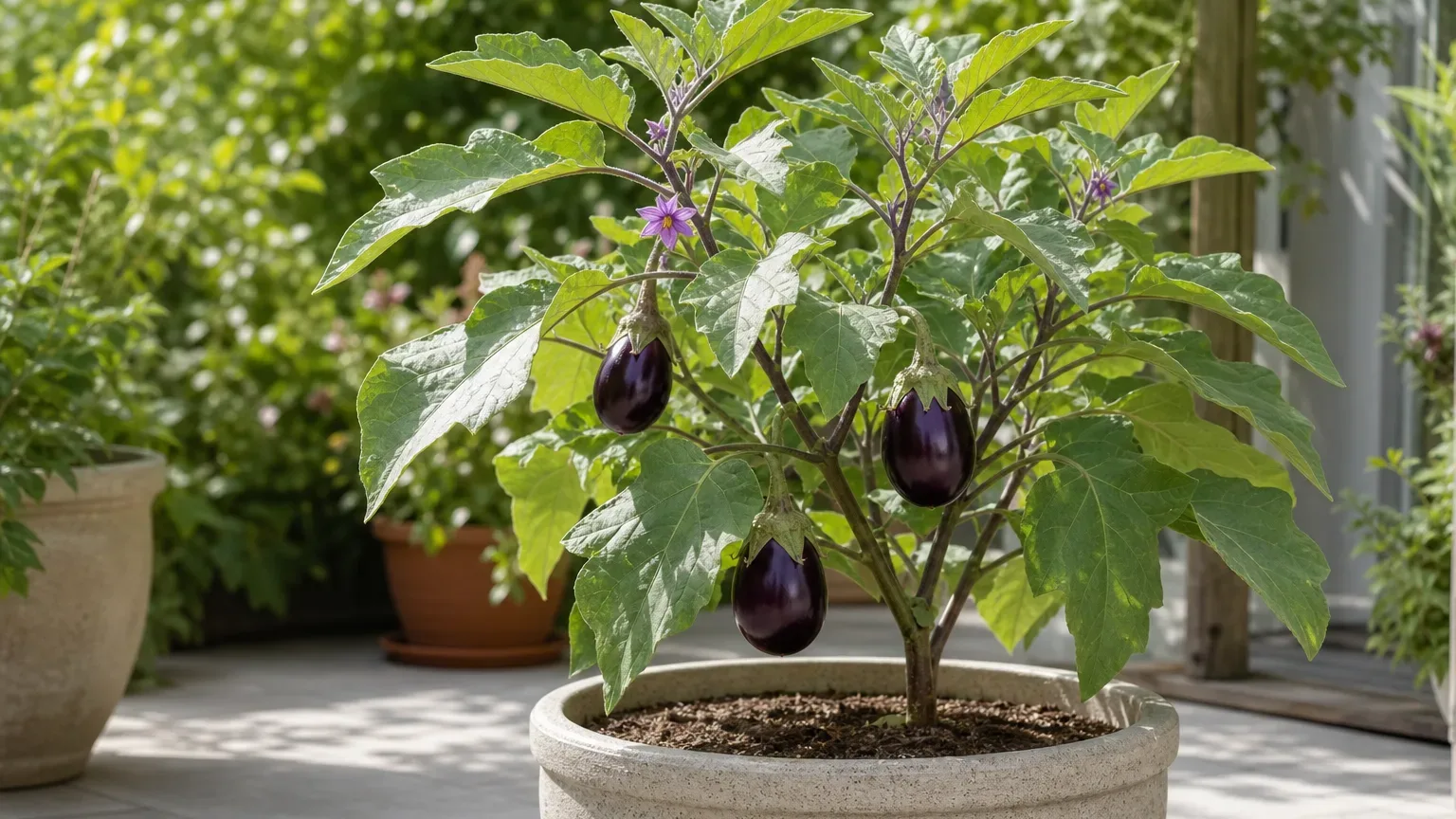
Eggplant rewards patient growers with fruit that is tender, mild, and far more varied than the familiar dark-purple globe at the grocery store. Its main requirement is not a complicated pruning routine or a special fertilizer; it is a long stretch of warm weather, a sunny position, and steady moisture from flowering through harvest.
That makes timing the first useful decision. Start seeds indoors or buy a transplant, then wait until frost risk has passed and the soil has warmed before planting outside. Give the plant enough root room, support it before fruit makes the branches heavy, and pick each eggplant while its skin is glossy and its size matches the variety.
Start with heat and frost timing
Eggplant is a warm-season crop. Cold soil slows root growth, and frost can kill plants, so the calendar date alone is a poor signal for setting seedlings outdoors. A south-facing bed, raised bed, or container may warm earlier than heavy ground soil, but the plant still needs a settled forecast and a warm root zone.
Extension recommendations show why growers should use local conditions rather than one universal cutoff. Utah State University Extension advises transplanting after frost danger has passed or when soil reaches about 60°F, while University of Georgia Extension recommends waiting for soil around 65–70°F and consistently warm weather. Texas A&M AgriLife likewise advises planting after frost danger when daytime temperatures are at least 65°F. These are regional guides, not contradictory guarantees: aim for warm soil, no frost in the forecast, and a stretch of mild-to-warm days before planting. (Utah State University Extension, University of Georgia Extension, Texas A&M AgriLife Extension)
If you have a short growing season, favor an early cultivar and use transplants rather than waiting for outdoor-sown seed to catch up. In a long, reliably hot season, you can plant later and still get a useful crop; in a cool coastal or mountain garden, a warm raised bed or movable pot can add helpful heat. Row cover can protect a young transplant during a brief cool spell, but remove it or open it for ventilation as weather warms and flowers need access to pollinators.
Seed or transplant?
Starting your own seed gives you access to more varieties and lets you time plants for your frost-free window. A nursery transplant is the simpler choice if you need only a few plants or do not have a warm, bright indoor seed-starting setup. In either case, check the cultivar’s days-to-maturity information; the number is usually an estimate from transplanting, and cool weather can push harvest later.
Direct sowing outdoors is usually worthwhile only where the season is long and warm from the start. In most temperate gardens, eggplant grows slowly when its roots are cold, so indoor-started seedlings or store-bought transplants make better use of the season. If you buy a plant, choose a compact, sturdy one with healthy leaves rather than the tallest seedling on the bench.
Choose a sunny, warm site
Give eggplant the sunniest part of the garden, ideally with eight or more hours of direct light. University of Georgia Extension recommends eight to ten hours of sun and well-drained soil. A warm wall or patio can help in a cool climate, but avoid crowding the plant against a wall where still air, reflected heat, or poor access makes routine inspection difficult.
The bed should drain freely and hold enough organic matter to stay evenly moist. A soil test is more useful than guessing at lime or fertilizer: University of Georgia Extension lists a preferred pH around 6.0–7.0, while Texas A&M AgriLife gives a broader 5.5–7.2 range. That overlap is a practical near-neutral target, but follow your local test recommendations rather than trying to force a precise number. Mix in mature compost if the soil is poor, and avoid fresh manure or a heavy dose of fertilizer directly in the planting hole.
Where possible, rotate eggplant away from last year’s tomatoes, potatoes, and peppers. These plants are in the same nightshade family and can share soilborne disease pressure. Rotation is especially valuable if a bed has had unexplained wilt or root disease; when space is limited, a large container filled with fresh potting mix avoids reusing the same garden soil.
Pick a variety for your space and season
Choose a variety by plant size, days to maturity, and the type of fruit you will actually use. Standard globe eggplants can become broad, heavy plants that need a stake or cage, while slender Asian types and compact cultivars may fit a small bed or patio more comfortably. Do not judge ripeness by grocery-store size: a miniature variety may be ready at a few inches, while an elongated type can be tender when much longer.
For pots or a balcony, look for words such as compact, dwarf, patio, or container on the seed packet. ‘Patio Baby’ and ‘Fairy Tale’ are compact choices discussed by Savvy Gardening; ‘Hansel’ and ‘Gretel’ are other small-fruited options commonly sold for limited spaces. For a short season, compare days to maturity and choose an early variety rather than assuming a familiar large-fruited type will ripen quickly. (Savvy Gardening’s eggplant variety guide)
Fruit color and shape vary widely: dark purple, lavender-striped, white, and green cultivars all exist. Write the variety name on the label and keep the packet until harvest. That small habit prevents the common mistake of waiting for a white eggplant to turn purple or letting a naturally small fruit become over-mature because it never reaches the expected size.
Start seeds indoors for sturdy plants
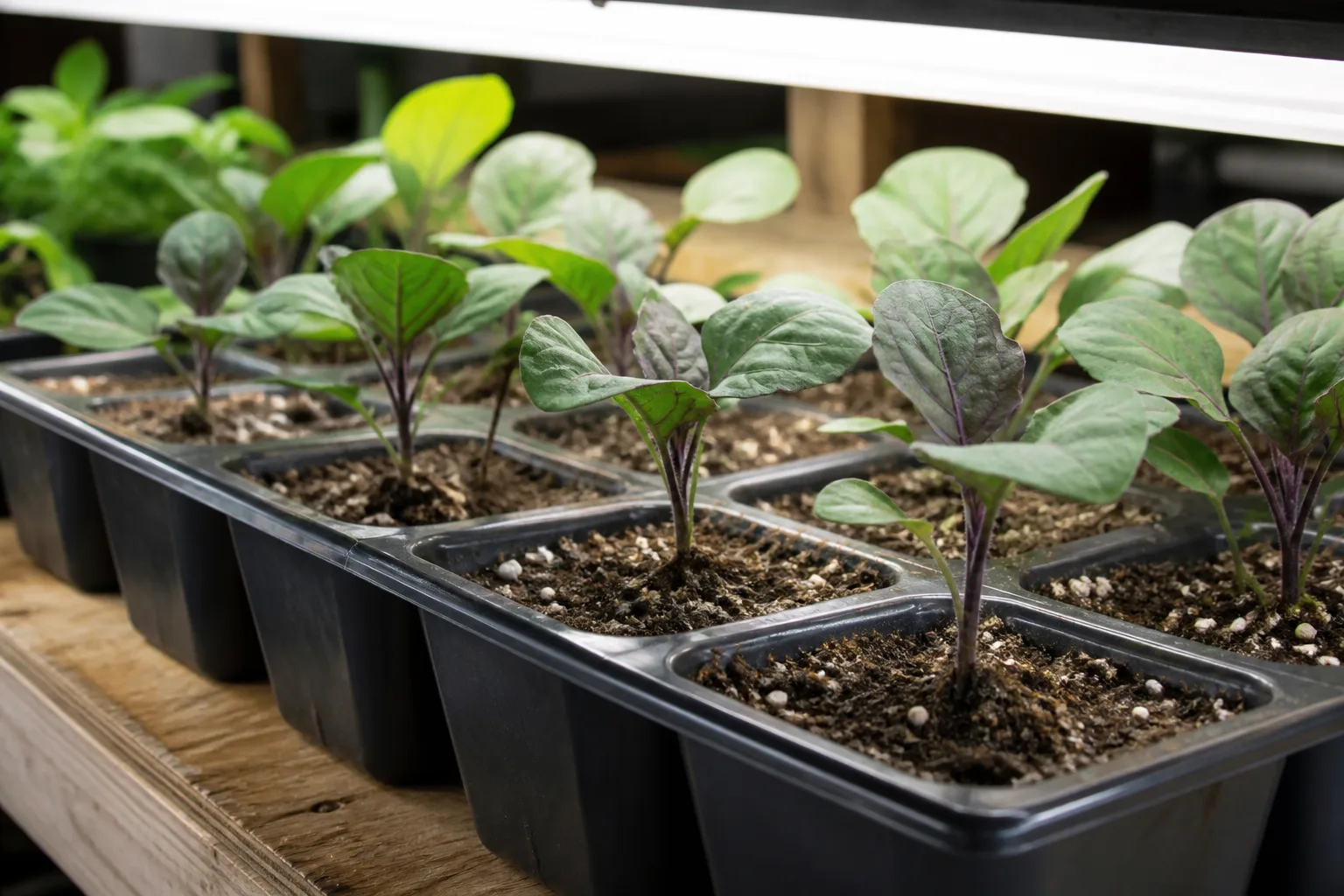
Start seed about six to eight weeks before the intended transplant date; in a short season, some growers allow closer to eight to ten weeks. The timing depends on how long the seedlings must wait for outdoor warmth, not simply on the first frost date. University of Georgia Extension recommends a six-to-eight-week head start, while Savvy Gardening gives a similar window and lays out a careful seedling routine. (University of Georgia Extension, Savvy Gardening’s seed-starting guide)
Use clean cell packs or small pots filled with fresh seed-starting mix. Sow seeds about ¼ inch deep, keep the mix evenly damp, and provide bottom warmth if the room is cool. Eggplant seeds germinate best in warm conditions—roughly 80–90°F at the seed level—so a heat mat can speed and even out germination. Once seedlings emerge, remove the dome and move them off the mat; prolonged heat without strong light encourages stretched, weak growth.
Bright light matters as much as warmth. A sunny window may be enough in a bright room, but seedlings commonly lean and stretch when winter light is weak. A grow light positioned close above the leaves, kept on for about 14–16 hours a day, gives more compact plants. Water gently when the surface begins to dry; the mix should stay lightly moist, never waterlogged. A small fan on a gentle setting can improve air movement and help stems strengthen.
Pot seedlings into individual containers when they develop true leaves and begin to crowd their cells. Handle them by a leaf rather than squeezing the tender stem, and use a pot that gives the roots room for the weeks before planting. If growth is pale or stalled, check the light, temperature, and moisture first; extra fertilizer will not correct a seedling that is cold, waterlogged, or light-starved.
Harden off and transplant at the right stage
Indoor-grown eggplant leaves are not adapted to direct sun, wind, or rapid temperature changes. Harden seedlings off over about five to seven days: begin in a sheltered, shady spot for a short period, then gradually lengthen the outdoor time and introduce gentle morning sun. Bring them in during cold nights or strong wind. A plant that wilts or scorches during this transition needs a slower adjustment, not a larger dose of fertilizer.
Transplant on a mild, cloudy day if possible, water the seedling before moving it, and water again after planting. For a short cold snap, a row cover can reduce stress, but it must not overheat the plant on bright days. Utah State University Extension notes that stocky transplants about five to eight inches tall with several true leaves establish more quickly than plants already carrying flowers or fruit. (Utah State University Extension)
Keep the root ball intact
Set the transplant at about the same depth it grew in its pot. Loosen only circling roots at the outside of a root-bound plug; do not strip or shake the root ball apart. In a bed, space plants according to the cultivar’s mature spread. Guidance ranges from roughly 18–24 inches for compact plants to 24–36 inches for larger varieties, with enough room between rows or neighboring crops for sunlight and airflow. If the packet gives a spacing range, use the wider end in a humid climate or for a vigorous cultivar.
Install a stake or tomato cage while the plant is still small. Pushing a stake through established roots later is more disruptive, and a fruit-laden branch can break suddenly in wind. Tie the main stem loosely with soft ties as it grows; leave room for the stem to thicken.
Prepare a bed or container that drains well
A raised bed warms sooner than dense ground soil and gives you control over drainage. In a garden bed, work compost into the top layer and keep the soil surface level around the plant so water reaches the roots rather than running away. Apply organic mulch after the soil has warmed; an early thick mulch can keep cold soil cool for longer. Once the bed is warm, straw or shredded leaves help reduce evaporation and weed competition.
Container growing is useful where garden soil is heavy, the bed is small, or you want to move a plant to a warmer patio. Use a quality vegetable potting mix rather than dense garden soil, which can compact and drain poorly in a pot. Choose a container with several open drainage holes and set it where the plant receives full sun and where you can reach it to water and harvest. A large, stable pot also helps keep a tall, fruiting plant from tipping.
Give container roots enough volume
Use one standard eggplant per container of at least five gallons. Gardening Know How recommends a five-gallon pot for container eggplant; that is a practical minimum, not a guarantee that a small pot will stay moist through a hot week. A larger container gives roots more room and buffers quick changes in temperature and moisture. Compact varieties can be grown in smaller pots, but they need closer attention to watering and may produce less than they would in a larger volume. (Gardening Know How’s container eggplant guide)
Fill the pot with fresh potting mix, not a layer of gravel at the bottom. Gravel does not replace drainage holes; it takes up root space and can leave a saturated layer above it. Water the mix before planting so it settles, then set the transplant at the same depth it had in its nursery pot. Add the support at planting time and top-dress with a thin layer of mulch once warm weather is established.
Containers dry faster than beds, especially when the pot is small, the material is porous, or the patio is windy. If possible, use a pot large enough that you are not forced to water several times a day. On hot concrete, a saucer can catch runoff, but empty it after watering rather than leaving the roots standing in water.
Water steadily and feed with restraint
Eggplant needs regular water from early growth through fruit development. For in-ground plants, about one to two inches a week is a useful starting point, adjusted for rainfall, soil texture, and heat. Utah State University Extension recommends deep, infrequent watering and notes that irregular watering can contribute to tough fruit or root rot. Texas A&M AgriLife also advises a thorough soaking rather than repeated shallow sprinklings. (Utah State University Extension, Texas A&M AgriLife Extension)
Check the soil rather than watering on a rigid schedule. In a bed, feel the soil a couple of inches below the surface; if it is dry there, water slowly at the root zone until moisture reaches deeper into the bed. In a container, check the top inch of mix and lift the pot occasionally to learn how heavy it feels after watering. Water thoroughly until some drains out, then let excess water escape. A container may need daily checking during hot, windy weather, while a large pot after rain may need several days before the next watering.
Water near the soil instead of soaking foliage late in the day. A consistent supply is better than alternating between bone-dry and saturated soil. If fruit develops a sunken, dark patch at the blossom end, stabilize moisture first and check that roots are not waterlogged; adding calcium without evidence of a soil deficiency may not solve an uptake problem.
Use a soil test before applying fertilizer to a bed. Eggplant needs fertile soil, but too much nitrogen can make a large leafy plant that delays flowering and fruit maturity. Start with compost and follow the test’s recommendation for a balanced vegetable fertilizer. For container plants, follow the potting mix and fertilizer label; frequent watering can carry nutrients out of the pot, but feeding more than the label recommends can burn roots or push excess leaf growth. (Utah State University Extension, University of Georgia Extension)
Support plants early; prune only with a reason
Eggplant stems can look sturdy when young, then bend under several heavy fruits. Put a stake or cage in place at planting, especially for large-fruited varieties, windy patios, or plants in a narrow pot. Tie stems loosely and check supports after storms; tight ties can cut into growing stems.
Routine pruning is usually unnecessary for an annual garden plant. Remove a broken or diseased branch and clear leaves that touch wet soil, but keep enough healthy foliage to shade developing fruit. In a greenhouse or a very long growing season, a tall plant may benefit from selective pinching or thinning to manage its shape, but do not remove healthy branches simply to force larger fruit. Eggplant needs leaves to make the energy that fills its fruit.
Help flowers set fruit
Eggplant flowers can pollinate themselves, but the pollen still needs to move inside the flower. Outdoors, wind and pollinating insects usually provide that vibration. In a closed greenhouse or a sheltered patio with little air movement, flowers may appear healthy and then drop without setting fruit. Savvy Gardening describes the flowers as self-fertile but dependent on vibration, while BBC Gardeners’ World suggests gently tapping or shaking greenhouse-grown flowers to help release pollen. (Savvy Gardening, BBC Gardeners’ World)
When flowers fall, check the conditions in this order: is the plant warm enough, is the root zone drying out between waterings, and is the plant receiving enough air movement? If the plant is indoors or behind mesh, gently tap the flower stalk or support once a day while flowers are open. Do not shake the whole plant hard or wet flowers repeatedly; the aim is light vibration, not damage.
A lush plant with few flowers may be receiving too much nitrogen or too little sun. Pause feeding, move a container to a brighter position if possible, and allow the plant to settle before making another change. If flowers form but small fruits yellow and drop, review recent heat, drought, and watering swings before assuming that the plant needs a different fertilizer.
Catch pests and disease before they spread
Check eggplant leaves, stems, and fruit at least once a week, and more often when plants are small. Flea beetles are a common early threat: the adults leave many tiny, round holes in leaves and can badly weaken young seedlings. Floating row cover or insect netting can protect transplants while they establish, but plan to remove or open it when flowers need insect access unless you are hand-pollinating. (Utah State University Extension, Texas A&M AgriLife Extension)
Look for larger chewing damage, frass, or insects on leaf undersides when holes are irregular rather than pin-sized. Hand-pick visible caterpillars or beetles where practical, remove badly damaged debris, and keep weeds from sheltering pests. If you consider a pesticide, identify the pest first and follow the product label and local extension advice; a general spray can harm pollinators and will not fix a watering or drainage problem.
Good spacing, drainage, clean tools, and rotation reduce disease pressure. Verticillium wilt can cause lower leaves to yellow and the plant to wilt even when the soil is moist; water stress can also cause wilting, so check soil moisture and compare symptoms before diagnosing. Avoid moving soil from a diseased bed into containers, and do not plant eggplant in the same spot after a serious wilt problem. If a plant collapses rapidly or shows spreading leaf spots, remove it and seek a local extension diagnosis rather than trying random treatments.
Read the pattern of damage
The location and timing of symptoms often tell you what to inspect first. Tiny holes on new leaves point toward flea beetles; limp leaves with dry soil suggest a watering need; limp leaves in wet soil call for a drainage and root check. A plant that stays green and leafy but makes few flowers may be overfed with nitrogen, shaded, or still responding to cool weather.
Fruit can also reveal stress. A dull, leathery fruit may have stayed too long on the plant or experienced extreme weather or uneven moisture. A dark, sunken blossom end often appears when the plant cannot move water consistently to developing fruit. Remove affected fruit, correct the underlying condition, and watch the next fruit rather than applying multiple amendments at once.
Harvest by variety-specific cues
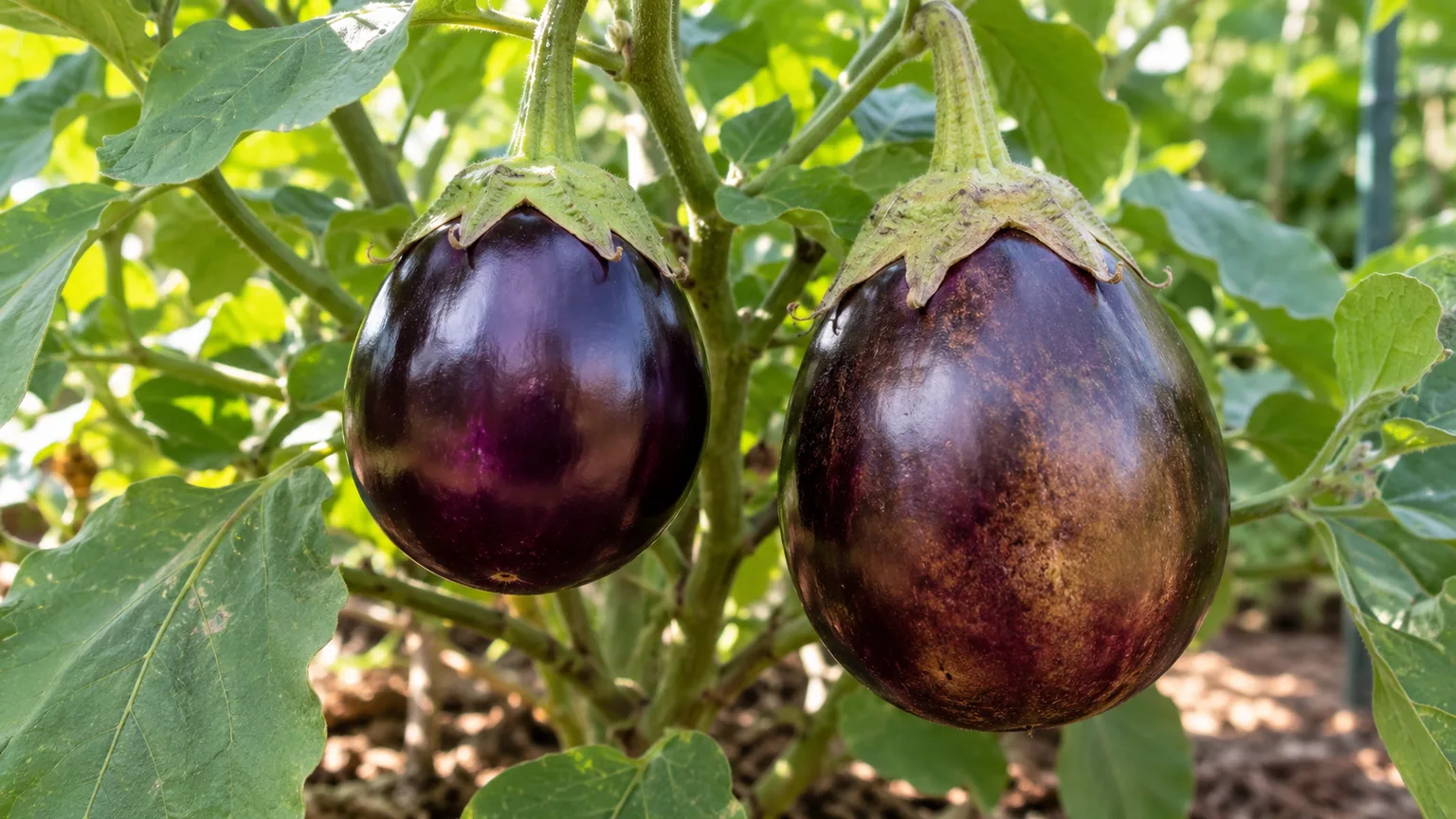
Use the seed packet’s days-to-maturity estimate to know when to start watching, not as a strict picking date. University of Georgia Extension gives a general harvest window of about 64–80 days depending on variety, while Utah State Extension notes that fruit may reach full size roughly 10–20 days after flowering. Weather, container size, and variety can shift both timelines. (University of Georgia Extension, Utah State University Extension)
Check the fruit every few days once it nears its expected size. A ready eggplant has the variety’s mature color, a smooth glossy skin, and firm flesh with slight give when pressed gently. Its shape should look full rather than narrow and hard. The size range can be very different among globe, Japanese, white, striped, and patio varieties, so compare the fruit with the seed packet or a reliable cultivar description. Savvy Gardening emphasizes using size and shape, proper color, sheen, and firmness together rather than judging by color alone. (Savvy Gardening’s harvest guide)
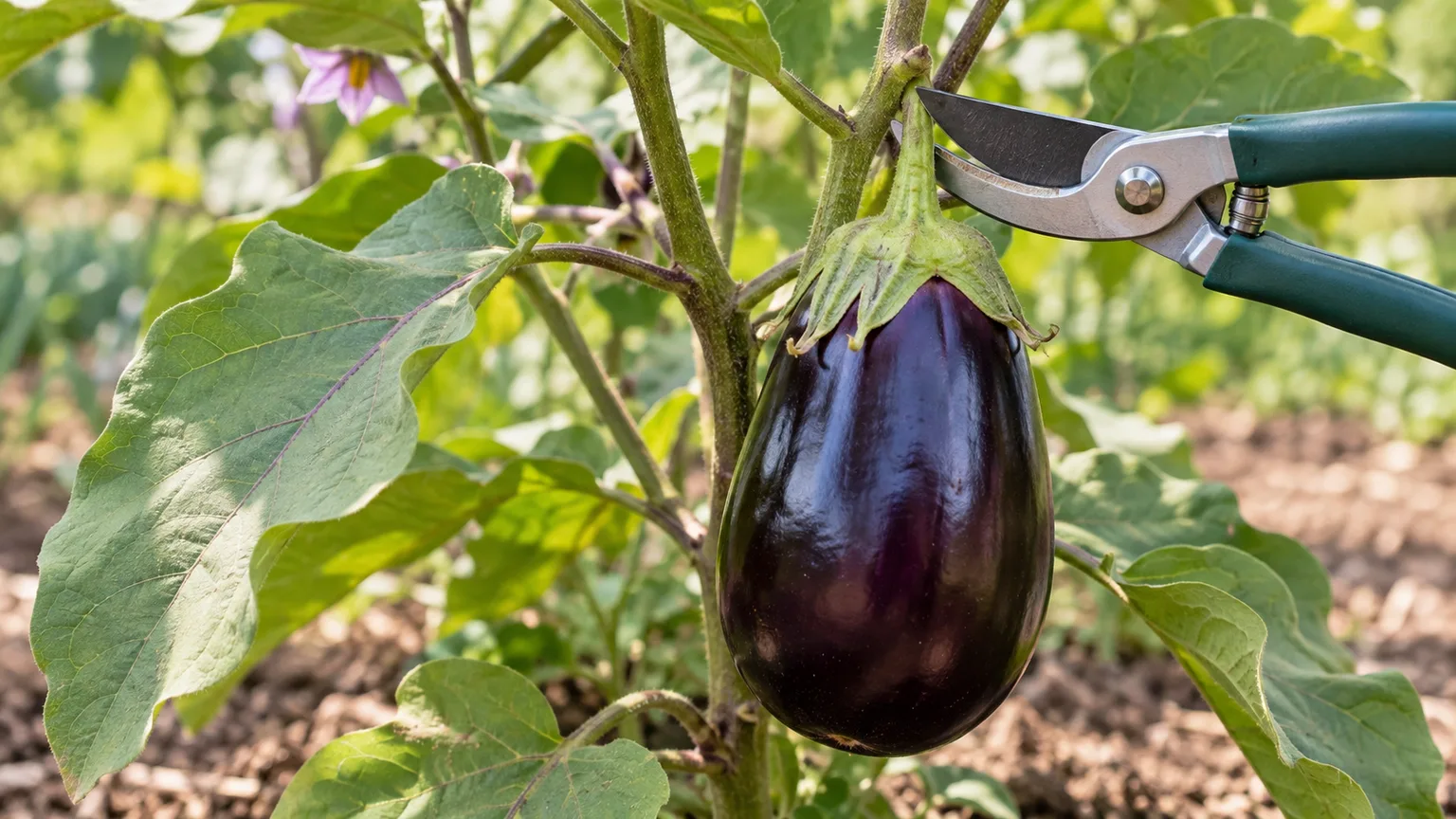
Cut the stem with clean pruners or a sharp knife instead of twisting or pulling the fruit. Leave a short piece of stem attached, and wear gloves if your variety has prickles on the calyx or stems. Pick fruit regularly: leaving over-mature fruit on the plant can slow the next flush, while harvesting a little young is usually better than waiting until the skin turns dull and the seeds harden.
Use eggplant soon after picking for the best texture. If you need to hold it for a few days, keep it cool and dry, away from freezing temperatures; storage advice varies by region, so treat the fruit as perishable rather than expecting it to keep for weeks. If the first fruits are bitter, seedy, or spongy, check their size and skin gloss next time and harvest earlier.
Conclusion
The reliable route to eggplant is simple: choose a variety that fits your season and space, raise sturdy seedlings, and wait for warm soil before planting. Give each plant sun, good drainage, early support, and enough root volume to keep moisture steady.
Then judge the plant by what it is doing. If flowers drop, check temperature, moisture, and pollen movement before feeding. If leaves show damage, identify the pest or disease pattern before treating. Harvest each variety when its fruit is full-sized, glossy, and just slightly yielding, and the plant can keep producing until cold weather ends the season.