How to Grow and Care for Black Hills Spruce in Your Yard
Learn how to grow Black Hills spruce with site, spacing, planting, watering, pruning, and troubleshooting advice for this long-lived northern evergreen.
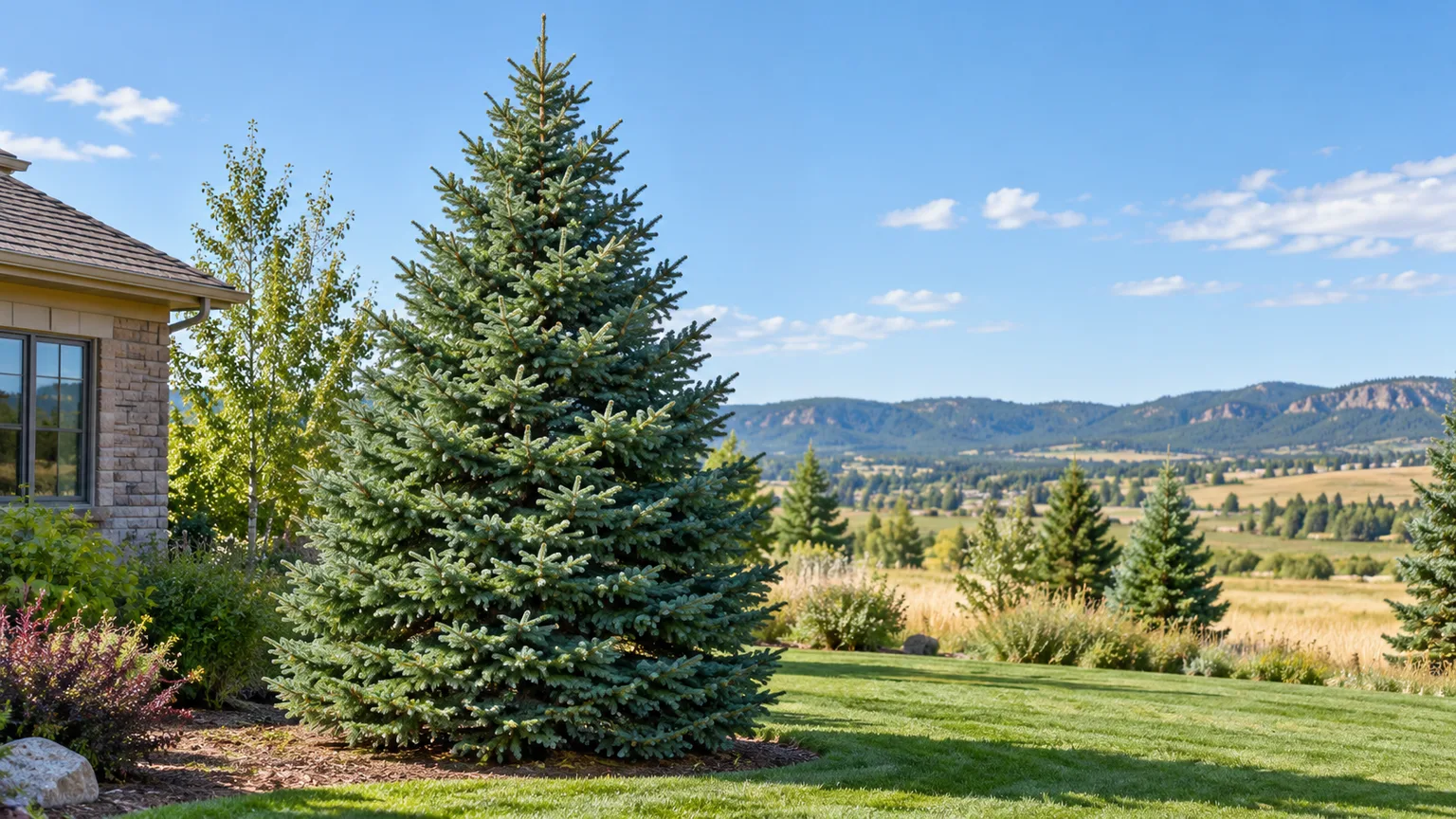
Black Hills spruce is a long-lived, dense evergreen for a site with cold winters, room for a large crown, and soil that drains after rain. It is not a miniature spruce just because it grows more slowly and stays narrower than ordinary white spruce. The most important care decision happens before planting: make sure the tree’s eventual size and climate preferences match the yard.
Once established, this spruce can be fairly drought resistant and needs little routine pruning or fertilizer. A newly planted tree is different. Its roots are still confined to a root ball, so it needs attentive watering and a planting hole that lets those roots expand into the surrounding soil.
What a Black Hills spruce is—and what it is not
Black Hills spruce is a naturally occurring regional form of white spruce, Picea glauca, associated with the Black Hills and other parts of the northern Great Plains. Forestry references may call it Picea glauca var. densata or describe it as a geographical variety; nursery labels often use Picea glauca ‘Densata.’ The naming varies, but the practical distinction is consistent: this is a dense, slower-growing white spruce selected for a compact, pyramidal outline compared with many white spruce forms. South Dakota Department of Agriculture and Natural Resources Forestry describes its darker, denser needles and regional traits.
It is not the same tree as black spruce, Picea mariana. Black spruce is a separate species associated with wetter northern habitats and has different landscape needs. If you are comparing nursery tags, check the botanical name rather than relying on “black” in a common name. The letters “Hills” matter: a Black Hills spruce should be identified as a form of white spruce, not as a black spruce.
This distinction also helps set expectations. A tree sold under a named selection is chosen for a recognizable form, but plants grown from seed can vary. If a uniform screen or a particular upright shape matters, buy correctly labeled nursery stock; treat home propagation as an experiment rather than a dependable way to reproduce an exact specimen.
Plan for a substantial tree, not a compact hedge
Published size estimates differ. South Dakota forestry lists Black Hills spruce at roughly 30 to 60 feet tall and 15 to 25 feet wide. That is a mature landscape tree, not a foundation shrub, even if a nursery sells it as a small, narrow juvenile. The state profile also notes its slow growth relative to white spruce and a potential lifespan of more than 150 years, so planting for the next few years alone is a poor sizing strategy.
Before choosing the spot, picture the full crown at its widest point. Leave room for branches to reach their natural outline without brushing a roof, blocking a window, pushing into a sidewalk, or requiring annual shearing. Account for overhead lines, underground utilities, snow storage, driveways, and nearby trees. A large evergreen near a building can be hard to prune safely later, and a tight row can lose lower foliage when crowded.
For a windbreak, use the full expected crown width to set spacing rather than planting a dense line of saplings shoulder to shoulder. Trees need air and light through the lower crown, and crowded branches stay wetter after rain. The exact spacing depends on the mature dimensions of the stock and the screen you want; ask a local nursery or extension service to check the plan before ordering several trees. Fine Gardening’s conifer-selection guidance makes the same useful point about treating conifers as long-term landscape investments and matching growth class to available space.
Check winter hardiness, summer climate, and sunlight
Black Hills spruce is strongly associated with cold, northern climates. South Dakota forestry lists a hardiness rating of Zone 2 and describes the tree as a good ornamental and windbreak choice in its region. Hardiness-zone labels estimate winter cold tolerance; they do not tell you whether a spruce will enjoy hot, humid summers, warm nights, reflected heat, or a long wet season. A tree can survive winter and still decline under a summer climate that keeps its needles warm and wet.
Choose an open, sunny location. The species can tolerate some less-than-ideal light, but a crowded, shaded position may produce a thinner, less balanced crown and slower growth. South Dakota forestry describes full sun as preferred, and MyGardenLife’s Black Hills spruce care profile also recommends matching its planting site to its full-sun habit.
Air movement is helpful, but “airflow” does not mean exposing a new transplant to the harshest wind on the property. A well-established tree used in a regional windbreak can handle conditions that stress a recently planted root ball. If your summers are hot and humid, your soil stays wet for long periods, or you garden near a salt-exposed coast, check with a local extension office before buying. A locally recommended native or another evergreen may be a better long-term fit.
Give roots drainage without engineering a new soil
Black Hills spruce tolerates a range of soil textures, from sandy or gravelly loam to finer clay, according to South Dakota forestry. That flexibility does not mean it tolerates every site. The same forestry profile notes that it is flood intolerant and sensitive to soil compaction. Drainage and oxygen around the roots matter more than trying to create a perfect acidic planting pocket.
Watch the site after a normal rain. If water remains pooled for a long time, the ground is compacted, or the tree would sit in a low spot that collects runoff, choose another location or ask a local arborist about correcting the grade. Do not assume a layer of gravel at the bottom of a planting hole will solve poor drainage; a hole that acts like a basin can trap water around the root ball.
A soil test is more useful than guessing based on needle color. The species prefers acidic, moist loams but can adapt to several soil types; if a test shows an unsuitable pH or nutrient level, follow its recommendation rather than adding sulfur or fertilizer by habit. Avoid replacing the backfill with a rich, loose amendment pocket. Roots need to move from the original root ball into the surrounding native soil, and a sharp change in texture can interrupt that transition.
Plant in spring or early fall at the visible root flare
Spring and early fall give a newly planted spruce time to start rooting before severe summer heat or frozen ground. Avoid planting during a hot, dry spell if you can postpone the job. Water the root ball before it goes into the ground, and have the planting hole ready so the roots do not dry in the sun or wind.
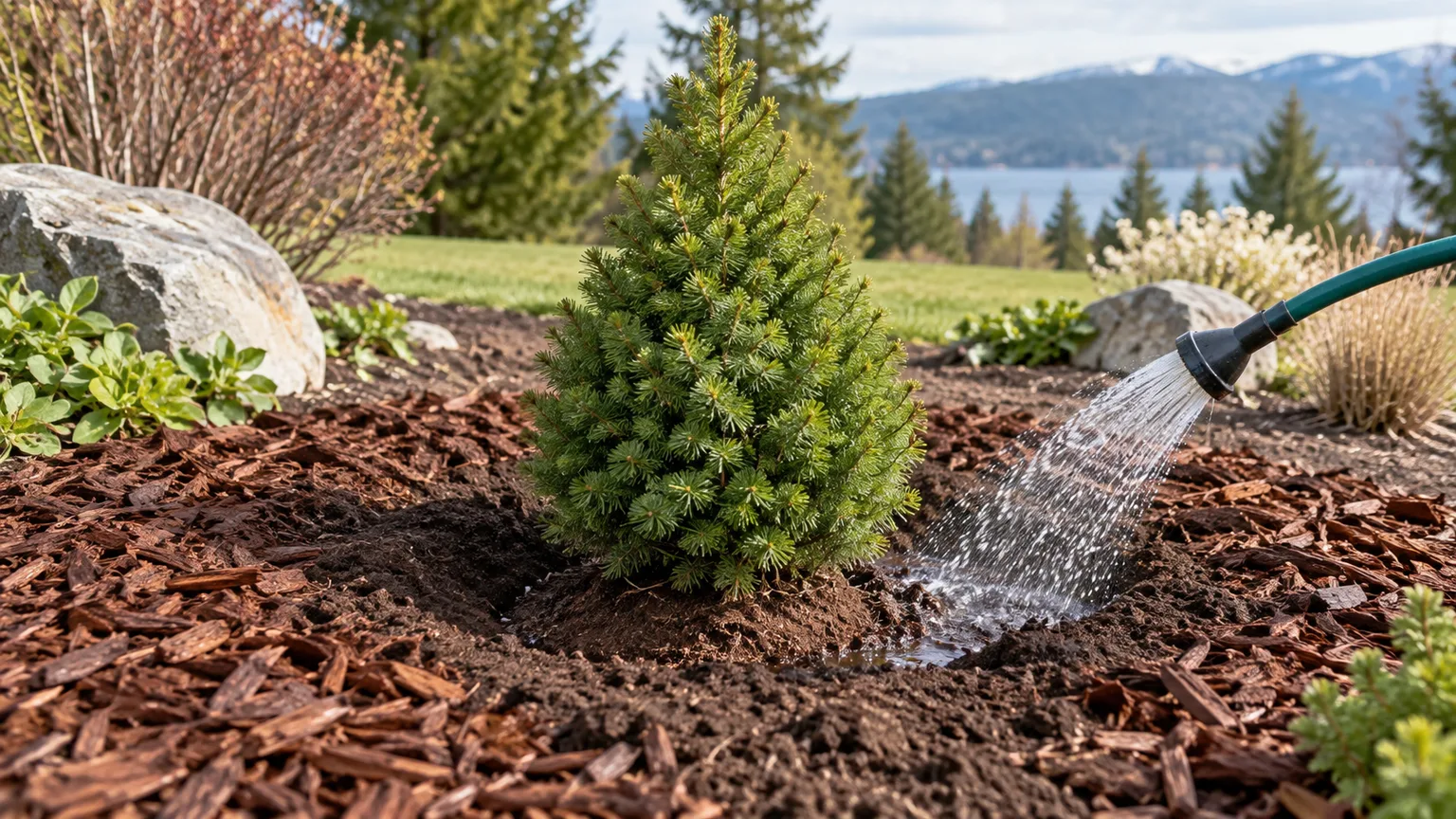
Dig a hole at least twice as wide as the root ball, with sloping sides, but no deeper than the root mass. Find the root flare—the point where the trunk widens and the first structural roots emerge—and set it at or slightly above surrounding grade. Penn State Extension’s tree and shrub planting guidance emphasizes the root flare as the depth reference; burying it reduces oxygen around the roots and keeps trunk bark wet.
Backfill with the soil you removed, breaking large clods and gently firming it to eliminate major air pockets without stomping it hard. Water slowly as you backfill so the soil settles around the roots. Do not add a large dose of compost, peat, or fertilizer to the hole unless a soil test or local recommendation calls for it. A moderate planting hole in the actual site soil helps you learn whether that site is suitable instead of masking a drainage problem temporarily.
Check container-grown and balled trees differently
For container-grown trees, remove the pot and inspect the root ball before planting. If roots are circling tightly around the outside, loosen or correct them so the new roots can grow outward; a tightly circling root system will not fix itself simply because you covered it with soil. Do not tear apart a sound, fibrous root ball unnecessarily.
For balled-and-burlapped stock, make sure the tree is stable and the root flare is visible. Remove twine and as much burlap as practical from the top and sides after the root ball is positioned; synthetic burlap and wire left around the trunk can interfere with future root growth. For a heavy tree, work with a nursery or arborist rather than lifting it by the trunk or trying to manipulate a large root ball alone.
Finish with a broad, shallow basin only if the grade and soil allow water to soak in rather than stand around the trunk. Recheck the tree’s upright position after the first deep watering. If settling exposes roots or sinks the flare below grade, correct it while the tree is still easy to lift.
Water for establishment, then taper by evidence
A tree described as drought resistant still needs regular water while it establishes. The root system of a transplanted spruce has been disturbed and is initially limited to the root ball. South Dakota forestry’s drought-resistance description applies to the tree’s landscape performance; it is not permission to leave a new transplant dry through its first summer.
Water the whole root ball and the soil just beyond it, slowly enough for the water to soak in. Penn State Extension’s new-tree watering guidance offers a starting rhythm of daily watering for the first one to two weeks, every two to three days through weeks three to twelve, then weekly watering through the first frost and continuing in the next growing season as needed. Treat that as a monitoring schedule, not an automatic timer: rainfall, heat, wind, soil texture, tree size, and drainage change how quickly the root zone dries. Joe Gardener’s tree-watering advice likewise emphasizes slow, deep watering and continued attention beyond the day of planting.
Do not water only at the trunk. Newly planted roots are spread through the root ball and surrounding soil, so apply water across that area. A low-flow hose, soaker hose, or slow watering bag can help, but each has limits: hoses can distribute unevenly, bags need refilling and removal before winter, and sprinklers wet foliage while sometimes missing the root ball. Check the actual soil before repeating a schedule.
Use a practical root-zone moisture check
Push a soil probe or narrow trowel into the ground at the root ball’s edge and check several inches down. Penn State suggests checking moisture about 6 to 9 inches deep for newly planted trees. If the soil is cool and moist there, wait and check again rather than adding more water; if it is dry, water slowly until the root zone is moist. In heavy clay, allow time for water to infiltrate and avoid keeping the root zone saturated.
One inch of rain is not always one inch of useful root-zone moisture. A slow, hours-long rain may soak in; a short cloudburst can run off compacted soil. Joe Gardener suggests using a straight-sided can to learn how much water a sprinkler delivers, but the more useful check for a new tree is still whether water reached the root ball. As roots expand beyond it and annual growth becomes steady, reduce supplemental watering. During a prolonged drought, even an established evergreen may benefit from a deep soak before the ground freezes.
Mulch wide and shallow; keep it off the trunk
A ring of organic mulch reduces competition from lawn grass, moderates soil temperature, and slows evaporation around the root zone. Spread a layer about 2 to 3 inches deep, extending as far as practical toward the drip line as the tree grows. Keep several inches of bare space around the trunk so the bark stays dry and the root flare remains visible.
Do not build a tall “mulch volcano” against the trunk. Deep mulch can hide the flare, hold moisture against bark, and encourage roots to grow in the wrong place. Pull mulch back if it has drifted against the stem, and do not add a fresh layer every year without checking how deep the old material has become.
Keep grass and weeds from competing directly with a young spruce, but do not cultivate deeply under the crown. Many tree roots lie near the soil surface; a string trimmer, mower, or hoe can wound them. A clean, expanding mulch ring is easier to maintain and safer for the tree than turf tight to the trunk.
Skip routine fertilizer
Black Hills spruce does not need an annual feeding simply because it is an evergreen. A fertilizer application can push soft top growth without correcting the real cause of pale needles or slow growth. Poor drainage, drought, buried roots, compacted soil, shade, and root damage are more common site problems to check first.
If growth is unusually weak across several seasons, take a soil test and describe the symptoms to a local extension office. Apply a nutrient only when the test or a qualified diagnosis supports it, and follow that recommendation’s amount and timing. Do not use lawn fertilizer around the tree; the high nitrogen and quick-release salts may be poorly matched to a conifer’s needs and can wash into nearby water.
A modest layer of compost spread over the surrounding soil can improve organic matter over time, but it is not a substitute for drainage or root-zone moisture. Keep any surface amendment away from the trunk, and do not bury the root flare as you add soil or mulch.
Prune lightly and preserve the leader
A Black Hills spruce usually needs little pruning beyond removing dead, broken, or diseased branches. The tree’s natural shape is a strong central leader with layered branches; routine shearing can destroy that outline and create an artificial shell that shades the inner crown. If you need to keep a tree short, this is the wrong species for the site.
Remove a damaged branch with a clean cut just outside the branch collar, the slight swelling where the branch joins the trunk or a larger limb. Do not leave a long stub or cut flush into the trunk. Penn State Extension’s landscape-tree pruning guidance recommends removal and reduction cuts that retain natural form, and warns against topping. Prune when you can see the branch structure clearly; for major structural work, use a qualified arborist.
Young trees sometimes develop competing leaders or branches that rub. Correct small defects gradually while the tree is young rather than removing a large portion of the crown at once. Do not remove every lower branch from a new transplant; those branches contribute foliage while roots reestablish. Keep tools sharp and clean, and leave work near power lines, large branches, or ladder-height crowns to trained professionals.
Grow from seed or cuttings with realistic expectations
You can raise white spruce relatives from seed, but the process is slow and the result is less predictable than buying a named, nursery-grown tree. A seed-grown plant may not match the dense outline or other traits that led you to choose Black Hills spruce. If a particular form matters, ask the nursery how its stock is propagated and choose a clearly labeled plant.
If you collect cones, wait until they are mature and dry enough to release seed; do not strip green cones from a tree. Keep seed labeled, follow a reliable conifer-seed pretreatment protocol for your source, and sow it in a clean, well-drained medium. Keep the seedbed evenly moist rather than waterlogged, protect seedlings from drying wind and strong midday sun, and expect to grow them in pots or a nursery bed before they are large enough for a landscape site. A seedling can take several years to become a durable planting tree.
Cuttings are another possible route, but rooting spruce cuttings is not a quick beginner shortcut. Success depends on the age and condition of the shoot, season, humidity, temperature, and aftercare. If you want to experiment, take more than one healthy cutting and keep them in a protected propagation setup; do not expect every cutting to root or grow evenly. For a single yard tree or a matching windbreak, nursery stock is normally more efficient and gives you a clearer idea of mature form.
Diagnose needle color before treating
A few brown inner needles do not automatically mean the tree is dying. Spruce retains needles for several years and sheds older needles as new growth continues, so some inner-crown browning can be normal. Look at where the change begins, whether it is limited to older shaded needles, whether new growth is affected, and whether the pattern is spreading along one branch or across the whole tree.
Check the root zone before reaching for a spray. Dry soil around a new root ball points toward insufficient water; persistently soggy soil, a buried flare, or a low saturated planting site points toward poor oxygen and drainage. Scorched outer needles on the exposed side can follow drought, winter wind, road salt, or reflected heat. A single symptom rarely identifies one cause, so compare the foliage pattern with recent weather, watering, and any construction or digging near the roots.
Pests and disease to watch
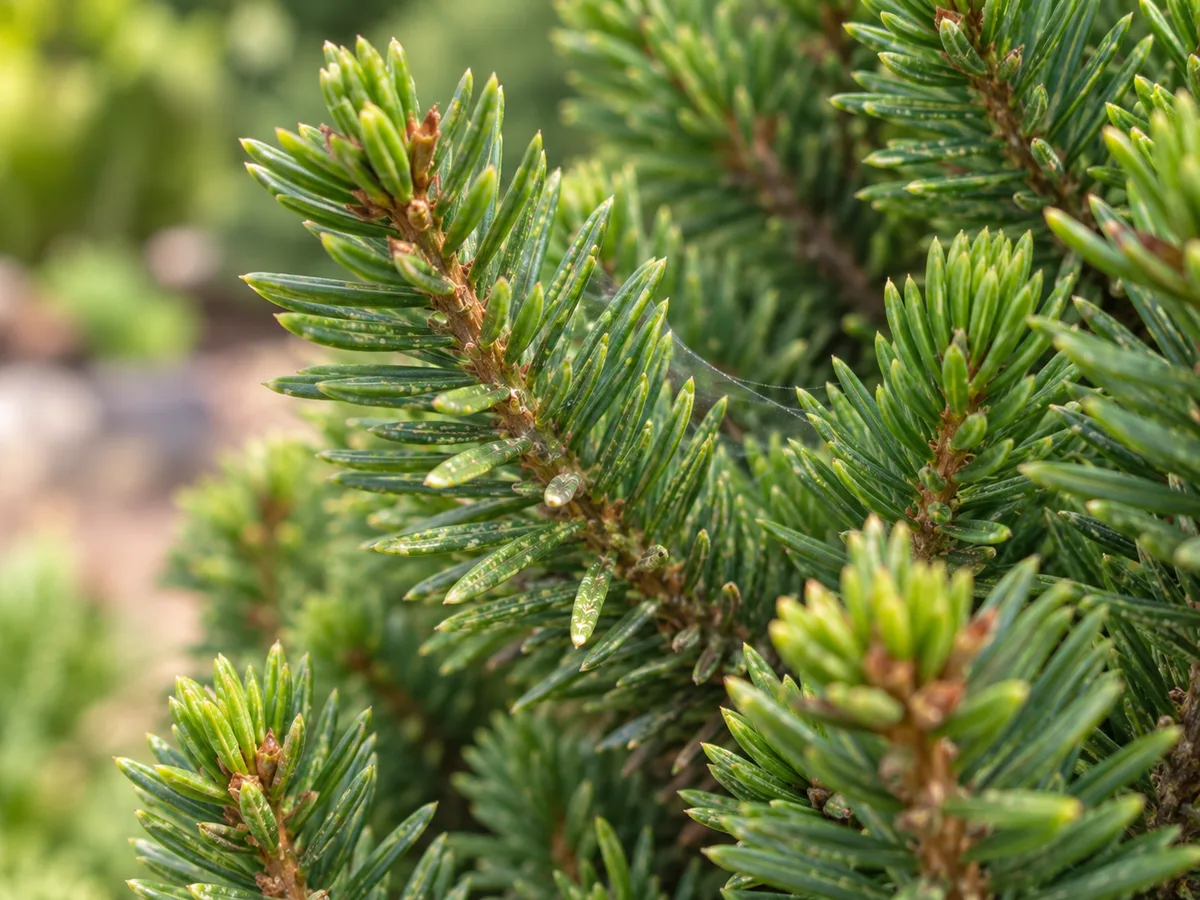
South Dakota forestry lists spider mites, spruce needle miner, pine needle scale, yellow-headed spruce sawfly, aphids, and Lirula needle blight among issues associated with Black Hills spruce. That does not mean every tree will develop them, or that every brown needle is an insect or fungus. A useful first step is to inspect both sides of affected twigs with a hand lens and note whether you see stippling, webbing, insects, scale-like bumps, larvae, or distinct needle lesions.
Spider mites can produce fine pale stippling and webbing; wash a small affected branch and check whether the new damage slows, but do not assume any web is a mite. Spider webs from ordinary spiders are not proof of infestation. Needle miner, scale, sawfly, and aphids call for different diagnoses, and fungicide or insecticide will not repair drought, compaction, or root injury. Photograph a full branch and a close-up, then consult a local extension diagnostic service if the damage progresses.
Avoid preventive pesticide sprays on a healthy spruce. If a pest is confirmed and treatment is justified, use only a product labeled for that pest, plant, and site, and follow its label exactly. On a mature tree or when symptoms affect the leader or several large limbs, have an arborist inspect before pruning away substantial live growth.
Follow the seasons instead of a rigid weekly schedule
In spring, inspect the leader and branch tips for winter breakage, confirm that mulch has not crept against the trunk, and resume checking moisture if the previous fall was dry. New growth may appear lighter green than older needles; judge the tree by whether buds expand normally and the tips remain healthy rather than expecting every needle to have identical color.
During summer, focus on establishment watering, especially in the first two or three growing seasons. Check moisture after hot, windy periods even when the surface looks damp, and remove weeds before they compete with roots. If needles pale or brown, pause before treating: test the root zone, inspect the pattern, and review recent heat, rainfall, irrigation, and nearby disturbance.
In fall, continue watering a young tree until the soil begins to freeze if rainfall has been limited. Keep the mulch ring in place, but avoid piling extra material for winter. In winter, do not shake heavy snow from stiff, frozen branches or wrap the crown in a way that traps moisture; simply note serious breakage and arrange safe pruning when conditions allow. A mature, well-sited spruce should not need a complicated monthly care calendar.
Use Black Hills spruce where its mature form can work
This tree makes sense as a long-term focal evergreen, a windbreak component, or winter cover on a spacious, cold-climate property. South Dakota forestry notes its use in conservation plantings and agroforestry windbreaks, as well as its value as winter cover for wildlife. Its dense form provides year-round structure, but the same density means the tree needs enough space and cannot be kept small indefinitely with clipping.
Choose another tree if the planting strip is narrow, the site stays wet, the crown would grow into utility lines, or the climate combines hot humid summers with poor airflow. Do not buy a Black Hills spruce solely because a nursery tag calls it “drought resistant” or “low maintenance.” First-year watering, correct depth, and an open, draining site are part of the low-maintenance outcome.
For the best start, pick a true-to-name nursery tree with a sound leader and non-circling roots, plant it at the visible flare, and keep the root zone evenly moist as it establishes. Then let the tree grow into its natural shape instead of fighting its eventual size.
Conclusion
Black Hills spruce is a handsome, hardy white-spruce form when the site suits it: cold winters, full sun, draining soil, and room for a broad, mature crown. Its long-term success depends less on fertilizer or regular pruning than on choosing the right location and avoiding a buried root flare or waterlogged planting hole.
Water the transplant steadily while its roots expand, then taper irrigation according to soil moisture and weather. If needles change color, read the pattern and inspect the roots before treating. Plan for a large tree, preserve its natural leader, and ask a local extension service or arborist when a spreading problem cannot be diagnosed from the ground.



