How to Grow and Care for Angelica
Learn how to grow angelica from fresh seed, keep its soil cool and moist, transplant before the taproot grows, and harvest with sensible safety precautions.
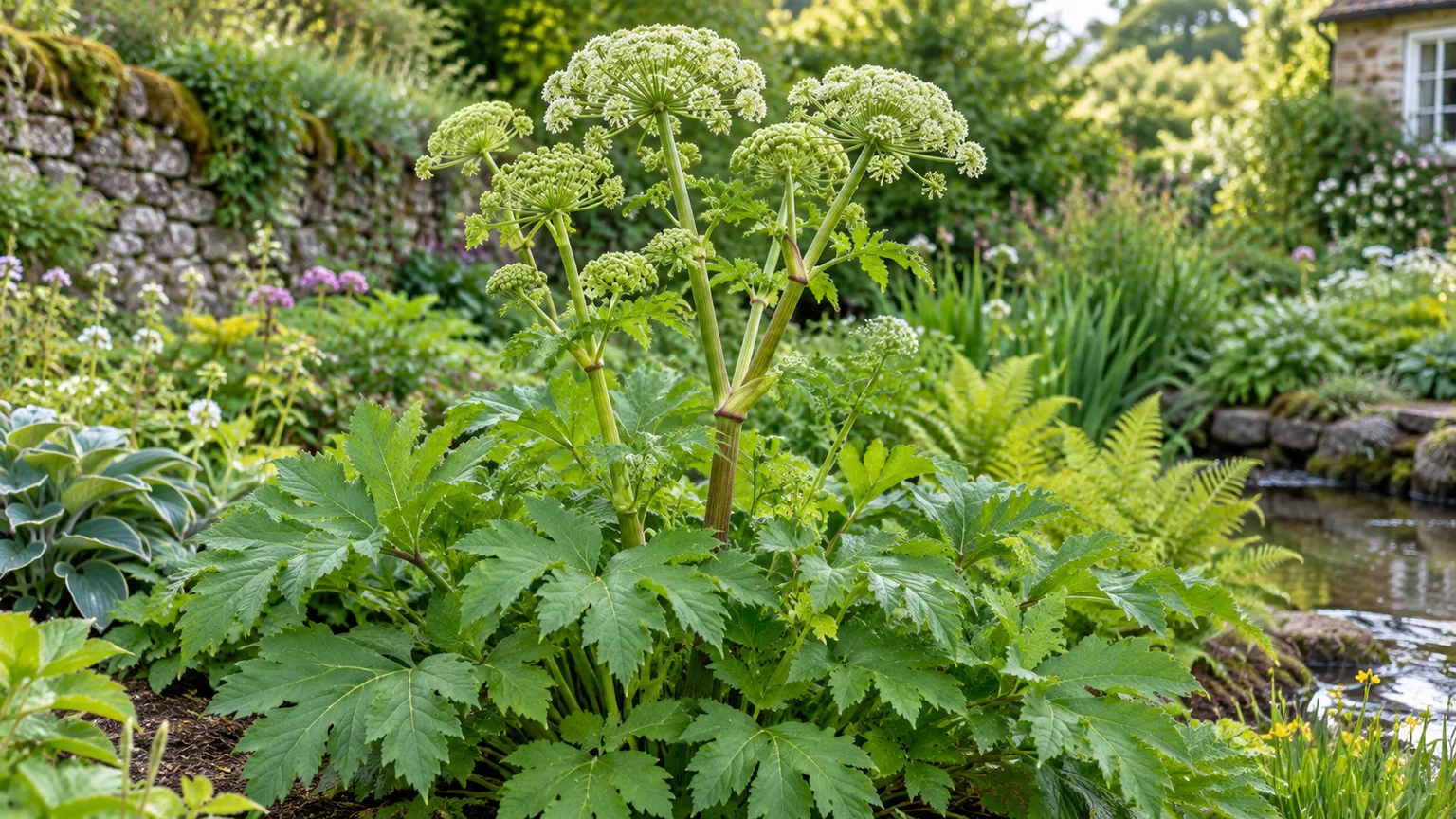
Garden angelica (Angelica archangelica) earns its place when a garden has a cool, reliably moist corner that needs height and texture. In its first season it builds a broad rosette of divided leaves; later, it can send up tall, hollow stems topped with rounded clusters of greenish-white flowers. It is a useful herb and a striking border plant, but it is not a plant to treat like a permanent, carefree perennial: its taproot dislikes disturbance, its seeds lose viability, and a flowering plant often dies after ripening seed.
For the most dependable result, start with fresh seed, give it light and fluctuating cool-to-warm conditions, and move seedlings while they are still small. Then keep the root zone evenly moist without leaving it waterlogged. That sequence answers most angelica-growing failures before they happen.
Angelica at a glance
Angelica belongs to the Apiaceae, the carrot family. Mature plants can reach roughly 3 to 7 feet tall, with a substantial spread, so give them room rather than tucking one into a narrow path. In the first year, expect foliage and a strong central root, not the tall flower display; flowering generally comes in the next growing season. UNH Extension describes it as a biennial that dies after setting seed, while Cornell notes that some plants persist longer when flower stems are removed. Treat it as a two-year crop and consider any extra season a bonus (UNH Extension; Cornell Cooperative Extension).
The best home for angelica is a cool, moist border with partial shade, or a sunny site in a cooler climate where the soil does not dry quickly. Think of it as a tall herb for the back of a bed, a streamside-style planting, or a pollinator border—not a compact kitchen-window herb. Its umbels draw insects, while the large coarse leaves add a bold backdrop to finer foliage.
Choose the right angelica species
The name “angelica” can describe several plants. This guide is about A. archangelica, often called garden angelica or Norwegian angelica, the species grown as a culinary herb. Other species may be more ornamental: A. gigas is noted for deep purple flowers, while A. sylvestris is a different, often smaller wild angelica. A seed packet or nursery label should give the botanical name; do not assume every plant sold as angelica has the same culinary use or growth habit. The Royal Horticultural Society also distinguishes garden angelica from ornamental forms and identifies A. archangelica as a preferred culinary choice (RHS).
A labeled, cultivated plant is especially important if you plan to harvest. Angelica sits among lookalikes in the carrot family, including poison hemlock and cow parsnip. Shared family traits—divided leaves and umbrella-shaped flower clusters—are not enough to identify a plant safely. Buy seed from a known supplier, keep the label with the bed, and never eat a plant based only on a quick photo match or a common name.
Find a cool site with steady moisture
Choose the location before you sow because angelica is easier to establish in its final bed than to move later. A site near a water source or in a naturally moisture-retentive border can work well, provided water does not stand around the crown. Enrich poor soil with finished compost, remove perennial weeds, and loosen the bed deeply enough for a taproot to grow. The goal is not a bog; it is soil that stays evenly damp and still has air spaces for roots.
Adjust sun exposure to your climate
In cool regions, angelica can take full sun if water is dependable. In warmer summers, give it morning sun or dappled to partial shade, particularly protection from harsh afternoon heat. NC State Extension describes it as suited to part shade or the full sun of more northern climates; Cornell similarly recommends the coolest, shadiest part of the garden during hot summers (NC State Extension; Cornell Cooperative Extension). If the plant wilts every afternoon despite moist soil, reduce heat exposure before increasing irrigation.
Space also matters. A mature rosette can sprawl, and the flowering stem rises above it, so place angelica where it will not shade short herbs or block a walkway. A back border or the north side of a mixed bed lets its height become an asset. In a small garden, one plant is often enough; self-sown seedlings can fill space over time.
Give roots rich soil that drains
Angelica likes fertile, moisture-retentive soil, but saturated soil is a different condition. A loam with compost and organic matter holds water more evenly than a sandy bed, while drainage prevents prolonged oxygen loss around the crown and root. If a spot puddles after ordinary rain, move the planting slightly higher or improve the site before planting. Do not solve a dry, sandy bed by placing the plant in a constantly flooded depression.
A soil test is useful when the bed is unusually acidic or alkaline, but angelica does not require a complicated fertilizer formula. Start with a good garden soil and a modest layer of compost. Avoid repeatedly adding quick-release fertilizer to force soft growth; steady water and a cool root zone matter more than heavy feeding. A 2- to 3-inch organic mulch can slow evaporation, but leave an open ring around the crown so it does not stay wet under a packed layer.
Start with fresh seed
Angelica is often easiest to establish from seed, but freshness matters more than most new growers expect. The Royal Horticultural Society advises sowing seed as fresh as possible because it does not store well. Fresh seed can be sown directly in fall or in spring; seed that has been kept dry and warm may need a period of moist chilling before it germinates. Treat “angelica is easy from seed” as a statement about the right seed and conditions, not a promise that an old packet will sprout on schedule (RHS; Johnny’s Selected Seeds).
A second point trips gardeners up: sources do not give one identical sowing depth. UNH Extension recommends sowing about a quarter inch deep, while RHS and Johnny’s emphasize that seed needs light and should be left uncovered or barely covered. For a seed tray, the safer practical choice is to press seed onto moist mix and cover it only with a very thin dusting of fine grit or vermiculite. Outdoors, follow the packet directions for that specific seed lot, and keep the surface from crusting or drying.
Sow outdoors in fall or spring
Fall sowing suits fresh seed because natural winter temperature swings provide a useful germination sequence, and seedlings emerge when spring moisture returns. Prepare a weed-free, finely raked strip in the final bed, water it before sowing if the soil is dry, then scatter seed thinly and press it into contact with the soil. Mark the row; tiny seedlings can be difficult to distinguish from weeds. Leave the soil surface lightly covered with mulch outside the row, but do not bury the seed under a thick blanket.
If you miss fall, sow fresh seed in early spring while temperatures remain cool. Keep the seedbed consistently moist until seedlings establish. Germination is not always synchronized, so do not discard a pot or bed simply because nothing has appeared after a week. Johnny’s lists about 30 days to germination, and RHS notes that it can take one to three months; those ranges reflect seed age and conditions as well as patience (Johnny’s Selected Seeds; RHS).
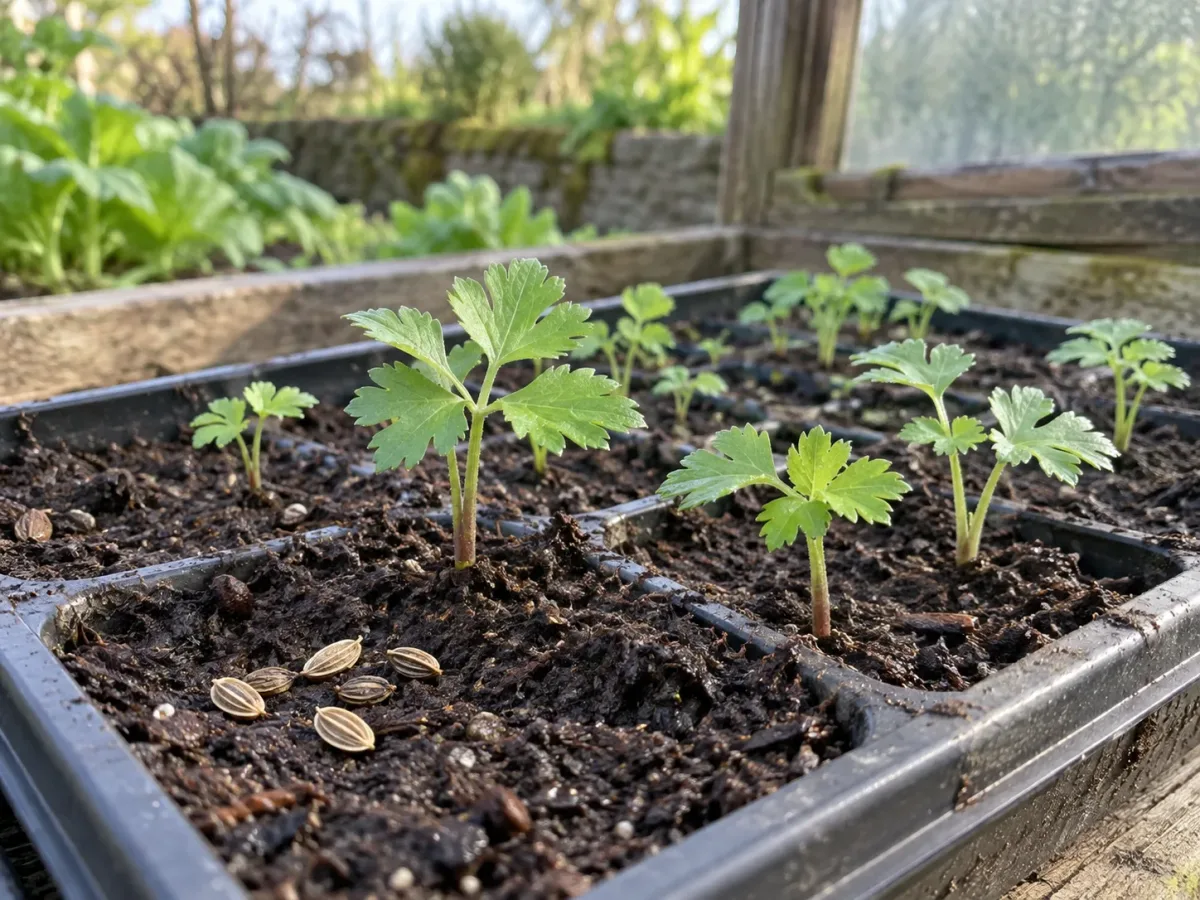
Start stored seed in a controlled tray
For older or stored seed, mix it with barely damp seed-starting medium in a labeled, sealed container and refrigerate it for about four to six weeks before sowing. The medium should feel cool and moist, not drip when squeezed. Check periodically for mold or early germination. This cold stratification imitates winter; it does not revive seed that has lost viability. After chilling, press the seed into a tray of moist, free-draining mix and keep the tray in a cool bright place. RHS recommends roughly 10–13°C during germination and warns against covering the seeds because they need light (RHS).
Use a tray with drainage holes and a clear cover only until germination begins; ventilate it so condensation does not keep seedlings constantly wet. Water from below or with a fine spray to avoid washing surface-sown seed into a corner. Once seedlings have true leaves, move them into deeper individual pots before the taproot becomes crowded. Do not pot on by pulling the seedling; lift the root ball gently and handle by a leaf, not by the stem.
Transplant seedlings before the taproot settles
Angelica develops a long taproot early, which is why late transplanting is a common avoidable setback. Move seedlings outdoors while they are still young—roughly 3 to 6 inches tall is a useful target—and after gradual hardening off. UNH Extension gives 4 to 6 inches as a transplant stage, while Johnny’s suggests 3 to 4 inches. Those recommendations point to the same principle: do not wait for a large pot-bound specimen (UNH Extension; Johnny’s Selected Seeds).
Harden seedlings for about a week by setting them outside in a sheltered, shaded spot for a few hours, then increasing their exposure to outdoor conditions. Choose a cloudy or mild day to plant. Set each plant at its existing soil depth, water it in, and space plants 12 to 24 inches apart; rows can be roughly 3 feet apart if you are growing a patch. If you only have one or two plants, give them the wider end of that range so air can move through the mature leaves and you can reach them without stepping into the bed.
Do not divide or shift an established angelica casually. It may survive root disturbance, but the large taproot makes the operation risky and undermines the main reason to grow it: a strong, upright plant. If seedlings appear where they are not wanted, move them while they are small or remove them; do not wait until they have formed a substantial root.
Water, mulch, and feed for even growth
Check the soil at the root zone rather than watering on a fixed weekly calendar. If the top inch is beginning to dry and the plant is in active growth, water deeply enough to moisten the root zone. During a dry spell, a slow soak is more useful than a brief sprinkle that wets only leaf surfaces. Angelica should not be allowed to dry out between waterings, but the crown should not sit in standing water; that balance is central to both vigor and rot prevention (NC State Extension).
Mulch helps even out moisture and keeps soil cooler, especially in a sunny border. Replenish a thin layer after it settles, and pull it back if the crown stays soggy or slugs shelter directly against the stems. Fertilizer is usually unnecessary in a bed enriched with compost. If growth is pale or weak, first check moisture, light, competition, and root health. Adding fertilizer to a drought-stressed or waterlogged plant does not correct the underlying problem and can create tender growth that is more vulnerable to stress.
Treat containers as a compromise
Angelica can be started in pots, but a container is not its best long-term home. The plant wants a deep taproot and eventually grows large enough to overwhelm a small pot; even a deep container may dry rapidly in warm weather. The RHS recommends against container growing for this reason. If a pot is the only option, use a deep, stable container with drainage holes, keep it in a cool partly shaded position, and monitor moisture more closely than you would in the ground (RHS).
A practical compromise is to germinate seed in a tray or deep pot, then plant it in the ground while small. For a balcony garden, use a large tub only if you accept that the plant may be shorter-lived, need more frequent water, and produce less reliably than an in-ground specimen. Do not put a pot without drainage inside a decorative cachepot where excess water can collect unseen. If you need a dependable container herb, choose a species with a more compact root system.
Plan around angelica’s two-year life cycle
In the first season, angelica invests in leaves and root. It may look like an oversized leafy plant without doing anything dramatic, but that is normal. In its second growing season, the central stalk elongates, branches, and produces large rounded umbels. After the flowers set and ripen seed, the original plant usually declines and dies. Plan a succession of seedlings if you want foliage every year and flowering plants every summer: sow a small new batch annually rather than expecting one plant to remain permanent (UNH Extension; NC State Extension).
There is a real choice at flowering time. If you want seed or a pollinator display, let at least one umbel mature, then collect seed when it turns dry and begins to loosen. If you want to prolong foliage on a plant that is beginning to flower, remove the flower stalk before seed ripens; some plants may persist longer, but deadheading does not guarantee another season. If you do not want volunteers, cut off flower heads before seed disperses. Letting every head mature can produce seedlings in the border, while removing every head sacrifices seed and some wildlife value.
Harvest leaves, stems, and seeds at the right stage
Harvest is most useful when planned around the plant’s age. Pick only a few leaves from a first-year rosette so it can continue building its root. The thick young stems are most tender before the flower stalk forms; once the central stem hardens and stretches, quality declines. Cut no more than you can use and leave enough foliage for the plant to replenish itself. The RHS recommends gathering stems young in late spring, and Johnny’s notes that leaves should be taken carefully in the first year so the main stem is not damaged (RHS; Johnny’s Selected Seeds).
Garden angelica has a sweet, aromatic flavor often compared with licorice. Young stems are commonly candied or used in syrups, while leaves and seeds may be used sparingly as flavorings. These are culinary uses, not evidence that angelica treats illness. Harvest only a plant you intentionally grew from correctly labeled seed, and do not assume that every species or garden volunteer has the same food use. If you are growing angelica mainly for its architecture and insects, leave the flowering stems intact and skip the edible harvest.
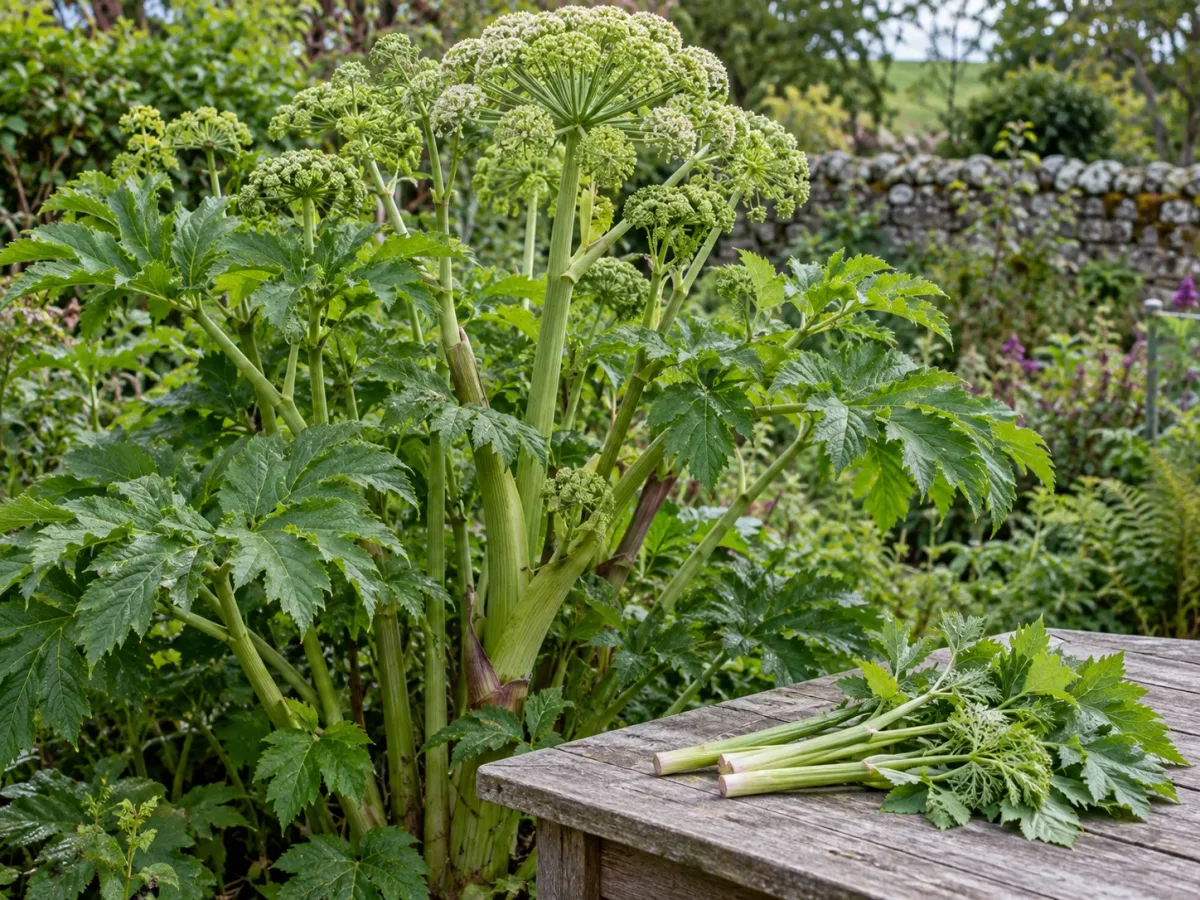
Handle angelica carefully and verify its identity
Angelica is not a plant to eat or handle carelessly just because some of its parts are used in food. NC State Extension reports low-severity poisonous characteristics, including photosensitivity and contact dermatitis, and identifies furocoumarins as the toxic principle. Sap on skin can become more problematic with sunlight exposure, so wear gloves and long sleeves when cutting or handling bruised stems, wash tools and skin afterward, and keep fresh sap away from eyes. If a skin reaction develops, get out of direct sun and seek medical guidance for severe or persistent symptoms (NC State Extension).
The more serious garden rule is not to forage an unidentified member of the carrot family. Poison hemlock and cow parsnip can be confused with angelica by an inexperienced observer, and a generic “umbrella-shaped white flowers” description is nowhere near enough for safe identification. Do not taste a volunteer, use an online image match as proof, or harvest from a roadside. If anyone ingests an uncertain plant, contact poison control or emergency services promptly. Cultivated seed with a retained label reduces confusion, but it does not eliminate the need to handle sap sensibly.
Prevent common pests and plant problems
Angelica’s biggest cultural problems begin with a mismatch between water and drainage. Yellowing and wilting in saturated ground can point to root or crown damage, while limp foliage in dry soil calls for a deep soak. Check the soil before responding: a wilted plant in wet soil needs improved drainage and removal of dead tissue, not more water. Leave enough spacing for air movement, remove fallen diseased leaves, and avoid wetting foliage late in the day when fungal leaf spots are appearing.
Aphids may cluster on tender shoots, and leaf-mining insects can mark leaves; dry weather can also favor mites. Start by checking whether the plant is still growing well and whether natural predators are present. For a small aphid colony, dislodge insects with a firm stream of water or prune an isolated infested tip. For mines or spots, remove only badly affected leaves and watch new growth. Identify a serious pest before applying any pesticide, follow the product label exactly, and avoid spraying flowers when pollinators are visiting. RHS lists aphids, slugs and snails, celery leaf-mining fly, and powdery mildew in dry summers among potential angelica problems (RHS; Cornell Cooperative Extension).
Troubleshoot slow starts and early flowering
| What you see | Likely cause | What to do next |
|---|---|---|
| No seedlings after a few weeks | Old seed, buried seed, or a surface that dried | Keep the mix evenly moist and cool; wait up to the longer germination window, then resow fresh seed if nothing emerges. |
| Seedlings emerge unevenly | Variable seed freshness or temperature | Keep the tray stable, label sowing dates, and avoid discarding late germinators too soon. |
| Seedlings wilt soon after transplanting | Root disturbance, dry root ball, or abrupt sun exposure | Shade temporarily, water the root zone, and leave the plant in place while it recovers. |
| Leaves wilt in wet soil | Poor drainage or crown/root injury | Stop adding water, improve drainage around future plantings, and remove a plant that is collapsing rather than recovering. |
| Plant flowers in its first season | A stressed or unusually mature plant, or a different growth history | Let it flower if seed is wanted; otherwise cut the stalk early and start a new seedling for future foliage. |
| Few stems in hot weather | Too much afternoon heat or drought | Add temporary shade and mulch, then water deeply; do not compensate with heavy fertilizer. |
A seed tray that has not germinated is not automatically a failure after ten days. Angelica’s schedule can stretch for several weeks, so keep notes on seed age, sowing date, chilling, and moisture. If you try again, make one change at a time—fresh seed, shallower coverage, or steadier temperature—so you learn which condition was limiting rather than repeating an uncertain method.
Early flowering is also not always a care mistake. Angelica’s flowering depends on its age and growing conditions, and the garden plant may behave as a biennial or short-lived perennial. If you need a predictable supply of tender leaves, sow replacements each year and regard flowering as the next stage of the plant rather than a problem to reverse. If flowers are the goal, keep the soil moist while the tall stalk develops and support it only if wind or a very exposed site causes leaning.
Conclusion
To grow angelica successfully, start with fresh, correctly named Angelica archangelica seed, sow it on or barely under moist soil, and give it the cool temperature changes that help it germinate. Plant seedlings in their final position while they are small, then provide rich but well-drained soil, steady moisture, and partial shade in hot climates. A deep root makes repeated moves and small pots poor bets.
Expect a leafy first year and a tall flowering second year, then choose whether to harvest young stems, save seed, or let the umbels feed insects and reseed the bed. Keep a label, use gloves around sap, and never eat a wild lookalike. Once those few constraints are built into the plan, angelica is a rewarding way to turn a damp, underused border into a fragrant, architectural herb patch.



