Carrot Care Guide: Beds, Pots and Cool Seasons
Daucus carota
Grow carrots with direct sowing, loose stone-free soil, steady moisture, proper thinning, and cultivars matched to container depth for straight roots.
Carrot Care Guide: Beds, Pots and Cool Seasons
Start with wateringThe most common care mistake for CarrotWatering guide → →Carrot care essentials
Light
Water
Keep the seedbed evenly moist until germination, then maintain moderate, steady moisture. Water deeply when the upper 2–3 cm begins to dry. Roots rot in soggy soil and become misshapen or bitter if allowed to dry out repeatedly.
Soil
Loose, stone-free sandy loam or a free-draining container mix with pH 6.0–6.8 (many cultivars tolerate 5.5–7.5). Compacted or rocky soil causes forked roots.
Humidity
Temperature
Fertilizer
A low-nitrogen, phosphorus- friendly fertilizer worked into the top few centimeters is enough for most beds.
About Carrot
Carrot is native to Europe and southwestern Asia (wild carrot); garden carrots are widely cultivated worldwide, typically reaches Feathery tops 20–45 cm tall; edible roots from baby size to 20–25 cm depending on cultivar and container depth indoors, with moderate — most varieties mature in about 65–75 days after sowing; seedlings emerge in roughly 2–3 weeks growth. Carrot has a herbaceous biennial (usually grown as an annual for the taproot) growth habit and part of the Apiaceae family. It is also known as Gajar and Garden carrot.
| Detail | Information |
|---|---|
| Also known as | Gajar, Garden carrot |
| Native region | Europe and southwestern Asia (wild carrot); garden carrots are widely cultivated worldwide |
| Mature size | Feathery tops 20–45 cm tall; edible roots from baby size to 20–25 cm depending on cultivar and container depth |
| Growth rate | Moderate — most varieties mature in about 65–75 days after sowing; seedlings emerge in roughly 2–3 weeks |
| Growth habit | Herbaceous Biennial (Usually Grown As An Annual For The Taproot) |
| Scientific name | Daucus carota |
| Family | Apiaceae |
Carrot Care Guide: Beds, Pots and Cool Seasons
Carrot care is less about pampering foliage and more about protecting an underground taproot from day one. Daucus carota is grown for that root, not for a long-lived ornamental rosette, so the winning plan is direct sowing into loose, stone-free soil, steady moisture through slow germination, and thinning without disturbing neighbors. Get those pieces right and most “mystery” failures — forked shapes, bitter flavor, or roots that never size up — become easier to diagnose.
If you are gardening in India or another warm lowland climate, add one more rule: treat carrot as a cool-season crop sown in the practical cool window, not as a monsoon or peak-summer filler beside heat-loving gourds. The Carrot plant hub summarizes species traits; this page is the full-path overview before you open topic-specific guides.
What garden carrot is and how it grows
Garden carrot is Daucus carota, a member of the carrot family (Apiaceae) bred for a sweet, storage taproot. Britannica describes the crop as a biennial herb grown for its edible root, which matches how most kitchens use it: sow, grow, harvest, then start again rather than keeping the same plant for years.
The taproot crop in the carrot family
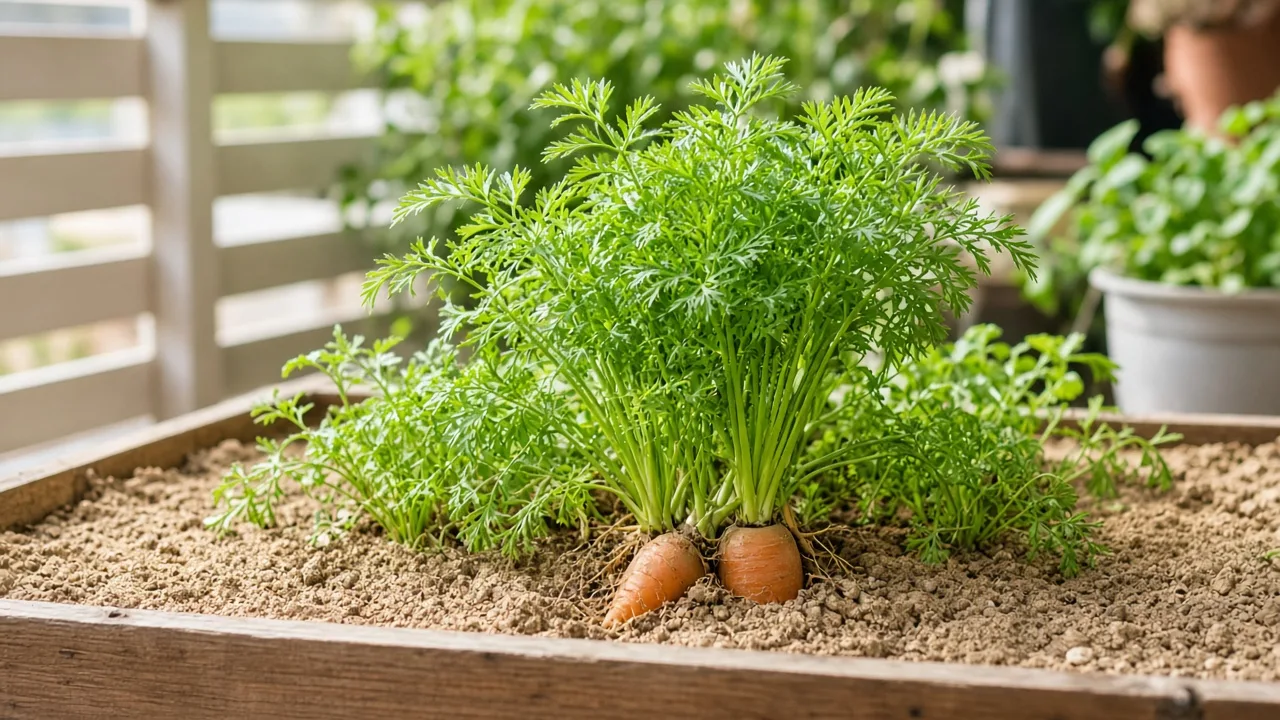
The feathery leaves you see above ground are only the visible half of the plant. Below, a single taproot elongates downward when soil is loose and competition is low. That anatomy is why carrots resent root disturbance, why stones cause forks, and why crowded seedlings make twisted roots long before any pest appears.
NC State’s profile of Daucus carota notes the species’ adaptability to soils and sun to partial shade in wild forms; garden cultivars still need bright light and a deep, fine root zone for quality roots. Do not confuse garden carrots with wild “Queen Anne’s lace” escapes — foraged look-alikes include toxic relatives such as poison hemlock, so grow and harvest only from labeled seed in clean beds.
Match the cultivar to your space and soil
Carrot cultivars differ more than color. Length, shoulder shape, and days to maturity change how much depth and working time you need. Read the seed packet as the final authority, but use two practical groups at home:
Short or round types (often marketed for containers) tolerate shallower soil if harvested young. Standard long types need a deeply prepared bed or a tall pot; forcing them into 15 cm of mix is how balconies end up with stunted or forked roots.
Depth limits for pots and shallow planters
Match pot depth to cultivar before you sow. Gardening Know How suggests at least 20 cm (8 in) for short types and 25–31 cm (10–12 in) for standard-length carrots in containers, with drainage holes mandatory so roots do not sit in soggy mix. On a terrace, a deep grow bag or tall planter is usually a better investment than a wide shallow bowl that looks generous but caps taproot growth.
In ground, the RHS warns that stony, shallow or heavy clay soil distorts long-rooted carrots — another reason to choose round or short cultivars on difficult sites. See the Carrot soil guide for mix ratios and stone-removal steps before you open a seed packet.
The best carrot season in India and warm climates
Carrots are a cool-season vegetable. Gardening Know How recommends sowing once outdoor soil is above about 50°F (10°C), with ideal germination often near **60–65°F (16–18°C)](https://www.gardeningknowhow.com/edible/vegetables/carrot/how-to-grow-carrots.htm), and notes that growth is most steady in roughly 55–75°F (13–24°C) for container crops.
India does not share one national sowing month. A Pune terrace, a Delhi raised bed, and a humid coastal plain differ in night temperature and drying speed. The transferable rule is to sow so most root filling happens while days are mild:
- Cool hill regions and north Indian winter often give the longest, most forgiving window.
- Warm lowlands usually do better in late autumn through winter, or in a brief pre-summer slot where local nights stay cool enough for germination.
- Peak summer heat commonly stalls root development even if seedlings survive; afternoon shade on containers and earlier harvest of baby roots are safer than waiting for supermarket size in hot soil.
The RHS main sowing season reference for temperate gardens (April–July) is a climate clue, not a calendar to copy verbatim in the tropics. Watch your local soil temperature and forecast, then sow small batches every few weeks inside your cool period for staggered harvests, as the RHS suggests for continuous harvests.
Carrot care at a glance
Healthy carrot foliage is fine and ferny; the diagnostic signs are underground. Before you adjust fertilizer, confirm season, depth, moisture, and spacing. If tops are lush but roots stay pencil-thin, excess nitrogen or heat is a likelier culprit than “not enough fertilizer.”
Light and temperature
Give carrots full sun where possible — about 6–10 hours of direct light daily for strong root development, per Gardening Know How’s full-sun guidance. In warming weather, morning sun with light afternoon shade on containers can reduce heat load on roots without replacing the need for a cool sowing window.
Heat management is not the same as cool-season replacement. Shade cloth or moving a pot may buy time, but it will not turn carrot into a tropical rainy-season crop. For window placement, reflectivity on terraces, and grow-light limits, use the dedicated Carrot light guide.
Water and root-zone moisture
Carrots need moderate, even moisture, especially during the 2–3 week germination period when the seedbed must not crust or dry out. After establishment, Gardening Know How’s benchmark of about 2.5 cm (1 in) of water per week is a useful starting point in active growth, while the RHS notes in-ground carrots are drought resistant and seldom need watering except in long dry spells — container growers should expect to water more often because pots dry faster.
The failure modes are symmetric: soggy soil rots roots and encourages hairy side roots; drought or wild swings crack roots and can push bitter flavor in maturing carrots. Check moisture a few centimetres below the surface rather than watering on a fixed calendar. The Carrot watering guide walks through wilt versus rot and the first fix when you are unsure.
Soil preparation, pH and spacing
Prepare soil 20–30 cm deep, rake fine, and remove stones, clods, and old roots before sowing. Target pH 6.0–6.8, with many cultivars tolerating roughly 5.5–7.5, as Gardening Know How summarizes for carrot beds. Avoid fresh high-nitrogen manure that fuels leafy tops at the expense of roots; work in mature compost instead.
Sow seed 6–13 mm deep in the final bed or pot — not in trays you plan to transplant. Space rows with room to thin; aim for roughly 5 cm between plants after thinning, in line with RHS spacing guidance. Fertility details and DIY mixes live in the Carrot soil guide and Carrot fertilizer guide.
Direct sowing, germination and thinning
Carrots are a poor transplant crop because the taproot is easily damaged. Gardening Know How is explicit: deep roots do not suit starting indoors and transplanting; wait until outdoor soil is warm enough and sow where the roots will mature.
Germination is slow — often 2–3 weeks — so keep the top centimetres evenly moist and protect the seedbed from crusting after hard rain. Seed tape or a light scatter followed by thinning both work; perfection in the row matters less than eventual spacing.
When seedlings reach roughly 8 cm tall, thin by snipping extras at soil level rather than pulling. Pulling one seedling can break the taproot of its neighbor, a common source of forked or stunted roots. Weed gently while plants are small; once foliage closes, carrots compete better but still need consistent moisture through mid growth.
For sowing technique, succession timing, and seed-saving limits, open the Carrot propagation guide. The Carrot repotting guide explains why “moving up a pot” is rarely the right frame for this crop.
Growing carrots in containers and on terraces
Containers are an excellent way to control depth and soil texture on paved terraces. Choose depth by cultivar, use a free-draining peat-free or quality potting mix with compost, and never block drainage holes. Expect more frequent watering than in-ground beds, and mulch lightly once seedlings are a few centimetres tall to slow surface drying.
In hot districts, move pots to catch morning sun, shield roots from radiant heat off walls, and harvest baby roots early rather than fighting summer stall. Round or mini cultivars are the honest choice when you only have a 20 cm pot. If you need step-by-step depth tables and mix tweaks, pair this page with the Carrot soil guide and Carrot watering guide.
Harvest timing and lifting roots cleanly
Most garden cultivars mature in about 65–75 days after sowing, though packet dates and weather always override generic ranges. The RHS harvest window of roughly 12–16 weeks for many sowings aligns with that ballpark. Harvest when roots reach usable size and flavor is sweet; oversized roots in warm soil can turn woody or less sweet.
Loosen soil with a fork before lifting, especially in clay, rather than yanking tops and snapping roots. For baby carrots, pull earlier when shoulders are finger-thick. In mild winters, some gardeners leave mature roots in place and lift as needed; avoid waterlogged soil that invites rot.
Leaf trimming for kitchen use is not the same as ornamental pruning; see the Carrot pruning guide for how to handle tops at harvest without storage mistakes.
Common carrot care mistakes
Transplanting or disturbing the taproot is the classic error — including “just moving” overcrowded seedlings. Direct sow and snip thin.
Sowing in the wrong season produces tops without filled roots. If heat arrives, harvest young or plan the next sowing for a cooler month.
Skipping soil prep guarantees forks in stony or compacted beds. Invest in raking and stone removal once per bed.
Pulling to thin breaks neighbor roots. Scissors at soil level are slower and safer.
Overfeeding nitrogen grows feathery tops and skinny roots. Fertilize lightly and only when needed; see the Carrot fertilizer guide before doubling feed rates.
Inconsistent watering splits roots and encourages hairy side roots, as the RHS notes when moisture levels vary. Containers amplify that swing — check them daily in warm wind.
Pets, foliage contact and kitchen use
Garden carrot roots are a familiar human food, but garden hygiene still matters: wash harvests, avoid soil splash, and follow any pesticide label restrictions.
For pets, the LeafyPixels hub cites ASPCA listing garden carrot (Daucus carota var. sativa) as non-toxic to cats, dogs, and horses, while noting psoralens in foliage that can irritate skin on contact. That is a reason to stop dogs from digging beds, not to panic over a small piece of washed root in moderation. Ask a veterinarian about large ingestions of tops or unusual symptoms.
When to use this page vs other Carrot guides
Use this overview to choose season, cultivar depth, and the direct-sow workflow. When one variable needs depth, open the matching topic page: light for sun and heat management, watering for moisture diagnostics, and soil for mix, pH, and stone removal.
Use fertilizer when growth is pale after temperature and water look correct. Use propagation for sowing cadence and seed handling, repotting for why carrots stay in one final container, and pruning for harvest-time top management — not hedge trimming.
Related Carrot guides
Start at the Carrot plant hub for the species profile and grower notes. Terrace growers should read Carrot watering next because pots dry faster than raised beds. Before your first sowing, read Carrot soil and Carrot propagation together — soil prep and seed placement are one continuous job for straight roots.
Conclusion
Good carrot care is season-led, depth-aware, and taproot-gentle. Sow in cool weather into loose, stone-free soil; keep seedbeds evenly moist; thin with scissors; and match cultivar length to your bed or pot. In India, success usually means using the coolest realistic local window rather than forcing carrots through peak heat.
When roots stall or fork, fix season, spacing, soil texture, and watering swings before chasing fertilizer. The cluster guides below this overview carry the step-by-step detail for each lever.
How to care for Carrot?
When should you water Carrot?
Keep the seedbed evenly moist until germination, then maintain moderate, steady moisture. Water deeply when the upper 2–3 cm begins to dry. Roots rot in soggy soil and become misshapen or bitter if allowed to dry out repeatedly.
- Feel 2–3 cm below the surface - Water deeply when the upper 2–3 cm begins to dry.
- water when that layer is beginning to dry - Water deeply when the upper 2–3 cm begins to dry.
- then drain containers fully - Keep the seedbed evenly moist until germination, then maintain moderate, steady moisture.
- Drain excess water - Water deeply when the upper 2–3 cm begins to dry.
What soil works best for Carrot?
Loose, stone-free sandy loam or a free-draining container mix with pH 6.0–6.8 (many cultivars tolerate 5.5–7.5). Compacted or rocky soil causes forked roots.
- 50% screened loam or quality potting mix - Loose, stone-free sandy loam or a free-draining container mix with pH 6.0–6.8 (many cultivars tolerate 5.5–7.5).
- 30% mature compost or leaf mold - Loose, stone-free sandy loam or a free-draining container mix with pH 6.0–6.8 (many cultivars tolerate 5.5–7.5).
- 20% coarse sand, perlite, or fine horticultural grit - Loose, stone-free sandy loam or a free-draining container mix with pH 6.0–6.8 (many cultivars tolerate 5.5–7.5).
Grower notes for Carrot
Match cultivar depth to the pot
Carrots are judged by the taproot, not the foliage. Short or miniature types suit pots 20 cm deep; standard roots need roughly 25–30 cm of loose soil. If depth is limited, choose a round or baby cultivar and harvest young instead of fighting forked roots in a shallow planter.
Direct-sow and leave the taproot alone
Garden carrots do not transplant well. Sow seed 6–13 mm deep in the final sunny bed or container and keep the top 2.5 cm evenly moist for 2–3 weeks until seedlings appear. Disturbing nearby roots when thinning or repotting is a common reason for stunted or twisted carrots.
Loose, stone-free soil is the whole game
Work soil 20–30 cm deep and remove rocks, clods, and old roots before sowing. Sandy loam or a light container mix with compost gives straight roots; heavy clay or fresh high-nitrogen manure encourages leafy tops and poor root development.
Thin by snipping, not pulling
When seedlings reach about 8 cm tall, cut extras at soil level so remaining plants stand roughly 5 cm apart. Pulling one seedling can break the taproot of its neighbor. Steady moisture and weed-free rows matter most while carrots are still small and slow.
Grow it cool for sweet roots
Carrots are a cool-season crop. They germinate once soil is above about 10°C and grow best around 13–24°C. In hot Indian lowlands, use the cooler sowing window or afternoon shade on containers so heat does not stall root filling. Most varieties are ready to pull in about 65–75 days.
Pet-aware note for Carrot
ASPCA lists garden carrot (Daucus carota var. sativa) as non-toxic to cats, dogs, and horses, but notes psoralens in the plant can irritate skin. Prevent pets from digging up beds, and do not treat garden foliage as a substitute for a balanced pet diet.
Safe for cats and dogs (with foliage caution)
ASPCA lists garden carrot (Daucus carota var. sativa) as non-toxic to cats, dogs, and horses. Foliage may contain psoralens that can irritate skin; keep pets from digging beds and ask a veterinarian about large ingestions.
Non-toxic classification applies to Daucus carota var. sativa per ASPCA; wild carrot foliage is not a salad green and can cause contact irritation. Do not confuse garden carrots with toxic look-alikes such as poison hemlock in foraged settings.
Watering Carrot
For Carrot, feel 2–3 cm below the surface; water when that layer is beginning to dry, then drain containers fully and water check daily during germination; established plants are watered by soil dryness rather than a fixed calendar — often about 2.5 cm of water per week in active growth. Sow in cool weather; increase checks in warm, windy container conditions and ease back as roots near harvest size.
| Detail | Information |
|---|---|
| How often | Check daily during germination; established plants are watered by soil dryness rather than a fixed calendar — often about 2.5 cm of water per week in active growth |
| How to check | Feel 2–3 cm below the surface; water when that layer is beginning to dry, then drain containers fully |
| Seasonal changes | Sow in cool weather; increase checks in warm, windy container conditions and ease back as roots near harvest size |
Signs of overwatering
- soft or rotting roots at harvest
- persistently wet soil with stalled seedling growth
- wilting despite a saturated root zone
Signs of underwatering
- cracked or misshapen roots
- bitter flavor in maturing roots
- dry soil pulling away from container edges
Soil & potting for Carrot
Use a mix of 50% screened loam or quality potting mix, 30% mature compost or leaf mold, 20% coarse sand, perlite, or fine horticultural grit for Carrot. Excellent drainage with a fine, deeply worked root zone; avoid heavy, wet mixes and high-nitrogen manure that favors tops over roots. Target soil pH around 6.0–6.8. Repot no routine repotting — direct-sow in the final bed or container because carrots resent root disturbance, ideally in sow in early spring as soon as soil can be worked, or in late summer for a fall crop in mild climates.
| Detail | Information |
|---|---|
| Recommended mix | 50% screened loam or quality potting mix, 30% mature compost or leaf mold, 20% coarse sand, perlite, or fine horticultural grit |
| Drainage | Excellent drainage with a fine, deeply worked root zone; avoid heavy, wet mixes and high-nitrogen manure that favors tops over roots |
| Soil pH | 6.0–6.8 |
| Repotting frequency | No routine repotting — direct-sow in the final bed or container because carrots resent root disturbance |
| Best season to repot | Sow in early spring as soon as soil can be worked, or in late summer for a fall crop in mild climates |
Signs it needs repotting
- seedlings are overcrowded and need thinning rather than transplanting
- the container is too shallow for the cultivar you chose
- stones or compaction appear after the first thinning
Humidity & temperature for Carrot
Fertilizer & pruning for Carrot
Use a low-nitrogen, phosphorus- friendly fertilizer worked into the top few centimeters is enough for most beds. for Carrot.
| Detail | Information |
|---|---|
| Fertilizer type | A low-nitrogen, phosphorus- friendly fertilizer worked into the top few centimeters is enough for most beds. |