Root Rot on Brinjal: Wet-Soil Wilt & Rescue
Quick answer
Root rot on brinjal usually follows saturated mix while the plant still needs steady moisture for fruit. First step: stop watering, check the upper 2–3 cm and pot weight, and press the stem base for softness before adding more water or feed.
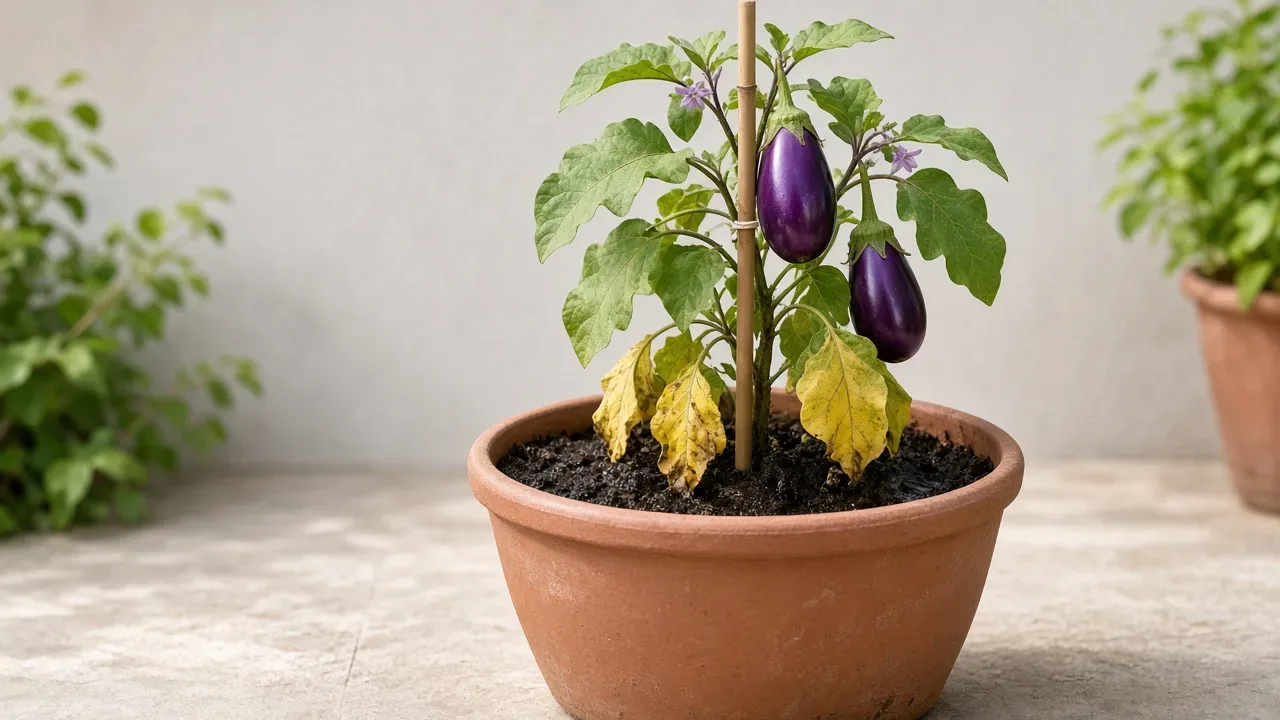
Root Rot on Brinjal: Causes, Checks & Fixes
This guide covers root rot on Brinjal. See also the general Root Rot guide, watering, and light pages for this plant.
Root Rot on Brinjal: Causes, Checks & Fixes
Quick answer
Root rot on Solanum melongena (brinjal, eggplant, aubergine) is root and stem-base failure from chronically wet, low-oxygen soil—not every yellow leaf on a fruiting nightshade. Brinjal needs moist, well-drained, fertile soil and a steady supply of moisture while it crops, which pushes many growers toward daily watering in heat. When drainage fails or monsoon rain stacks on top of irrigation, the same habit that supports fruit can leave the root zone saturated for days.
For how chronic wet mix destroys roots in general, see our root rot guide. On brinjal, the warning pattern is wilt or yellowing lowers on soil that stays wet, a heavy pot, sour smell at the drain hole, and softening at the stem base while upper fruit may still look fine.
First step: stop all watering and empty saucers or cachepots. Then check the upper 2–3 cm with your finger, lift the pot for weight, and press the stem base gently. Soft tissue on wet mix means unpot and inspect roots the same day—do not add water, fertilizer, or fungicide first.
When to use this page vs other Brinjal guides
| What you see | Read next |
|---|---|
| Wet heavy pot, yellow lowers, soft stem base (this page) | Stay here for unpotting and rescue |
| Wet mix but roots still mostly firm | Overwatering on Brinjal — dry-down pause may be enough |
| Limp leaves on a light, dry pot | Underwatering or wilting |
| Midday wilt that recovers overnight on dry soil | Wilting — heat stress vs rot |
| Surface mold, gnats, firm stem | Mold on soil or fungus gnats |
| Lower yellow only, firm stem, neutral smell | Yellow leaves — senescence vs root failure |
Browse the full cluster on the Brinjal problems hub when symptoms overlap.
What root rot looks like on Brinjal
Brinjal is a warm-season Solanaceae crop with broad leaves, a thick stem, and heavy fruit on side branches—often staked in pots at least 30 cm wide. Root rot hides under that canopy: the top may still carry glossy fruit while lower leaves yellow and the stem base weakens underground.
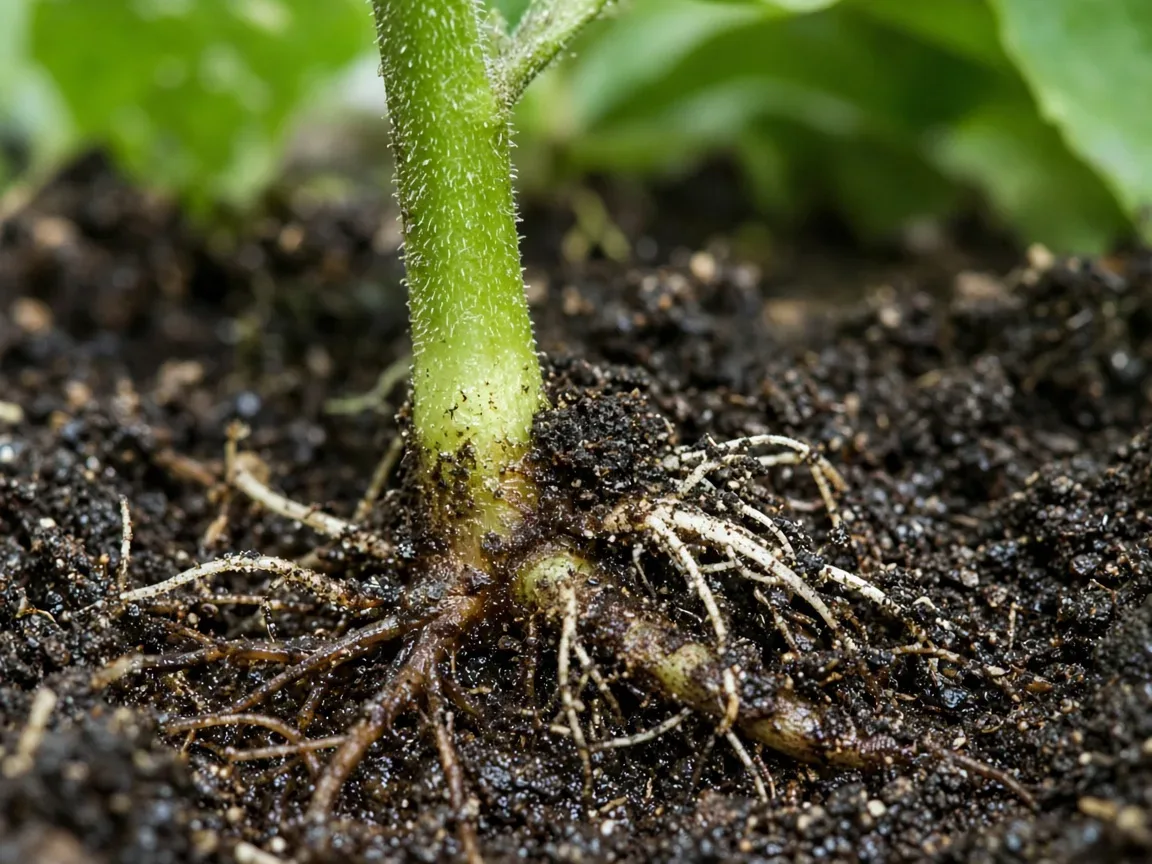
Root rot at the brinjal stem collar—darkened soft tissue where the stem meets damp mix, with brown slimy root tips visible after gentle unpotting.
Early signs
- Yellowing lower leaves while the upper 2–3 cm of mix feels moist or wet for many days
- Midday limpness that does not match a dry pot—leaves hang despite a heavy container (irregular watering can contribute to root rot)
- Sour or musty smell from drainage holes when you tilt the pot
- Stalled new side shoots or flower drop while soil stays damp (moisture stress during fruiting reduces yield)
- Fungus gnats over constantly wet surface mix
- Quick unpotting shows brown, mushy, or hollow roots; healthy brinjal roots are firm and pale
Advanced signs
- Soft, dark stem base at or just above the soil line; stake ties may sink into weakened tissue
- Whole-plant wilt on soggy mix because decaying roots cannot move water upward—same visual as drought, opposite soil condition
- Fruit sunscald or odd texture when leaf cover collapses; Utah State notes irregular watering can toughen fruit
- Most roots slimy on inspection; only a short stub of firm tissue remains
- Collapse within days after cool cloudy weather when evaporation slowed but irrigation continued
Lower leaves that fully yellow rarely re-green. Judge recovery by new shoots, firm upper stems, and stable flowering—not by saving every old leaf.
Monsoon and fruit-set watering trap
Brinjal growers are told—correctly—that flowering and fruit filling need steady moisture. RHS guidance for aubergines stresses a steady supply, and containers may need daily watering in hot weather. That advice becomes dangerous when monsoon rain, humid cloudy spells, or a oversized pot keep the root zone wet long after you stop the hose.
The failure mode looks like care, not neglect: you water “for the fruit,” the surface dries briefly, but the core of a large plastic pot stays saturated. Brinjal’s broad leaves still transpire in heat, so you see wilt and assume thirst—then add more water to a root zone that already lacks oxygen. Saturated mix deprives roots of oxygen and kills fine roots first, so the plant wilts exactly like a dry one.
Count rain as irrigation. During monsoon, check below the surface before every drink. Raise pots on feet, clear blocked holes, and pause feeding until moisture rhythm stabilises—details in the Brinjal watering guide.
Why Brinjal gets root rot
Primary triggers on this species are waterlogging and poor drainage, sometimes with soil-borne fungi attacking roots already weakened by anaerobic conditions. NC State lists brinjal for good drainage with moist soil—not permanently wet soil.
Common brinjal-specific setups that lead to rot:
- Calendar watering through a cloudy monsoon week while the upper 2–3 cm never truly dries
- Saucers and cachepots holding runoff after each deep drink on a patio container
- Final pot too large too early—outer volume stays wet for weeks while roots occupy only the centre (restricted roots in undersized pots stress plants; oversized wet outer zones invite rot)
- Heavy compost-rich mix without perlite or sand in a plastic pot that dries slowly
- Reused nightshade bed or old tomato-chilli mix with poor structure after a wet season
- Cold, wet roots after transplanting into cool soil—growth stalls while mix stays damp
Large-fruited cultivars on a single stem concentrate weight on a narrow root plate; any stem-base softening is serious because the whole crop hangs from that point.
Nightshade rotation and reused container mix
Brinjal shares Solanaceae soil issues with tomato, chilli, potato, and pepper. Utah State recommends rotating eggplant to ground where solanaceous crops were not grown in the preceding three years to reduce carry-over of shared soil-borne problems. In a balcony garden, “rotation” means fresh mix or a different container, not the same waterlogged soil after a failed tomato.
If last season’s pot grew another nightshade, assume the mix may be compacted, salt-loaded, or harbouring pathogens that attack stressed roots. Root rot after rotation failure often shows as wilt on wet soil within weeks of transplant, with roots brown far from the stem even when you watered carefully. When salvage is uncertain, restarting from seed in clean mix—see Brinjal propagation—can beat nursing a collapsing stem through fruit set.
Stem-collar check on a staked brinjal
Unlike a trailing houseplant, brinjal is usually tied to a stake as fruit loads. Root rot often appears first at the collar—the stem segment buried at transplant depth or piled with mulch—not at the leaf tips.
Before unpotting:
- Slip ties down and inspect the stem 2 cm above and below the soil line.
- Press with a fingernail—firm green tissue is reassuring; soft brown tissue is rot.
- Look for mulch or compost mounded against the stem; brinjal should not be buried deeper than it was in the nursery pot (transplant at the same depth).
- Compare sides—the side pressed against a hot wall or plastic saucer often rots first.
If the collar is firm but roots are mushy, you may save the plant by trimming below. If the collar is soft, recovery through the main stem is unlikely; take healthy 10–15 cm side-shoot cuttings only if tissue above the rot is still firm, or sow a backup seedling while the season allows.
How to confirm the cause
Work through this order before repotting or feeding:
- Pot weight — Heavy with limp leaves suggests saturation or failed roots, not thirst.
- Moisture at 2–3 cm — Use a finger or skewer; wet deep mix with a dry crust is common in large containers.
- Wilt pattern — Whole-plant limpness on wet mix for 48+ hours strongly suggests rot. One yellow lower leaf on firm stems may be normal senescence.
- Stem base and smell — Soft collar or sour odor moves you from suspicion to confirmed rot.
- Drainage — Holes open? Standing water in saucers? Drainage holes are necessary so roots do not stand in water and develop root rot.
- Root inspection — Slide the root ball out. Rotted roots are brown, slimy, or hollow; firm white roots support a milder diagnosis.
- Recent history — Monsoon week, moved to shade, or doubled watering when fruit set are common triggers.
Confirmed rot: wet mix throughout, soft stem base or mostly mushy roots. Possible early uptake failure: wet mix but mostly firm roots and neutral smell—stop watering, improve airflow, re-check in 48 hours before aggressive trimming.
First fix for Brinjal
Stop watering immediately. Move the pot to full sun with good air movement if it was in a stagnant corner, and empty every saucer. Do not fertilize, prune heavily, or spray fungicide on reflex.
- Early wet-soil stress, firm stem, mostly firm roots — Hold water until the upper half of the mix dries; confirm drainage; follow the dry-down rhythm in Brinjal watering.
- Sour smell, soft stem base, or mushy roots on a quick peek — Unpot within 24 hours and start the rescue steps below.
The critical mistake on brinjal is watering because fruit or flowers “need moisture” when the pot is already heavy—that deepens anaerobic conditions at the collar.
Step-by-step rescue
When inspection shows decay:
- Unpot on a tarp — Brinjal leaves and stems contain toxic alkaloids; wear gloves when handling damaged tissue and keep pets away from prunings.
- Shake off wet mix — Rinse roots gently with lukewarm water only if you need to see extent of damage.
- Trim all mushy roots — Cut brown or slimy roots back to firm white tissue with clean, sharp scissors. Sterilise blades between cuts on badly infected plants.
- Assess the stem — If the collar is firm above the damage line, the plant can stay on the stake. If the collar is mushy, discard the base and rely on cuttings or a new seedling.
- Air-dry briefly — Let trimmed roots and any stem cuts sit 1–2 hours in shade so surfaces callus slightly.
- Repot into fresh mix — Use the Brinjal soil balance (potting mix, compost, perlite or sand) in a pot sized to the trimmed root mass, not the former canopy. Open drainage holes are mandatory.
- Re-stake lightly — Support the stem without crushing the collar; follow Brinjal repotting timing if the plant was recently moved.
- Hold water — Wait until the upper 2–3 cm of new mix dries before the first thorough drink unless leaves are severely limp and the new mix is bone dry.
Do not stack repotting, hard pruning, relocation, and fertilizer on the same day.
Recovery timeline
Mild cases — After trim and repot, the pot should feel lighter on a predictable schedule within one to two weeks. Look for stopped spread of yellowing and new side shoots within two to four weeks in warm sun.
Moderate cases — Expect three to six weeks before flowering and fruit set look normal. Old yellow leaves may not recover; that is cosmetic.
Collar involvement — When the stem base is mushy through the grafted depth, the main plant is often not saveable. Start a backup via propagation if the season still has heat.
Worsening signs — Stem softening climbs, wilt spreads after repot, or no firm new growth appears after four weeks of corrected care.
Lookalike symptoms
| Pattern | Likely cause | Key check |
|---|---|---|
| Limp leaves, wet mix, heavy pot | Root rot or uptake failure | Mushy roots, sour smell |
| Midday wilt, dry mix, light pot | Underwatering / heat | Soil dry 2–3 cm down |
| Wilt right after repot | Transplant stress | Firm collar; wait 5–10 days |
| Lower yellow, wet mix, firm roots | Overwatering early stage | Trim watering before rot |
| Yellow with purple veins, not wet | Nutrient or pH issue | See yellow leaves |
| Speckled leaves, webbing | Spider mites | Inspect undersides |
What not to do
- Do not keep watering for fruit when soil is already wet—watering rotting roots worsens the problem
- Do not repot into a much larger pot as a rescue; extra wet volume invites repeat rot
- Do not use dense garden clay without compost and aeration in containers
- Do not fertilize until new growth resumes; salts stress damaged roots
- Do not mound mulch against the stem “to keep moisture” during monsoon
- Do not assume every limp leaf is rot—run the wet-vs-dry check on wilting first
How to prevent root rot next time
Match watering to how your pot dries in your weather, not a calendar. In hot fruiting weather, deep, consistent irrigation matters—but only when the upper 2–3 cm has begun to dry. Pair that rhythm with:
- Drainage holes and empty saucers within 30 minutes of watering
- Airy container mix from the soil guide—not straight heavy compost
- Pot size matched to cultivar—final containers at least 30 cm wide, but not enormous relative to roots
- Full sun and airflow so the plant uses water steadily (Brinjal light)
- Fresh or rotated mix for nightshades each season when possible
- Early warning from fungus gnats or mold on soil on chronically wet surfaces
When to worry
Escalate immediately if the stem base softens, most roots are mushy, wilt spreads through the canopy on soggy mix, or the plant collapses further after you stopped watering and cleared drainage.
Lower urgency when only one or two lower leaves yellow, the collar is firm, smell is neutral, and roots are mostly pale on a quick check—you may still be in early overwatering, not advanced rot.
Conclusion
Root rot on brinjal is a drainage and timing problem on a crop that genuinely needs moisture while fruiting: wilt on wet soil, sour mix, and a soft stem base tell the story. Stop watering, confirm with depth checks and unpotting, trim decay, repot into appropriately sized airy mix, and judge success by new shoots and stable flowering. When the collar is lost, a clean restart through seed often beats forcing a collapsing stem through harvest. For day-to-day prevention, pair full sun with the moisture checks in the watering guide—and use wilting when you are still deciding wet versus dry.
Related Brinjal guides
- Brinjal overview — cultivar size, warmth, and seasonal planning
- Brinjal problems hub — all common issues on this species
- Brinjal watering — 2–3 cm checks, monsoon, and fruit-stage rhythm
- Brinjal soil — mix, pH, and rotation after other nightshades
- Overwatering on Brinjal — when roots are still firm
- Yellow leaves on Brinjal — lower-leaf yellow without confirmed mush
Related tool
Use the Root Rot Risk Checker to narrow causes for root rot on this plant before changing multiple variables at once.