Underwatering on Brinjal: Dry Pot & Midday Wilt Fixes
Quick answer
Underwatered brinjal wilts in hot sun, drops open flowers and small fruit, and sits in a feather-light pot with dusty dry mix at 2–3 cm depth—often with soil pulled from the rim. First step: water deeply once until it drains freely, then resume the brinjal dry-down check instead of sprinkling the surface.
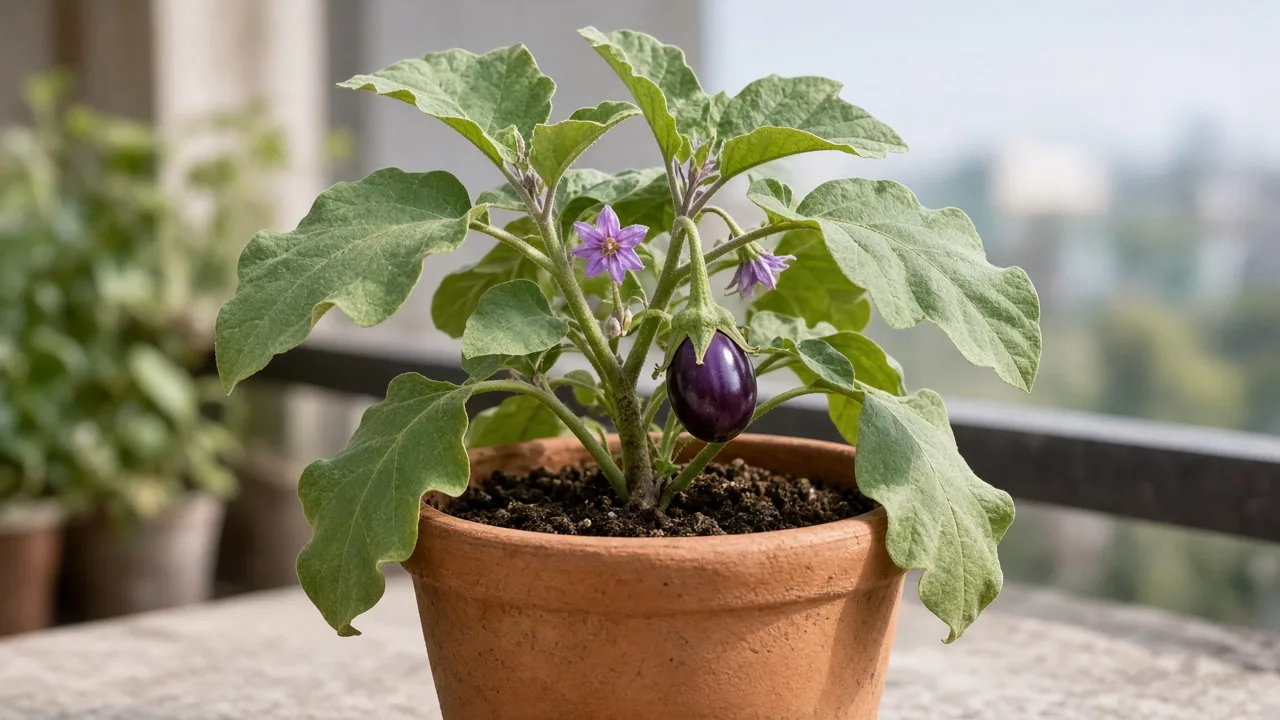
Underwatering on Brinjal: Causes, Checks & Fixes
This guide covers underwatering on Brinjal. See also the general Underwatering guide, watering, and light pages for this plant.
Underwatering on Brinjal: Causes, Checks & Fixes
Quick answer
Brinjal (Solanum melongena) is a warm-season nightshade that moves a lot of water through large, lobed, often fuzzy leaves while flowers and fruit load the plant. When the root zone stays dry too long, you see midday wilt, dull foliage, dry mix pulled from the pot rim, and dropped flowers or small fruit—not the yellow lower leaves of a soggy pot.
For how chronic dry mix limits water uptake in general, see our underwatering guide. On brinjal, the pattern almost always traces to a missed drink on a fruiting container, a calendar watering habit during dry summer heat, peat-heavy mix that repels water after drought, or a pot that is too small for a vigorous cultivar—not a mysterious leaf disease.
First step: confirm the upper 2–3 cm is dusty-dry and the pot feels light, then water deeply once until water runs freely from the drainage holes and the saucer is emptied. One soak that rewets the whole root ball beats several shallow sprinkles that only darken the surface. After that, return to the brinjal 2–3 cm dry-down check—do not feed, repot, or prune heavily on the same day.
When to use this page vs other Brinjal guides
| Pattern | Read next |
|---|---|
| Midday wilt, light pot, mix pulled from pot edge | This page — thirst on dry mix |
| Yellow lower leaves, heavy wet pot, soft stem base | Overwatering |
| Wilt on wet mix or sour smell at collar | Root rot |
| Wilt plus stippling and fine webbing on undersides | Spider mites |
| Bleached sun-facing lobes while mix is slightly cool | Light / heat stress |
| Crisp lobe tips only, stem still firm | Brown tips |
| General wilt triage (wet vs dry) | Wilting |
What underwatering looks like on Brinjal
Brinjal shows drought early because it crops in full sun with broad leaves and constant new shoots. NC State Extension describes eggplant as a full-sun plant that prefers moist, well-drained, fertile sandy or loamy soil—on a patio or balcony, that biology reads as visible wilt long before the plant dies.
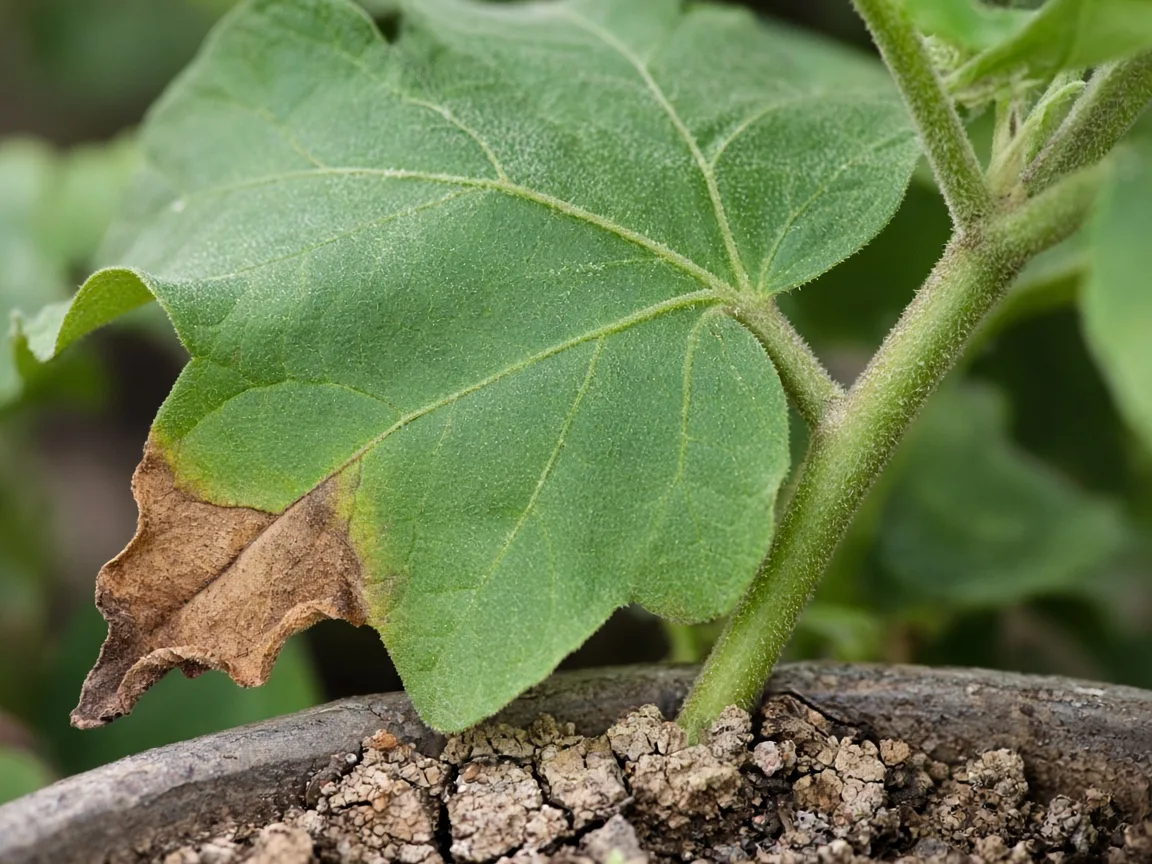
Dry mix shrinking from the pot rim and dull lobe tips on brinjal—dead edge tissue will not re-green; watch the next fuzzy flush for turgid leaves.
Typical underwatering signs:
- Midday wilt on large lobes that may still look green but feel thin and limp in hot afternoon sun
- Wilt that is still obvious after sunset when the upper 2–3 cm of mix is dusty-dry and the pot feels light
- Soil pulled away from the container rim and a pale, cracked surface on peat-heavy mix
- Flower drop or aborted small fruit after a dry day or two during active flowering—common on fruiting nightshades when moisture swings
- Dull, matte leaves and dry brown lobe tips on older foliage after repeat dry cycles—often overlaps brown tips but the pot weight confirms thirst
- Water running straight through the pot without wetting the center—hydrophobic mix after prolonged dryness
What underwatering is not: yellowing lower leaves on cool, clinging wet mix (overwatering), collapse with soft stem base and sour smell (root rot), or stippling with webbing on undersides (spider mites).
Fruiting containers and the 2–3 cm dry-down
This section is brinjal-specific—it would not apply to a snake plant or a fern crown.
Once purple flowers and small glossy fruit load the plant, transpiration jumps. RHS guidance for aubergines notes that plants need a steady supply of moisture to crop well and that container plants are particularly susceptible to drying out, sometimes needing daily watering in hot weather. Brinjal growers often water on a weekday calendar; the better signal is the upper 2–3 cm from the watering guide.
When that layer goes dusty-dry while fruits swell, midday wilt can appear within hours even though the main stem still feels firm. A 30 cm-wide patio pot with a vigorous cultivar may need water every day in dry Indian summer heat, then stay wet for days during monsoon cloud cover—underwatering after a dry spell means one deep soak; thirst on wet mix means stop topping up and read overwatering instead.
Flower and fruit drop when the pot runs dry
Another eggplant-only clue is reproductive abort—not just limp leaves.
Uneven moisture during flowering and fruit filling can reduce the crop on solanaceous vegetables. UF/IFAS notes that eggplant prefers evenly moist soil and that very hot or dry conditions can affect fruit quality and flavor. On brinjal, owners often report open flowers falling or pin-head fruit shriveling after a missed watering on a sunny balcony while lower leaves still look green.
If flower drop happens on moist mix with a heavy pot, suspect heat stress or pests before you add more water—see light and aphids. If drop follows a light pot and rim-gap dry mix, rehydrate once and watch the next flower cluster; buds that already aborted will not reopen.
Dry summer vs monsoon: calendar traps on Brinjal
This rhythm is specific to warm-climate brinjal culture in pots and terrace beds.
Growth is strongest around 21–29°C with at least six hours of direct sun—see the overview and light guide. In pre-monsoon heat, a fruiting container can go from moist to bone-dry in one windy afternoon; waiting for “watering day” causes repeat midday wilt and tip burn. During monsoon humidity, the same pot may stay wet for days while leaves still wilt in a brief sunny break—dry-down at 2–3 cm separates true thirst from a temporarily dry surface over a saturated root ball.
Match soil that holds moisture without waterlogging: heavy compost without enough perlite dries slowly when wet but can also repel water once it bakes dry—then drought stress returns even after you sprinkle the top.
How to confirm underwatering (before you change anything)
Work in this order so you do not drown a plant that is actually suffocating in wet mix:
- Lift the pot an hour after your last watering and again now—underwatered brinjal feels dramatically lighter.
- Probe the upper 2–3 cm with a finger or skewer—dusty, crumbly, no cool clinging layer means thirst.
- Check the rim gap—mix shrunk from the sides is a strong drought signal on containers.
- Note time of day—midday wilt on dry mix that eases after a soak points here; wilt on wet mix at dawn points to roots or disease.
- Inspect newest shoots—firm fuzzy growth starting to droop on dry mix fits underwatering; soft base on wet mix does not.
Inconsistent water availability causes multiple crop problems in the tomato-pepper-eggplant family—brinjal is in that group, so confirm one primary water pattern before you stack fixes.
The first fix to try
After dry mix at 2–3 cm and a light pot, water deeply once until water exits the drainage holes, then empty the saucer.
Use lukewarm water if the mix has gone hydrophobic; slow pours or two short passes five minutes apart may be needed so the center rewets. Deep irrigation that wets the root zone thoroughly beats shallow sprinkles for solanaceous crops. Stop there for 24 hours and re-check the dry-down—your only job next is to see whether midday wilt eases and new shoots stay turgid.
Do not fertilize a wilted brinjal to “ perk it up,” do not repot on day one, and do not strip half the leaves unless you have confirmed severe root failure elsewhere.
Step-by-step recovery (after the first soak)
If the first deep drink helped but the plant still looks stressed:
- Set a dry-down routine from the watering guide—daily checks in hot fruiting weather, slower cadence in cool cloudy weeks.
- Break hydrophobic mix by rewetting slowly; refresh the top third of peat-heavy mix at repot time if water always tunnels down the sides—see soil and repotting when roots fill the pot.
- Move off hot reflected paving if leaves bake while mix dries twice as fast—pair with light adjustments, not extra feed.
- Mulch the surface on in-ground beds (not piled against the stem) to slow evaporation during dry spells.
- Resume feeding only after new growth looks firm for a full week—follow the fertilizer guide so you do not push soft growth during recovery.
Recovery timeline
Hours: Midday wilt on dry mix often eases the same evening after one thorough soak if stems stay firm.
Days: New fuzzy leaves should open with a glossy, turgid look within 3–7 days once moisture stays even. Old crisp lobe tips stay tan.
Weeks: If repeat dry cycles dropped flowers, expect 1–3 weeks before the next reliable fruit set after steady watering—fruit already shriveled will not refill.
Worsening signs: wilt persists after a good soak on previously dry mix, yellow lower leaves on wet soil, or soft collar—shift to overwatering or root rot.
Lookalike symptoms
| What you see | Likely cause | Next check |
|---|---|---|
| Afternoon wilt, light pot, dry 2–3 cm | Underwatering | Deep soak, then dry-down routine |
| Wilt at midday, heavy pot, wet 2–3 cm | Overwatering / poor roots | Overwatering |
| Sun-facing bleached lobes, mix slightly cool | Heat / scorch | Light |
| Stippling, webbing, dusty undersides | Spider mites | Spider mites |
| Slow growth, pale new leaves, wet mix | Not enough light or nutrients | Not enough light, fertilizer |
Mistakes to avoid
- Sprinkling the surface every morning while the root ball stays dry in the center.
- Assuming wilt always means “add water” when the pot is heavy and mix clings— that path worsens root rot.
- Feeding wilted plants before moisture is stable—nightshade tips burn easily on stressed roots.
- Repotting into a much larger pot as a first response; fix the watering signal on the current container unless roots are truly root-bound per repotting.
- Ignoring cultivar size—a compact brinjal in an oversized dry pot is rare; a vigorous type in a too-small pot dries out faster than a calendar allows.
How to prevent underwatering next time
- Water when the upper 2–3 cm dries, not on a fixed weekday—RHS container guidance applies directly to fruiting aubergines in pots.
- Expect daily checks on fruiting containers in hot dry weather; relax when monsoon humidity keeps mix wet longer.
- Use moisture-retentive, well-drained mix from the soil guide and a final pot at least 30 cm wide for standard cultivars on the overview.
- Keep six or more hours of direct sun but shade pots from reflected afternoon heat that doubles evaporation.
- Scout weekly during peak summer—catch a light pot before flowers drop.
When to worry
Treat as urgent if the plant collapses in afternoon heat with bone-dry mix, if every flower aborts during peak fruit set, or if young fruit shrivels while the pot feels empty—rehydrate the same day.
Lower urgency: slight midday droop that recovers by evening when mix is only slightly dry at the surface but cool below—adjust timing, not panic.
Escalate to problems hub triage if wilt persists after a confirmed deep soak on dry mix, or if stems soften on wet soil.
Conclusion
Underwatering on brinjal is a water-volume and timing problem on a thirsty cropping nightshade, not a death sentence. Solanum melongena tells you early with light pots, rim-gap dry mix, midday wilt, and dropped flowers while stems are still firm. Run the 2–3 cm dry-down, deliver one deep soak, and read the next fuzzy shoots and flower clusters for the verdict. Old crisp lobes stay damaged, but turgid new growth means you found the right lever—then fold the habit back into everyday Brinjal care.
Related Brinjal guides
- Brinjal overview — cultivar size, heat, and cluster map
- Brinjal watering — 2–3 cm check and seasonal rhythm
- Brinjal soil — moisture retention without waterlogging
- Brinjal light — full sun vs scorching reflected heat
- Overwatering on Brinjal — when wet mix, not thirst, drives wilt
- Brinjal problems hub — all common issues on this crop
Related tool
Use the Plant Watering Calculator to narrow causes for underwatering on this plant before changing multiple variables at once.