Brinjal Repotting: Seedlings, Pots & Transplanting
Brinjal Repotting: Seedlings, Pots & Transplanting
Brinjal Repotting: Seedlings, Pots & Transplanting
Brinjal does not need routine repotting for years like a foliage houseplant. Solanum melongena is usually raised as a warm-season crop: a seedling may move once from a cell or seed tray into a small individual pot, then once more into its final container or garden position. The aim is uninterrupted root growth without leaving a small plant marooned in a large mass of wet mix.
That distinction matters on an Indian balcony or terrace. A vigorous long-fruited brinjal, a stocky Thai type, and a compact patio cultivar do not make the same root system or carry the same fruit load. Choose the final pot and support from the cultivar label and expected mature habit, then make the last move before flower and fruit production make root disturbance costly.
The short answer
Pot up a brinjal seedling after it has true leaves and its roots hold the plug together, but before roots form a dense mat around the container. The University of Maryland’s eggplant production guidance says seedlings can move into 5 cm or larger pots after the first true leaves appear (University of Maryland Extension). Use a modest interim pot, maintain warmth and bright light, and do not bury the stem deeper than it previously grew.
Before the final outdoor move, harden the plant gradually and wait for warm nights and warm root-zone conditions. Penn State recommends planting when night temperatures are consistently above 13°C (55°F) (Penn State Extension); in frost-free India, use the same principle rather than the frost calendar—avoid a cool winter spell, a cold saturated monsoon week, or any period when the plant has stopped active growth.
Repotting versus transplanting brinjal
For brinjal, potting up means moving a young seedling into a slightly larger nursery pot so it can build a cohesive root ball. Transplanting is the final move into a large container, raised bed, or open ground. A container-grown crop may stay in that final pot for the rest of the season; repeated moves after flowering offer little benefit unless drainage has failed or the plant is genuinely rootbound.
Brinjal is commonly grown from transplants because it is cold-sensitive and needs a long warm season. Illinois Extension advises setting transplants out only after soil has warmed because eggplant is more vulnerable to low-temperature injury than tomato (University of Illinois Extension). Treat warmth as part of repotting technique: perfect root handling cannot compensate for putting a tender seedling into cold, waterlogged media.
Pot up seedlings before they become rootbound
Move crowded seedlings into individual pots while the roots are white or tan, branching, and just beginning to reach the plug edge. Do not wait until growth stalls, irrigation runs straight through, or roots circle repeatedly at the base. RHS guidance recommends transplanting while roots have just filled the existing medium and before young vegetables become hard to water without wilting (Royal Horticultural Society).
If several seedlings share one tray cell, separate them when small. Hold each by a leaf rather than squeezing the stem, tease roots apart with a label or dibber, and discard weak, damaged, or diseased seedlings. Brinjal stems become tougher with age, but its productive clock is still set back when a rootbound plant must rebuild torn roots before it can resume top growth.
Read the roots and true leaves, not just seedling age
Seed packets give a useful sowing calendar, but readiness is visible. A suitable plant has at least its first true leaves, a short sturdy stem, and a root system that holds the medium together when the cell is eased out. Penn State similarly advises moving seedlings to larger pots once true leaves appear and keeping bright overhead light on them (Penn State Extension).
Delay pot-up if only cotyledons are present, the stem base looks pinched, the mix smells sour, or roots are barely visible. Moving too early makes the fragile root zone fall apart. Move promptly if roots emerge through drainage holes, lower leaves pale despite normal feeding, or the plug dries much faster than neighbouring seedlings.
Choose an interim pot that protects the young root ball
An interim pot around 7.5–10 cm wide is enough for most home-raised seedlings after a cell tray. It should have open drainage holes and contain fresh seedling or potting mix, not heavy garden soil. The aim is a small increase in root space—not the final harvest container while the plant still has only a few leaves.
Overpotting leaves a ring of uncolonised medium that can remain wet around a small root ball. The RHS explains that excess fresh compost dries slowly because there are too few roots using its moisture and recommends increasing pot diameter by only about 2.5–5 cm at a time for ordinary potting-up (RHS overpotting guidance). Brinjal grows quickly in warmth, so you can skip the interim stage only when a sturdy plug is ready for its final, warm, actively managed container.
How to pot up a brinjal seedling
Water the seedling several hours before moving it so the plug is moist but not dripping. Pre-fill the new pot, make a hole the size of the plug, and ease the seedling out from below rather than pulling the stem. If roots lightly circle the outside, loosen only the outermost strands; do not wash away the mix or aggressively comb a healthy young root ball.
Set the seedling at the same depth, firm the mix gently, and water once to settle gaps. RHS transplant guidance specifically advises planting pot-raised vegetables no deeper than they stood in the original container (Royal Horticultural Society). Return the pot to bright light and shelter it from hard midday sun for a day, then restore its normal high-light conditions so the stem does not stretch.
Harden brinjal before the final outdoor move
Hardening is a gradual change from protected nursery conditions to outdoor sun, wind, and faster moisture loss. Over 7–14 days, begin with one or two hours in bright shade or gentle morning sun, then lengthen exposure each day. Bring plants back under shelter for harsh afternoon heat, strong wind, heavy rain, or an unusually cool night, and keep the root ball moist without deliberately wilting it.
The RHS recommends about two weeks of cooler, better-ventilated conditions for greenhouse-raised vegetable transplants (RHS transplanting advice). In hot Indian weather, “hardening” does not mean baking a seedling dry. Its purpose is acclimation: add direct sun in steps, expose it to natural air movement, and practise the watering rhythm the final site will require.
Choose the final container by cultivar and crop load
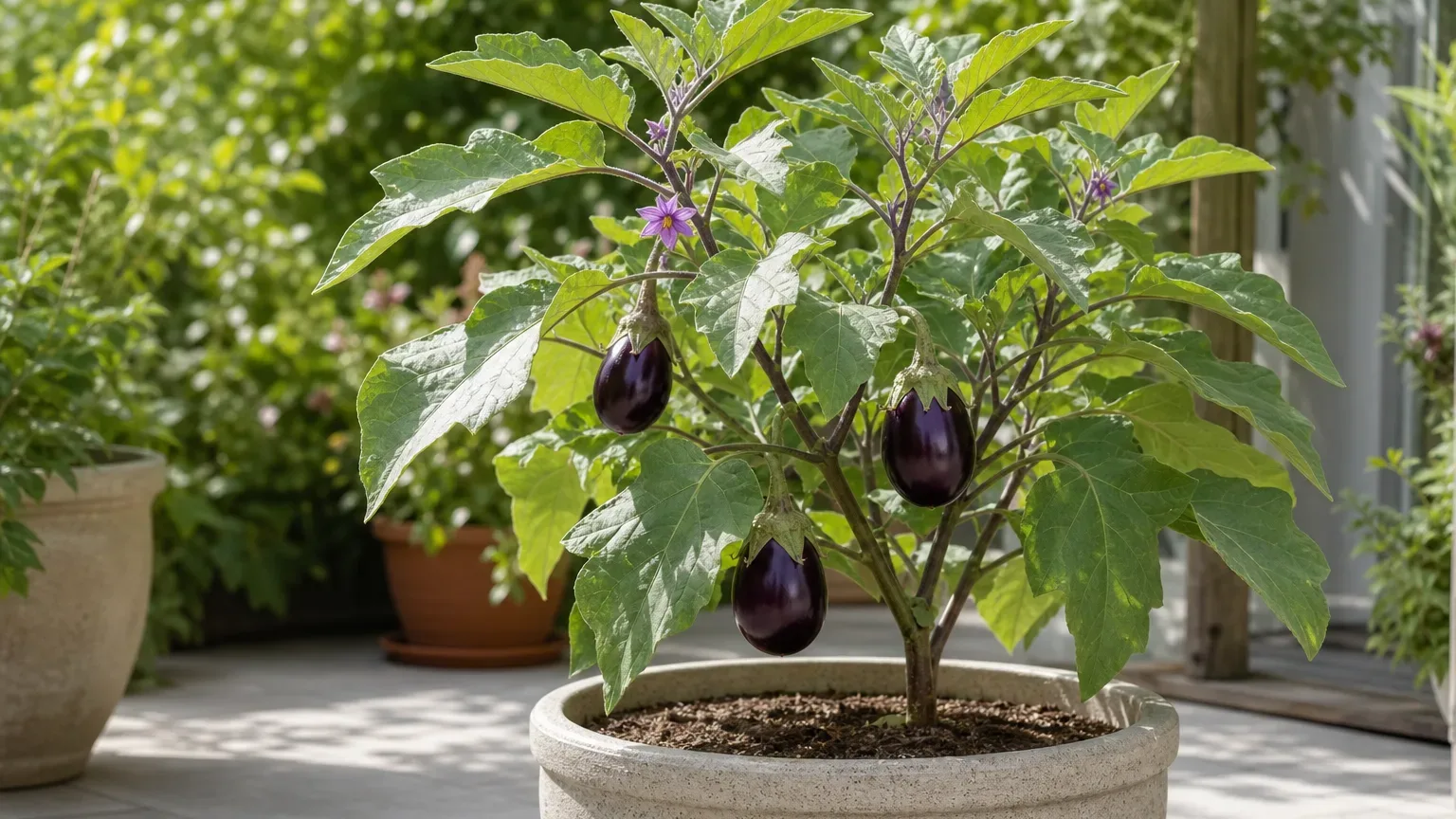
Use 30 cm width as a minimum, not a universal ideal. A compact small-fruited cultivar can finish in a container roughly 30–35 cm wide and deep if drainage and watering are reliable. A vigorous, tall, or large-fruited selection deserves a 40–50 cm container or approximately 20–30 litres of usable mix, plus a stable base that will not tip when branches carry fruit.
One brinjal per final container is the safest rule. Multiple plants in one modest pot compete for water and make staking difficult. Penn State lists compact cultivars such as ‘Calliope’, ‘Fairy Tale’, and ‘Patio Baby’ as suitable for containers, while ‘Rosa Bianca’ is presented as better suited to a garden bed (Penn State Extension); cultivar habit, not fruit colour alone, should decide the setup.
Compact, Indian, Thai, and large-fruited plants need different space
“Brinjal” covers round green Indian fruits, long purple Asian types, white forms, stocky Thai types, and large oval cultivars. UF/IFAS describes Oriental, Thai, and Indian eggplants as Solanum melongena and notes that Thai types tend to be relatively compact and stocky (UF/IFAS Extension). A compact plant can use a smaller final pot, but it still needs enough mix to buffer hot-weather drying.
Large-fruited cultivars need both greater soil volume and stronger support because individual fruits load side branches heavily. Long-fruited vigorous types may not carry the same fruit weight at once, yet their taller framework and wind exposure still favour a wider, heavier container. If the cultivar is unknown, choose the larger final pot and install a full-height stake rather than hoping a 20 cm nursery pot will sustain flowering and fruit filling.
Use a fertile mix that drains after monsoon rain
Fill the final container with a fresh, structured vegetable potting mix that holds moisture but drains freely. A practical blend is quality potting mix or screened loam with mature compost and an aerating fraction such as coarse perlite, fine bark, or coarse sand. Every container needs unobstructed holes; a layer of stones at the bottom does not repair a dense, saturated root zone.
Brinjal performs in mildly acidic to near-neutral soil. UF/IFAS production guidance identifies the crop and planting system across standard, Oriental, Thai, and Indian eggplants (UF/IFAS Extension), while Penn State gives a workable pH range of 5.5–7.5 for outdoor transplant sites. For the detailed mix and pH decisions, use the Brinjal soil guide rather than repeatedly shifting a plant between pots to solve a medium problem.
Install support during the final transplant
Put the stake, cage, or three-stick frame into the final container before or at transplanting. Early installation lets you place support beside the root ball, where you can see and avoid major roots. Driving a stake through a mature root system after fruit set causes preventable injury and may destabilise the plant exactly when it becomes top-heavy.
Match support to the cultivar. A compact small-fruited plant may need one stake and two loose ties; a vigorous or large-fruited type benefits from a cage or several stakes supporting side branches. Use broad soft ties in a loose figure-eight and inspect them every two weeks so a rapidly thickening stem is not girdled.
Transplant into the final pot or garden bed
Prepare the site before removing the plant from its nursery pot. Water both the root ball and final medium, make a hole no deeper than the existing root ball, and place the support. Slide the plant out intact, loosen only tight outer circling roots, set it at its original depth, backfill, firm lightly, and water slowly until the entire root zone is evenly moist.
For a garden bed, space according to the cultivar and seed supplier; Illinois Extension uses roughly 45–60 cm between plants, with closer spacing possible for small-fruited types (Illinois Extension). For a container, keep one plant centred or slightly offset from its support. Do the work in the late afternoon or on a bright overcast day, then give temporary protection from severe sun or wind without leaving the plant in deep shade for a week.
Wait for warm conditions and protect the root ball
Choose a period of active growth. In temperate regions that means after frost danger and once soil has warmed; in tropical and subtropical India, it means avoiding the coldest local nights and avoiding a move immediately before several days of waterlogging rain. A warm but not brutally hot morning or late afternoon gives roots time to settle before peak evaporative demand.
Keep the root ball intact. Pot- or cell-raised vegetables generally suffer less transplant shock because their medium travels with the roots, but they can become pot-bound if held too long (RHS). If the plant is severely rootbound, make a few shallow vertical loosening passes around the outside; do not strip all medium from brinjal roots unless you are removing genuinely diseased substrate.
Care for brinjal during the first two weeks
Water immediately after transplanting, then check daily until new growth confirms establishment. The root ball and surrounding mix can dry at different rates, so test both zones. Keep them evenly moist, never permanently saturated; the RHS notes that vegetable transplants commonly need steady water while they root into surrounding soil, often for about 14 days (RHS).
Give established outdoor light after hardening, but provide brief midday protection during an extreme heat spell. Do not add a strong fertiliser dose to a stressed, freshly moved root system. If the mix was prepared correctly, wait until the plant is upright and making a new leaf, then follow the Brinjal fertilizer guide and adjust irrigation through the Brinjal watering guide.
Diagnose wilt and stalled growth after transplanting
A little daytime droop on the first hot day can be normal if leaves recover by evening. Persistent wilt in dry mix means the small root ball is losing moisture faster than surrounding media can supply it. Water the original root-ball zone slowly, add temporary wind protection, and reassess the next morning.
Wilt in wet mix is different. Check for blocked holes, a buried stem, cold saturated media, or a pot much too large for the roots. Yellowing plus sour-smelling mix points toward poor aeration, not thirst. If roots were badly torn, reduce sun stress for two or three days but keep bright ambient light; do not repeatedly flood the pot or feed heavily to force recovery.
If new leaves remain small after 10–14 days, inspect stem ties, pest damage, night temperature, and root-zone moisture before repotting again. Young brinjal is particularly vulnerable to flea-beetle feeding; Penn State notes that small plants with few leaves can be harmed more severely than larger established plants (Penn State Extension). A second unnecessary move adds stress without fixing those causes.
When not to repot brinjal
Do not repot solely because a healthy plant has reached a date on the calendar. Avoid moving it during a heat wave, just before prolonged monsoon rain, while the root zone is waterlogged, or while damping-off or stem-base rot is active. Correct the environment and stabilise the seedling first.
Avoid a voluntary late-season move once a plant is flowering and carrying fruit. If it is healthy but the container is somewhat small, more careful watering, surface compost, and stronger support are usually less disruptive than tearing up a mature root ball. Repot a fruiting plant only when the current container is failing—such as blocked drainage, severe instability, or extreme root binding—and accept that flower or young-fruit drop may follow.
When to use this page vs other Brinjal guides
- Start with the Brinjal overview when choosing a cultivar or deciding whether your climate and space suit the crop.
- Use the Brinjal propagation guide for sowing, germination, thinning, and producing the seedling before its first pot-up.
- Use the Brinjal soil guide to formulate or correct the final container mix.
- Use the Brinjal watering guide once the plant is established and irrigation frequency becomes the main question.
- Use the Brinjal light guide to choose the final sunny position and acclimate leaves without scorch.
Related Brinjal guides
- Brinjal care overview — whole-crop requirements and cultivar context.
- Brinjal propagation — seed-starting steps before pot-up.
- Brinjal soil — drainage, organic matter, and pH.
- Brinjal watering — root-zone checks after establishment.
- Brinjal fertilizer — feeding after transplant recovery.
- Brinjal pruning — canopy and support decisions after growth resumes.
Conclusion
Successful brinjal repotting is a short, deliberate sequence: pot up after true leaves when roots hold the plug, harden the seedling gradually, and make the final move only into warm soil or mix. Preserve the root ball, keep the original planting depth, water the newly occupied root zone, and give the plant roughly two weeks of close observation before judging the result.
The final container is where cultivar awareness matters most. A compact small-fruited brinjal can crop in a minimum 30 cm pot, while a vigorous or heavy-fruited plant needs more volume, a stable base, and stronger branch support. Install that support during the final transplant, then stop moving a healthy plant and let roots, flowers, and fruit use the space you planned for them.