Not Enough Light on Brinjal: Causes, Checks & Fixes
Quick answer
Not enough light on Brinjal shows as long internodes, a canopy that leans toward one opening, delayed or sparse purple flowers, and small glossy fruit that never fills out—even when soil moisture looks fine. First step: move the container to the sunniest open spot you can manage (aim for at least six hours of direct sun on the leaves) and change nothing else for two weeks.
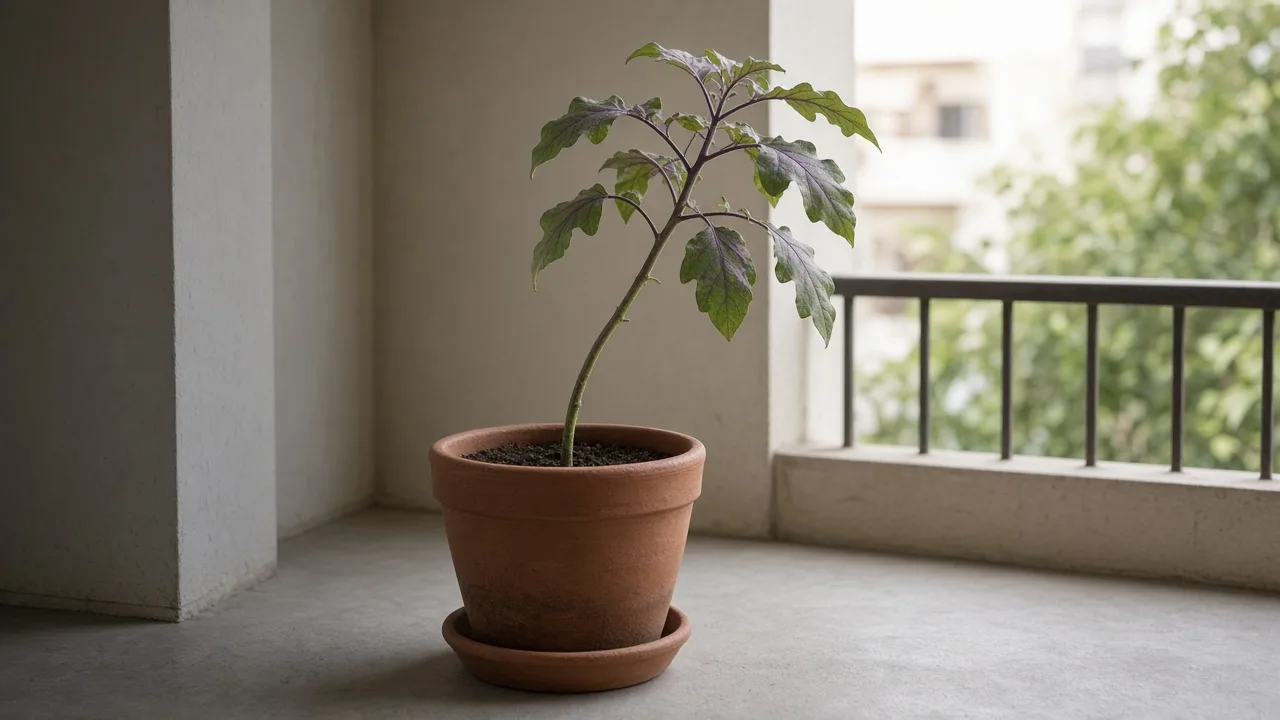
Not Enough Light on Brinjal: Causes, Checks & Fixes
This guide covers not enough light on Brinjal. See also the general Not Enough Light guide, watering, and light pages for this plant.
Not Enough Light on Brinjal: Causes, Checks & Fixes
Quick answer
Brinjal (Solanum melongena—eggplant, aubergine, baingan) is a warm-season fruiting nightshade, not a foliage plant that can stay pretty in a bright-looking room. It needs the same energy budget as tomato and chilli: full sun with at least six hours of direct sunlight on the canopy during active growth. In too little light, stems stretch, leaves stay small and pale, purple flowers arrive late or abort, and fruit stalls small and dull even when your watering rhythm looks reasonable.
For how low light limits photosynthesis in general, see our not enough light hub. On brinjal, the decisive check is direct sun on the leaves at canopy height—not whether the balcony “faces south” or the room feels bright to you.
First step: move the container to the sunniest open position you can manage (outdoor terrace, roof, or the brightest unobstructed window you have) and leave watering, fertilizer, and pot size unchanged for two weeks so you can read the plant’s response.
When to use this page vs other Brinjal guides
- Leggy growth — when elongated stems and window-lean are the main complaint
- Slow growth — when cool nights, root-bound pots, or poor nutrition stall a plant that already gets strong sun
- Yellow leaves — when lower leaves fade on heavy wet soil or after drought, not when the whole canopy is pale and stretched
- Wilting or drooping leaves — when turgor collapses midday despite moisture checks
- Light guide — long-term sun targets, balcony obstructions, heat vs shade, and grow-light backup
- Problems hub — full symptom index
What not enough light looks like on Brinjal
Healthy brinjal in strong sun builds a broad, slightly prickly-haired canopy with lobed leaves spaced at reasonably short intervals along the main stem and side branches. Flower buds show purple nightshade blooms; developing fruit stays glossy until harvest maturity. Low light breaks that rhythm before the plant turns yellow.
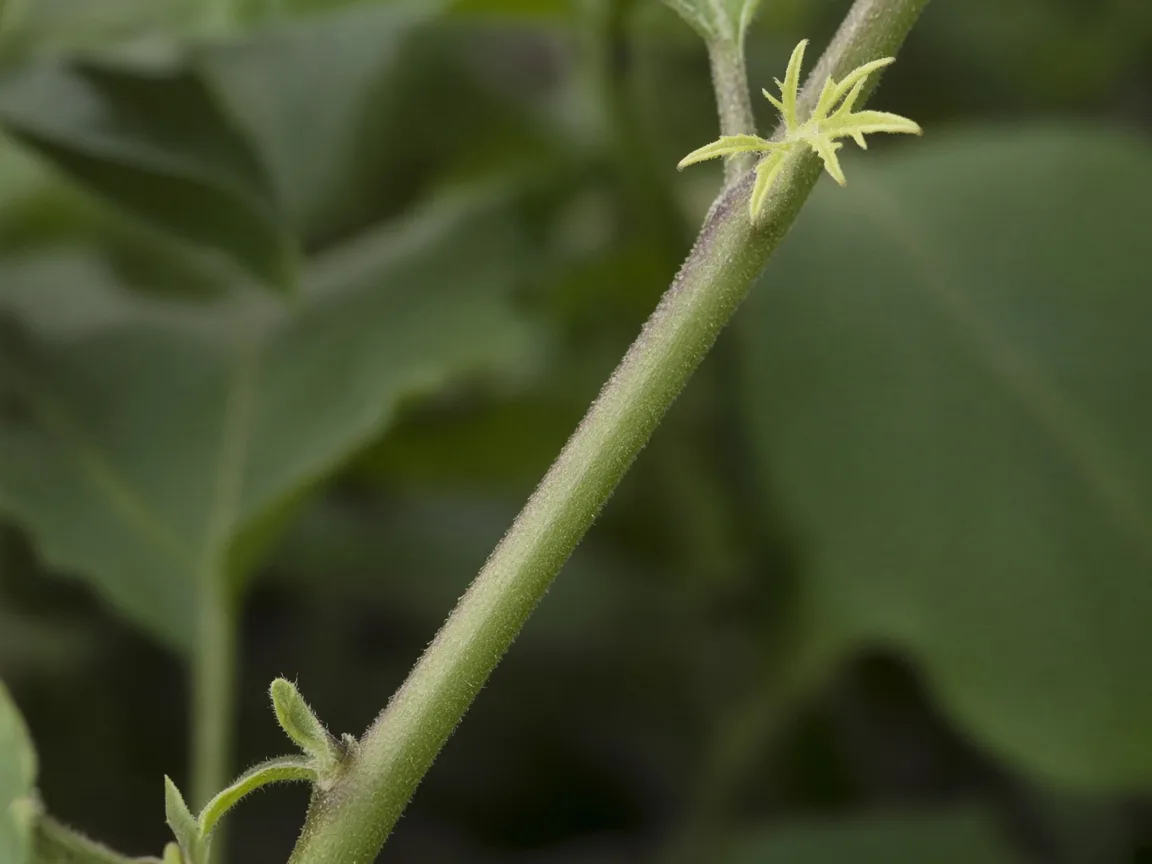
Long internode with a thin pale leaf at the tip—compare spacing and leaf size to firmer nodes lower on the same stem.
Typical shade-stress pattern on Solanum melongena:
- Long internodes on the leading shoot and upper branches—often obvious on the top 15–30 cm
- Smaller, thinner new leaves than leaves the plant made in a sunnier period
- Pale yellow-green foliage that never deepens to the rich green of a well-lit flush
- Strong lean toward one window, terrace gap, or neighboring building opening
- Delayed, sparse, or dropping flowers while the plant still looks vaguely “healthy”
- Small or absent fruit—energy never reaches the fruit-filling stage
- Soft succulent new growth that aphids and spider mites colonize quickly in dry rooms
This differs from underwatering when the pot is light and the upper 2–3 cm is dry, from overwatering when the stem base softens on sour wet mix, and from low humidity when leaf margins crisp in dry AC air while internode length stays normal.
Why Brinjal gets not enough light
NC State classifies eggplant as a warm-season vegetable that grows best in full sun—defined there as six or more hours of direct sunlight a day. Missouri Botanical Garden likewise describes Solanum melongena as cold-sensitive, needing a long warm season, and recommends planting in full sun in fertile, well-drained soil. Iowa State’s home-garden guidance places eggplant in fertile soil in full sun—standard crop culture, not an optional boost.
That biology clashes with how brinjal is often grown on deep balconies, indoor seed-starting benches, or monsoon-cloudy terraces. Human eyes adapt to dim interiors; the canopy at leaf height may receive far fewer photons than a wall-mounted direction label suggests. When light is limiting, the plant extends stems toward the brightest gap—etiolation—and thins leaf area at each new node because it cannot afford a full nightshade canopy.
Brinjal-specific triggers:
- Obstructed “full sun” balconies — parapets, AC units, and taller towers shade most leaves while one corner gets brief rays
- Indoor holding before transplant — nursery brinjal kept in a bright room without direct sun arrives stretched before it ever flowers
- Leggy seedlings under weak window light — warm germination mats plus dim light produce tall pale starts that stay weak outdoors unless hardened off in real sun
- Monsoon and winter cloud cover — growth slows and internodes lengthen even when watering stays steady; light, not moisture, becomes the bottleneck
- Competing shade from taller pots — grouped displays shade the brinjal crown while lower plants still look lit
- Choosing the wrong fix — extra nitrogen or water on a dim plant pushes soft growth without flowers
Do not blame shade alone if the collar is soft on wet soil—confirm a firm green stem before you treat stretch as purely a light problem.
Counting direct sun on a fruiting nightshade canopy
Brinjal must support leaves, flowers, and filling fruit at the same time. That workload needs direct rays on the upper and middle canopy, not just the pot rim.
On three clear days, note when sunlight first hits the leaves and when shade from walls or rails takes it away. A west-facing slot may deliver a hot but short exposure; an east opening may give gentle morning sun then deep shade by noon—both can fall below six useful hours on the foliage even when the balcony “gets sun.”
| What you see on the newest stem section | What it usually means | First adjustment |
|---|---|---|
| Short internodes; broad lobed leaves | Light likely adequate | Look at water, nutrition, or pests if other symptoms persist |
| Long internodes; small pale tip leaves | Chronic insufficient light | Move to sunnier open placement; hold fertilizer |
| Lean toward one opening with normal lower nodes | Recent shade or seasonal sun-angle change | Improve the bright side; rotate pot weekly after the move |
| Green stretch, few flowers, moist soil | Light limiting crop set | More direct sun—not more water |
| Pale stretch plus sticky new shoots | Pests on weak tissue | Inspect for aphids; still improve light |
Press the stem 10–15 cm above the soil line. Firm and green with pale slow tips points to placement. Soft and wet-smelling on a heavy pot demands dry-down first regardless of stretch.
Flower and fruit signals on low-light brinjal
On a well-lit plant, purple nightshade flowers should appear on a warm schedule tied to cultivar and age—not months after transplant with only leaves to show. In shade, brinjal often holds green growth while flowers abort or never open strongly, and young fruit stalls small and dull. That pattern overlaps slightly with drought, but the distinguishing clue is moist soil at 2–3 cm depth with continued stem elongation toward light.
Compact cultivars in patio pots need the same photon budget as vigorous types—they simply finish shorter. A 30 cm-wide container does not replace sun; it only roots the plant. If fruit count is the goal, light comes before fertilizer tweaks.
How to confirm not enough light
Work through these checks in order:
- Direct sun on leaves — on a clear morning, confirm rays touch foliage, not just the balcony floor.
- Internode comparison — measure spacing between the last four nodes on the growing tip versus four nodes from mid-stem during a sunnier spell.
- Pot weight vs watering — if the upper 2–3 cm dries on your normal rhythm and the plant still stretches, light is a stronger suspect than drought.
- Flower and fruit audit — count open blooms and pin-head fruit; shade often shows up here before lower leaves yellow.
- Pest cross-check — flip the newest leaf; stippling or colonies on pale shoots mean pests and weak light—fix placement while you treat insects.
If stretch appeared immediately after moving to a darker room or deeper balcony, you already have a confirmed diagnosis—skip straight to placement.
The first fix to try
Move the container to the sunniest open position in one deliberate step—not permanent heavy shade, and not a dark corner “rest” after heat stress.
Practical targets for home Solanum melongena:
- Open terrace or roof with the widest sky view and at least six hours of direct sun on the canopy when weather allows
- South- or west-facing balcony where leaves—not just the rail—receive rays; remove visual obstructions when safe
- Brightest unobstructed window for temporary holding, accepting that indoor sun rarely matches outdoor crop light
- Full-spectrum grow light 30–45 cm above the canopy for 14–16 hours daily if only dim north light is available—ordinary room bulbs are not enough for fruiting goals
Leave watering, fertilizer, and pot size unchanged for two weeks. Brinjal in low light uses water slowly; stacking extra irrigation while you experiment invites fungus gnats and collar rot on nightshade stems.
Step-by-step recovery
After the move:
- Harden off gradually if the plant lived in deep shade—add an hour or two of direct sun every few days until the canopy tolerates full exposure, watching for bleached patches on leaves moved too fast in midsummer heat.
- Stake the main stem early so stretched tissue does not snap when fruit finally loads; see the overview for cultivar-sized support.
- Rotate the pot a quarter turn every few days until lean stops increasing.
- Hold fertilizer until new growth looks deeper green for two weeks; feeding a shade-stressed brinjal does not replace photons.
- Scout shoot tips weekly—nightshade pests love pale succulent flush in warm weather.
Salvaging leggy brinjal seedlings
If you started from seed indoors, weak light often appears before transplant. Gardening Know How notes that tomatoes, tomatillos, and eggplants can recover from leggy starts because they form new roots along buried stems. After you move starts to a brighter spot or grow light, you can remove lower leaves and plant deeply (or trench on a slope) so only the top cluster remains above soil—then harden off into full sun before the warm season planting window.
That salvage works on young flexible stems, not woody mature plants. For a large container brinjal, placement and tip pruning after new firm growth matter more than burying the trunk.
Recovery timeline
| Severity | What you usually see | Realistic window |
|---|---|---|
| Mild (recent move to dim balcony) | Next node slightly shorter; leaf a bit broader | 2–3 weeks after brighter direct sun |
| Moderate (months of stretch, few flowers) | Two to three flushes with better spacing and color | 4–8 weeks in warm growing weather |
| Severe (woody stretched top, no fruit) | Firm new nodes after light fix; possible tip prune | One warm season; old stretched wood stays thin |
Winning signs: shorter internodes, deeper green new leaves, purple flowers that hold, and glossy young fruit beginning to swell. Losing signs: continued stretch on wet soil, yellowing lower leaves on a heavy pot, or mite webbing spreading—re-check overwatering and pests.
Lookalike symptoms
| Pattern | Likely cause | Where to go |
|---|---|---|
| Long internodes, pale small tip leaves, firm stem | Not enough light | Stay on this page |
| Long internodes only toward one side | Uneven obstructions | Improve placement; rotate pot |
| Yellow lower leaves on heavy wet pot | Root stress | Overwatering or root rot |
| Midday wilt, dry upper 2–3 cm | Drought | Underwatering |
| Small twisted shoots, sticky honeydew | Pests | Aphids |
| Green but stalled in cool weather | Temperature | Slow growth after light is ruled out |
What not to do
- Do not flood a dim brinjal because growth slowed—wet mix in low light worsens nightshade root stress.
- Do not fertilize heavily hoping leaves darken without brighter direct sun.
- Do not repot to fix stretch—root room does not replace photons on a fruiting crop.
- Do not keep seedlings on a heat mat without strong light—they will elongate faster.
- Do not assume a “heat-loving” label means any sunny hour is enough—hours on the leaves still matter.
How to prevent not enough light
Match crop logic at home: full sun on the canopy, warm nights, and steady moisture from the watering guide once the plant can use it in bright conditions. Re-read placement when monsoon cloud cover thickens or when neighboring construction adds shade. Pair light checks with the upper 2–3 cm dry-down test—low light slows water use, and the two stresses often arrive together on winter window sills.
Start seeds under adequate artificial light or a truly sunny hardening bench, then transplant only after chilly weather has passed, as warm-season eggplant culture recommends. (Missouri Botanical Garden) Use fertile, well-drained soil in the final pot so when sun returns, the plant can convert it into flowers and fruit—not just taller stems.
Related Brinjal guides
- Overview — cultivar choice, staking, and harvest cues
- Problems hub — all sibling symptoms
- Light — six-hour baseline, balconies, and heat acclimation
- Watering — dry-down rhythm that shifts with light level
- Soil — container mix for moisture without waterlogging
Related tool
Use the Why Is My Plant Dying? Tool to narrow causes for not enough light on this plant before changing multiple variables at once.