Lettuce Care Guide: Grow Looseleaf and Head Types
Lactuca sativa
Grow looseleaf, butterhead, romaine, and head lettuce with cool weather, steady moisture, rich soil, correct spacing, and practical bolting control.
Lettuce Care Guide: Grow Looseleaf and Head Types
Start with wateringThe most common care mistake for LettuceWatering guide → →Lettuce care essentials
Light
Water
Keep the shallow root zone consistently moist but not saturated. Check the upper 1–2 cm frequently and water when it begins to dry, especially in containers and warm, windy weather.
Soil
Organically rich, moisture-retentive but well-drained soil. Lettuce performs best around pH 6.0–6.7.
Humidity
Temperature
Fertilizer
About Lettuce
Lettuce is native to Mediterranean region to Siberia, typically reaches Usually 15–30 cm tall and wide before bolting; size varies by cultivar and spacing indoors, with rapid - looseleaf types may be ready in 30–60 days, while heading types commonly need 60–80 days growth. Lettuce has a cool season herbaceous annual growth habit and part of the Asteraceae family. It is also known as Garden Lettuce, Leaf Lettuce, Head Lettuce, Romaine Lettuce, Cos Lettuce, and Butterhead Lettuce.
| Detail | Information |
|---|---|
| Also known as | Garden Lettuce, Leaf Lettuce, Head Lettuce, Romaine Lettuce, Cos Lettuce, Butterhead Lettuce |
| Native region | Mediterranean region to Siberia |
| Mature size | Usually 15–30 cm tall and wide before bolting; size varies by cultivar and spacing |
| Growth rate | Rapid - looseleaf types may be ready in 30–60 days, while heading types commonly need 60–80 days |
| Growth habit | Cool Season Herbaceous Annual |
| Scientific name | Lactuca sativa |
| Family | Asteraceae |
Lettuce Care Guide: Grow Looseleaf and Head Types
Lettuce care succeeds or fails on two early decisions: which type you are growing and whether the weather is cool enough to finish it. Looseleaf lettuce can give several small harvests from a compact container. Butterhead, romaine and crisphead need progressively more uninterrupted time and space to form the shape promised on the seed packet.
The plant also has a firm seasonal limit. Lactuca sativa can be shaded, watered and selected for bolt tolerance, but persistent warmth eventually pushes it from leaf production into flowering. For most warm Indian lowlands, lettuce is therefore an autumn-to-winter crop; cooler hill regions have a longer window, while very hot districts may have only a short practical season. Start with the local temperature pattern, not a sowing month copied from another climate.
What lettuce is and how it grows
Lettuce is Lactuca sativa, an accepted species in the daisy family, Asteraceae. Kew treats it as a cultigen associated with western Asia, while horticultural sources describe the familiar garden crop through its many bred forms. That cultivated diversity explains why a red looseleaf rosette, an upright romaine and a dense iceberg head can all be the same species.
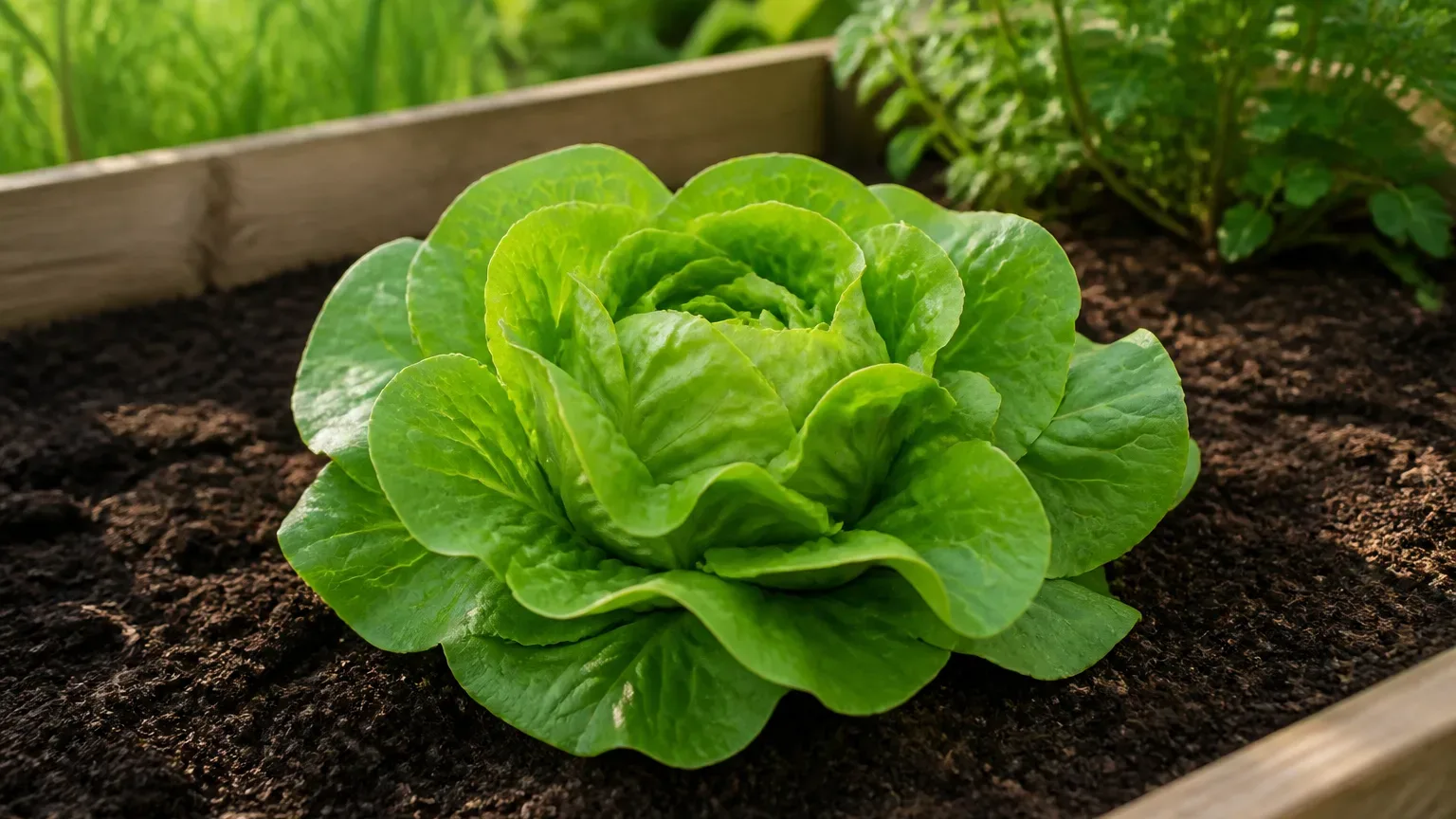
Before flowering, a lettuce plant stays low and builds a rosette or head from a central growing point. Most garden plants reach roughly 15–30 cm tall and wide before bolting, although spacing and cultivar alter the final size. Its fine, relatively shallow root system makes rapid top growth possible but leaves little buffer when the upper soil dries.
The short annual cycle
Grow lettuce as a short-lived annual food crop, not as a permanent foliage houseplant. It germinates, builds edible leaves, forms a head if genetically programmed to do so, then sends up a taller flower stalk and produces seed. NC State classifies lettuce as an annual cool-season vegetable and notes that high temperature plus dry soil can accelerate the switch to flowering.
This short cycle changes the care strategy. You normally transplant a seedling once into its final bed or pot, harvest it, and start a fresh sowing rather than repeatedly moving the ageing plant to larger containers. A two-week succession during suitable weather is more reliable than expecting one lettuce to remain tender indefinitely.
Choose the lettuce type before choosing the care plan
Four groups cover most home-grown lettuce: looseleaf, butterhead, romaine or cos, and crisphead. UF/IFAS confirms these four major types and specifically notes that leaf lettuce suits a mild climate and repeated harvest. Named cultivars within a group still differ, so use the group as a starting point and the seed packet as the final authority for spacing and maturity.
Do not assume every plant should make a tight head. Open, ruffled leaves can be normal looseleaf growth, not a failure. Conversely, crowding a crisphead seedling because leaf lettuce tolerates close spacing usually produces a small, loose plant with poor air movement.
Looseleaf lettuce for repeated harvests
Looseleaf cultivars make open rosettes rather than a single dense heart. They suit balcony boxes and small pots because you can harvest a few outer leaves once they are usable, leaving the central growing point intact. The RHS describes looseleaf lettuce as a quick cut-and-come-again crop harvested over several weeks.
Leaf lettuce is also the practical choice when the cool season is short. NC State gives a broad benchmark of 50–60 days from seed for leaf lettuce, compared with 70–80 days for head lettuce, though the packet date and local weather matter more than a universal countdown. Under approaching heat, harvesting young loose leaves is often wiser than waiting for maximum size.
Butterhead, romaine and crisphead need time and room
Butterhead makes a soft, relatively loose heart; romaine or cos grows upright around a crisp midrib; crisphead develops the densest, broadest head. Heading types are usually harvested once rather than leaf by leaf for weeks. They also need enough spacing for their outer wrapper leaves to feed a developing centre.
Heat response is not identical across groups. NC State reports that leaf and butterhead types generally tolerate warmth better than romaine, with head lettuce least tolerant in its guidance. Treat that as a planning hierarchy, not a guarantee: a named cultivar selected for bolting resistance may outperform a poorly adapted cultivar from a supposedly tougher group. University of Minnesota Extension likewise recommends choosing head-lettuce traits by season, including heat, bolting and tipburn resistance for warmer plantings.
The best lettuce season in India
India does not have one lettuce calendar. A Bengaluru balcony, a Delhi terrace, a coastal Chennai garden and a Himalayan valley differ in night temperature, humidity and season length. The transferable rule is to sow so most leaf growth and head formation happen during the coolest practical local period, then adjust for elevation and urban heat.
In warm lowlands, that usually means autumn through winter rather than late spring or summer. The comparison with subtropical Florida is useful: UF/IFAS calls winter the preferred lettuce-growing period. Indian growers should still check local weather rather than copy Florida dates. TNAU’s minor-vegetable guidance recognizes both head and leaf/cos types, reinforcing the need to choose a locally suitable crop form as well as a season.
In genuinely cool weather, give lettuce full sun for compact, quick growth. As afternoons warm, morning sun and light afternoon shade can reduce heat load. Shade is a season extender, not a cure for hot nights or persistently hot soil; if a plant is already elongating from the centre, harvest usable leaves rather than trying to reverse its reproductive transition.
Heat, dry soil and the bolting sequence
Bolting starts when the central stem lengthens and leaf spacing opens. The plant then becomes taller, produces smaller leaves, develops flower buds and directs resources toward seed. Leaves commonly become tougher and more bitter as this progresses. The RHS confirms that hot, dry weather can trigger bolting and recommends steady water plus light shade during warm periods.
NC State identifies roughly 21–27°C (70–80°F) combined with dry soil as a trigger range, while Utah State says growth is best below about 24°C and that higher summer temperatures reduce quality. These are warning ranges, not a precise switch: day length, root temperature, cultivar and plant age all influence the response. Once a seed stalk is visibly extending, no pruning or fertilizer treatment returns that plant to a compact juvenile rosette.
Lettuce care at a glance
For a quick decision, give lettuce cool weather, useful sun, evenly moist but drained soil, and spacing matched to type. If growth stalls, check temperature and root-zone moisture before reaching for fertilizer. If the centre begins rising during a warm spell, harvest promptly.
Healthy looseleaf lettuce makes fresh leaves from a compact centre. Healthy heading lettuce steadily fills its allotted space and begins closing toward the middle. Slow growth can come from heat, dry roots, poor light, crowding or low fertility, so diagnose the whole growing setup rather than treating pale or small leaves in isolation.
Light and temperature
Use full sun while days are mild. In warming conditions, several hours of morning sun followed by bright shade is a practical compromise; NC State suggests three to four hours of direct sun with shade for the remainder when lettuce is grown in summer. Deep shade may keep leaves cooler but often gives thin, stretched growth and delays the harvest.
On a hot terrace, reduce reflected heat as well as direct sun. Move containers away from west-facing walls, group pots so the container sides shade one another, and use a light mulch without burying the crown. For a deeper placement guide, use the Lettuce light guide rather than treating shade cloth as a complete care plan.
Water and root-zone moisture
Keep the shallow root zone consistently moist, never permanently saturated. Feel the upper 1–2 cm and water when it begins to dry. Containers may need daily checks during warm, windy weather, while cool cloudy periods slow water use. Utah State warns that moisture fluctuations impair leaf and head quality, so alternating drought and flooding is worse than adjusting water to actual soil moisture.
Direct water to the soil, especially around dense heads, and make sure excess drains. Limp leaves in hot afternoon sun may recover after temperatures fall; limp growth in dry soil needs prompt watering. Yellow outer leaves with wet soil, a soft crown or collapsing seedlings point toward excess moisture or disease risk. The Lettuce watering guide covers these signs and first actions in detail.
Soil, spacing and feeding
Use fertile soil that holds useful moisture while draining freely. NC State gives an optimal soil pH of 6.0–6.7. In a container, a quality potting mix amended with finished compost and a modest aeration component is safer than dense garden clay. In a bed, work in mature compost and avoid burying the crown after transplanting.
Spacing is cultivar-dependent. Looseleaf crops can be close when harvested young, while full head lettuce often needs around 20–30 cm between plants; Utah State recommends 20–30 cm for heading plants. Thin early rather than letting roots and leaves compete for weeks. Consult the Lettuce soil guide for mix choices and the Lettuce fertilizer guide before adding nitrogen to already rich soil.
Growing lettuce in containers
Lettuce is well suited to containers because its roots do not require a very deep pot. A vessel about 15–20 cm deep can support many leaf cultivars if it has unobstructed drainage; choose a broader pot and respect packet spacing for heading types. A 30 cm-wide container may hold several young looseleaf plants but usually only one large heading plant comfortably.
Fill the container close to the rim so the leaves receive light and moving air. Do not leave a small seedling at the bottom of a deep, shaded pot. Move a plug or cell-grown plant into its final container while young, keeping the crown at the original level. The Lettuce repotting guide explains why repeated pot changes rarely benefit this short crop.
Container colour and position matter in India. A dark pot against a sun-heated wall can warm roots even when the leaves are shaded. Use a cooler outer cachepot only if water cannot collect around the inner pot, or shade the container wall while keeping foliage in adequate light.
Harvest according to type
For looseleaf lettuce, remove clean outer leaves while leaving the central growing point untouched. Take only what the plant can replace under current conditions; in a slowing or warming crop, a whole-rosette harvest is often more sensible. Harvest in the cool morning, rinse the leaves thoroughly, and discard damaged or decaying material.
Harvest butterhead and romaine when the heart has the size and firmness expected for that cultivar. Cut crisphead once the head feels firm but before the central stem lengthens. Utah State recommends harvesting leaf lettuce before the seed stalk forms, while heading types are judged by their characteristic early or firm head stage.
If you want a continuous supply, sow a small amount every two weeks during suitable weather. This spreads risk and prevents a glut of mature heads. It also works with lettuce biology: fresh young plants replace ageing rosettes rather than asking one crop to remain productive beyond its natural cycle.
Common lettuce care mistakes
The first mistake is growing the wrong type for the available season. Crisphead planted just before persistent heat may never make a dense head, however carefully it is watered. Choose looseleaf or a bolt-tolerant cultivar when the cool window is short, and choose a heading type only when it has time to finish.
The second mistake is confusing heat management with heat prevention. Afternoon shade, mulch and steady water can delay stress, but they cannot make lettuce a tropical summer crop. The third is crowding heading plants according to baby-leaf spacing. Thin by the intended harvest, not by how small the seedlings look today.
Other avoidable errors include letting a shallow pot dry completely, keeping a tray under the pot full of water, feeding heavily without checking soil fertility, soaking dense foliage late in the day, and waiting too long to harvest a plant that has begun to bolt. If seedlings fail rather than established plants, start with the Lettuce propagation guide and check seed temperature, sowing depth and damping-off conditions.
Food use, sap and pets
Lettuce leaves are a familiar human food crop, but garden hygiene still matters. Wash harvests, keep soil splash off leaves where possible, and follow every pesticide label’s crop and harvest restrictions. Do not eat diseased, decaying or chemically contaminated leaves.
NC State lists low-severity poison characteristics from the plant’s milky sap, including potential contact irritation associated with lactucin and lactucopicrin. This does not mean ordinary washed lettuce leaves are poisonous food. Wear gloves if broken stems irritate your skin and wash after handling a bolting crop.
Human edibility is not a species-specific veterinary feeding recommendation. Keep pets away from treated plants and potting media, prevent unrestricted grazing, and ask a veterinarian about suitable foods and portions for the animal involved.
When to use this page vs other Lettuce guides
Use this overview to choose a lettuce type, season, container and harvest strategy. For one care variable, go deeper: use light to position the crop, watering to diagnose wilt or wet soil, and soil to build a moisture-retentive but draining root zone.
Use the fertilizer guide when growth is pale or slow after temperature, light and water have been checked. Use repotting for transplant timing and final container choice, and propagation for sowing, germination and seedling establishment.
Related Lettuce guides
Start at the Lettuce plant hub for the species profile and complete care cluster. The most useful next page for warm-climate growers is usually the Lettuce light guide, because it separates productive cool-weather sun from heat-management shade. Container growers should pair it with the Lettuce watering guide because small volumes dry quickly even during a short crop cycle.
For crop planning, read Lettuce propagation before sowing and Lettuce pruning before treating harvest cuts like ornamental pruning. Lettuce is replaced by succession, not maintained as a permanent specimen.
Conclusion
Good lettuce care is cultivar-aware and season-led. Looseleaf gives the most flexible harvest in small spaces and short cool periods; butterhead, romaine and crisphead need increasing commitment to spacing, time and stable conditions. All types need useful light, even root-zone moisture and free drainage.
In India, choose the coolest realistic local window, then use morning sun, afternoon shade and bolt-tolerant genetics to extend that window rather than deny its limits. When the centre begins to rise, harvest. Starting the next small sowing at the right time is usually a better response than trying to force an ageing, heat-stressed plant back into leaf production.
How to care for Lettuce?
When should you water Lettuce?
Keep the shallow root zone consistently moist but not saturated. Check the upper 1–2 cm frequently and water when it begins to dry, especially in containers and warm, windy weather.
- Feel the upper 1–2 cm of soil and check below the leaf canopy - Check the upper 1–2 cm frequently and water when it begins to dry, especially in containers and warm, windy weather.
- water when it is beginning to dry - Check the upper 1–2 cm frequently and water when it begins to dry, especially in containers and warm, windy weather.
- Drain excess water - Check the upper 1–2 cm frequently and water when it begins to dry, especially in containers and warm, windy weather.
What soil works best for Lettuce?
Organically rich, moisture-retentive but well-drained soil. Lettuce performs best around pH 6.0–6.7.
- 60% quality potting mix or fertile loam - Organically rich, moisture-retentive but well-drained soil.
- 25% finished compost
- 15% perlite, fine bark, or coarse grit - Organically rich, moisture-retentive but well-drained soil.
Grower notes for Lettuce
Match the harvest to the lettuce type
Lettuce is a crop group, not one uniform shape. Looseleaf cultivars can be harvested a few outer leaves at a time and spaced more closely, while butterhead, romaine, and crisphead cultivars need room to form their characteristic heads. Leaf lettuce commonly reaches harvest sooner than heading types. Follow the seed packet for final spacing and maturity rather than expecting every Lactuca sativa cultivar to make a tight head.
Use the cool season in warm climates
Lettuce grows best as a cool-season crop. NC State Extension notes that temperatures around 21–27°C, especially when paired with dry soil, can trigger bolting, bitterness, and the end of useful leaf production. In warm Indian climates, sow during the coolest practical autumn, winter, or high-elevation window. Afternoon shade and heat-tolerant cultivars can extend harvest, but they do not make lettuce immune to persistent heat.
Looseleaf and head types handle heat differently
Looseleaf and butterhead lettuces generally tolerate warmth better than romaine, and romaine generally handles it better than crisphead lettuce. That ranking is useful for warm-season planning, but cultivar genetics still matter: a heat- or bolt-tolerant selection can outperform a poorly adapted plant in the same category. Harvest loose leaves young when a heat spell arrives rather than waiting for an unlikely full head.
Keep shallow roots evenly moist
Lettuce has a shallow root system, so repeated drying quickly affects texture, flavour, and growth. Check containers daily in warm or windy conditions and water at soil level when the upper 1–2 cm begins to dry. The goal is even moisture, not permanently saturated compost. Drainage holes and an airy mix are essential because wet seedling media also increases the risk of damping-off.
Give sun without trapping summer heat
In genuinely cool weather, full sun supports compact, quick growth. As conditions warm, morning sun with afternoon shade is often more useful than an exposed all-day position. NC State recommends only three to four hours of sun with shade for the rest of the day when lettuce is grown in summer. Treat shade as heat management, not a cure for hot nights or an unsuitable season.
Transplant once, then harvest
Lettuce is normally raised from seed and moved once from a plug or nursery cell to its final bed or container. Looseleaf plants can fit relatively close together, while heading cultivars need wider spacing. Avoid repeatedly shifting an established crop into larger pots; succession sowing every couple of weeks during suitable weather gives a steadier supply than trying to keep one ageing plant indefinitely.
Is Lettuce safe around pets?
Lettuce is an edible human food crop, but the reviewed extension source does not provide a species-specific safety classification for household pets. Prevent unrestricted grazing, avoid leaves treated with garden chemicals, and ask a veterinarian about suitable portions for your animal.
NC State Extension describes Lactuca sativa as having low-severity poison characteristics for people because sap containing lactucin and lactucopicrin can irritate skin. This is a contact-sap warning, not evidence that ordinary harvested lettuce leaves are poisonous food. Pet-specific toxicity was not established in the authoritative source reviewed for this hub.
Watering Lettuce
For Lettuce, feel the upper 1–2 cm of soil and check below the leaf canopy; water when it is beginning to dry and water check daily in warm weather and every 2–3 days in cool weather; water according to soil moisture. Increase checks as days warm, but reduce frequency during cool or cloudy periods; dry soil plus heat encourages bolting.
| Detail | Information |
|---|---|
| How often | Check daily in warm weather and every 2–3 days in cool weather; water according to soil moisture |
| How to check | Feel the upper 1–2 cm of soil and check below the leaf canopy; water when it is beginning to dry |
| Seasonal changes | Increase checks as days warm, but reduce frequency during cool or cloudy periods; dry soil plus heat encourages bolting |
Signs of overwatering
- yellowing outer leaves while soil remains wet
- soft crown or stem base
- damping-off or collapse in seedlings
Signs of underwatering
- limp leaves that do not recover after the day cools
- dry or bitter leaves
- early flower-stalk development during warm weather
Soil & potting for Lettuce
Use a mix of 60% quality potting mix or fertile loam, 25% finished compost, 15% perlite, fine bark, or coarse grit for Lettuce. Moist but freely drained; shallow roots need steady moisture without standing water. Target soil pH around 6.0–6.7. Repot usually not repotted after its final transplant; lettuce is a short-lived annual crop, ideally in the locally cool growing season, before persistent heat.
| Detail | Information |
|---|---|
| Recommended mix | 60% quality potting mix or fertile loam, 25% finished compost, 15% perlite, fine bark, or coarse grit |
| Drainage | Moist but freely drained; shallow roots need steady moisture without standing water |
| Soil pH | 6.0–6.7 |
| Repotting frequency | Usually not repotted after its final transplant; lettuce is a short-lived annual crop |
| Best season to repot | The locally cool growing season, before persistent heat |
Signs it needs repotting
- seedling roots fill or circle the starter cell
- growth stalls between waterings
- the plant has several true leaves and is ready for final spacing
Humidity & temperature for Lettuce
Fertilizer & pruning for Lettuce
Common problems on Lettuce
Yellow Leaves
MediumLikely cause: Common on this plant type; confirm with recent watering, light, and root checks.
Quick fix: Inspect the plant and correct the most likely care stressor before stacking treatments.
Full fix guide →Brown Tips
MediumLikely cause: Common on this plant type; confirm with recent watering, light, and root checks.
Quick fix: Inspect the plant and correct the most likely care stressor before stacking treatments.
Full fix guide →Root Rot
MediumLikely cause: Common on this plant type; confirm with recent watering, light, and root checks.
Quick fix: Inspect the plant and correct the most likely care stressor before stacking treatments.
Full fix guide →Overwatering
MediumLikely cause: Common on this plant type; confirm with recent watering, light, and root checks.
Quick fix: Inspect the plant and correct the most likely care stressor before stacking treatments.
Full fix guide →Underwatering
MediumLikely cause: Common on this plant type; confirm with recent watering, light, and root checks.
Quick fix: Inspect the plant and correct the most likely care stressor before stacking treatments.
Full fix guide →Spider Mites
MediumLikely cause: Common on this plant type; confirm with recent watering, light, and root checks.
Quick fix: Inspect the plant and correct the most likely care stressor before stacking treatments.
Full fix guide →Mealybugs
MediumLikely cause: Common on this plant type; confirm with recent watering, light, and root checks.
Quick fix: Inspect the plant and correct the most likely care stressor before stacking treatments.
Full fix guide →Aphids
MediumLikely cause: Common on this plant type; confirm with recent watering, light, and root checks.
Quick fix: Inspect the plant and correct the most likely care stressor before stacking treatments.
Full fix guide →Leggy Growth
MediumLikely cause: Common on this plant type; confirm with recent watering, light, and root checks.
Quick fix: Inspect the plant and correct the most likely care stressor before stacking treatments.
Full fix guide →Slow Growth
MediumLikely cause: Common on this plant type; confirm with recent watering, light, and root checks.
Quick fix: Inspect the plant and correct the most likely care stressor before stacking treatments.
Full fix guide →Wilting
MediumLikely cause: Common on this plant type; confirm with recent watering, light, and root checks.
Quick fix: Inspect the plant and correct the most likely care stressor before stacking treatments.
Full fix guide →Drooping Leaves
MediumLikely cause: Common on this plant type; confirm with recent watering, light, and root checks.
Quick fix: Inspect the plant and correct the most likely care stressor before stacking treatments.
Full fix guide →Low Humidity
MediumLikely cause: Common on this plant type; confirm with recent watering, light, and root checks.
Quick fix: Inspect the plant and correct the most likely care stressor before stacking treatments.
Full fix guide →Not Enough Light
MediumLikely cause: Common on this plant type; confirm with recent watering, light, and root checks.
Quick fix: Inspect the plant and correct the most likely care stressor before stacking treatments.
Full fix guide →Fungus Gnats
MediumLikely cause: Common on this plant type; confirm with recent watering, light, and root checks.
Quick fix: Inspect the plant and correct the most likely care stressor before stacking treatments.
Full fix guide →Mold on Soil
MediumLikely cause: Common on this plant type; confirm with recent watering, light, and root checks.
Quick fix: Inspect the plant and correct the most likely care stressor before stacking treatments.
Full fix guide →