Mold on Soil on Lettuce: Causes, Checks & Fixes
Quick answer
White or gray fuzz on lettuce container soil is usually harmless surface fungus feeding on damp organic mix, not a disease on the lettuce itself. Scrape off the top layer, let the surface dry, and fix the moisture habit that grew it — unless seedlings are toppling or lower leaves are rotting, which point to real disease.
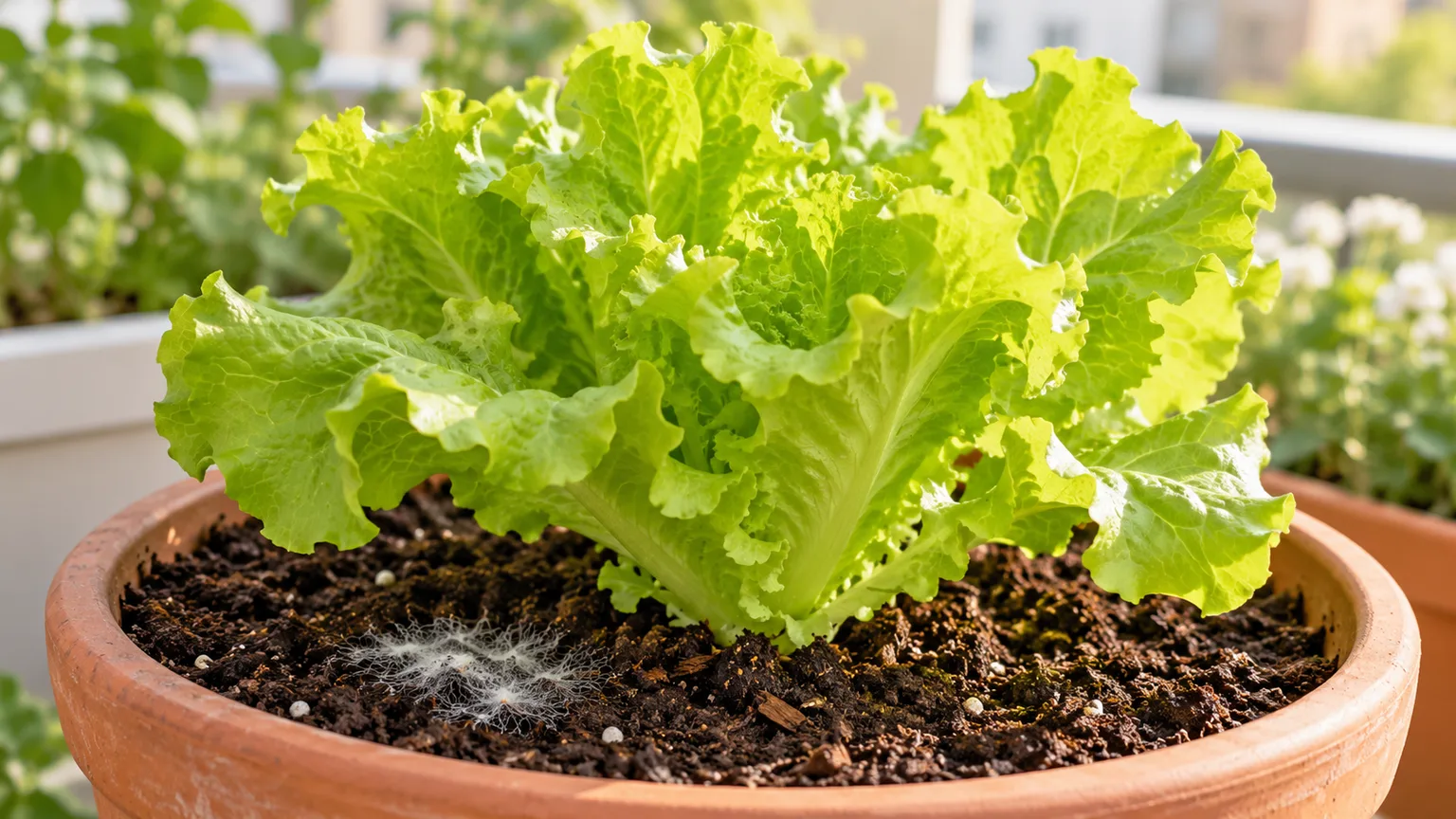
Mold on Soil on Lettuce: Causes, Checks & Fixes
This guide covers mold on soil on Lettuce. See also the general Mold on Soil guide, watering, and light pages for this plant.
Mold on Soil on Lettuce: Causes, Checks & Fixes
Quick answer
Your lettuce pot has white or gray fuzz on the soil surface and you want to know whether to scrape it, spray it, or pull the plants. Start with what makes lettuce different from a typical houseplant: it is a fast-growing, cool-season annual with shallow roots grown in containers of rich, moisture-holding mix — exactly the damp organic surface that saprophytic fungi colonize. Seed-starting mold may be harmless, or it may lead to damping off, which kills seedlings, so the fuzz deserves a quick diagnosis, not panic.
First step: scrape off the top 1–2 cm of moldy mix and let the surface dry before watering again. If stems are firm, seedlings stand upright, and the center is pushing clean new leaves, you are correcting a moisture imbalance, not rescuing a dying plant. Surface mold is usually harmless surface fungus on damp organic matter — the danger is the wet environment behind it, not the fuzz itself.
Is this surface mold or something worse on lettuce?
Use this table before spraying anything or throwing the pot out:
| What you see | Likely cause | Urgency | First action |
|---|---|---|---|
| White/gray fuzz on soil only; firm stems; upright seedlings | Saprophytic surface mold on damp mix | Low | Scrape top layer → surface dry-down |
| Mold plus tiny dark flies when you water | Same wet soil feeding fungus gnats | Medium | Dry the surface; sticky traps for adults |
| Mold returns within days of scraping | Chronic overwatering or soggy mix | Medium | Fix the watering rhythm and drainage |
| Seedling stems pinch thin and topple at the soil line | Damping-off disease, not surface mold | High — same day | Remove collapsed seedlings; ventilate; resow in fresh mix |
| Lower leaves soft and watery with white cottony growth | Lettuce drop or bottom rot | High — same day | Remove affected leaves or plants; improve airflow |
| Soft crown with sour smell in wet soil | Early root rot | High — same day | Unpot, inspect roots, follow the rot guide |
Lettuce seedlings and low-sitting head leaves are the exception to the “mold is harmless” rule. A fuzzy surface on a seed tray can share conditions with the fungi that remain in the soil and topple emerged seedlings, so check stems at the soil line, not just the fuzz.
When to use this page vs other lettuce guides
This page is the symptom-first entry for fuzzy growth on the soil of a lettuce pot or tray. Use it to decide what the surface growth means and which action comes first.
- Overwatering — go here for the full container dry-down rhythm and wet-soil wilting on lettuce
- Root rot — go here when roots are brown and mushy or the crown softens at the base in wet mix
- Fungus gnats — go here when small flies swarm after every watering alongside surface mold
- Watering — go here for the long-term 1–2 cm finger-check rhythm after mold clears
- Soil — go here for organically rich but free-draining lettuce mix that holds moisture without staying soggy
- Yellow leaves — go here when lower leaves yellow alongside damp soil, which points past surface mold
- All lettuce problems — go here when you are unsure which symptom page matches
What mold on soil looks like on lettuce
Healthy lettuce container mix should have a surface that dries and lightens between waterings. Mold shows up differently:
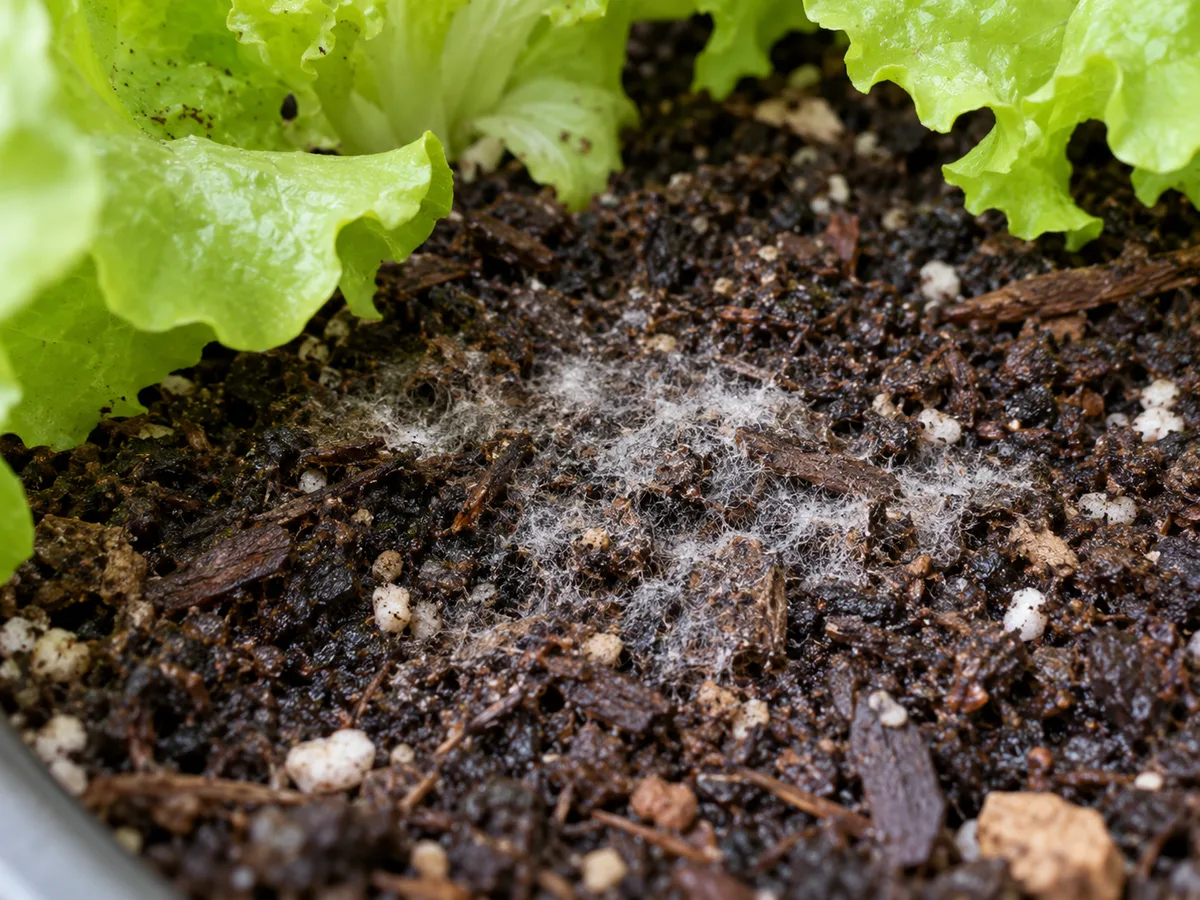
Mold on soil on lettuce — white surface fuzz over rich container mix; compare with firm stems and a clean growing center on the same plant.
Typical harmless surface mold:
- White, gray, or occasionally tan fuzzy patches across the top of the mix
- Growth concentrated where compost fines, fallen outer leaves, or mulch sit damp
- Soil surface still dark and cool to the touch days after watering
- Lettuce stems firm, seedlings upright, center pushing clean new leaves
Signs the wet conditions behind mold are hurting lettuce:
- Mold returns within days of scraping
- Small dark flies rise when you water — larvae sharing the same damp layer
- Pot feels heavy long after the last watering
- Lower leaves yellow while the mix stays moist — compare with the yellow leaves guide
- Sour or swampy smell from the pot instead of a normal earthy compost scent
- Seedlings keel over with pinched, thread-thin stems at the soil line
- Lower leaves touching the soil turn soft and watery with cottony white growth — the signature of lettuce drop described by UC IPM
Because lettuce grows fast in rich mix, its pots can look lush above while the surface never dries. Do not treat recurring mold as cosmetic when the pot stays heavy and damp.
Why lettuce pots grow mold
Lettuce invites surface mold for reasons tied directly to how it is grown. It is a cool-season annual raised for rapid leaf production in fertile, moisture-holding soil, and NC State lists damping-off and lettuce drop among its disease problems — a reminder that wet soil around lettuce is never just cosmetic.
Compost-rich mix that never dries on top. Lettuce wants organically rich soil, and container growers rightly add generous compost. That same compost is fungal food. When the top layer stays moist for days, spores already present in the mix colonize it.
Dense rosettes and heads trapping moisture. Looseleaf types, butterhead, romaine, and crisphead all hold their lowest leaves close to damp mix. Those leaves shade the surface, block airflow, and sit in their own humidity — mold often fruits exactly under the outer-leaf skirt. Picking outer loose leaves regularly is not just harvest; it ventilates the soil line.
Shallow roots plus saucer water. Lettuce roots occupy the top few centimeters of the pot, so growers water often to keep that zone moist — and saucers left full wick moisture straight back up. The result is a permanently damp surface over a shallow root zone.
Cool-season watering on autopilot. Lettuce drinks steadily while actively growing, but growth stalls in heat, and indoor winter sowings under weak light barely sip. Keeping the same watering volume through a slow spell leaves the surface wet. For how chronic wet mix damages roots in general, see our soil mold guide. On lettuce, the pattern usually shows up as fuzz over compost-rich mix in a heavy pot with yellowing outer leaves.
Crowded seed trays and humidity domes. Lettuce is usually direct-sown thickly, and covered trays trap humid, still air over constantly damp mix. Excess humidity from covers is a classic trigger for white fluffy fungus on seed-starting soil, and a small fan run a few hours a day makes it much harder for the fungus to grow. On seedlings the same still, wet conditions favor damping-off, which is worse in cold soils with poor drainage in conjunction with overwatering.
How to confirm the cause
Work through these checks before spraying or repotting anything:
- Surface moisture test — Push a finger 1–2 cm into the mix, the standard lettuce check. If that layer feels cool and clings to your skin days after watering, the surface is too wet regardless of what deeper soil holds.
- Pot weight — Lift the container. A heavy pot long after watering confirms saturation throughout, not just surface fuzz.
- Drainage check — Look under the pot. Water sitting in the saucer, blocked holes, or no drainage at all explain mold that returns after every scrape.
- Crown and stem-base inspection — Part the lowest leaves and look at the crown where leaves meet the soil. Firm and green means surface mold only; soft, dark, or sour-smelling tissue points toward rot — follow the root rot guide.
- Seedling stem check — In trays, look for pinched, brown, thread-thin stems at the soil line with water-soaked lesions. Collapsed seedlings are damping-off, a seedling disease, not cosmetic mold — remove them so it does not spread along the row.
- Lower-leaf rot check — Look for soft, watery decay on leaves touching the soil with white cottony mycelium, sometimes with hard black resting bodies as tissue dries. That is lettuce drop or bottom rot — Delaware extension notes white mycelial growth accompanying soft rot on lower lettuce leaves — not surface mold.
- Gnat check — Disturb the surface and watch for tiny dark flies. They breed in the same damp layer as the mold.
If stems are firm, seedlings stand upright, lower leaves are intact, and only the top layer is fuzzy, you are dealing with cosmetic surface fungus on wet mix — not an active lettuce disease.
Lookalike comparison
| What you see | Likely cause | How to tell apart |
|---|---|---|
| White/gray fuzzy threads on damp mix | Saprophytic surface mold | Scraping reveals wet mix beneath; stems firm |
| Hard white or tan crust, no fuzz | Fertilizer or hard-water salt buildup | Scraping reveals dry mix beneath, not threads; see the fertilizer guide |
| Smooth green film on wet surface | Algae on constantly wet mix in low light | Same moisture fix as mold; needs brighter placement per the light guide |
| Soft watery rot with cottony growth on lower leaves | Lettuce drop or bottom rot | Decay is in leaf tissue touching soil, often with black sclerotia — not just fuzz on mix |
| Collapsed seedlings, pinched stems | Damping-off | Stems thin and brown at soil line; seedlings topple — not just surface fuzz |
First fix for lettuce
Scrape off the top 1–2 cm of moldy mix with a spoon and discard it in the trash — then let the surface dry before the next watering.
University of Maryland Extension recommends discarding the upper layer when fungal mats appear on indoor plant soil, and the same physical removal works in lettuce containers. Bag the scraped material rather than composting it at home, since home piles rarely heat enough to kill spores. On an edible crop, physical removal beats spraying: no residues land on leaves you plan to eat.
This single step addresses both the visible mold and its cause: a surface that never dries. Established lettuce tolerates a dry top layer well because its shallow roots draw from just below it.
Step-by-step recovery
After the first scrape, work through these steps in order based on what you find:
If mold was cosmetic and stems are firm:
- Wait until the top 1–2 cm feels dry (the normal lettuce finger check) before watering again.
- Water in the morning at soil level so the surface dries in daylight, keeping water out of dense heads, then empty the saucer the same day.
- Pick outer loose leaves or thin crowded seedlings so air reaches the soil line.
- Resume the container watering rhythm: water when the check layer begins to dry, adjusted for heat or weak-light slowdowns.
If mold returns within a week:
- Scrape again and replace the top layer with fresh, coarser mix rather than fine compost.
- Confirm drainage holes are open and the pot is not sitting in a full saucer.
- Space containers apart so air moves between them, especially on a sheltered balcony.
- Review the soil guide if the mix stays soggy — lettuce needs moisture-retentive but free-draining loam, not dense sludge.
If fungus gnats appear with mold:
- Keep the top layer dry between waterings to break the gnat life cycle.
- Add yellow sticky traps to catch adults while the surface dries.
- Clear fallen leaf debris from the pot surface so larvae have less to feed on.
- Follow the dedicated fungus gnats guide if flies persist after two weeks of dry surfaces.
If seedlings are damping off:
Stop treating this as surface mold. Remove and discard collapsed seedlings immediately, thin the survivors for airflow, remove humidity covers once sprouts emerge, and water from the base rather than overhead soaking. Resow into fresh, clean mix if a whole tray section has fallen — pinched seedlings do not straighten, and lettuce seed is cheap while a stalled tray costs weeks.
If lower leaves show watery rot with cottony growth:
Stop surface fixes and treat this as lettuce drop or bottom rot. Remove and destroy affected leaves or whole plants, including crop debris, since the fungus survives in dead tissue — UC IPM advises removing infected plants promptly and spacing for air circulation. Do not compost diseased material. Resow in fresh mix once the container surface can be kept drier.
If the crown softens or smells sour:
Stop surface fixes and treat this as potential crown or root rot in wet soil. Unpot, inspect roots, trim decay, and repot into fresh mix before watering again — surface mold was the visible tip of a deeper moisture failure.
Recovery vignette: balcony container of looseleaf
A looseleaf lettuce in a 20 cm balcony pot developed white fuzz across compost-rich mix after two weeks of twice-daily watering (roughly 300 ml per drink) through a humid spell. Seedlings stood upright with no pinched stems; the saucer held standing water each evening. The grower scraped the top 2 cm, trashed the material, emptied the saucer, picked the outer leaves for dinner, and switched to morning watering only when the top 1–2 cm tested dry. No new fuzz appeared after about ten days. The fix was drainage and timing — not fungicide.
Mistakes to avoid
- Scraping mold without changing watering — The fungus returns within days if the surface stays damp.
- Spraying fungicide, peroxide, or vinegar as the first response — Surface treatments do not fix drainage or overwatering. Correct moisture first, especially on an edible crop days from harvest.
- Watering in the evening — Wet mix sitting through cool nights is prime mold habitat. Morning watering lets the surface dry in daylight.
- Keeping the saucer full — Standing water wicks straight back into shallow lettuce roots. The overwatering guide covers the full saucer-water trap.
- Sowing trays thickly under sealed covers — Dense, humid sowings invite both mold and damping-off. Sow thinly and ventilate once seeds sprout.
- Piling mulch against the crown — Thick mulch touching stem bases traps moisture exactly where rot starts.
- Feeding a stressed plant — Do not add fertilizer to fix mold; excess nitrogen in already-rich mix feeds the problem. Feed only on the normal schedule once growth resumes — see the fertilizer guide.
- Repotting a mature plant on day one — Mild mold resolves with scraping and dry-down. Lettuce is a short-lived crop: resow rather than repot when the plant is near the end of its harvest window.
- Ignoring collapsed seedlings — Damping-off spreads along damp rows. Pulling victims early saves the rest of the tray.
Recovery timeline
Surface mold usually clears within one to two weeks once the top layer dries and stays dry between waterings. You should see:
- No new fuzzy growth on the surface
- The top 1–2 cm lightening and drying between drinks
- Firm crowns and clean new leaves unfolding from the center
- Continued outer-leaf harvests on mature plants without new yellowing
New fuzz within a week, persistent gnats, or yellowing outer leaves mean the moisture fix was incomplete — escalate to mix change, drainage repair, or root inspection. Compare ongoing leaf symptoms with wilting if plants flag despite dry surfaces. Remember the crop clock: looseleaf is often ready in 30–60 days, so a badly diseased sowing is usually better restarted than nursed.
How to prevent mold next time
Build the container routine around lettuce’s fast, shallow-rooted growth:
- Check moisture with a finger 1–2 cm deep — not the surface color — before every watering.
- Water in the morning at soil level and empty saucers the same day so pots never stand in water.
- Harvest outer leaves regularly and thin seedlings so air reaches the soil surface.
- Space pots for airflow rather than packing them leaf-to-leaf on a small balcony.
- Reduce watering volume during heat stalls or weak-light spells when growth slows — lettuce still needs even moisture, just less of it.
- Remove fallen leaves from the pot surface promptly so fungi have less to colonize.
- Sow seed trays thinly, ventilate after germination, and avoid reusing suspect mix.
Follow the watering guide and soil guide for long-term prevention after the surface clears.
When to worry
Treat mold as urgent when:
- Seedling stems pinch thin and topple at the soil line
- Lower leaves turn soft and watery with cottony white growth
- The crown feels soft or smells sour at the base in wet mix
- Multiple outer leaves yellow rapidly while soil stays moist
- Scraping and dry-down fail twice in a row
In those cases, the mold is signaling seedling disease, lettuce drop, or rot — not a harmless surface issue. Remove diseased material and inspect per the root rot guide before the container fails with little above-ground warning.
Mild fuzz on firm crowns with healthy new growth is low urgency. Fix the watering habit and the problem usually resolves without losing the plant.
FAQs
Is white mold on my lettuce soil dangerous?
Usually the fuzz itself is harmless saprophytic fungus, but the constantly wet mix behind it can kill seedlings through damping-off and rot lower leaves through lettuce drop. Treat mold as a moisture warning: scrape it off, dry the surface, and fix drainage rather than spraying the fuzz.
How can I confirm mold on lettuce soil is not root rot?
Surface mold stays in the top layer while crowns stay firm and the center pushes clean leaves. Root rot brings a sour smell, soft dark crown tissue, and yellowing leaves even after scraping. If probing reveals soft tissue, follow the root rot guide instead of scraping again.
Will mold-damaged lettuce seedlings recover?
Collapsed seedlings with pinched stems will not straighten — remove and discard them so damping-off does not spread along the row. Seedlings that stayed upright beside the victims usually grow on normally once airflow improves and the surface dries.
When is mold on lettuce soil urgent?
It is urgent when seedling stems topple at the soil line, lower leaves develop soft watery rot with cottony growth, fungus gnats swarm every watering, or the crown softens with a sour smell. Those signs mean disease or rot conditions, not cosmetic mold — act the same day.
How do I prevent mold on lettuce soil long term?
The watering guide and soil guide carry the full routine.
Related lettuce guides
- Lettuce overview — cool-season growing basics and cultivar differences
- Watering — the 1–2 cm finger-check rhythm and seasonal adjustments
- Soil — organically rich but free-draining mix for shallow roots
- Overwatering — primary cause behind recurring surface mold
- Root rot — crown and root inspection when probing fails
- Fungus gnats — companion pest on the same wet mix
- Yellow leaves — when damp soil starts costing foliage
- All lettuce problems
Related tool
Use the Plant Problem Diagnosis Tool to narrow causes for mold on soil on this plant before changing multiple variables at once.