Brown Tips on Lettuce: Causes, Checks & Fixes
Quick answer
Brown tips on lettuce are usually tipburn (a calcium-transport failure in young leaves), a dry-wet watering swing in a shallow container, or salt and fertilizer burn on the margins. Check the upper 1-2 cm of mix first: dry and light means underwatering, moist with browning young leaves means tipburn or nutrition. First step: water deeply once at soil level only when the top 1-2 cm is dry, drain the saucer, and change nothing else for a week.
Brown Tips on Lettuce: Causes, Checks & Fixes
This guide covers brown tips on Lettuce. See also the general Brown Tips guide, watering, and light pages for this plant.
Brown Tips on Lettuce: Causes, Checks & Fixes
Quick answer
Brown tips on lettuce are usually one of three things: tipburn (a calcium-transport failure in fast-growing young leaves), a dry-wet watering swing in a shallow container that dries faster than you expect, or salt and fertilizer burn along the leaf margins. The fastest triage is the finger check from the lettuce watering guide: dry in the upper 1–2 cm and light means the plant ran thirsty, while moist and heavy with browning young leaves points at tipburn or a nutrition problem. First step: water deeply once at soil level only when the top 1–2 cm has dried, empty the saucer completely, and change nothing else for a week so you can read the plant’s response. For how uneven moisture scorches leaf edges on houseplants in general, see our brown tips guide. On lettuce the pattern usually shows up on the leaves you are about to eat, so reading young inner leaves versus old outer leaves correctly saves you from treating the wrong cause.
What brown tips look like on lettuce
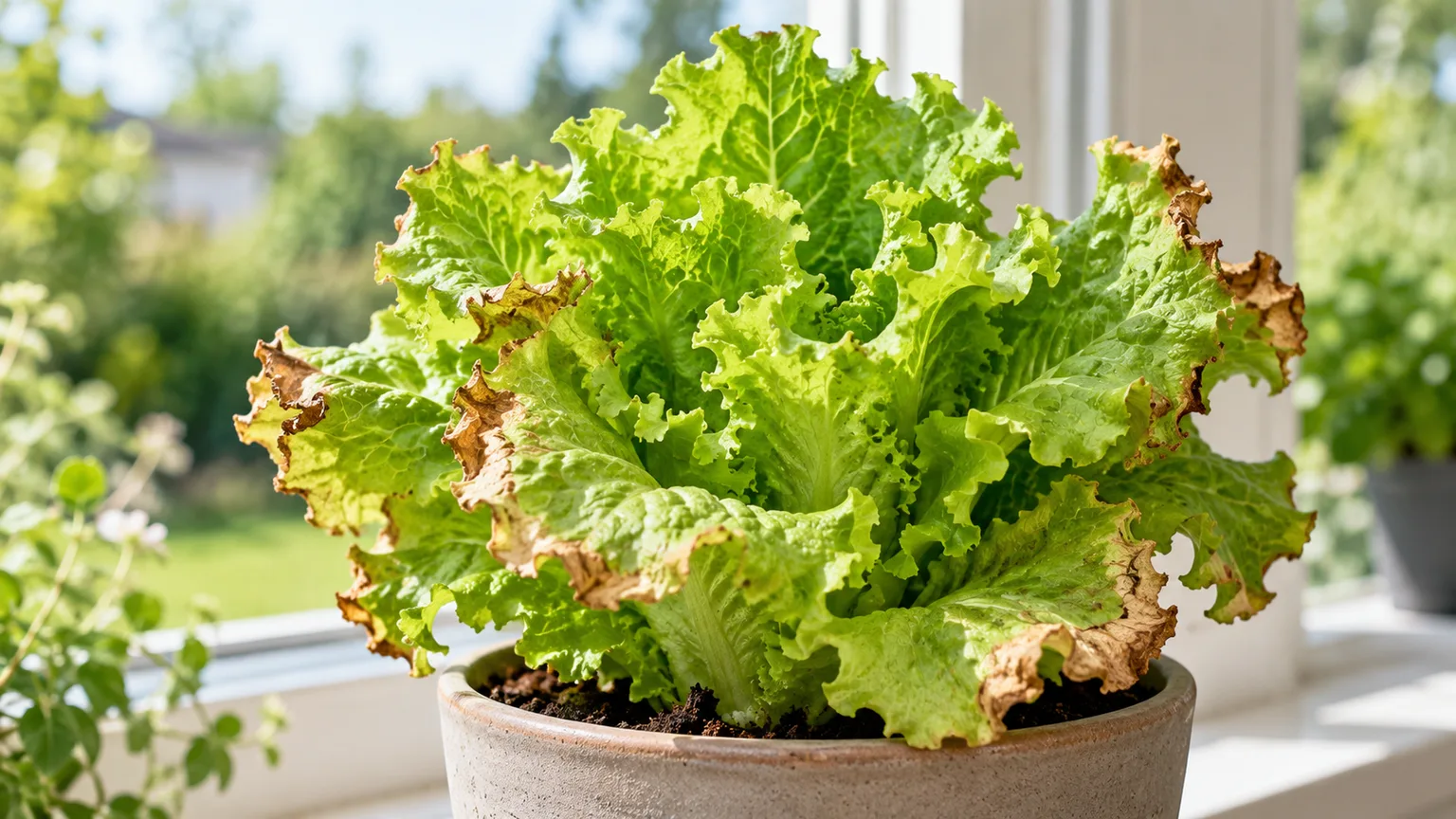
On looseleaf lettuce the damage starts as crisp, tan-to-brown drying at the very tip and along the leaf edge, then creeps inward if the cause continues. On romaine it reads more cleanly: the long upright blade browns from the tip downward while the midrib stays green for a while. Tipburn looks different again — the youngest leaves near the growing point or inside a forming head develop papery, necrotic margins even though the soil feels moist, because the tissue itself has collapsed rather than simply dried out.
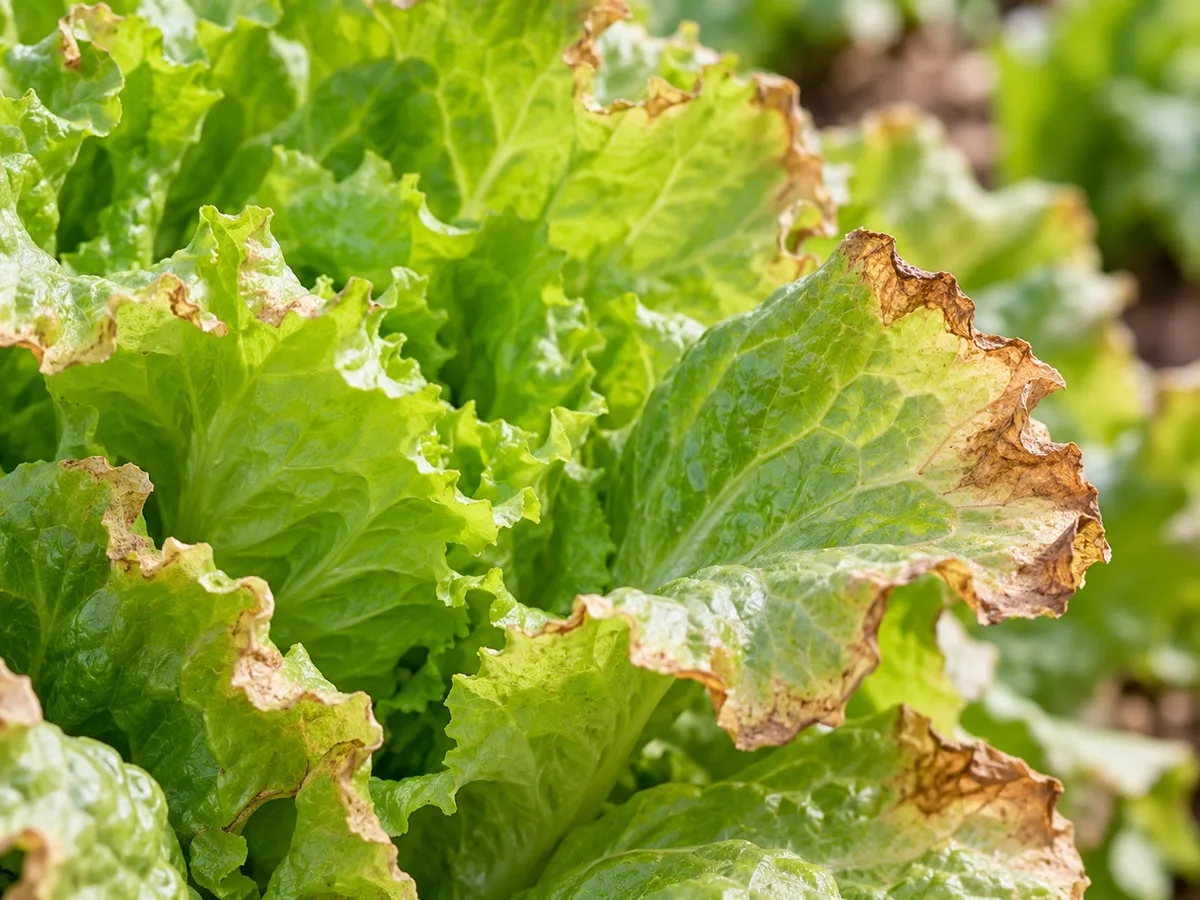
Close-up: tan-brown drying starting at the leaf tip and margins — note whether the youngest leaves near the center or only the oldest outer leaves are affected.
That location detail is everything on this plant. Browning confined to the lowest, oldest outer leaves while the center pushes clean growth is usually normal turnover on a harvested crop. Browning on the young leaves around the growing point or hidden inside a head is a nutrition or water-transport problem worth fixing.
Tipburn: lettuce’s inner-leaf calcium problem
This is the section that only makes sense on lettuce. Tipburn is characterized by browning of the margins of young, maturing leaves in head and leaf lettuces, sometimes with speckled pinpoint necrosis along the edge or browned veins near the lesions. It is a physiological disorder, not a germ: tissue collapses because developing leaves run short of calcium at the moment they need it most.
Why does lettuce run short even in decent soil? Calcium moves with the transpiration stream, so calcium deficiencies in growing tissue appear whenever transpiration stalls — overcast, still, humid weather with low evapotranspiration is the classic trigger. UC IPM explains that inner leaves transpire less than outer wrapper leaves, which is exactly why head formation makes iceberg and butterhead types so vulnerable: the enclosed leaves receive less calcium even when the soil has plenty. Rapid growth, foggy weather that suppresses transpiration, and soil water stress that interrupts calcium transport all produce the same transient deficiency.
Bayer’s lettuce pathology review frames it the same way: tipburn is a localized calcium deficiency in specific leaf tissue, producing brown necrotic areas along the edges of inner lettuce leaves shortly before harvest maturity. Open-leaf varieties tend to show it less under normal conditions because the transpiration gap between inner and outer leaves is smaller — one more reason looseleaf types forgive beginners more easily than crisphead.
Practical upshot for home growers: keep soil pH in lettuce’s preferred 6.0–6.7 range, since extension guidance starts tipburn control with managing liming so that soil pH is above 6.0 and limiting ammonium forms of nitrogen. Avoid pushing soft, forced growth with heavy nitrogen while calcium uptake lags behind. If your mix is acidic or you have been feeding a high-nitrogen formula hard, that imbalance — not a mysterious disease — is the prime suspect when young leaf edges scorch on moist soil.
Containers dry faster than lettuce roots allow
Lettuce carries a shallow root system and requires consistently moist soil for proper growth and flavor, and it builds leaf area fast in cool weather. A small pot on a sunny sill can swing from moist to dry within a day, and each dry swing kills fine root hairs at the pot edge. The plant answers with browned margins, limp or bitter blades, and stalled growth.
Container guides capture the rhythm: lettuce needs a consistent supply of moisture yet cannot tolerate wet roots, with consistent, shallow watering suited to its shallow roots and professional moisture-holding mix in pots with drainage holes. Garden plants get by on roughly an inch of water a week; pots need more, checked daily in warm or windy weather. The lettuce soil guide matters here because an extremely gritty mix can dry too quickly for moisture-demanding roots, while dense mix stays soggy and invites the opposite problem. If your container dries within a day of a thorough soak, the pot is likely too small — NC State notes containers should hold at least 2 quarts and run 6–8 inches deep — so re-read the lettuce repotting guide before answering with ever-heavier watering.
Looseleaf types are the forgiving choice for pots: they harvest sooner, tolerate closer spacing, and let you pick outer leaves first so the center keeps producing. Heading types need wider spacing, steadier moisture, and more patience — and they hide tipburn inside the head until harvest.
Salt, fertilizer, and hard-water burn
Lettuce is a fast feeder in a small volume of mix, which tempts growers to overfeed — and overfed margins scorch. Fertilizer salts accumulate in containers that never get a full flushing soak, and the oldest leaves show it first as brown, dry margins that look like underwatering but occur in moist soil.
Suspect salts when margins brown shortly after feeding, white crust appears on the mix surface, or tips keep burning while compost stays evenly moist. The fix is restraint: pause feeding for two weeks, flush once with plain water until a generous volume drains freely, and resume at half strength only when new growth looks clean. Full feeding rates and salt-avoidance steps live in the lettuce fertilizer guide.
One caution worth stating plainly: University of Delaware extension notes that foliar calcium sprays have not been shown to be effective for controlling tipburn incidence in general. On closed-head lettuce the spray cannot reach the susceptible inner tissue in time, so fix water steadiness, pH, and growth pace instead of misting calcium repeatedly.
Heat, bolting, and the end of the cool season
Lettuce is a cool-season annual, not a heat-loving green. NC State records that both high temperatures around 21–27°C and dry soil can trigger plants to bolt and flower, turning leaves bitter and stopping leaf production. In summer heat the plant is supposed to finish, not keep producing tender leaves.
Confirm heat before treating: check soil moisture in the morning. Moist soil with overnight recovery means warmth, not thirst — add light afternoon shade as described in the lettuce light guide, since NC State recommends only 3 to 4 hours of sun with shade the rest of the day for summer-grown plants. Harvest to Table puts the ceiling plainly: lettuce bolts past about 80°F, so afternoon shade plus bolt-resistant cultivars are the way to stretch the season. Dry soil with leaves still limp the next morning means genuine thirst, covered under underwatering on lettuce. Do not answer heat wilt with extra fertilizer; feeding a heat-stressed plant compounds margin burn.
Cultivar choice is a genuine prevention lever here: looseleaf and butterhead types generally tolerate warmth better than romaine, which itself handles heat better than crisphead — but a named heat-tolerant selection still beats a poorly adapted plant in the same category.
How to confirm the cause
Run this sequence before treating anything:
- Soil first. Push a finger into the upper 1–2 cm and lift the pot. Dry plus light means a watering swing; moist plus heavy means tipburn, salts, or drainage trouble. This one check separates underwatering on lettuce from every other cause.
- Leaf age map. Oldest outer leaves only, center clean: normal aging or salt accumulation — harvest the damaged leaves. Young leaves near the growing point or inside the head browning on moist soil: tipburn or nutrient imbalance. Whole plant at once with limp stems: water or root emergency — compare wilting on lettuce.
- Feeding history. Heavy or frequent fertilizer, no flushing soaks, white crust on the mix surface: suspect salt burn and check the lettuce fertilizer guide.
- pH and nitrogen form. Acidic mix or ammonium-heavy feeding with fast soft growth: suspect calcium lockout behind tipburn.
- Heat check. Bitter flavor, elongating central stem, or browning that arrived with a hot spell: the season is ending — harvest, don’t fertilize.
- Roots only if decline continues. Slip the root ball out if stems soften at the soil line or damage spreads daily. White firm roots mean the plant recovers in place; brown mushy roots with a sour smell mean root rot on lettuce or overwatering on lettuce, not tip drying.
- Pests last. Chewed holes or aphid clusters with sticky residue are insect damage, not tipburn — see aphids on lettuce if sap-feeders are present.
The first fix to try
Even out the moisture — one action, not a bundle. If the upper 1–2 cm check reads dry, give one deep watering at soil level until excess drains freely, empty the saucer, and stop. If it reads moist, hold all water, clear the saucer, and improve airflow instead. Bayer’s lettuce guidance frames management the same way: choose less susceptible varieties and keep crop inputs appropriate rather than shocking the plant with several corrections at once. Do not fertilize, repot, or prune heavily on day one — read the response to steady moisture first.
Step-by-step recovery
If no new browning appears within a week of steady watering, resume the 1–2 cm check routine and harvest only the fully spent outer leaves.
If young-leaf tipburn continues on moist soil, work through nutrition:
- Pause all fertilizer for two weeks so accumulated salts stop compounding the problem.
- On the next scheduled watering, flush the pot with plain water until a generous volume drains freely, then empty the saucer — one leaching soak, not repeated flooding.
- Check pH with a basic soil test. Below 6.0 on a peat-heavy mix, top-dress with a little garden lime per product rates rather than guessing with ash or baking soda.
- Resume feeding at half strength with a balanced fertilizer or compost tea, timed to the lettuce fertilizer guide, and keep ammonium-heavy doses away from young plants in fast growth.
- If stems soften at the soil line or the mix smells sour despite corrected watering, escalate to the root rot on lettuce protocol — trim rotted roots and repot into fresh draining mix per the lettuce repotting guide.
If heat and bolting are the real story, no nutrition fix applies: harvest what is still tender, succession-sow a bolt-tolerant cultivar for the next cool window, and move remaining pots to morning sun with afternoon shade.
Recovery timeline
Mild cases — a few browned outer tips, firm stems, steady new growth — stabilize within one to two watering cycles once moisture evens out. Tipburn cases need longer: the damaged young leaves never heal, so judge by the next flush of growth from the center over two to three weeks. Salt-burn cases follow the same clock after one flushing soak and a feeding pause. If browning keeps spreading to new leaves after a month of steady moisture, balanced feeding, and correct pH, suspect chronic root restriction or the end of the cool season, and compare notes with slow growth on lettuce before investing in another rescue round.
Lookalike symptoms
| What you see | More likely | Where to go |
|---|---|---|
| Dry light soil, limp leaves, crispy margins, perks up after watering | Underwatering swing | Underwatering on lettuce |
| Yellow lower leaves on wet soil, soft stem base, sour mix | Overwatering or root rot | Overwatering on lettuce |
| Wilt that recovers overnight, moist soil, bitter flavor, elongating stem | Heat stress and bolting | Lettuce light guide |
| Uniform yellowing rather than brown edges | Nutrient or light shortfall | Yellow leaves on lettuce |
| Droop plus dullness after transplant or cold snap | Transplant or cold shock | Drooping leaves on lettuce |
| Sticky residue, clustered insects, distorted new growth | Aphids or sap-feeders | Aphids on lettuce |
| White mold on the mix surface alongside edge browning | Chronically wet surface | Mold on soil on lettuce |
| Only oldest outer leaves browning, center clean | Normal aging — harvest, don’t treat | Lettuce overview |
Mistakes to avoid
- Watering on a fixed calendar through cloudy weeks and warm spells alike instead of checking the upper 1–2 cm.
- Pouring fertilizer onto dry roots to “green up” scorched tips — salts burn margins further.
- Misting the leaves or spraying calcium repeatedly to fix browning: wet foliage does not deliver calcium into enclosed growing tissue and invites foliar disease.
- Repotting, pruning hard, and spraying on the same day as the first watering correction — stacked shocks hide which fix worked.
- Stripping every blemished leaf at once for appearance, removing photosynthetic area the plant needs while it pushes replacements.
- Treating normal outer-leaf aging on a harvested crop as a deficiency and escalating doses each week.
- Feeding a bolting plant back into tenderness — once the flower stalk rises, leaves stay bitter.
How to prevent it next time
Grow lettuce as the cool-season crop it is: sow for the coolest practical window, give full sun in genuinely cool weather, and keep moisture even from transplant onward. Mulch containers with mature compost to slow surface drying. Feed steadily rather than heavily, keep pH near 6.0–6.7, and harvest outer leaves regularly so the plant keeps producing from a healthy center — the cut-and-come-again rhythm described in the lettuce overview. Choose tipburn-resistant or bolt-tolerant cultivars where summers run hot, and re-check pot size each sowing: a plant that dries within a day of soaking has outgrown its container, and no watering trick substitutes for the right volume reviewed in the lettuce repotting guide.
When to use this page vs other lettuce guides
Use this page when leaf tips and margins turn brown and dry — the edge-scorch pattern. If the pot stays waterlogged or dries within hours, start with the lettuce soil guide instead. If yellowing dominates rather than browning, the yellow leaves on lettuce differential fits better. If stems are already soft and the mix smells sour, skip ahead to root rot on lettuce for the full unpot-and-trim protocol. For schedule building after rescue, the lettuce watering guide and lettuce fertilizer guide are the references to bookmark, and the lettuce problems hub collects the full symptom index when you are unsure which page fits.
Related lettuce guides
- Lettuce overview — cool-season identity, cultivars, and harvest basics; start here if you are new to the plant.
- Lettuce problems hub — full symptom index; use when you are unsure which problem page fits.
- Watering lettuce — the 1–2 cm check and seasonal rhythms; use for ongoing care after rescue.
- Soil for lettuce — moisture retention, drainage, and pH; use when pots swing between soggy and dust-dry.
- Fertilizer for lettuce — steady feeding without salt buildup; use when margins brown after feeding.
- Light for lettuce — cool-season sun and warm-spell shade; use when browning coincides with heat.
- Underwatering on lettuce — dry-side mirror of this page; use to confirm thirst versus tipburn.
- Overwatering on lettuce — wet-side mirror; use when moist soil pairs with yellowing and soft stems.
Related tool
Use the Brown Tips Diagnosis to narrow tipburn, dry swings, and salt burn on this plant before changing multiple variables at once. For schedule building afterward, the Plant Watering Calculator adapts frequency to your pot size and cool-season sun.