Underwatering on Lettuce: Limp Leaves, Bolt Risk & Recovery
Quick answer
Underwatering on lettuce shows as limp, dull leaves on light, dry mix that do not recover overnight, followed by dry bitter edges and early bolting in warm weather. Check the upper 1-2 cm and lift the pot: dry plus light means thirst, moist plus heavy means heat, roots, or disease instead. First step: water slowly once at soil level until excess drains freely, empty the saucer, and change nothing else until the plant responds.
Underwatering on Lettuce: Causes, Checks & Fixes
This guide covers underwatering on Lettuce. See also the general Underwatering guide, watering, and light pages for this plant.
Underwatering on Lettuce: Causes, Checks & Fixes
Quick answer
Underwatering on lettuce looks like limp, dull leaves on a light pot with dry mix that stay floppy into the morning, then crisp brown edges, stalled growth, and — in warm weather — a central flower stalk rising as the plant bolts. The fastest triage comes from the lettuce watering guide: push a finger into the upper 1–2 cm and lift the pot. Dry plus light means the shallow roots ran out of water; moist plus heavy means heat, root trouble, or disease is mimicking thirst. First step: water slowly once at soil level until excess drains freely, empty the saucer completely, and change nothing else until you see how the plant responds. For how dry root zones collapse leaves on houseplants in general, see our underwatering guide. On lettuce the stakes are higher than on an ornamental, because every dry swing pushes this cool-season crop closer to bitter, unmarketable leaves.
What underwatering looks like on lettuce
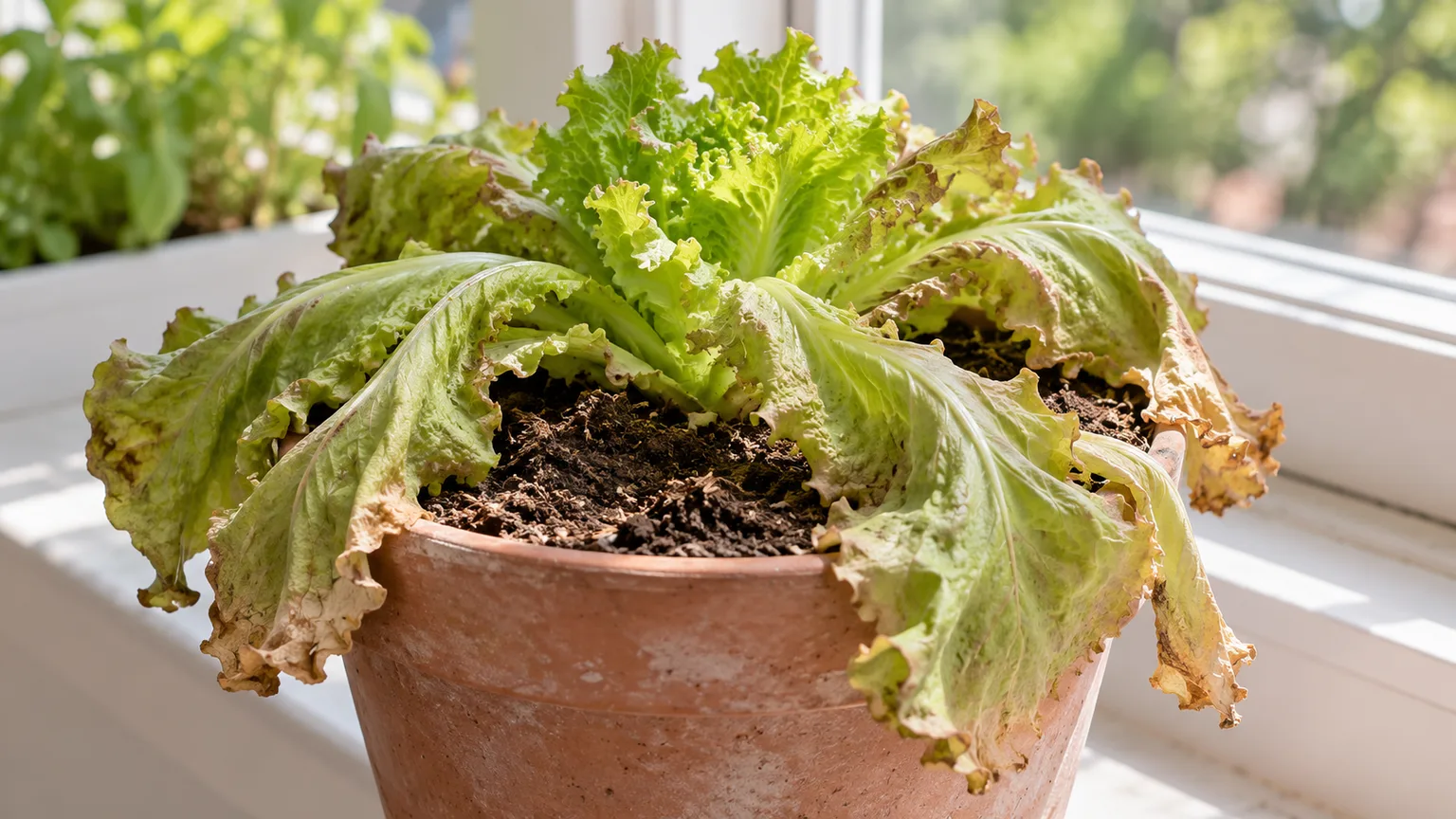
A thirsty lettuce wilts from the outside in. Outer leaves lose their crisp posture first and lie flat against the mix, the surface looks dull rather than glossy, and the pot feels noticeably light. If drying continues, leaf edges turn papery and tan, growth stalls, and in warm weather the center elongates into a flower stalk — bolting that ends useful leaf production.

Close-up: limp, dull blades with drying edges over shrunken mix — note whether the growing center is still green and pushing new leaves.
That center check decides the outcome. A green, active center on dry soil is a plant waiting for water and usually worth saving. A brown or mushy crown, sour-smelling mix, or stems softening at the soil line is root failure, not simple thirst — compare root rot on lettuce before pouring on more water.
Shallow roots in a fast-drying container
This is the section that only makes sense on lettuce. Lettuce carries a shallow root system and requires consistently moist soil for proper growth and flavor, so it cannot chase water deep the way a tomato can. A small container on a sunny sill can swing from moist to dust-dry within a single warm day, and each dry swing kills fine root hairs at the pot edge before the leaves ever wilt.
Professional guidance matches the plant: leafy crops like lettuce are shallow-rooted and need frequent watering but only in the top 6 inches of soil, and growers are advised toward smaller but more frequent irrigation sessions rather than occasional floods. Utah State’s vegetable specialists put it bluntly — leafy greens are extremely sensitive to water stress, with establishment, rapid leaf sizing, and the run-up to harvest as the critical windows. Miss water during rapid leaf sizing on lettuce and you lose exactly the leaves you planted it for. If the lettuce soil guide mix is extremely gritty, it may drain too fast for these roots; if it is dense, it swings to the opposite problem, covered in overwatering on lettuce.
Dry soil plus heat pushes lettuce to bolt
No other common vegetable punishes a missed watering quite like this. NC State records that both high temperatures around 21–27°C and dry soil can trigger plants to bolt and flower, turning leaves bitter and stopping leaf production. North Carolina production guidance adds that lettuce has a relatively high water requirement, and even short periods of moisture stress can severely limit growth and head development.
The practical consequence: a drought episode in warm weather is not just a cosmetic wilt. Once the central stem elongates and flowering begins, bitterness is locked in and no amount of later watering sweetens those leaves — harvest what is still tender and succession-sow instead. Confirm heat before treating: moist soil with overnight recovery means warmth, not thirst, so add light afternoon shade per the lettuce light guide and note that regular watering keeps lettuce less bitter and slower to bolt. Dry soil with leaves still limp the next morning means genuine thirst, and this page is the right one.
Looseleaf vs heading types read thirst differently
Lettuce is a crop group, not one shape, and the type changes both the symptom and the salvage. Looseleaf cultivars show thirst fast — open rosettes wilt dramatically — but they also forgive fastest, because you can harvest the damaged outer leaves and let the center keep producing. They suit small pots and close spacing, as described in the lettuce overview.
Heading types — romaine, butterhead, crisphead — hide trouble longer and recover slower. A romaine heart can look upright while outer leaves crisp, and a forming crisphead can stall permanently after one severe dry spell since the enclosed heart cannot be replaced by picking. NC State’s production notes rank the types plainly: leaf and butterhead types tolerate heat better than romaine, which itself does better than head lettuce — but cultivar genetics still decide individual performance. In a heat wave, harvest young loose leaves rather than waiting for a perfect head, and favor named heat- or bolt-tolerant selections for the next sowing.
How to confirm the cause
Run this sequence before treating anything:
- Soil first. Push a finger into the upper 1–2 cm and lift the pot. Dry plus light confirms thirst; moist plus heavy rules it out and points at heat, drainage, or roots. This single check separates this page from overwatering on lettuce.
- Morning test. Check before the sun hits the plant. Leaves still limp at dawn on dry mix mean drought; wilt that appeared at midday but recovered overnight on moist mix means heat — compare wilting on lettuce.
- Center and crown. Green active center with firm stem base: rehydrate in place. Brown mushy crown, soft stem at the soil line, or sour drain smell: unpot and inspect for root rot on lettuce.
- Leaf age map. Oldest outer leaves crisping while the center pushes clean growth: drought swing or normal harvest turnover — pick the spent leaves. Whole plant limp including young leaves: water or root emergency. Uniform yellowing rather than limp crisping: see yellow leaves on lettuce.
- Heat and stalk check. Bitter flavor plus an elongating central stem after a hot dry spell: drought-triggered bolting, not an ongoing watering deficit — harvest, don’t keep rescuing.
- Pests last. Distorted new growth, sticky residue, or clustered insects with adequate moisture: sap-feeders, not thirst — see aphids on lettuce.
The first fix to try
Rehydrate slowly — one action, not a bundle. Set the pot in a saucer, water gently at soil level until excess drains freely, wait ten minutes, and repeat once if the surface still resists wetting and water races down the pot edge. Then empty the saucer completely and stop. Dry peat-heavy mix can turn hydrophobic, so a second slow pass beats one hard flood that channels past the root ball. Do not fertilize, repot, or prune on day one — read the plant’s response to water first, and keep guidance from the lettuce watering guide as your schedule reference.
Step-by-step recovery
If leaves firm up within hours and no new crisping appears over the next few days, resume the 1–2 cm check routine and harvest only the fully spent outer leaves.
If the pot dried again within a day of a thorough soak, the container is the problem:
- Move the plant — young and intact — into a larger container, at least 6–8 inches deep, with fertile draining mix near pH 6.0–6.7 per the lettuce soil guide and the lettuce repotting guide.
- Mulch the surface with a thin layer of mature compost to slow surface drying, a standard steady-moisture practice for lettuce beds and pots.
- Shift pots to morning sun with afternoon shade during warm spells, since NC State gives summer plants only 3 to 4 hours of sun with shade the rest of the day.
- If stems soften at the soil line or the mix smells sour despite corrected watering, escalate to the root rot on lettuce protocol instead of watering harder.
If heat and bolting are the real story, no watering schedule applies: harvest what is still tender, compost the bolted plant, and succession-sow a bolt-tolerant cultivar for the next cool window.
Recovery timeline
Mild cases — one wilt episode, firm stems, green center — firm up within hours of rewetting and stabilize within one or two watering cycles. Moderate cases with crisped outer edges need a week: the damaged margins never heal, so judge by clean new leaves emerging from the center. Severe drought plus heat that triggers bolting does not reverse on any timeline; once the flower stalk rises and leaves turn bitter, the planting is finished and replacement sowing is the recovery. If limpness returns within a day of every watering despite a right-sized pot, suspect root loss or chronic hydrophobic mix and compare notes with slow growth on lettuce before another rescue round.
Lookalike symptoms
| What you see | More likely | Where to go |
|---|---|---|
| Wilt that recovers overnight on moist soil, bitter flavor, elongating stem | Heat stress and bolting | Lettuce light guide |
| Yellow lower leaves on wet soil, soft stem base, sour mix | Overwatering or root rot | Overwatering on lettuce |
| Brown dry leaf tips on otherwise upright leaves | Tipburn, salt, or dry-swing scorch | Brown tips on lettuce |
| Uniform yellowing rather than limp crisping | Nutrient or light shortfall | Yellow leaves on lettuce |
| Droop after transplant or cold snap, soil adequate | Transplant or cold shock | Drooping leaves on lettuce |
| Sticky residue, clustered insects, distorted new growth | Aphids or sap-feeders | Aphids on lettuce |
| White mold on the mix surface after rescue overwatering | Chronically wet surface | Mold on soil on lettuce |
| Collapse limited to oldest outer leaves, center clean | Normal aging — harvest, don’t treat | Lettuce overview |
Mistakes to avoid
- Watering on a fixed calendar through cloudy weeks and heat waves alike instead of checking the upper 1–2 cm.
- Flooding a hydrophobic pot once and assuming the root ball is wet — slow passes beat one hard pour.
- Pouring fertilizer onto dry roots to “green up” wilted leaves — salts burn stressed roots further.
- Misting the leaves to fix a root-zone drought — wet foliage does not rewet the mix and invites foliar disease.
- Repotting, pruning hard, and feeding on the same day as the first rehydration — stacked shocks hide which fix worked.
- Stripping every wilted leaf at once for appearance, removing tissue that would have recovered within hours.
- Trying to water a bolted plant back into tenderness — once the stalk rises, leaves stay bitter.
How to prevent it next time
Grow lettuce as the cool-season crop it is: sow for the coolest practical window, since optimal vegetative growth sits around 60 to 65°F and prolonged warmth pushes bolting regardless of watering. Give full sun in genuinely cool weather and morning sun with afternoon shade as days warm. Keep moisture even from transplant onward with the 1–2 cm check, mulch containers, and favor drip or soil-level watering that wets the shallow zone without soaking the crown. Choose bolt-tolerant cultivars where summers run hot, succession-sow every couple of weeks during suitable weather, and harvest outer leaves regularly so the plant keeps producing from a healthy center — the cut-and-come-again rhythm in the lettuce overview. Re-check pot size each sowing: a plant that dries within a day of soaking has outgrown its container, and no schedule substitutes for the volume reviewed in the lettuce repotting guide.
When to use this page vs other lettuce guides
Use this page when leaves go limp on dry, light mix and firm up after watering — the thirst pattern. If the pot stays waterlogged or dries within hours, start with the lettuce soil guide instead. If wilt recovers overnight on moist soil with bitter flavor, the lettuce light guide heat story fits better. If stems are already soft and the mix smells sour, skip ahead to root rot on lettuce for the full unpot-and-trim protocol. If browning dominates rather than wilting, the brown tips on lettuce differential fits better. For schedule building after rescue, the lettuce watering guide and lettuce fertilizer guide are the references to bookmark, and the lettuce problems hub collects the full symptom index when you are unsure which page fits.
Related lettuce guides
- Lettuce overview — cool-season identity, cultivars, and harvest basics; start here if you are new to the plant.
- Lettuce problems hub — full symptom index; use when you are unsure which problem page fits.
- Watering lettuce — the 1–2 cm check and seasonal rhythms; use for ongoing care after rescue.
- Soil for lettuce — moisture retention, drainage, and pH; use when pots swing between soggy and dust-dry.
- Light for lettuce — cool-season sun and warm-spell shade; use when wilt coincides with heat.
- Fertilizer for lettuce — steady feeding without salt buildup; use when growth stalls after rehydration.
- Overwatering on lettuce — wet-side mirror of this page; use when moist soil pairs with yellowing and soft stems.
- Wilting on lettuce — wilt differential; use when limpness needs heat, root, and thirst causes separated.
Related tool
Use the Plant Watering Calculator to narrow causes for underwatering on this plant before changing multiple variables at once.