Spider Mites on Lettuce: Causes, Checks & Fixes
Quick answer
Pale stippling plus fine webbing on lettuce leaf undersides in hot, dry weather usually means spider mites. First step: rinse every leaf, undersides first, with a firm stream of water in the morning, then confirm with a white-paper tap test before spraying anything.

Spider Mites on Lettuce: Causes, Checks & Fixes
This guide covers spider mites on Lettuce. See also the general Spider Mites guide, watering, and light pages for this plant.
Spider Mites on Lettuce: Causes, Checks & Fixes
Quick answer
Pale stippling plus fine webbing on lettuce leaf undersides in hot, dry weather usually means spider mites. First, move containers to make access easy and rinse every leaf — undersides first — with a firm stream of water in the morning. Then confirm with a white-paper tap test before spraying anything, because lettuce is a fast annual you eat, and water plus harvest timing solve many early infestations without residues.
For how these mites feed and spread in general, see our spider mites guide. On lettuce, the pattern usually shows up as speckled outer leaves that wilt even when the soil feels moist, during the warmest part of the growing window.
What spider mites look like on lettuce
Early feeding shows as tiny pale dots — stippling — scattered across the outer and lower leaves, while the veins often stay green at first. As feeding continues, leaves take on a dusty, bronzed cast, dry at the edges, and wilt even though the root zone may be moist. Flip a damaged leaf and look closely: fine silk webbing stretched across the underside, sometimes bridging leaf folds, is the signature that separates mites from plain drought stress.
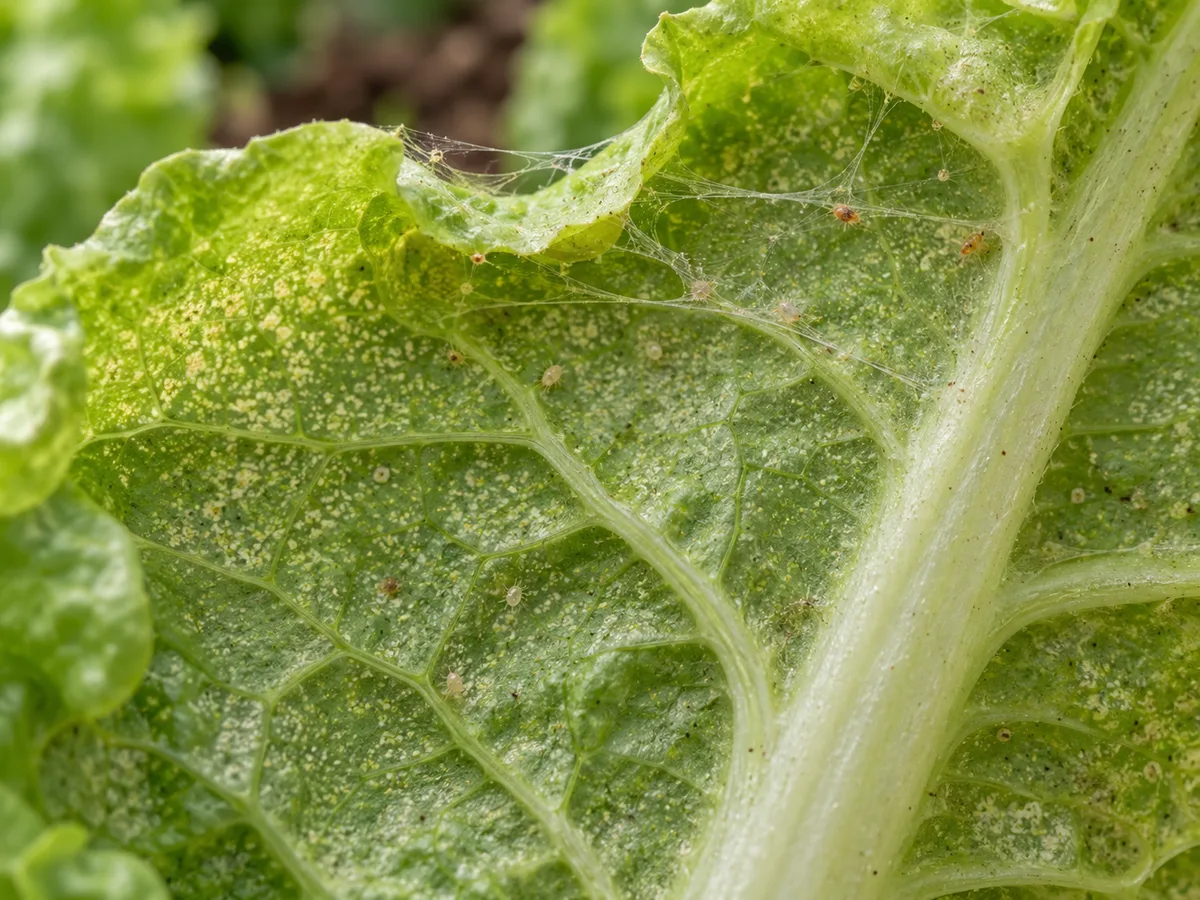
Close-up: pale stippling plus faint webbing on the underside of an outer lettuce leaf — check the midrib and leaf folds with a hand lens.
The mites themselves are pinhead-sized moving specks, often reddish or pale green, and a single one is barely visible to the naked eye. By the time bronzing is obvious, the population is usually large, which is why the tap test below matters more than hunting for individual mites.
Where mites hide on a lettuce plant
Start with the lowest wrapper leaves, which sit closest to warm soil and dust. Then work inward and upward: the upright folds of romaine channel mites and webbing deep between leaves, while the cupped heart of a butterhead shelters them where sprays rarely reach. On looseleaf rosettes, run your eye along the underside of each midrib, where feeding clusters first.
Seedlings in plugs and nursery cells deserve their own check, because a starter tray bought or held in hot, dry air can carry mites straight into the bed. Before transplanting, tap-test the starts over paper and reject trays with webbed or heavily speckled lower leaves. Also inspect neighboring crops and weeds: the culprit is usually the two-spotted spider mite, Tetranychus urticae, which feeds on a very wide range of vegetables and ornamentals, so a nearby infested bean or cucumber row can reseed your lettuce within days.
Why heat and dry soil turn lettuce into mite food
Lettuce is a cool-season annual with a shallow root system, so it has almost no buffer when hot weather arrives. Dry soil combined with temperatures around 21–27°C pushes lettuce toward bolting and bitterness — and the same hot, dry spell is exactly when spider mites breed fastest. The mite thrives in warm, dry conditions, and drought-stressed plants are attacked first: mites target water-stressed plants before healthy ones.
Containers make this worse because a 15–20 cm pot of mix dries out far faster than a bed, especially in wind. And if you water only at the base with drip or a careful soil-level pour, foliage never gets washed — base watering leaves undisturbed colonies on the undersides, a trade-off worth knowing during heat waves. Review your recent pattern in the lettuce watering guide: daily surface dry-outs in warm weather are both a bolting trigger and a mite invitation. Shade placement matters too — NC State recommends just three to four hours of sun with shade for the rest of the day for summer-grown lettuce — so a crop baking in all-day sun is doubly exposed; compare notes with the lettuce light guide.
How to confirm mites before treating
- Tap test. Hold white paper under a suspect lower leaf and tap the leaf sharply. Crawling dust-like specks confirm live mites. No movement after two tries on different leaves means the stippling may be old damage or another problem.
- Webbing check. Mist the leaf underside lightly — fine silk threads show up against the droplets. Dust washes away; webbing stays strung between folds and midribs.
- Pattern check. Mite stippling starts on outer, lower leaves and moves inward during hot, dry weather. Uniform yellowing of the oldest leaves with no dots points more toward normal aging or feeding issues — see yellow leaves on lettuce to compare.
- Growth check. Look at the very center. A heart still pushing clean, normally colored leaves is treatable. A stalled, bronzed center plus webbing over the crown is a salvage decision, covered below.
Skip the urge to spray “just in case.” On an edible crop with a short life, every spray costs harvest days, so confirm first.
The first fix: rinse the whole plant, undersides first
Do this on the morning you confirm mites. Take container plants where spray runoff will not hit other crops, or work in the bed row by row. Using a hose nozzle or a strong sink sprayer, wash every leaf with a firm but non-shredding stream, spending most of the effort on the undersides, midribs, and leaf folds. A strong stream of water physically detaches mites and breaks up webbing, and it leaves zero residue on leaves you plan to eat.
Keep the blast moderate on tender butterhead hearts so you do not bruise the crown, and tilt containers so runoff drains away instead of pooling in the rosette. Morning timing lets foliage dry by evening, which matters because water trapped overnight in a dense head invites rot — the overwatering guide shows what soggy crowns lead to. Repeat the rinse every three to four days for two weeks to catch newly hatched mites; one wash never finishes the job.
Step-by-step follow-up, in order
- Keep rinsing on schedule. Three to four rinses over two weeks, always with underside coverage. Judge by the tap test, not by hope — fewer moving specks each round means progress.
- Strip the worst outer leaves. Pull the most bronzed, webbed wrapper leaves, bag them, and bin them — do not compost infested material. This removes a large share of eggs and opens the plant for better spray coverage.
- Spot-treat only if rinsing stalls. Use insecticidal soap or neem oil mixed and applied exactly per its label, coating the undersides until wet. Test one leaf first and wait two days for burn. Never apply plant-oil sprays when temperatures exceed 90°F (32°C) or when the plant is wilted from dry soil — the combination scorches lettuce fast.
- Invite predators outdoors. Predatory mites, lady beetles, and lacewings all feed on spider mites. Avoid broad-spectrum insecticides entirely: they kill these allies and mite populations rebound worse than before.
- Respect the harvest. Check the product label for the waiting period between spraying and picking, and wash every harvest thoroughly in cool water. If you sprayed within the label interval, keep picking outer leaves only after the interval passes — or skip eating them and let the center produce the next clean round.
Wear gloves while handling heavily infested plants: lettuce sap contains compounds that can irritate skin, a low-severity contact warning rather than a food-safety issue, but itchy hands make sloppy work.
Harvest-first salvage: think like an annual grower
Lettuce is a short-lived crop, not a perennial you nurse for months, so salvage math favors the harvest. Keep picking clean outer leaves from looseleaf types every few days — each harvest removes potential mite habitat and still puts salad on the table. If stippling stays confined to the wrapper leaves and the center keeps emerging clean, the plant can carry you to a respectable harvest.
Pull the whole plant when webbing mats over the heart, two weeks of rinsing produce no clean center growth, or a flower stalk starts rising through damaged leaves — a bolting plant channels energy into seed, turns bitter, and will not outgrow mites. Bag and bin pulled plants. Then use the vacancy: succession sowing every couple of weeks during suitable weather gives steadier supply than rescuing one ageing crop, with leaf types ready in roughly 50–60 days and head types in 70–80. Fresh mix or a rotated bed position also breaks the cycle, since mites and eggs sheltering in debris get left behind. For spacing and depth at replanting, recheck the lettuce soil guide.
Lookalike symptoms on lettuce
| What you see | More likely | Check |
|---|---|---|
| Clusters of visible insects plus sticky residue | Aphids — they excrete honeydew and cluster on new growth | Aphids on lettuce |
| White cottony clumps in leaf axils | Mealybugs, not webbing mites | Mealybugs on lettuce |
| Brown, papery leaf margins without stippling | Tipburn or edge burn from moisture swings | Brown tips on lettuce |
| Limp leaves that recover after watering and cooling | Simple underwatering rather than pests | Underwatering in lettuce |
| Limp leaves in soggy mix, soft crown base | Root or crown trouble from excess water | Wilting on lettuce |
| Stretched pale stalk with bitter leaves in heat | Bolting, the annual end-of-life response | Leggy growth on lettuce |
| Fine stippling but no mites on the tap test | Old mite damage already controlled, or another sampler — retest new leaves in a few days | Lettuce problems hub |
Mistakes to avoid
- One spray and done. Mite eggs survive most contact treatments, so a single application followed by silence guarantees a rebound. Schedule the repeats before you start.
- Reaching for broad-spectrum insecticide. It kills predators and often misses mite eggs, trading a setback for an explosion. Soap, oil, water, and predators are the proportionate ladder.
- Fertilizing a mite-stressed crop. A nitrogen push on damaged leaves will not outrun feeding, and soft lush growth is easy mite food. Hold feed until clean center growth resumes; the lettuce fertilizer guide sets the normal cadence.
- Soaking heads late in the day. Evening overhead water sitting in butterhead cups and romaine folds invites rot. Rinse in the morning and let the crown dry.
- Repotting or transplanting mid-infestation. Lettuce is transplanted once to its final spot as a seedling; shifting an established, infested crop damages shallow roots without touching the mites.
- Treating one plant in a row. Mites drift between touching leaves. Tap-test the neighbors and rinse the whole row the same week.
How to prevent mites on the next sowing
Sow for the cool shoulder seasons rather than fighting midsummer with a cool-season crop. In unavoidable heat, morning sun with afternoon shade plus steady shallow moisture keeps plants growing instead of stalling into susceptibility. Space to the seed packet’s final spacing — heading types need room for airflow and head development, while looseleaf can stand closer — because cramped, dusty, drought-pulsed rows are ideal mite nurseries.
Make foliage rinsing a routine chore during hot spells, not an emergency measure: a weekly underside wash dislodges early colonies before webbing appears. Mulch beds lightly to cut soil dust, keep irrigation even so the upper mix never stays bone-dry for days, and walk the row weekly with the tap test while populations are still small. If spider mites return every summer despite this, treat them as a season signal — shift the main lettuce crop earlier or later and let heat-tolerant greens hold the bed through the peak.
When to worry
Worry when seedlings collapse with webbed cotyledons, when webbing sheets across the heart and the tap test stays positive after two weeks of rinsing, or when most of the row bronzes at once during a heat wave. A single speckled wrapper leaf on an otherwise growing plant is maintenance; a stalled bronzed crown on a bolting plant is compost math. Because you eat this crop, also weigh spray history: if the label interval cannot be honored before the plant bolts, stop spraying, harvest only what the label allows, and replant clean.
Related tool
Use the Pest Identifier Tool to confirm stippling-and-webbing against aphids and other lettuce pests before you commit to a spray schedule.
Related lettuce guides
- Lettuce problems hub — start here when more than one symptom is present or the tap test is negative.
- Aphids on lettuce — when you see clustered insects and sticky honeydew instead of dry stippling and webbing.
- Wilting on lettuce — when limp leaves dominate and you need to separate root trouble from mite feeding.
- Lettuce watering guide — set the even shallow-moisture baseline that keeps plants growing past mite pressure.
- Lettuce light guide — place the crop for morning sun and afternoon shade during heat.
- Lettuce overview — cultivar types, spacing, and harvest timing for the replant decision.
When to use this page vs other lettuce guides
Use this page when stippling plus fine underside webbing in hot, dry weather points to spider mites. Switch to the aphids guide for clustered visible insects with honeydew, yellow leaves for unstippled yellowing tied to water or nutrients, slow growth for stalled plants without pest signs, and the problems hub when several symptoms overlap.