Corn Companion Plants: Best Neighbors and Layout Tips
Find the best corn companion plants, from beans and squash to cucumbers and dill, with planting layouts, timing, spacing, and crops worth keeping apart.
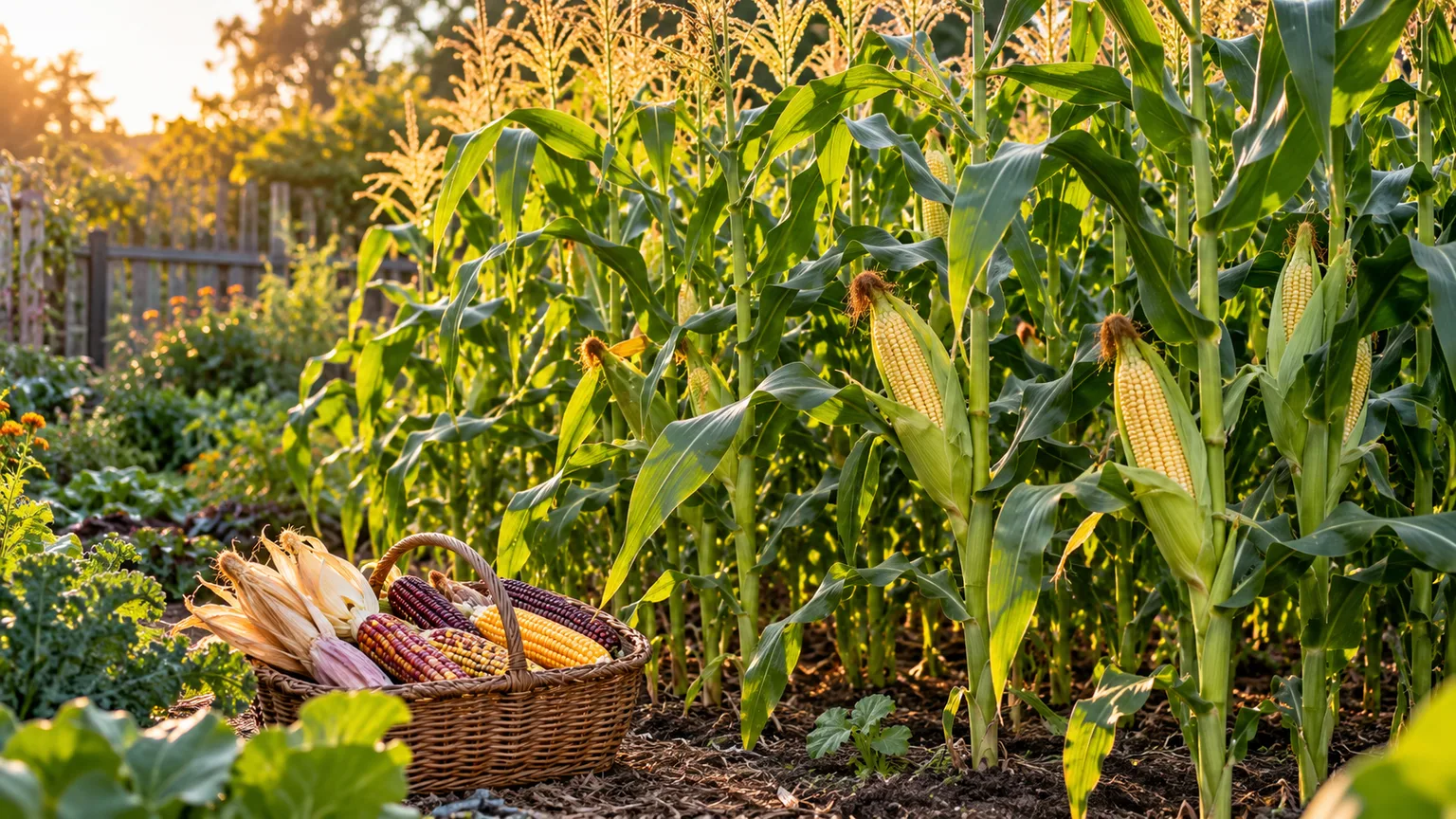
The most dependable plants to grow with corn are pole beans and squash: together with corn, they form the Three Sisters planting system. Other crops can share a bed when their timing, height, roots, and water needs fit, but a neighbor does not improve corn just because it appears on a companion-planting chart.
Start with the job you want the companion to do. Pole beans climb and add a legume to the planting; squash shades soil and occupies the ground; lettuce can use the open space before corn gets tall. The right choice also depends on whether you want fresh sweet corn, dry beans and storage squash, a compact garden, or the simplest possible harvest.
How to judge a corn companion plant
Corn is a tall, warm-season crop that needs sun, steady moisture, fertile soil, and enough pollen moving among tassels and silks to fill ears. A sensible companion should use space that corn leaves open, mature at a different time, or offer a practical function such as climbing support or soil cover. It should not block light during establishment or make routine work around the corn impossible.
The term companion planting covers several different ideas: crops can fit together physically, support a traditional polyculture, attract insects, or produce measurable changes in yield or pest pressure. Those are not the same claim. A familiar pairing can be worth trying without guaranteeing fewer pests or more corn, so treat strong claims as hypotheses to test in your own garden rather than promises.
This is why it helps to choose by function. For a small garden, a vining squash may make better use of ground area than a second upright crop; for an easy-to-reach sweet-corn row, lettuce or a flowering border may be less disruptive than a vigorous vine. The chart below distinguishes the main strengths from the main cautions.
| Companion | Best reason to include it | Main trade-off |
|---|---|---|
| Pole beans | Climb and complete a Three Sisters planting | Can tangle with corn or pull weak stalks if planted too early or too densely |
| Squash or pumpkin | Covers bare soil and can suppress weeds | Vines sprawl, compete for water, and block access |
| Peas | Cool-season crop that can finish before corn fills the bed | Usually a timing partner, not a same-season fertilizer for corn |
| Lettuce | Quick crop for space around young corn | Heat and later shade can end the crop or make it bolt |
| Dill or flowers | Adds bloom and insect habitat at the bed edge | Pest-control effects are variable; flowers do not replace monitoring |
The Three Sisters: corn, pole beans, and squash
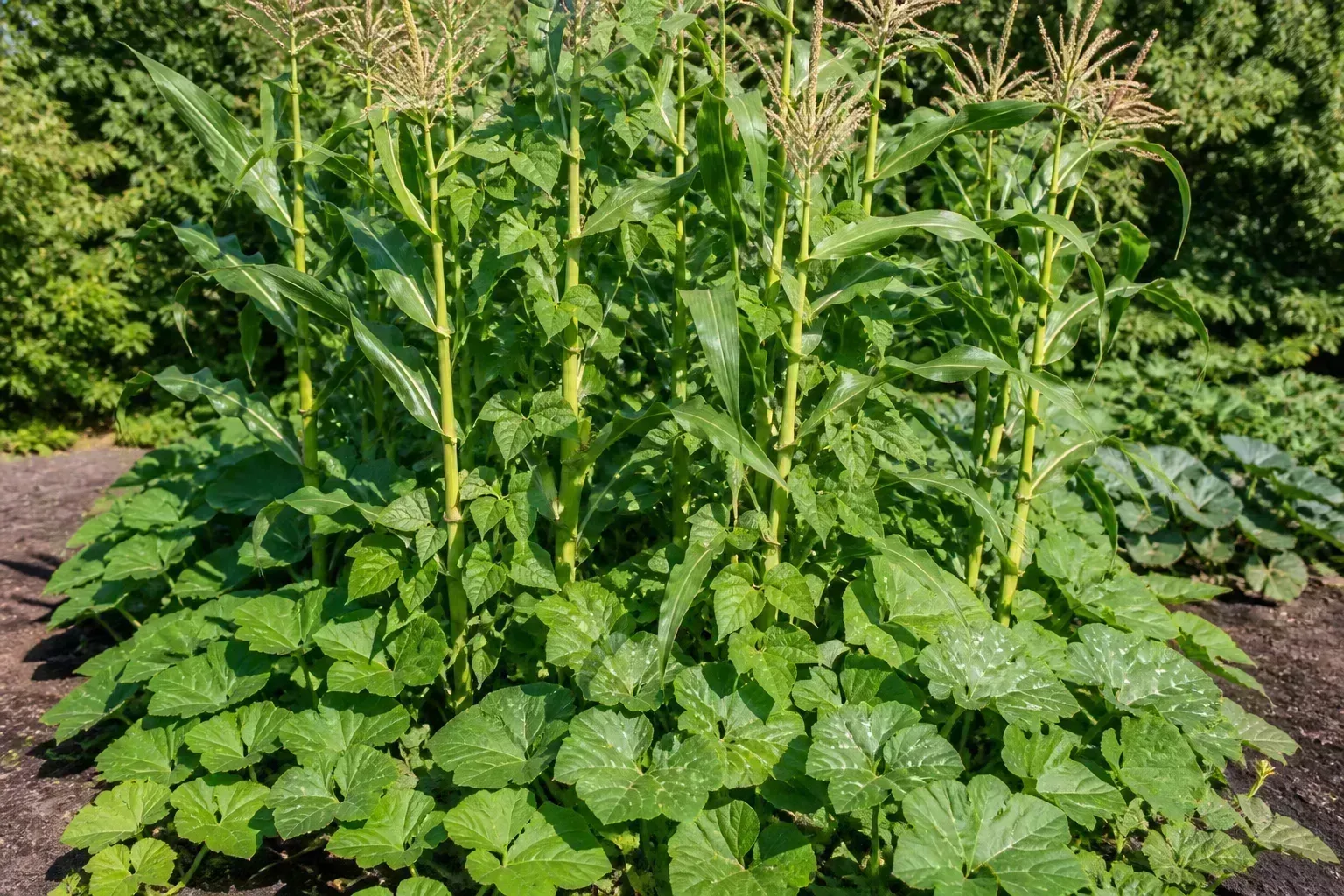
The Three Sisters is a well-known Indigenous agricultural system in which corn, climbing beans, and squash are grown together. Cornell Garden-Based Learning documents the tradition in a lesson about Haudenosaunee (Iroquois) gardening and describes the cultural and horticultural role of these crops; it is more accurate to recognize that specific context than to treat Indigenous agriculture as a single uniform recipe. The University of Arkansas Cooperative Extension describes a familiar garden layout with corn in the center, beans close around it, and squash farther out.
The planting has complementary shapes. Corn grows upright and can provide a living support for pole beans; squash spreads low and shades some of the soil. The arrangement can make a productive mixed planting, but these crops still compete for sunlight, nutrients, and moisture. Their compatibility depends on spacing and timing, not on a rule that plants never compete.
There is an important nitrogen detail that companion lists often skip. Beans host nitrogen-fixing bacteria in root nodules, but the nitrogen they capture is used first by the bean; most is not immediately available to a neighboring corn plant during the same season. Cornell Cooperative Extension notes that bean roots need to break down before much of that nitrogen returns to the soil, and that corn may still need additional fertility for a good crop. Grow beans as a food crop and long-term soil contributor, not as a substitute for a soil test or a corn feeding plan.
The traditional mound format suits gardeners who want all three crops and can give vines room. One Cornell Cooperative Extension layout uses a mound roughly 18 inches to 3 feet across and about 12 inches high: sow four to seven corn seeds around six inches apart in the middle and thin to three or four plants. When corn reaches about six inches, sow roughly six pole bean seeds in a circle six inches from the stalks and thin to three or four; plant several squash or pumpkin seeds about a foot farther out and keep one vigorous seedling.
That is a starting layout, not a fixed formula for every variety. A compact bush squash may need less perimeter than a long-vining pumpkin, and mound height should reflect local rainfall: a slight depression can help hold water in dry conditions, while a heavy, wet soil may need a flatter bed. The mound is also less convenient when you plan to harvest sweet corn and snap beans frequently, since reaching ears through squash foliage can crush vines and compact soil. The University of Arkansas Extension discusses a row-based variation for fresh corn and beans, with squash along an edge; that layout gives you paths and easier picking while retaining some of the trio’s benefits.
Pole beans and peas: climbers and cool-season partners
Pole beans are the clearest vegetable companion for corn when you want to try the Three Sisters. The beans can use corn stalks as support, so you do not need to install a separate trellis. But a corn plant that is only a few inches high is not a sturdy trellis yet. Cornell Cooperative Extension’s guidance waits until corn is about six inches tall before sowing pole beans nearby, while practical garden guides recommend a similar stagger; planting beans into a tall, leafy canopy also makes it harder for their seedlings to get established.
Use a moderate number of vines and watch their direction. If several vigorous bean plants wrap one stalk, they can pull on it in wind, shade corn leaves, and make the stalk harder to inspect or harvest. Guide the first tendrils to the stalks and keep extra vines at the edge; if your corn is a short, weak, or ornamental variety, a separate trellis is safer than asking it to carry climbing beans.
Peas are legumes too, but their season makes them a different kind of partner. They prefer cool growing weather, so they can occupy a future corn bed early in spring and be harvested before corn needs the full space. Do not sow a late spring pea row under established corn expecting the nitrogen from living pea plants to feed it right away; harvest or cut the pea crop, then use the bed according to local corn planting temperatures and season length.
Squash and pumpkins: living mulch with real space costs
Summer squash, winter squash, and pumpkins can spread over exposed soil and shade the ground. That canopy may slow some weeds and reduce direct sun on soil, which is the practical “living mulch” role people value in a Three Sisters bed. It does not mean you can stop weeding completely: young corn needs protection from competition before the squash canopy fills in, and weeds at the base of seedlings still need careful removal.
Choose the squash habit for the space, not just the name. A compact bush zucchini is easier to fit beside a short row than a long-vining pumpkin, while a sprawling winter squash needs an open perimeter or a path that can tolerate vines. Cornell Cooperative Extension’s mound instructions put squash outside the beans and corn; directing vines toward the sunny edge preserves access to the corn and lets leaves cover ground without trapping the harvest inside a wall of foliage.
Squash flowers need pollination to set fruit, and the plant may keep growing even when little fruit forms. Leave room for pollinators, check flowers and young fruit, and water the root zone rather than assuming the nearby corn will solve a pollination problem. If your main goal is easily harvested sweet corn, plant squash along one outside edge or grow it in a separate bed rather than between every corn row.
Cucumbers and melons: spreading crops for generous beds
Cucumbers, muskmelons, and watermelons share warm-season conditions with corn, and their trailing stems can occupy ground that would otherwise need mulch or weeding. That makes them possible companions when a garden has enough room. In a small plot, however, spreading vines can cover corn roots, make it difficult to walk in to pick ears, and compete with the corn during hot or dry stretches.
Do not count on a corn stalk as a safe trellis for heavy fruit. A cucumber may climb nearby support, but corn stalks are living crop stems that move in wind and already carry ears; a separate trellis is more reliable for climbing cucumbers. Let melon vines run toward the bed edge, where their fruit can rest on soil or a dry mulch surface without sitting in a dense tangle against the corn.
Spacing is more important than the companion label. If you cannot keep the vine’s center and leaves from smothering the corn row, use a different bed or grow a compact variety. For a large garden, test one vine at the edge before planting several, then note whether corn still gets enough sun and whether you can harvest without stepping on runners.
Lettuce and quick greens: use the early-season window
Leaf lettuce and other fast greens can make use of the light around young corn before its leaves form a dense canopy. This is succession in space and time, not a way to make lettuce tolerate midsummer heat. Sow a short row between corn rows while the corn is small, then harvest the greens before they are shaded or before you need room to cultivate, side-dress, and water the corn.
The shade that may delay bolting in hot weather can also be too deep once corn grows tall, particularly for head-forming lettuce. Choose a heat-tolerant leaf variety, provide consistent moisture, and plan on an early harvest. The Farmer’s Almanac includes corn among the crops that can provide nearby shade for lettuce, but use that as a placement possibility rather than a guarantee that lettuce will keep producing through summer.
Dill, nasturtiums, and sunflowers: flowers with measured expectations
Dill and flowering annuals can add nectar, pollen, and habitat to the border of a vegetable plot. Gardener’s Path describes letting dill flower and using nasturtiums as a possible aphid trap crop, while its corn guide also discusses sunflowers as a “fourth sister.” These are practical ideas to test, not dependable pest barriers: a flower patch does not repel every insect, and a trap crop only helps if you inspect it and act when pests concentrate there.
Keep these plants at the sunny edge instead of interplanting them so densely that they compete with corn. Dill can become tall and shade young plants if it is placed on the wrong side; large sunflowers can do the same and draw heavily on water. Nasturtiums are easier to use as a low border, but if they attract aphids, remove heavily infested foliage rather than letting a growing aphid colony become a reservoir for the rest of the bed.
The simplest reason to include a flower is often that you want flowers, edible blooms, or a more diverse garden—not a guaranteed increase in corn yield. Leave a clear path for inspection, keep blooms through the season when possible, and track whether you actually see more beneficial insects or fewer problems before expanding the planting.

Potatoes: a possible neighbor, not a yield shortcut
Corn and potatoes can share a large garden in some layouts because their harvests use different parts of the plant: corn makes ears above ground while potatoes form tubers below. That does not make them effortless roommates. Potatoes need hilling and digging, which can disturb corn’s shallow roots, and mature corn can shade potato foliage. Place the crops in separate adjacent rows with enough room to cultivate potatoes without working through the corn roots.
Claims that potatoes automatically benefit from being beside corn often confuse intercropping with using corn residues or corn as a cover crop in a planned rotation. For a home garden, choose this pairing only if you can preserve sunlight and access for potato care. If your space is tight, keep potatoes in their own bed and use the corn understory for a quick crop that finishes earlier.
Choose a layout that protects corn pollination
Corn pollen moves from tassels at the top of plants to silks on ears below. Because wind carries that pollen, a compact block of rows generally gives pollen a better chance to land on nearby silks than a single isolated row. Poor pollination can leave gaps in ears, so layout should begin with a functional corn block; companions fit along its sides and in the spaces you can spare.
For Three Sisters, use a mound or a series of mounds where a central group of corn is surrounded by pole beans and squash is planted on the outside. Cornell Cooperative Extension gives a practical mound example roughly 18 inches to 3 feet wide and about a foot high, with several corn seeds thinned to a few plants. Treat those dimensions as a starting point, not a universal prescription: variety size, soil, rainfall, and local gardening practice affect the best spacing.
For fresh sweet corn and snap beans, make several short corn rows rather than one long line, put beans where you can reach them, and place squash at an outer edge. The University of Arkansas Cooperative Extension notes that this row arrangement can improve access and corn pollination compared with a mound layout when the goal is fresh corn and beans. In the Northern Hemisphere, placing the tallest crop toward the north side helps reduce shade on shorter crops; in the Southern Hemisphere, reverse that orientation.
When to plant each companion
Plant corn after frost risk has passed and the soil has warmed; cold, wet ground slows germination and can cause seed to rot. Local extension recommendations and the seed packet are better guides than a fixed calendar date because spring arrives at different times, and early and late corn varieties have different days to maturity. Choose corn that can ripen before the first expected fall frost in your area.
For a staggered Three Sisters bed, sow corn first and wait until the seedlings have become sturdy—about six inches is a useful cue—before adding pole beans. Plant squash at the same time as the beans if it is a compact type and the season is short; if it is a vigorous vine that could shade small bean seedlings, wait until the beans emerge and begin to establish. Simple Garden Life’s practical planting sequence delays squash until bean seedlings have emerged, while Cornell Cooperative Extension plants the crops at about the same stage; base the choice on growth habit and remaining season rather than following a rigid number of days.
Peas and lettuce are best used as early crops that finish before corn fills the bed. Cucumbers and melons can be planted after frost, but give them a route toward the sunny edge. Dill and flowers can be sown or transplanted at the border without crowding the corn’s young root zone.
Spacing, water, and fertility in a shared bed
Follow the spacing on each seed packet first, then add room for the mature plant’s spread and for your hands to reach the corn. Corn planted too far apart in a tiny group can pollinate poorly; an over-dense stand competes for light and makes leaves stay wet longer. A squash vine needs a direction to travel, beans need space not to smother stalks, and a gardener needs a path to harvest without stepping on wet soil around roots.
Water the whole planting consistently, especially during germination, tasseling, silking, and fruit fill. A large squash canopy may reduce evaporation from the soil surface, but its leaves also transpire water and can compete with corn in a dry spell. Use rainfall and soil moisture as cues, water deeply at the base when the bed dries, and avoid assuming that one companion will manage irrigation for another.
Corn is a hungry crop, so prepare the bed with mature compost and use soil-test results to guide additional fertilizer. Legumes do not remove the need for a fertility plan. Cornell Cooperative Extension recommends side-dressing corn during growth in its Three Sisters guidance; if you follow local fertilizer recommendations, place nutrients where roots can use them without piling material against stems or overfeeding squash at the expense of fruiting.
What to keep away from corn
The main crops to separate from corn are those that lose the sun or compete for the same space, and those that can share important pests. Tomatoes are not biologically incompatible with corn, but corn earworm and tomato fruitworm are the same species, Helicoverpa zea, and the caterpillars feed on both crops. If you have recurring earworm problems, keeping tomatoes and corn in different beds can make scouting and crop protection easier; distance alone will not create a pest-proof barrier.
Eggplants also need sun and room, so a tall corn canopy can make them poor bedmates even when you do not have a specific pest concern. Cabbage-family crops such as broccoli, kale, and cauliflower are not automatically poisoned by corn, but they need consistent light and space; placing them under a tall, dense corn stand can reduce growth. Avoid calling these pairings universally “bad” when the real issue is shade, crowding, or a pest that you already know occurs in your garden.
If you use flowers, herbs, or a trap crop as a border, keep it from blocking airflow and pathways. The goal is a bed that you can monitor and maintain, not the maximum number of species in the smallest possible area.
Common companion-planting failures and fixes
Beans climb before corn is sturdy. If the stalk bends or the leaves are pulled into a knot, thin the beans and provide a separate support for the remaining vines. Next season, wait until corn is established before sowing beans, and avoid pairing very vigorous beans with short, fragile corn.
Squash hides weeds and corn stems. A groundcover that becomes a solid thicket can hide pests, make watering uneven, and turn ear harvest into a chore. Train runners toward the bed edge, remove only the growth needed to create access, and thin extra squash seedlings early rather than trying to force several plants into a mound.
The garden looks lush but corn ears are poorly filled. Incomplete ears can follow weak pollination, especially when a few plants stand alone or tassels and silks do not overlap in time. Plant corn in a compact block, avoid putting a tall barrier between plants, and make sure water is available while tassels and silks develop.
The beans are vigorous but corn still looks hungry. That is not proof that the companion planting failed; fixed nitrogen is not delivered on demand to corn. Check soil fertility, weed pressure, moisture, and corn variety, and use a soil test or local extension guidance before adding fertilizer.
The bed is hard to harvest. If every crop is tangled together, change the arrangement rather than blaming the plants. Put vines on an outside row, leave a path, and place crops you harvest often nearest the path; a less traditional layout can be a better fit for sweet corn and snap beans.
A simple plan for a first mixed corn bed
For a manageable first attempt, use a sunny bed with access to water and choose one corn variety suited to your local season. Plant enough corn together to form a block, not a lone row. If pollination is your priority, give that block first claim on the bed before deciding how many companions will fit.
Next, choose one approach. For a Three Sisters mound, plant the corn at the center, add a few pole beans when the corn is established, and set one squash plant outside the bean ring with room for its vines. For a fresh-corn row bed, keep corn in several short rows, put beans where you can reach them, and try squash along one border rather than throughout the block.
If you want to test a second companion, add a short run of lettuce before the corn canopy closes or a small patch of flowering dill or nasturtiums at the edge. Keep notes on harvest, shade, insects, watering, and access. One season of observations will tell you more about your site than a long chart of supposedly universal plant friends.
Conclusion
Pole beans and squash are the most useful classic corn companions, especially when you have enough room for the Three Sisters. Peas and lettuce work best as early-season crops, while cucumbers, melons, herbs, and flowers need space and should be chosen for a clear purpose. Potatoes can fit in a separate, accessible row, but they are not a guaranteed yield booster.
Build the corn block for pollination first, then add companions around its light, water, and access needs. Stagger sowing, give vines somewhere to go, and remember that beans do not replace fertility management. A thoughtful layout is a better companion-planting strategy than trying to squeeze every suggested neighbor into one bed.