42 Black Plants for Home and Garden
Explore 42 black and near-black plants for shelves, containers, borders, and beds, with practical notes on light, climate, placement, and color.
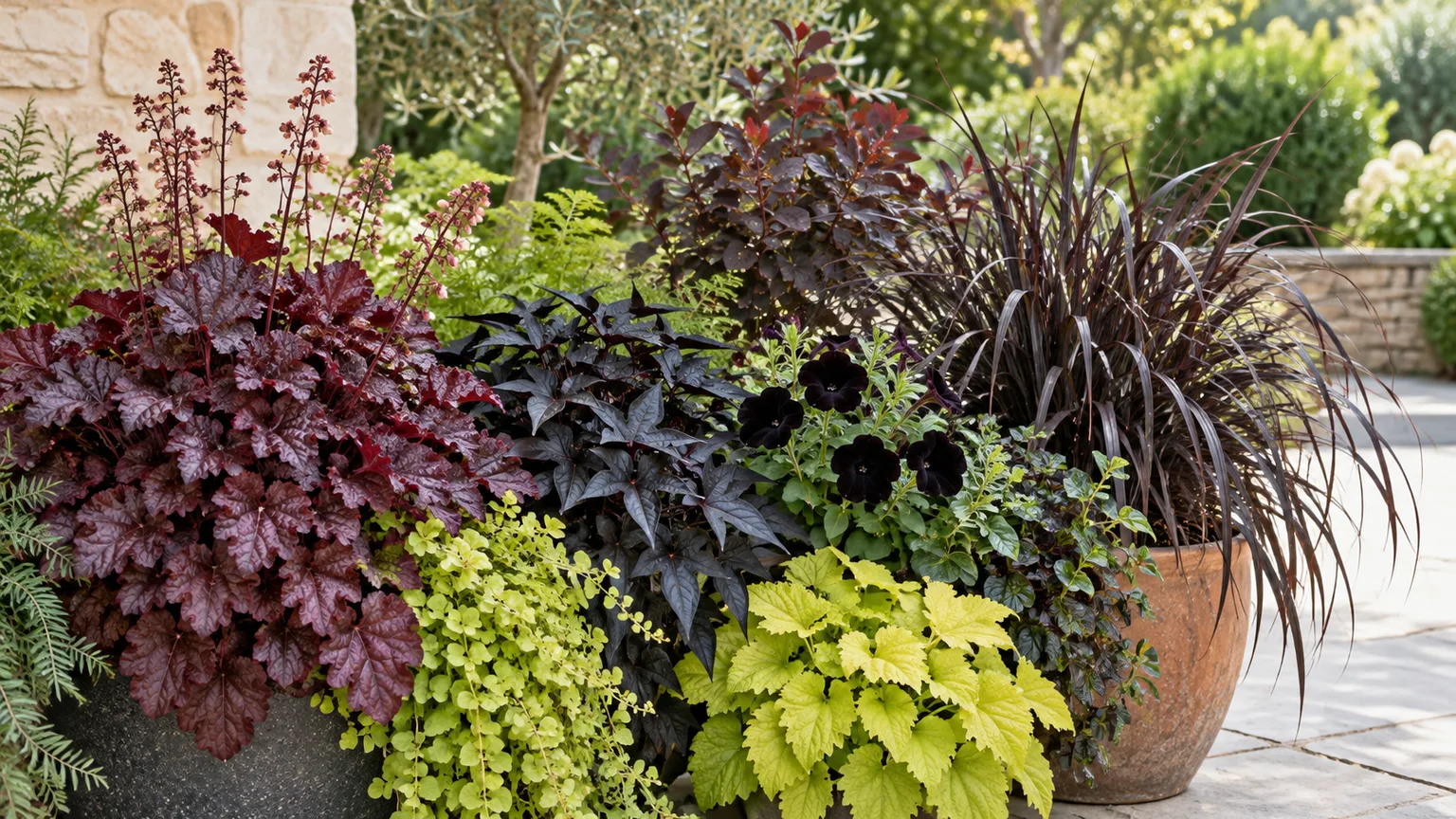
A black plant can be a glossy houseplant on a shelf, a dark-leaved shrub anchoring a border, or a near-black flower that changes color as the light shifts. The strongest choices do more than look dramatic in a nursery photo: they suit the light you have, hold enough contrast to remain visible, and fit the space at mature size.
Most plants marketed as black are actually deep purple, red, burgundy, or bronze. That is part of their appeal: a leaf can look almost ink-dark in shade and show wine-colored undertones in sun. Below are 42 choices, grouped by how you might use them, with the main growing constraint to check before buying.
What “black” means on a living plant
There are few truly black leaves. Many dark foliage cultivars contain deep purple, maroon, or brown pigments that visually obscure green chlorophyll; the plants still photosynthesize. Penn State Extension notes that dark leaves often deepen in brighter light and can look lighter in shade, though that is a tendency rather than a universal care rule. Match exposure to the plant, not to the word “black.” (Penn State Extension)
Flowers and fruit create different effects. A near-black flower may be deep burgundy or purple rather than black, while a fruit such as Indigo Rose tomato colors most strongly where it receives direct light. Black mondo grass is a notable foliage exception with leaves that are described as black by the RHS. (RHS dark foliage selections)
42 black and near-black plants to consider
Dark houseplants and tender container plants
These are good starting points for shelves, bright rooms, patios, and movable pots. “Indoor” does not mean “low light”: most dark foliage keeps its shape and color better near a bright window, while succulents need substantially more direct light than tropical foliage plants.
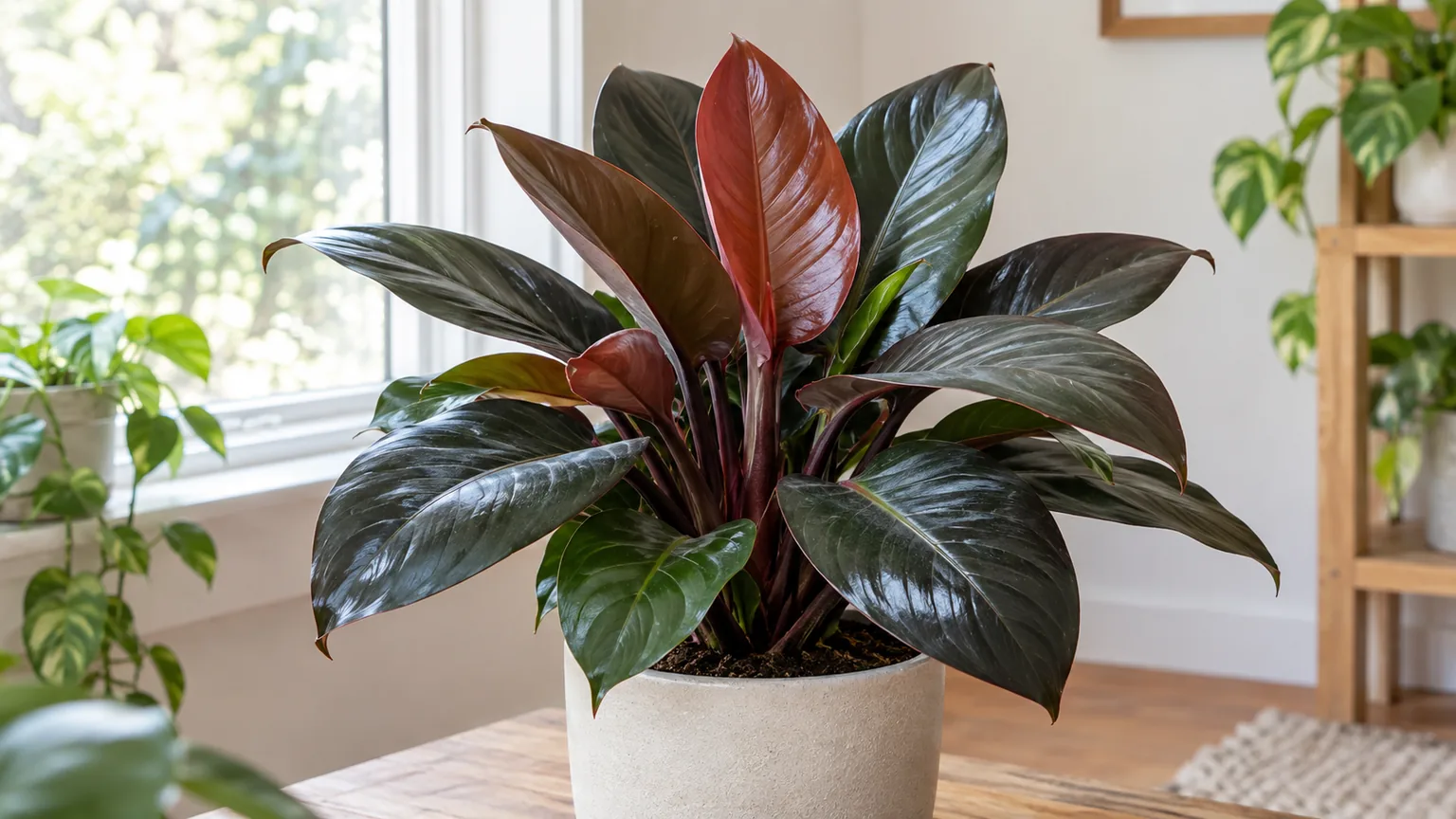
1. Raven ZZ (Zamioculcas zamiifolia ‘Raven’)
Raven ZZ sends out new leaves in bright green, then darkens to glossy green-black as they mature. That slow color change is normal, so a small plant may not yet resemble a product photo. It tolerates lower light than many colorful houseplants, but bright indirect light usually gives denser growth; let the potting mix dry well between waterings.
2. Black Cardinal philodendron (Philodendron erubescens ‘Black Cardinal’)
This self-heading philodendron unfurls reddish leaves that age into deep burgundy-green, with red petioles adding contrast. Give it a warm spot with bright, indirect light and a loose, draining mix. Direct hot sun can scorch its foliage, while a dark corner can leave growth sparse and the leaves less richly colored.
3. Black velvet alocasia (Alocasia reginula)
The compact, heart-shaped leaves are dark green to nearly black, with pale silvery veins and a velvety surface. The effect is strongest up close, which makes this a useful desk or shelf plant. Keep it warm, out of harsh direct sun, and evenly—but not constantly—moist; cold, soggy soil is a common route to root trouble.
4. Burgundy rubber plant (Ficus elastica ‘Burgundy’)
The broad, polished leaves are very dark green with burgundy-red tones, especially on new growth and undersides. This is a better pick for a bright room with vertical space than for a dim nook: adequate indirect light keeps the plant sturdy and its leaves well spaced. Rotate the pot occasionally so one side does not lean toward the window.
5. Black Beauty oxalis (Oxalis triangularis ‘Black Beauty’)
Three triangular leaflets fold and reopen with changes in light, giving this plant movement as well as dark purple foliage. It fits a bright window or shaded outdoor pot in mild weather, but avoid baking afternoon sun. Oxalis can enter a rest period and lose leaves; reduce watering while it is dormant instead of treating the bare pot as a dying plant.
6. Purple heart (Tradescantia pallida ‘Purpurea’)
This trailing plant has narrow leaves that shift from purple to deep, nearly black plum in strong light. Use it in a hanging pot or as a container spiller where its stems can trail without being crushed. It is frost-tender, and too little light makes stems stretch and color fade; pinch tips to keep the plant fuller.
7. Black Prince echeveria (Echeveria ‘Black Prince’)
The rosettes range from dark red to almost black, with the deepest color developing in strong light. Treat it as a sun-loving succulent, not as a low-light tabletop plant: provide a bright window or outdoor sun with a gradual adjustment period. A gritty, fast-draining mix and dry-down between waterings are safer than frequent sips in dense potting soil.
8. Black rose aeonium (Aeonium ‘Zwartkop’)
Large, dark burgundy rosettes sit at the tips of branching stems, giving this succulent a sculptural, almost floral silhouette. It works well in a sunny container where it can be moved before frost. Aeoniums grow actively in cooler, mild seasons and may slow in hot summer weather, so do not respond to summer dormancy by keeping the soil wet.
Dark garden foliage: perennials, groundcovers, and annuals
Foliage plants carry the color beyond a brief bloom window. The options below range from low, spreading groundcovers to tall tropical leaves, so check whether you want an edging plant, a seasonal container, or a permanent bed anchor before planting.
9. ‘Obsidian’ coral bells (Heuchera ‘Obsidian’)
‘Obsidian’ forms a compact mound of glossy, near-black purple leaves, with small light flowers held above the foliage. It is a strong front-of-border plant where you can see the leaf shine, and it is more flexible than many full-sun dark-leaved plants. Give it well-drained soil and protect it from the punishing afternoon sun of very hot climates. The RHS describes the foliage as deepening to near-black as it matures. (RHS)
10. ‘Black Scallop’ bugleweed (Ajuga reptans ‘Black Scallop’)
Glossy, scalloped leaves make a dark mat, and short spikes of blue flowers add spring color. Use it to edge a path or fill a small gap rather than place it in a tiny mixed bed: ajuga spreads by runners and can crowd delicate neighbors. It takes sun to part shade, with leaf color often strongest where it gets more light without drying out.
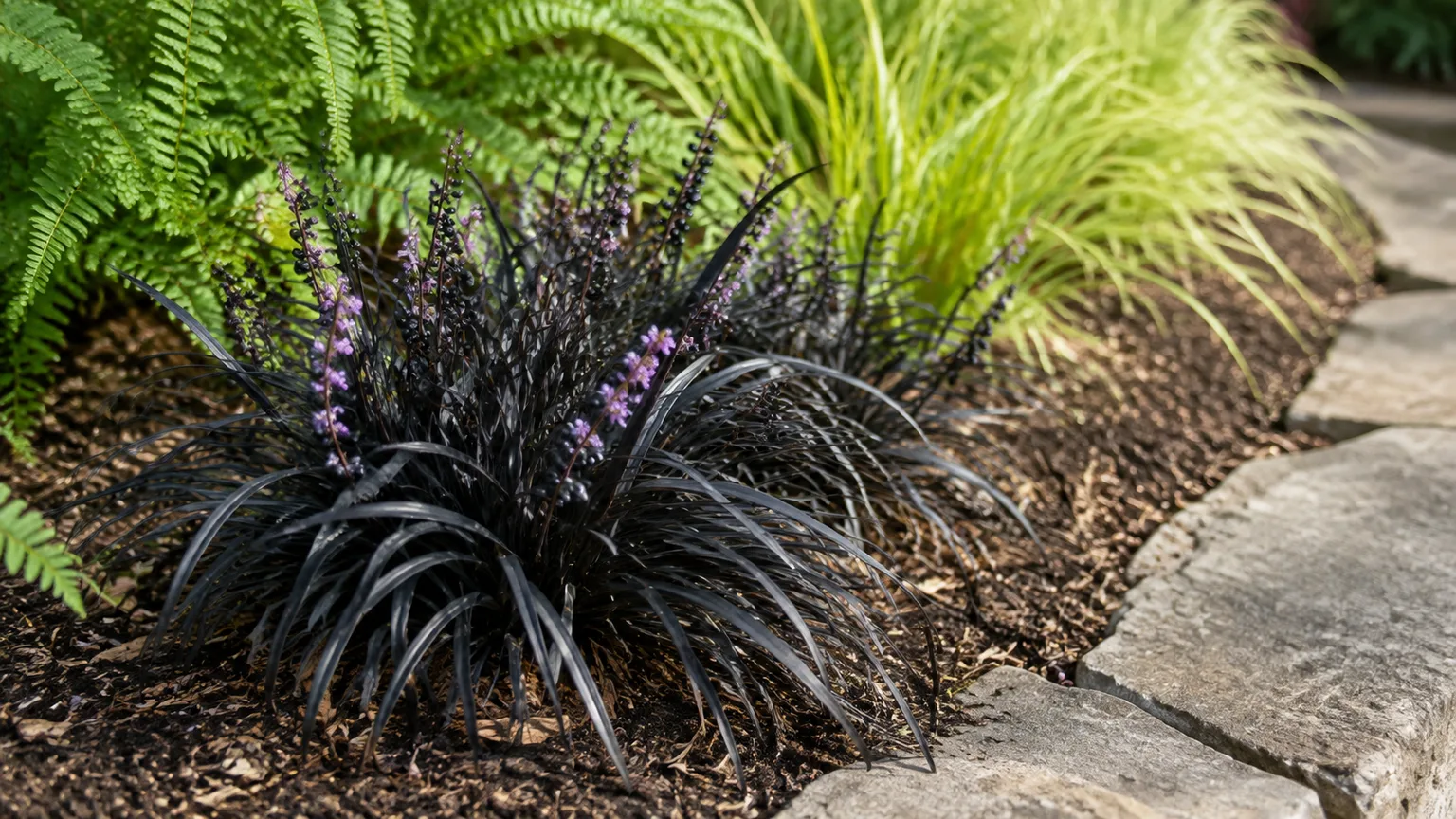
11. Black mondo grass (Ophiopogon planiscapus ‘Nigrescens’)
This slow-spreading evergreen makes arching, almost-black blades in tidy clumps, with purple flowers and dark berries as seasonal details. It is one of the best choices for a low edge or the front of a container, especially beside pale gravel or chartreuse foliage. It tolerates some shade, but does not rush to fill a large bed; the RHS notes its persistent rootstock and black foliage. (RHS)
12. ‘Dark Towers’ beardtongue (Penstemon digitalis ‘Dark Towers’)
Deep burgundy foliage gives this upright perennial interest before and after its pink flower spikes open. It suits a sunny border with drainage and pairs naturally with pale blooms or silver leaves. Unlike a true black foliage plant, its strongest color reads purple-red; planting it against dark bark or a shaded wall can make the leaves disappear.
13. ‘Xenox’ stonecrop (Hylotelephium ‘Xenox’)
This upright stonecrop combines compact, wine-colored leaves with late-season pink flowers. Its fleshy foliage makes it a useful choice for sunny beds that dry between rain, and the flowers carry the planting into late summer. Give it drainage and avoid rich, constantly wet soil, which encourages softer growth and a less stable shape. Strong light helps the foliage show its best color. (RHS dark foliage selections)
14. ‘Hillside Black Beauty’ bugbane (Actaea simplex ‘Hillside Black Beauty’)
Tall, dark foliage provides a dramatic backdrop for the plant’s slender white flower spikes. It suits a part-shade border with humus-rich soil that stays evenly moist, rather than a hot, dry bed. The flowers rise above the foliage, so allow vertical room and avoid crowding it under a low eave or dense tree canopy.
15. ‘Britt-Marie Crawford’ leopard plant (Ligularia dentata ‘Britt-Marie Crawford’)
Large, rounded leaves have dark purple-brown tops and often contrasting undersides; orange-yellow daisies appear later in summer. This is a useful way to add dark mass to a moist, shaded garden, especially near a pond edge or a consistently watered bed. If the soil dries in summer, leaves can wilt dramatically, so it is a poor choice for a hands-off dry border.
16. ‘Australia’ canna lily (Canna ‘Australia’)
Broad, upright leaves read purple-black behind vivid red flowers, creating a strong focal point in a sunny summer container or tropical-style bed. Canna likes warmth, sun, and regular moisture while actively growing. In colder climates, treat the rhizomes as tender and lift or protect them before hard freezes; do not assume a dramatic container plant is winter-hardy in the ground.
17. ‘Black Magic’ elephant ear (Colocasia esculenta ‘Black Magic’)
The enormous heart-shaped leaves are dark purple and can look nearly black when backlit. Use it where scale and water needs are welcome: a large pot, warm pond margin, or lush summer bed. It needs warmth and steady moisture, and its mature leaves can shade smaller neighbors. Cold winters usually mean moving or storing the plant rather than leaving it outdoors.
18. ‘Blackie’ sweet potato vine (Ipomoea batatas ‘Blackie’)
Deep purple, lobed leaves spill over containers and soften the hard edge of a planter. It grows quickly in warm weather and is useful as a seasonal trailer beside upright canna or bright flowers. Give it sun for dense growth and trim it back if it overtakes companions; frost ends the display in cold climates.
19. ‘Bishop of Llandaff’ dahlia (Dahlia ‘Bishop of Llandaff’)
Its nearly black, finely cut foliage contrasts with bright red flowers, so it brings dark color without asking the blooms themselves to be black. Plant in sun and give the stems room; tall growth may need support in a windy garden. In frost-prone areas, the tubers need winter protection or lifting, so plan storage before buying a large planting.
20. ‘Black Prince’ coleus (Coleus scutellarioides ‘Black Prince’)
Coleus gives fast foliage color in pots and shady borders, and ‘Black Prince’ brings deep red-purple leaves that can read almost black. It is often grown as a warm-season annual, though it may persist in frost-free climates. Pinch flower spikes if you want compact foliage, and choose the light exposure on the plant tag because coleus cultivars vary in sun tolerance.
Shrubs and small trees with lasting structure
Woody plants give you dark color at a larger scale, but they are harder to move than a pot. Check mature width, local hardiness, and how the plant looks after leaves drop; a purple-leaf shrub can be the right anchor only if it has enough room and a bright enough backdrop.
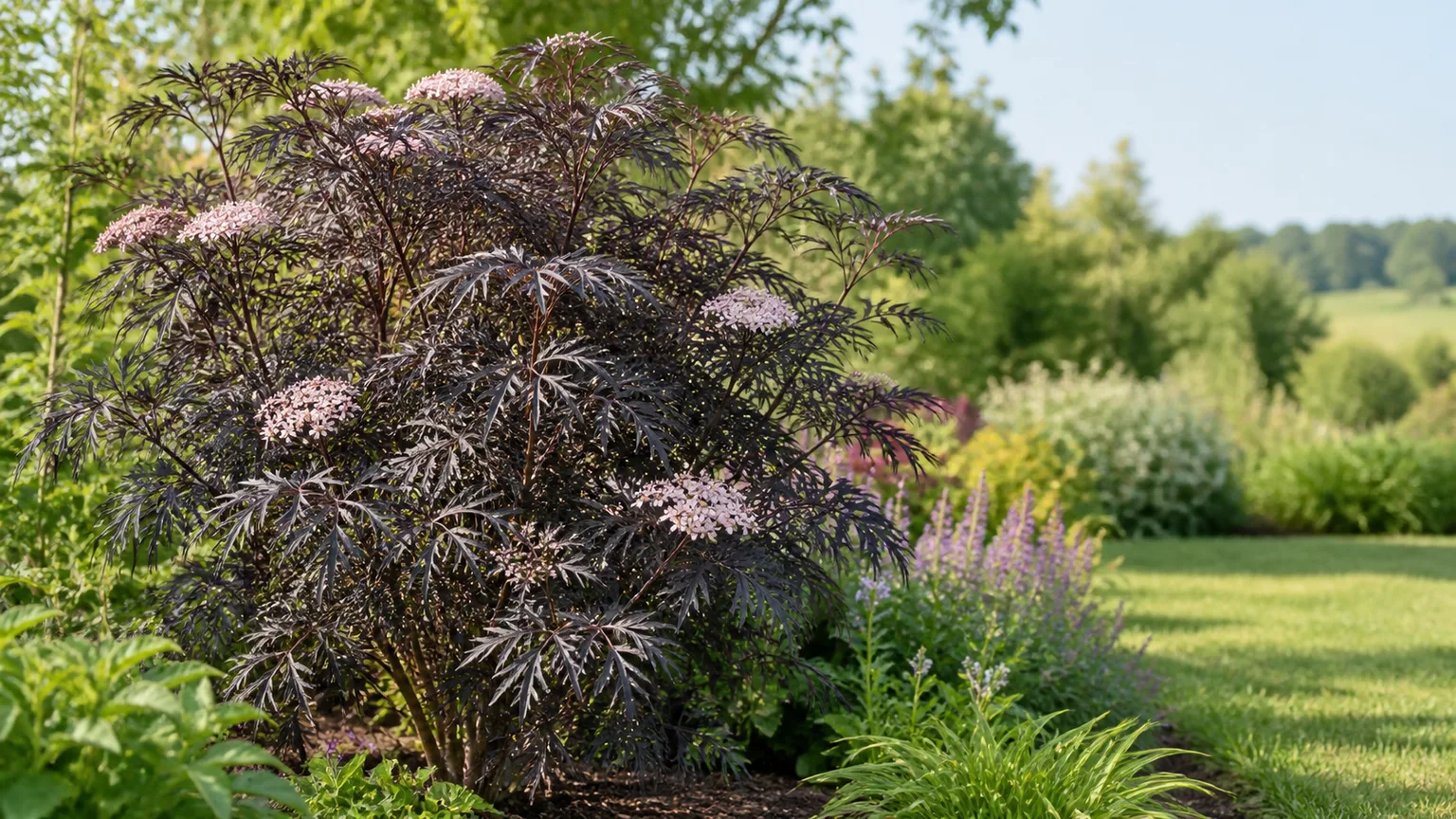
21. Black Lace elderberry (Sambucus nigra ‘Black Lace’)
Finely cut purple-black foliage creates a lacy silhouette, followed by pale pink flower clusters and dark berries. It makes a striking specimen or loose screen where the shrub can reach its mature size; pruning can control shape but cannot turn a large cultivar into a permanent tiny shrub. Give it sun for stronger color and check local guidance on elderberry fruit before using it as food.
22. ‘Diabolo’ ninebark (Physocarpus opulifolius ‘Diabolo’)
This tough deciduous shrub has dark maroon leaves, clusters of pale spring flowers, and exfoliating bark that adds winter texture. It works best where its eventual size will not block a path or window. Full sun generally produces richer foliage color; part shade can be useful in hot regions but may shift the leaves toward green.
23. ‘Bloodgood’ Japanese maple (Acer palmatum ‘Bloodgood’)
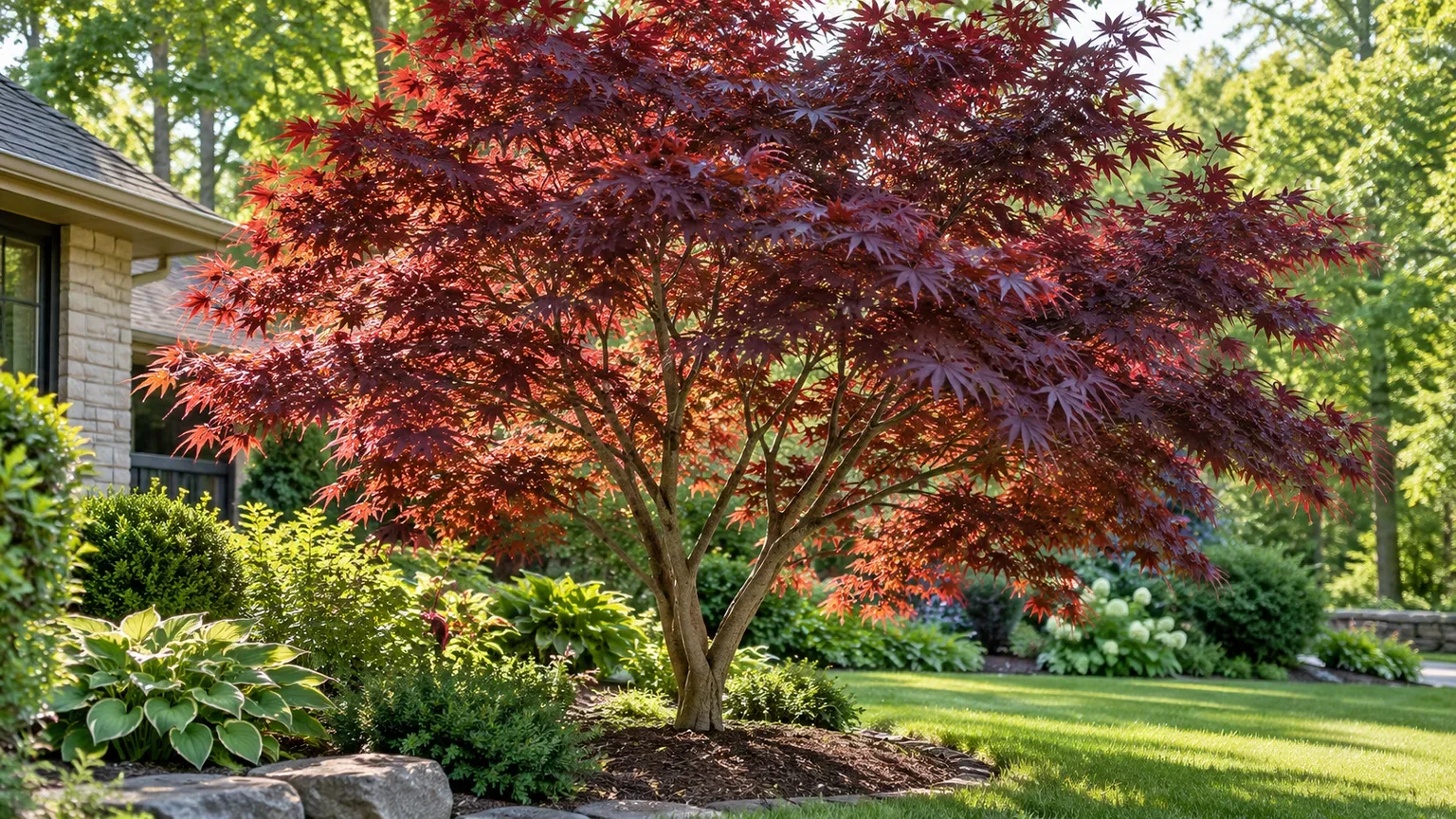
A small tree for layered color, ‘Bloodgood’ opens with reddish-purple leaves, holds a deep tone through much of summer, then brightens in autumn. It looks most refined against a green hedge or pale wall, not tucked into a dark corner. Provide shelter from strong winds; in hot climates, afternoon shade can reduce leaf scorch. (RHS)
24. ‘Royal Purple’ smoke bush (Cotinus coggygria ‘Royal Purple’)
Rounded burgundy leaves make a substantial backdrop, while airy flower plumes can give mature plants their smoky look. Use it as a focal shrub with enough width to develop naturally; frequent hard pruning can change the flower display and shape. Sun brings out stronger leaf color, but the full-size plant may be too large for a narrow foundation bed.
25. ‘Thundercloud’ purple-leaf plum (Prunus cerasifera ‘Thundercloud’)
This small ornamental tree carries purple foliage through the growing season and pale pink blossoms in spring. It is useful when you want a dark canopy rather than a groundcover, but its scale and root-zone footprint make it a poor fit beside a tight walkway or small patio. Site it in sun and check local tree-disease and maintenance guidance before committing.
26. ‘Forest Pansy’ redbud (Cercis canadensis ‘Forest Pansy’)
Pink flowers emerge on bare branches in spring, followed by heart-shaped leaves that shift from red-purple toward bronze-green as they age. That seasonal change is a feature, not a failed color match. Give this small tree moist but well-drained soil and enough room for its canopy; avoid moving an established specimen once its roots have settled.
27. ‘Kesselringii’ Tatarian dogwood (Cornus alba ‘Kesselringii’)
This one earns its place for dark purple-black winter stems, not black leaves. Once foliage drops, the stems stand out against snow, pale gravel, or variegated groundcover. It is a useful choice if you want a winter effect instead of a summer foliage statement; give it room and prune selectively to encourage young, colorful growth. (Gardens Illustrated)
Edible plants with dark leaves or fruit
A dark appearance does not make a plant edible, and “ornamental” on a label does not tell you whether a pesticide treatment permits eating it. These four choices have food uses, but follow the variety label and only harvest from plants grown with products approved for edible crops.
28. ‘Dark Opal’ basil (Ocimum basilicum ‘Dark Opal’)
The leaves and flower stems range from deep purple to burgundy, bringing color to a sunny herb pot as well as flavor to the kitchen. Pinch the growing tips to encourage leafy branching and delay flowers if you want a longer harvest. Like other basil, it is tender to frost, so treat it as a seasonal herb in cold climates.
29. Purple shiso (Perilla frutescens var. crispa)
Ruffled maroon leaves bring a dark accent to a kitchen garden, and their strong, aromatic flavor is used in several East Asian cuisines. Give it sun or light shade and harvest the leaves while tender. It can self-seed readily, so remove flower spikes before seed set if you do not want seedlings spreading through the bed.
30. ‘Indigo Rose’ tomato (Solanum lycopersicum ‘Indigo Rose’)
The fruit develops a purple-black shoulder where it receives sun, while shaded areas stay redder; the plant itself has ordinary green foliage. Grow it for edible fruit and an unusual color shift, not as a black-leaved ornamental. Full sun, a sturdy support, and consistent root moisture matter more than trying to force deeper pigment with fertilizer.
31. ‘Black Pearl’ ornamental pepper (Capsicum annuum ‘Black Pearl’)
Glossy, round fruits begin dark purple-black and turn red as they mature, while the foliage also carries a purple cast. It makes a compact seasonal accent in a sunny pot. Treat the fruits as ornamental unless you have confirmed the exact plant and its growing treatment; color alone does not tell you the heat level or whether a nursery pesticide is approved for food crops.
32. ‘Empress of India’ nasturtium (Tropaeolum majus ‘Empress of India’)
This compact nasturtium pairs dark bluish-green leaves with red flowers, making a useful edible accent along a sunny bed edge or in a pot. The leaves and flowers are used as peppery garnish, but harvest only from plants grown without ornamental-only pesticides. Avoid rich, heavily fertilized soil, which can encourage leaves at the expense of flowers.
Near-black flowers and bulbs
Dark blooms are easiest to appreciate close to a path, porch, or container, where their outlines and undertones are visible. In a distant bed, repeat them in small groups or frame them with pale companions rather than planting one isolated flower against dark mulch.
33. ‘Black Beauty’ pansy (Viola × wittrockiana ‘Black Beauty’)
The velvety petals are so dark purple that they look black at a glance, with tiny yellow centers providing a focal point. Pansies are cool-season bedding plants in many climates, so use them for spring or fall color where summer heat arrives early. A pale pot or edging helps the small flowers read from a short distance.
34. ‘Black Cat’ petunia (Petunia ‘Black Cat’)
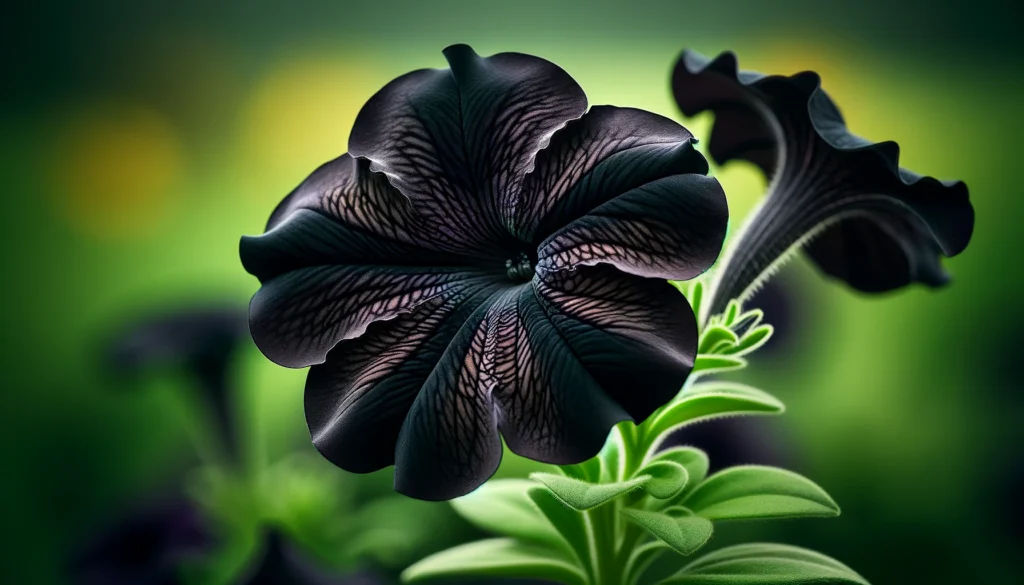
This petunia has deep, near-black flowers that look richer against a light pot or chartreuse trailer. Put it in sun and use a container that drains freely; shade and wet soil tend to reduce flowering. The petals can show purple or maroon in strong light, which is normal for a very dark cultivar. (Gardens Illustrated)
35. ‘Queen of Night’ tulip (Tulipa ‘Queen of Night’)
The late-season, eggplant-purple petals look almost black when they open, especially beside white, pale pink, or silver foliage. Plant bulbs in autumn in well-drained soil and full sun to part shade, depending on climate. Tulips often perform best as a planned seasonal display rather than a guaranteed permanent perennial in warm-winter regions.
36. ‘Black Parrot’ tulip (Tulipa ‘Black Parrot’)
Deep purple petals with ruffled edges make this a textural alternative to a smooth, cup-shaped tulip. Its near-black color is easier to see when a bloom is lit from the side or backed by pale green foliage. Like other tulips, it needs a cool dormant period and sharp drainage; do not expect reliable repeat blooms where winters are mild.
37. ‘Before the Storm’ bearded iris (Iris germanica ‘Before the Storm’)
This celebrated iris is a deep purple-black rather than pure black, with upright standards and falls that show their shape in direct light. Give it sun and drainage, and keep the rhizome near the soil surface rather than burying it deeply. Crowded clumps flower less, so divide when the center becomes congested.
38. ‘Black Charm’ Asiatic lily (Lilium ‘Black Charm’)
Satin petals in deep red-burgundy give this lily a near-black appearance, especially in a cluster with pale flowers. It is a bulbous perennial for a sunny bed or container with drainage, but the petals are not truly black. Keep true lilies out of any area a cat can reach: even small exposures can cause severe kidney injury. (Pet Poison Helpline)
39. ‘New York Night’ hellebore (Helleborus ‘New York Night’)
Dark purple flowers open when much of the garden is still quiet, with evergreen foliage helping the plant hold structure afterward. Use it in dappled shade or part shade with humus-rich, well-drained soil. Hellebore flowers are most visible when planted near a path or raised slightly, because many cultivars angle their blooms downward.
40. ‘Nigra’ hollyhock (Alcea rosea ‘Nigra’)
The large, deep burgundy flowers have an almost-black center and make a striking vertical accent against a pale fence. Hollyhocks are often biennial or short-lived perennials, so let a few seed pods mature if you want replacements. Give the tall stems sun and air circulation, and avoid placing them where wind can flatten the flower stalks.
41. Chocolate cosmos (Cosmos atrosanguineus)
Velvety maroon blooms read nearly black and are known for a cocoa-like scent when conditions are right. They make a close-viewing container plant or front-of-border accent, but they are tender in regions with hard freezes. Grow in sun with good drainage, and plan to protect or lift the tubers if winter temperatures fall below the plant’s tolerance.
42. ‘Black Pantha’ agapanthus (Agapanthus ‘Black Pantha’)
Glossy black buds open into deep violet flowers on tall stems above gray-green leaves, so the plant’s drama comes from the contrast between bud and bloom. Use it in a sunny border or a movable container where winter protection is needed. Gardeners’ Path describes the cultivar as a compact evergreen selection with dark purple flowers; its near-black stage is the unopened bud. (Gardeners’ Path)
Match dark plants to light, water, and winter
For a sunny bed, start with plants whose foliage or flowers are expected to deepen in strong light: ‘Black Scallop’ ajuga, ‘Dark Towers’ penstemon, ‘Xenox’ stonecrop, ‘Blackie’ sweet potato vine, and dark succulents. Acclimate nursery-grown plants gradually before putting them into intense afternoon sun. A plant can need strong light for color and still scorch when heat, reflected pavement, and dry roots combine.
For a shady border, choose plants that tolerate filtered light rather than assuming any dark plant will thrive without sun. ‘Obsidian’ heuchera, black mondo grass, bugbane, and leopard plant offer dark foliage in part shade; the latter two need reliably moist soil. A north-facing room is different from a shaded outdoor bed: most houseplants still need daylight, and a dark corner may preserve survival while sacrificing compact growth and color.
Climate matters as much as exposure. Raven ZZ and black velvet alocasia are indoor tropicals; canna, colocasia, aeonium, and chocolate cosmos need frost protection in cold regions; tulips need an appropriate winter chill; woody shrubs need space for their mature canopy. Check the specific cultivar label and local hardiness advice before treating a nursery-zone number as a guarantee, especially in a wet winter or exposed microclimate.
Make dark color visible in a planting
Dark foliage absorbs attention but can also disappear at dusk, under a deep canopy, or against dark soil and mulch. Give it a light-colored edge: silver foliage, pale gravel, white flowers, chartreuse leaves, a limestone wall, or a light pot. Penn State Extension also cautions that too much dark planting can read as one large visual mass; repeat a dark accent and leave lighter gaps rather than filling every layer with it. (Penn State Extension)
For containers, use one dark focal plant, one plant with a different leaf shape, and one lighter spiller or filler. For example, pair a ‘Black Magic’ colocasia with lime sweet potato vine and a green upright plant, or set a black petunia in pale stone with silver foliage. Leave enough room for mature width and growth rate; a vigorous vine can hide the plant you meant to feature.
For a border, repeat dark foliage at a few points so the eye travels through the planting. Use larger shrubs such as ninebark or smoke bush as anchors, then smaller heuchera, ajuga, or mondo grass near the edge. Place dark flowers where you can see their detail up close; if the bed is viewed from the street, frame them with brighter companions.
Check safety, spread, and lifespan before planting
Dark pigment is not a safety signal. Some plants in this list are ornamental cultivars rather than food crops, and some may be harmful if chewed. In particular, ‘Black Charm’ is a true lily: the FDA and veterinary poison specialists warn that lilies can be life-threatening to cats. Do not plant it where cats can access the flower, pollen, vase water, or fallen plant parts; choose a non-lily alternative if you cannot reliably exclude them. (Pet Poison Helpline)
Also check whether the plant is a spreader, a seasonal annual, or a woody investment. Ajuga and purple heart can travel beyond their original footprint; petunias and coleus are commonly treated as seasonal plants; shrubs and small trees may outgrow a foundation bed. If you rent, have a small patio, or want to test a color before changing a border, put the first dark plant in a movable pot.
Common mistakes that flatten the effect
The first mistake is buying by a close-up photo and expecting the same color in every season. New leaves, older leaves, shade, sun angle, and bloom age all alter what reads as black. Look for the cultivar name, then check several photos or a local nursery specimen so you know whether its mature color is wine, plum, bronze, or almost ink.
The second is solving every color problem with more sun. Dark-leaved plants often need enough light to hold their color, but a shade-tolerant heuchera, heat-sensitive maple, or indoor tropical has different limits from a sun-loving succulent. If leaves scorch or wilt, correct exposure and root moisture before adding fertilizer or moving the plant into harsher sun.
The third is placing dark plants in a visual dead end: a black pot against dark mulch at the back of a shaded bed. Move the subject closer, create a pale border, or add a light companion. Contrast makes the dark pigment legible; adding more dark plants does not necessarily make the display more dramatic.
Conclusion
The best black plants are not necessarily the darkest on a label. They are the ones whose color stays visible in your light, whose mature size fits the space, and whose water, winter, and safety needs match how you actually garden. Choose a small number of dark accents, pair them with a lighter value or varied texture, and let the plant’s true undertone be part of the design.