10 Best Plants for Erosion Control on Slopes
Choose erosion-control plants by sun, soil moisture, and region. Compare native groundcovers, grasses, and shrubs, then protect bare soil as roots establish.
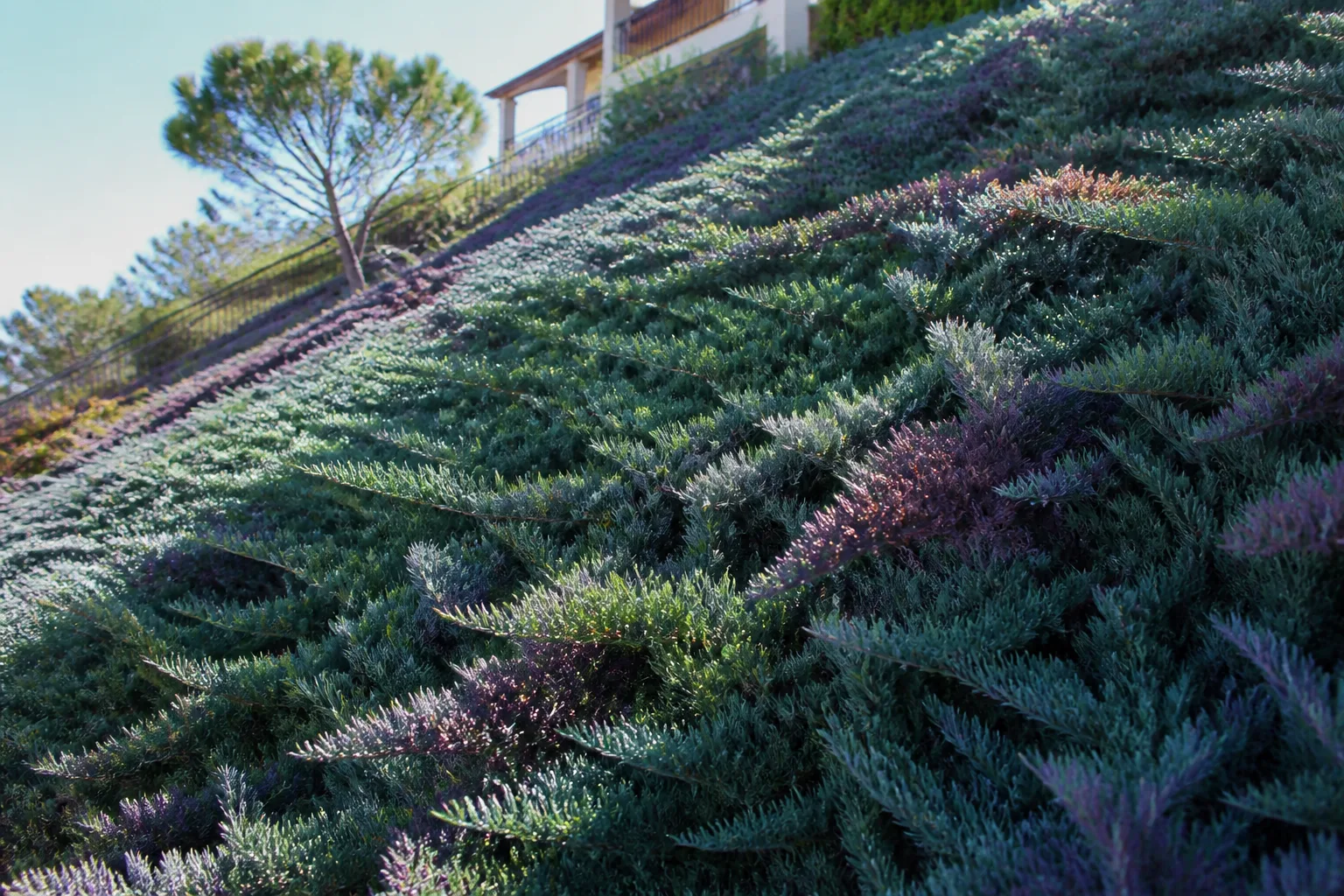
The best plants for erosion control are the ones that can root into your particular slope and keep the soil covered through its hardest season. A sunny, dry bank needs a different palette from a shaded woodland slope or a wet stream edge. For most yards, a layered mix of low groundcovers, fibrous-rooted grasses or sedges, and a few appropriately sized shrubs protects more of the soil surface than a single spreading plant.
Planting helps with surface runoff and topsoil loss. It is not a structural repair for a slope that is moving, undercut, or threatening a home. Start by identifying which problem you have; then match plants to the site, keep temporary cover in place while they establish, and correct concentrated water flow that would wash through the planting.
First, tell surface erosion from slope movement
Surface erosion usually leaves clues such as thin soil, exposed roots, small channels called rills, sediment fans, or mulch that collects at the bottom after rain. Plant foliage softens the impact of raindrops, while roots and ground-level stems help hold the upper soil together. A mix of plant heights and root forms also slows water more effectively than one uniform carpet, according to Iowa State University Extension and Outreach.
Slope movement is different: a deeper mass of earth shifts downhill. New cracks or bulges in the ground, leaning trees or fences, water appearing where it never did before, or new cracks in a nearby foundation can indicate a possible landslide. Plants cannot diagnose or repair that condition. The U.S. Geological Survey’s warning-sign guidance recommends reporting signs and having a qualified professional assess the area. Keep people away from an actively moving slope and contact local authorities if there is immediate danger.
If your problem is topsoil washing across a stable yard slope, plantings are a useful long-term layer. They work best alongside water management and temporary erosion protection, not as a substitute for either.
Match a plant to the slope’s light, water, and region
Walk the slope after a normal rain and note where water enters, where it travels, and where it leaves. The upper part often dries faster because runoff leaves before it soaks in; the toe may stay wetter or receive sediment from above. Also record sun hours, soil texture, any exposed tree roots, and whether the area is reachable for weeding and watering. On a long slope, drainage and access can matter more than the plant label’s hardiness range.
Use this quick match as a shortlist, not a universal prescription:
| Slope condition | Plants to consider | Main trade-off |
|---|---|---|
| Sunny, dry, rocky | Creeping juniper, moss phlox, little bluestem, bearberry where locally native | Slow coverage; site must drain well |
| Dry shade or woodland edge | Pennsylvania sedge, plus regionally native woodland groundcovers | Some choices spread slowly and need weed control early |
| Moist, partly shaded | River oats; Virginia sweetspire in its eastern range | River oats can self-seed; sweetspire can sucker |
| Wet bank or stream edge | Locally native red-osier dogwood, sedges, and other riparian plants | Stream work may have local permit or buffer rules |
| Broad, sunny bank needing woody coverage | Fragrant sumac in areas where it is native | Root suckers can extend beyond the intended bed |
The plants below are North American species, but “native” is local: a plant native to one state or habitat may not belong in another. Check your state or county extension service, native-plant society, and official invasive-species list before buying. For example, University of Maryland Extension flags periwinkle, Japanese spurge, and creeping lilyturf among groundcovers to avoid in its region. That is a regional recommendation, not a claim that every species is prohibited everywhere.
For example, a Southern California slope needs a different shortlist from an eastern woodland bank. Fine Gardening highlights regional chaparral plants such as coyote bush, purple sage, and California buckwheat for slope retention; use a locally native plant list for your county before substituting a species (Fine Gardening).
Ten plants that can help hold a yard slope
These options solve different jobs. A low evergreen mat can shield soil from rain, a grass or sedge can add dense fibrous roots, and a shrub can create deeper structure or cover a larger area. Use the notes on spread and moisture to decide where each plant belongs instead of filling the whole slope with whichever one grows fastest.
Creeping juniper for sunny, dry ground
Creeping juniper (Juniperus horizontalis) is a good candidate for a sunny upper bank that drains freely and is difficult to irrigate. Its evergreen branches spread close to the ground, and the species is native to northern North America. North Carolina State Extension describes mature plants spreading as much as 10 feet, with cultivars varying in size and color; check the plant tag for the cultivar’s mature width before spacing plants (NC State Extension).
It dislikes persistently wet soil and performs poorly in dense shade, so don’t use it at a soggy slope toe just because the surface looks exposed. A mature juniper can cover a broad patch, but small plants need time and water to root. Keep the bed weeded during that period, and leave the existing soil cover in place wherever possible.
Moss phlox for a sunny, rocky edge
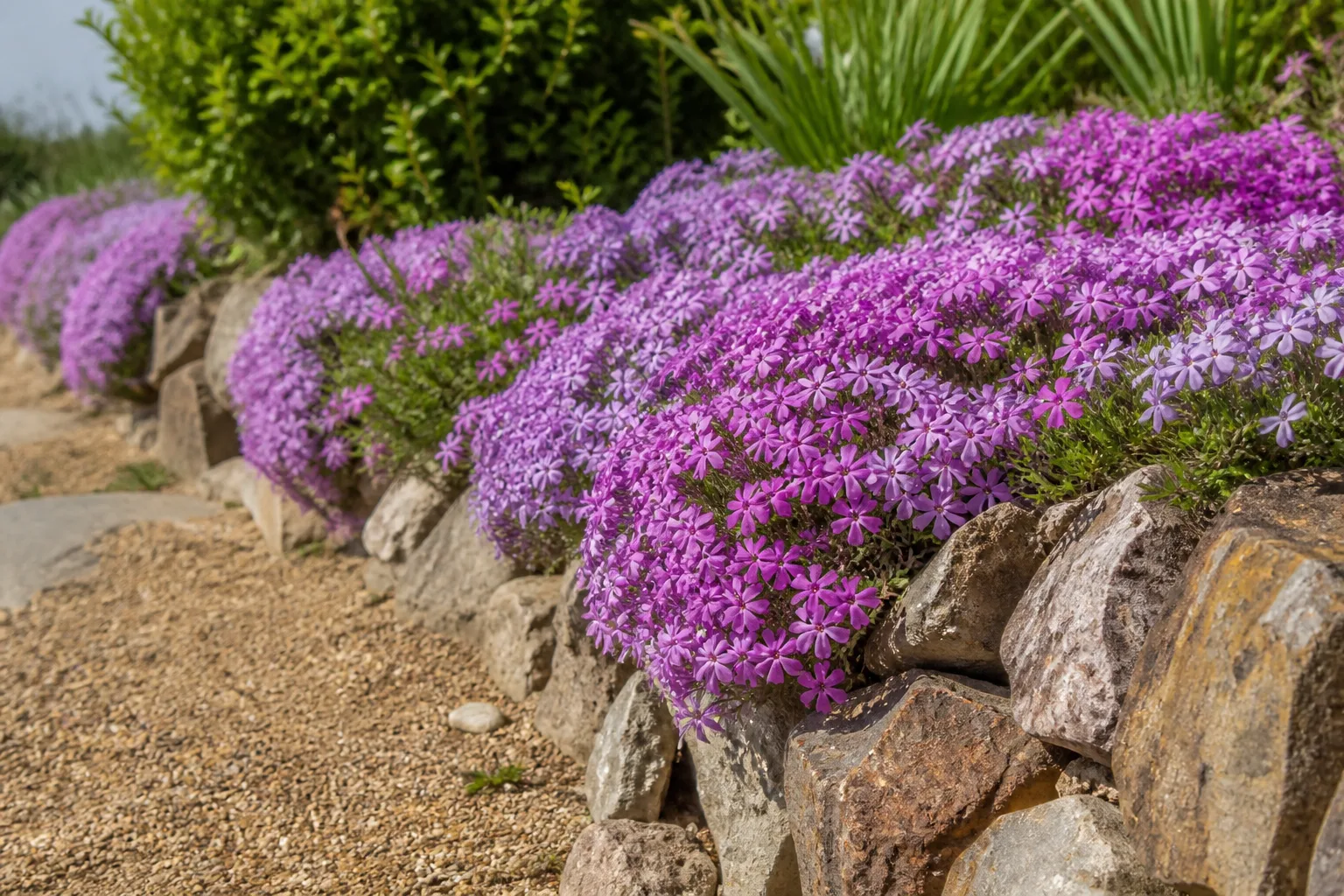
Moss phlox (Phlox subulata), also sold as creeping phlox or moss pink, forms a low evergreen-to-semi-evergreen mat and flowers in spring. It suits full sun and well-drained, rocky or sandy soil, especially near the top of a slope where taller shrubs would obscure a view. NC State Extension describes a typical spread of about 2 to 3 feet and notes that the plant is native to parts of central and eastern North America (NC State Extension).
Think of phlox as surface cover, not an engineered anchor. It will not thrive in waterlogged clay, and older mats can open in the center, leaving soil exposed. Pair it with clumping grasses or sedges rather than relying on phlox alone for a long, high-runoff bank.
Pennsylvania sedge for dry shade
Pennsylvania sedge (Carex pensylvanica) fits a dry woodland slope beneath trees where turf struggles. The fine leaves create a soft, low cover and tolerate dry to moist shade; the plant is native to eastern North America. It is a sedge, not a true grass, and it should not be treated like a high-traffic lawn. NC State Extension notes its low-maintenance use as a shade groundcover, while Penn State Extension includes it among native groundcovers for difficult sites (NC State Extension, Penn State Extension).
The trade-off is speed: sedge can take longer to knit together than aggressive nonnative groundcovers. Plant plugs in staggered groups, mulch exposed soil with a restrained layer of coarse organic material, and hand-weed until the clumps expand. If your region has a locally native sedge better suited to the site, prefer that species over relying on the common name alone.
River oats for moist, partly shaded ground
River oats (Chasmanthium latifolium) is a graceful grass for a moist, partly shaded slope or the upper edge of a rain garden. Penn State Extension says it develops a firm root mass that can make it useful on slopes; NC State Extension lists it as a native plant for moist to wet, well-drained soil in part sun or part shade (Penn State Extension, NC State Extension).
Its loose, oat-shaped seed heads add winter interest, but they also point to the main caution: it self-seeds readily and can spread by rhizomes. Give it room on a naturalized slope, then remove seedlings where it crosses into beds or neighboring property. It is a poor fit for a hot, dry crest that receives little establishment water.
Little bluestem for sunny, lean soil
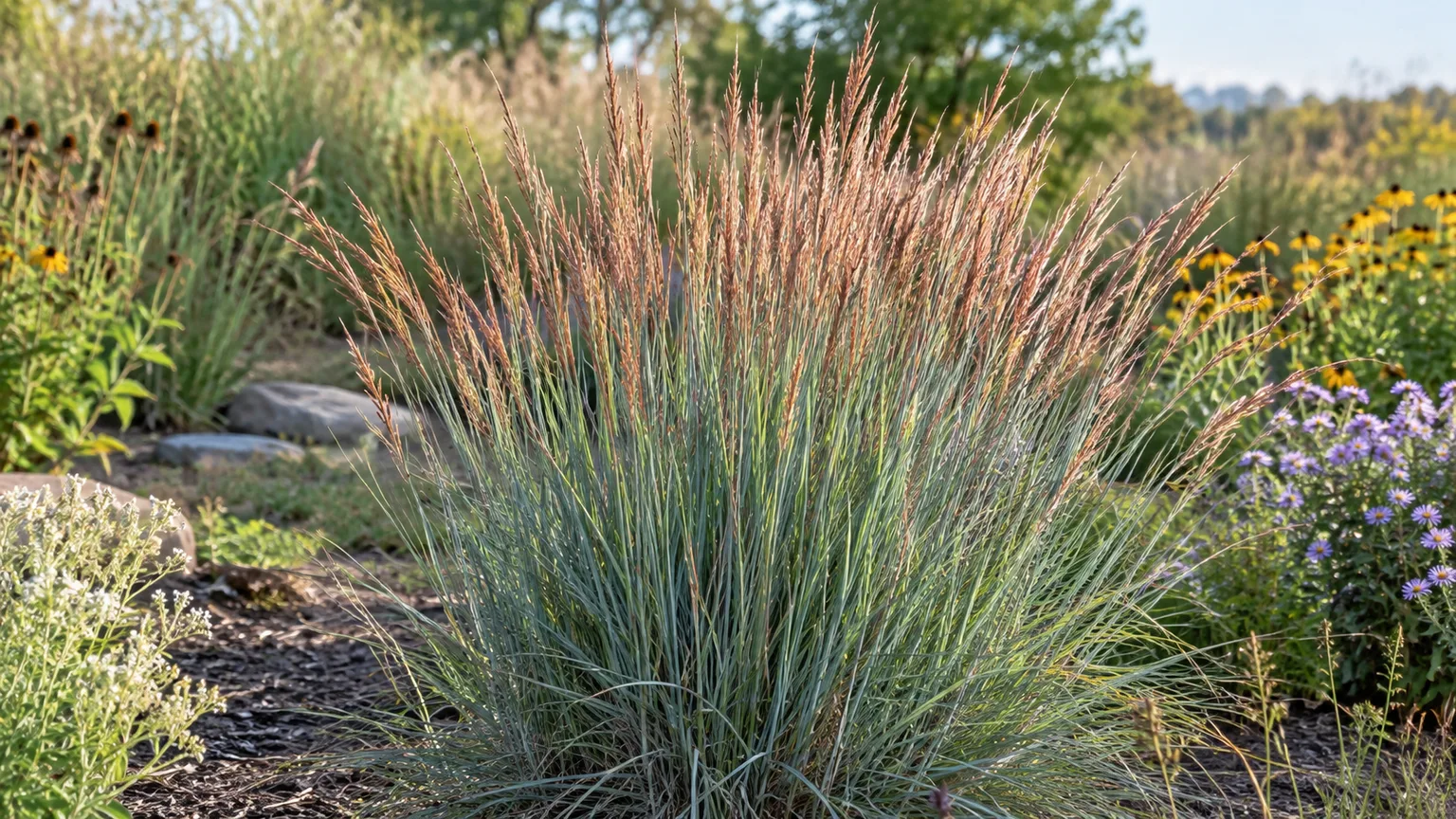
Little bluestem (Schizachyrium scoparium) is a clumping, warm-season grass for open slopes in regions where it is native. It tolerates dry-to-medium moisture and a range of soils, including clay and relatively infertile ground. Its upright stems remain after the growing season, adding some aboveground cover as the plant goes dormant. NC State Extension describes the species as a native grass with strong drought tolerance once established.
Unlike a rhizomatous carpet, a clump leaves space between plants until you install enough plugs or combine it with lower groundcovers. That mix is useful: phlox or another low plant can cover the spaces while bluestem contributes a taller root system and seasonal structure. Plant in full sun; shade can make grasses lean or thin.
Switchgrass for open slopes with room
Switchgrass (Panicum virgatum) tolerates a wider range of soil moisture than many ornamental grasses and develops slowly spreading rhizomes. It can be useful on an open, sunny bank where taller vegetation is welcome. The species is native across much of North America, though the local ecotype and cultivar matter. NC State Extension describes it as resistant to erosion and adaptable to wet and dry soils.
This is not a small edging plant: cultivars may reach several feet tall, and shade can make the stems flop. NC State also rates it highly flammable. Avoid placing it directly against a home or inside a fire-prone defensible-space zone; follow local firewise guidance and select a lower-flammability plant near structures. Use it where height, dormant stems, and enough width are assets rather than obstacles.
Fragrant sumac for broad, dry banks
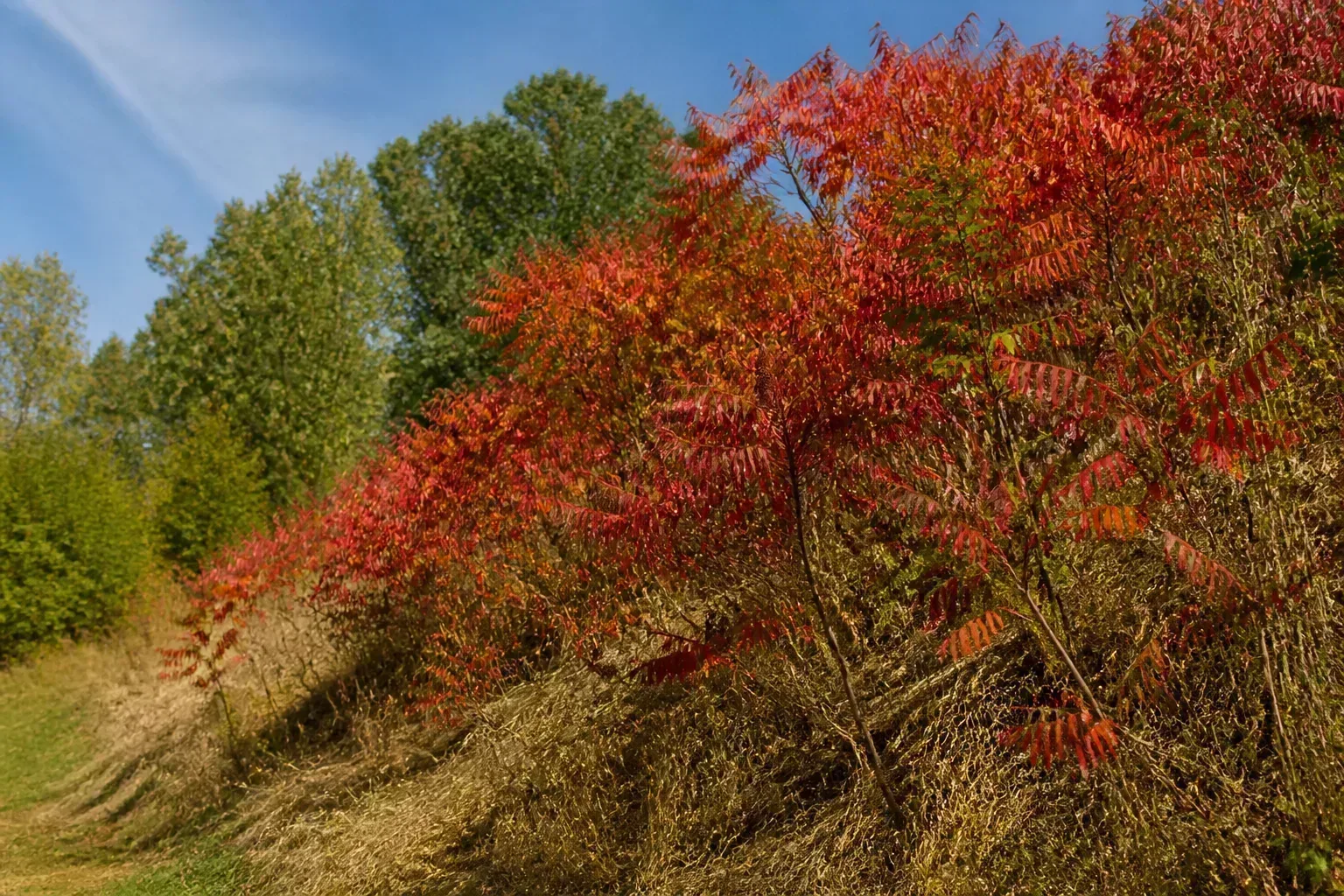
Fragrant sumac (Rhus aromatica) is a low, spreading shrub for a sunny to partly shaded bank with well-drained soil. Its branches can root where they touch soil, and suckering roots gradually form a wide colony. NC State Extension specifically recommends it for mass plantings on slopes and embankments; it is native across much of eastern and central North America, with its actual native range varying by locality.
The spreading habit is why it can cover more ground than a tidy border shrub—and why you should not tuck it into a small bed. Confirm that the species or cultivar is suitable for your area, then allow up to several feet of width and monitor the colony edge. It is a practical choice for a larger bank where fall color and wildlife value are welcome.
Virginia sweetspire for moist eastern slopes
Virginia sweetspire (Itea virginica) suits moist, often acidic soil in the eastern United States, especially a lower slope or rain-garden edge that receives sun or part shade. It flowers in early summer and develops fall color. Its suckering habit can help build a colony on a damp bank; NC State Extension notes this use but also warns that unchecked suckers may be a problem (NC State Extension).
That spread is useful only where you want a colony. A compact cultivar may be easier to manage in a small garden, but verify whether it keeps the same root-suckering habit and whether its mature size fits the slope. Do not use it as a substitute for plants native to a western or dryland site.
Red-osier dogwood for wet banks
Red-osier dogwood (Cornus sericea) belongs on a moist to wet bank, not a hot, droughty slope crest. This multi-stemmed shrub spreads by underground stems and can form a thicket that covers ground. NC State Extension says its spreading roots may help mitigate erosion; OSU Extension identifies red-osier dogwood among native shrubs used along southwest Oregon streams and notes that stream vegetation can slow erosion (NC State Extension, OSU Extension).
Give it room and choose it only if its moisture needs match the site. In a small yard, suckers can become a maintenance issue. Along streams or lakes, check local rules before removing vegetation or adding plants; riparian buffers and bank repairs can be regulated.
Bearberry for dry, acidic sites
Bearberry (Arctostaphylos uva-ursi), also called kinnikinnick, is a low evergreen groundcover for dry, sandy or rocky, acidic soils in cooler parts of North America and some western mountain regions. It is not a quick universal solution: it dislikes compacted soil, can be difficult to transplant, and performs best when planted in a site that already matches its habitat. NC State Extension describes its natural settings as rocky, sandy, and dry.
Choose a locally appropriate source and do not amend the whole bank heavily in an effort to make it suit bearberry. If you need a fast cover, install established plugs at a closer spacing and protect the soil between them while they spread. In other regions, ask a native-plant nursery for an equivalent local evergreen groundcover rather than assuming bearberry is native everywhere.
Plant the slope without leaving it exposed
The period just after planting is often the most vulnerable: the root balls are small, open soil remains between them, and the first heavy rain can move mulch and seed downhill. Iowa State Extension recommends keeping existing vegetation or its dead roots in place when possible, staggering plants to avoid runoff channels, and using biodegradable erosion-control blankets where needed. The RHS similarly recommends pegging coarse coconut matting on steeper slopes and planting through it.
Use a low-disturbance sequence:
- Mark the water path. Redirect roof or driveway runoff before it enters the planting, using a safe outlet that will not shift the problem to a neighbor or another unstable spot. Do not simply aim a downspout at the top of the slope.
- Keep stable roots in place. If turf or weeds already hold the soil and you can manage them, remove them in stages or plant through a killed surface layer. Avoid stripping a whole bank to bare earth immediately before a wet season.
- Plant across the flow. Arrange drifts on the contour and stagger plants so water does not run in straight downhill rows. Use a mix of groundcovers, grasses or sedges, and shrubs suited to each band of moisture and light.
- Set plants securely. On a slope, the upper side of a root ball should sit level with the existing grade. Firm soil around roots and shape a small basin on the downhill side so irrigation can soak in instead of racing past.
- Protect the open ground. Lay a biodegradable coir or jute mat over the soil, pinned snugly to the surface, where runoff or grade warrants it. Plant through the mesh where its product instructions allow. A blanket is temporary protection, not a permanent root system.
For a large area, seed can cost less than buying enough plugs, but seeded slopes need a firm seedbed, species-specific timing, and mulch or hydromulch to prevent seed from washing away. On a steep or inaccessible bank, a local conservation district, native-plant nursery, or landscape professional can help choose an installation method that matches the grade and soil.
Water, mulch, and monitor while roots establish
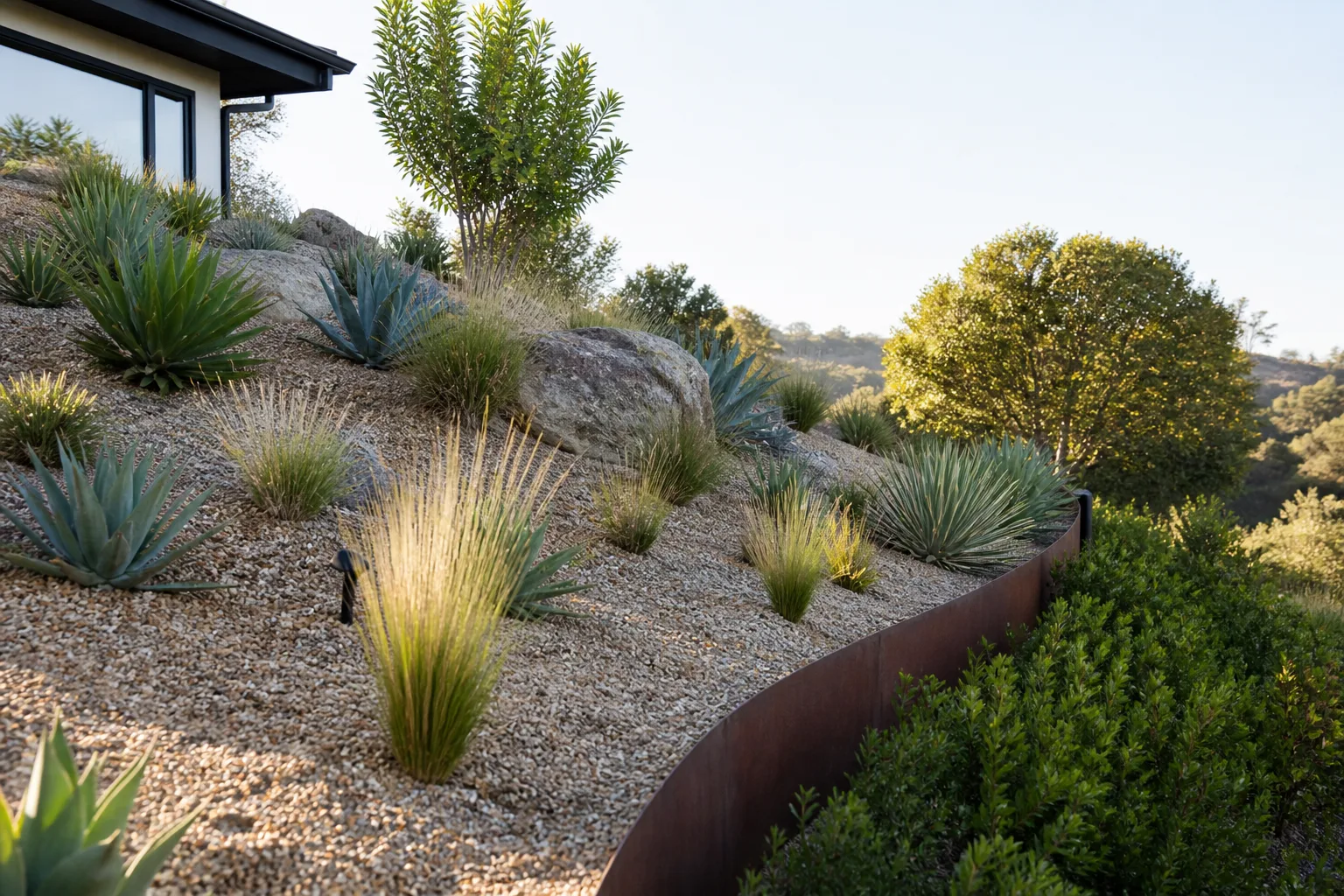
Native and drought-tolerant plants still need water while their roots expand. Water slowly at the root zone, using dripline or soaker hose when practical. If water runs off before soaking in, pause and make another pass rather than turning up the flow. Check soil below the surface near a new root ball; the top can look damp while the plant remains dry inside.
Use a coarse organic mulch in small, stable pockets around plants, keeping it away from crowns and shrub stems. On steep ground, loose bark chunks can float or slide; use the matting or a less mobile mulch recommended for the local site. Avoid smooth plastic or synthetic landscape fabric as a blanket under a full slope planting: it can shed water, become exposed, and complicate future repairs. Penn State Extension recommends against plastic or synthetic cloth on slopes and favors biodegradable fiber netting where interim support is necessary.
Inspect after heavy rain, especially in the first season. Pull out silted soil from the plant crowns, refill small washouts, reset loose mats, and note where water has created a new channel. If the same line washes out repeatedly, the answer is usually to change the flow path or slow the water—not just add another row of plants in the channel.
Know when planting is not enough
Plants address surface cover and shallow soil loss. They cannot reliably support a retaining wall, protect a house from a deep slide, stop a bank being undercut by a stream, or correct a leaking pipe. A steep slope may also need grading, a properly designed retaining structure, drainage work, or a professionally designed stabilization plan. Those solutions depend on the soil, groundwater, slope geometry, and what lies above and below it.
Take new ground cracks, bulging soil, tilting trees or walls, new seepage, or recurring soil movement seriously. The USGS lists these as potential warning signs and advises evaluation by professionals experienced with landslides. If the slope is near a home, road, utility, or waterway, consult local authorities and a geotechnical professional before digging, redirecting water, or installing a wall.
Conclusion
Choose plants for the slope you have: juniper, phlox, little bluestem, or bearberry for suitable sunny and dry sites; sedge for dry shade; river oats, sweetspire, or red-osier dogwood for moisture where each is locally appropriate; and fragrant sumac where you have room for a spreading shrub. A diverse planting usually protects more of the ground than a single groundcover.
Keep existing cover where possible, plant across the slope, manage runoff, and protect bare soil while roots establish. If the ground itself is moving or water is undercutting a bank, get the slope evaluated instead of expecting plants to solve a structural problem.